Best Customer Review Software in 2026: Collection, Analysis & Display
Comprehensive comparison of the best customer review software across 3 functions — collection, analysis, and display. Compare Birdeye, Podium, Trustpilot Business, Yotpo, Bazaarvoice, and Sentimyne with pricing tables, feature matrices, and clear guidance on which platform fits your business size and goals.
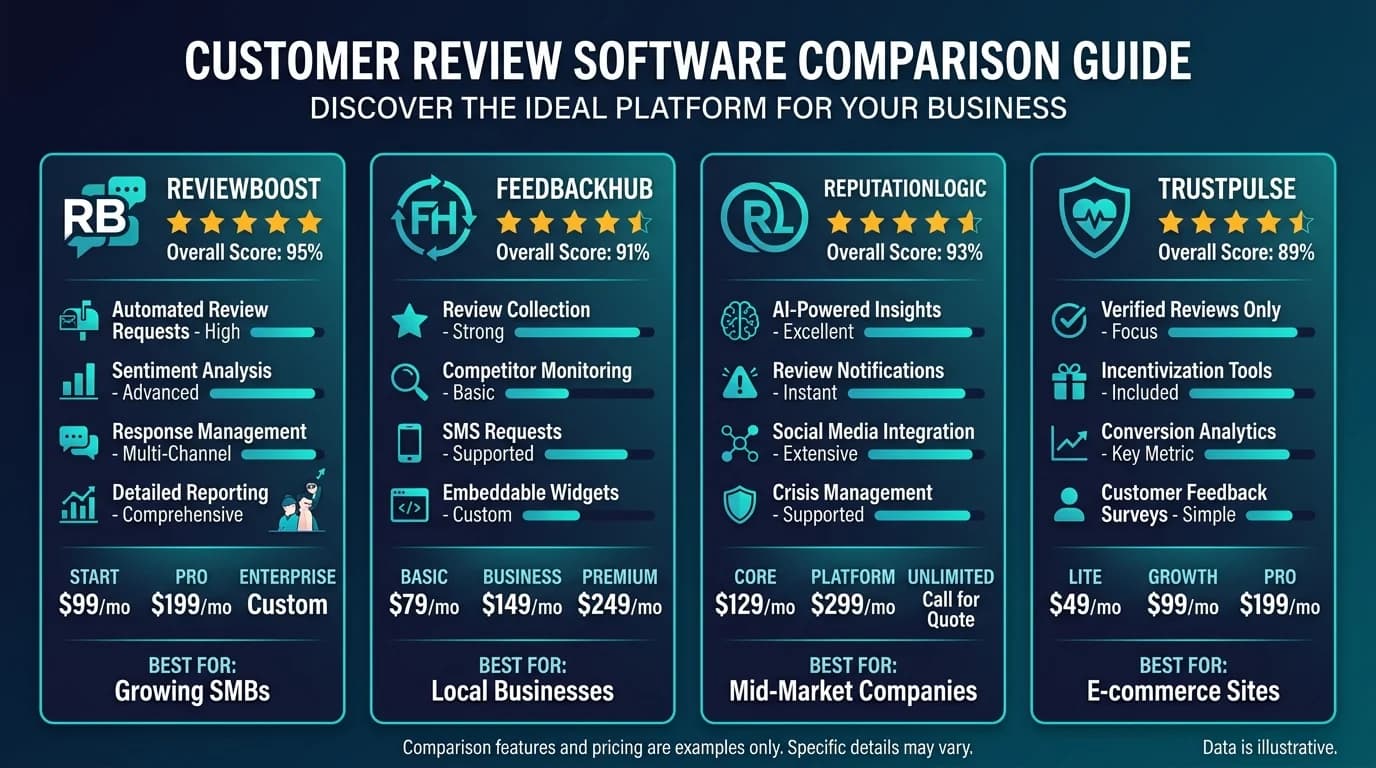
Customer review software is no longer optional. In 2026, 93% of consumers read online reviews before purchasing, and 79% trust reviews as much as personal recommendations. The question is not whether you need review software — it is which type you need, because review software is not a single category.
Review software serves three distinct functions: collection (getting more reviews from customers), analysis (understanding what reviews reveal about your product, brand, and competitors), and display (showing reviews on your website to build trust and improve conversion). Most platforms specialize in one or two of these functions. Very few do all three well.
This guide compares the leading review software platforms across all three functions, with honest pricing breakdowns, feature matrices, and clear guidance on which platform fits your business type, size, and primary goal.
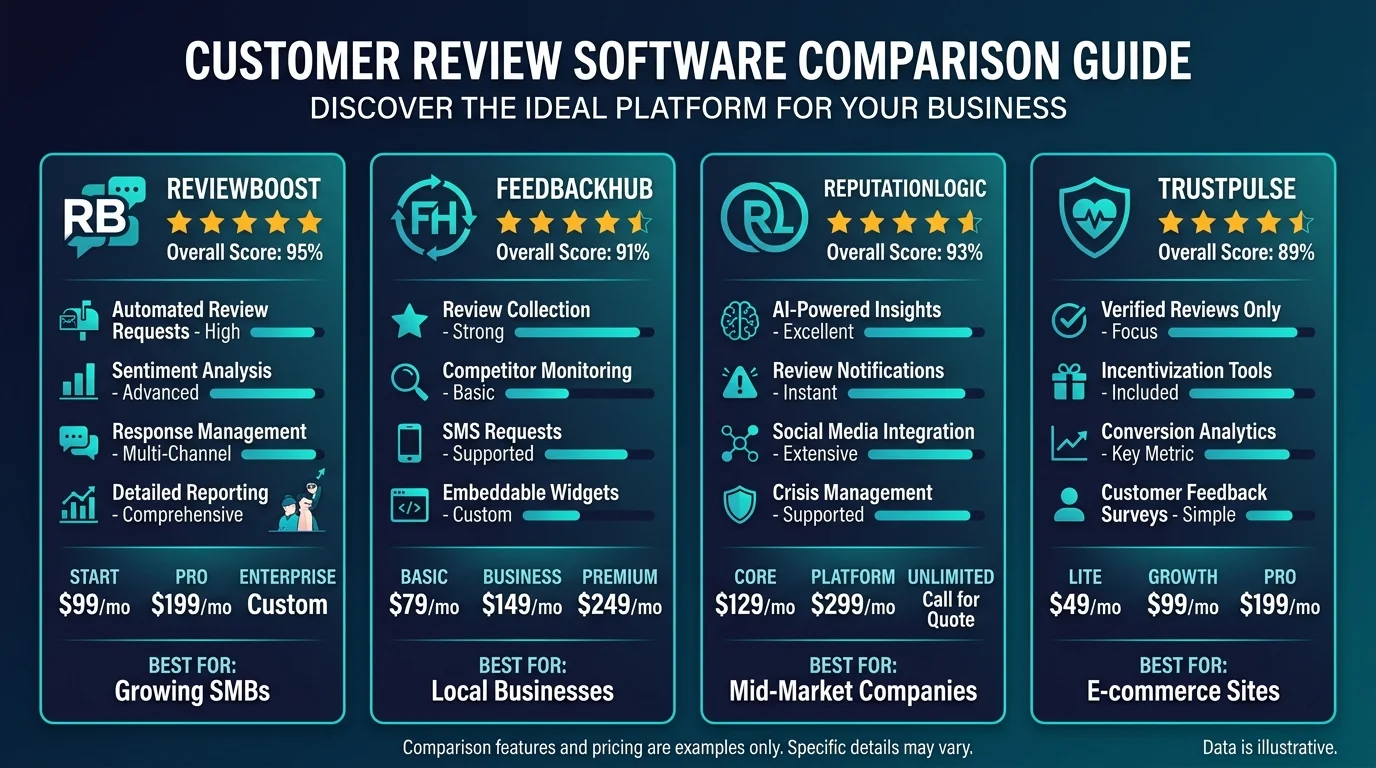
The Three Functions of Review Software
Before comparing platforms, you need to understand what each function involves and why trying to cover all three with a single tool usually means compromise.
Function 1: Review Collection
Review collection software automates the process of asking customers to leave reviews. It sends post-purchase emails or SMS messages with direct links to review platforms, manages the timing and frequency of requests, and often includes features to route unhappy customers to private feedback channels before they leave public negative reviews.
Key capabilities: - Automated review request emails and SMS - Multi-platform distribution (Google, Facebook, industry-specific sites) - Timing optimization (send requests at peak response times) - Negative feedback interception (route 1-2 star ratings to private channels) - Review volume tracking and reporting
Who needs collection software most: Local businesses (restaurants, medical practices, service companies), e-commerce sellers with repeat customers, SaaS companies building G2/Capterra presence.
For strategies on increasing review volume, see our how to get more product reviews guide.
Function 2: Review Analysis
Review analysis software extracts intelligence from existing reviews — sentiment scores, theme clusters, competitive insights, and trend data. It transforms hundreds or thousands of individual reviews into structured insights that inform product, marketing, and strategy decisions.
Key capabilities: - Sentiment analysis (overall and feature-level) - Theme clustering and categorization - Competitive benchmarking (your reviews vs. competitor reviews) - Trend tracking over time - SWOT analysis generation - Multi-platform aggregation
Who needs analysis software most: Product managers, brand strategists, competitive intelligence teams, agencies serving multiple clients, e-commerce sellers monitoring product perception.
For a comparison of analysis approaches, see our best AI review analysis tools guide.
Function 3: Review Display
Review display software embeds reviews on your website — product pages, landing pages, and dedicated testimonial sections. It includes widgets, carousels, star ratings, and schema markup that enables rich snippets in Google search results.
Key capabilities: - Embeddable review widgets and carousels - Star rating displays with schema markup - Photo and video review galleries - Review filtering and moderation - A/B testing for widget placement and design
Who needs display software most: E-commerce stores, SaaS landing pages, local businesses with websites, any business where social proof influences purchase decisions.
For technical guidance on review display implementation, see our embed reviews on your website guide and our review schema markup for star ratings tutorial.
Platform-by-Platform Comparison
Birdeye
Primary function: Collection + Display Best for: Multi-location local businesses (medical, dental, legal, home services, restaurants)
Birdeye is the dominant platform for local business review management. Its core strength is automating review collection across Google, Facebook, and industry-specific platforms, then displaying aggregated reviews on your website. The platform also includes basic sentiment tracking and competitive monitoring, but these analysis features are secondary to its collection engine.
Strengths: Excellent multi-location management. Strong Google review focus. Built-in messaging (SMS, web chat). Automated review responses. Good for businesses with 5-500 locations.
Limitations: Expensive for small single-location businesses. Analysis capabilities are surface-level (aggregate sentiment, not theme clustering or SWOT). Enterprise-oriented sales process. Limited for e-commerce (built for local/service businesses).
Podium
Primary function: Collection + Communication Best for: Local businesses wanting review collection integrated with customer messaging
Podium combines review collection with a unified inbox for text messaging, web chat, and payments. Its pitch is that customer communication and review generation should be part of the same workflow — you text a customer about their appointment, then follow up with a review request.
Strengths: SMS-first approach (higher response rates than email). Clean unified inbox. Payment integration. Strong in automotive, home services, and healthcare verticals.
Limitations: Expensive ($399+/month for most plans). Review analysis is basic (star rating tracking, no sentiment or theme analysis). Not built for e-commerce or SaaS.
Trustpilot Business
Primary function: Collection + Display Best for: Online businesses wanting a trusted third-party review platform
Trustpilot is unique because it is both a review platform (where consumers go to read reviews) and a review software provider (tools for businesses to collect, manage, and display Trustpilot reviews). The brand credibility of "Trustpilot" carries weight with consumers, especially in Europe.
Strengths: Strong consumer brand recognition. TrustBox widgets for website display. Google Seller Ratings integration. Large existing consumer audience.
Limitations: Reviews live on Trustpilot's platform (not your own). Pricing is opaque and reportedly aggressive. Limited analysis beyond basic sentiment. Some controversy around review moderation practices. Platform risk — you are building on someone else's infrastructure.
For in-depth Trustpilot analysis methodology, see our Trustpilot review analysis guide.
Yotpo
Primary function: Collection + Display Best for: E-commerce brands (especially Shopify) wanting reviews integrated with loyalty and referral programs
Yotpo is the e-commerce review platform leader, particularly in the Shopify ecosystem. It combines review collection with photo/video reviews, loyalty programs, referral marketing, and SMS marketing. The platform is designed to turn customers into advocates across the full post-purchase journey.
Strengths: Deep Shopify integration. Photo and video review collection. Combined reviews + loyalty + referrals in one platform. Strong for DTC brands.
Limitations: Gets expensive quickly (review features start free, but useful tiers are $79-$169+/month per product). Analysis is basic. Primarily e-commerce focused. Bundled products mean you pay for features you may not need.
Bazaarvoice
Primary function: Collection + Display (enterprise) Best for: Large retailers and brands wanting syndicated reviews across retail partner sites
Bazaarvoice operates at enterprise scale, syndicating reviews across retail networks. If you are a brand that sells through Walmart, Target, Best Buy, and your own DTC site, Bazaarvoice distributes reviews collected on one platform to all others. This review syndication is its unique capability.
Strengths: Review syndication across retail networks. Content moderation at scale. Sampling programs (send products to customers in exchange for reviews). Enterprise-grade compliance and fraud detection.
Limitations: Enterprise pricing ($20,000+/year). Complex implementation. Not suitable for small businesses. Analysis features exist but are secondary to collection and distribution.
Sentimyne
See What Your Reviews Really Say
Paste any product URL and get an AI-powered SWOT analysis in under 60 seconds.
Try It Free →Primary function: Analysis Best for: Product managers, agencies, e-commerce sellers, and anyone needing deep intelligence from existing reviews
Sentimyne takes a fundamentally different approach than the other platforms on this list. While Birdeye, Podium, Yotpo, and Bazaarvoice focus on generating and displaying reviews, Sentimyne focuses on understanding them. You paste a product URL, and Sentimyne's AI analyzes reviews from 12+ platforms to produce a SWOT analysis with sentiment scores, theme clusters, competitive mentions, and supporting quotes — in under 60 seconds.
Strengths: AI-powered SWOT analysis (not just sentiment scores). 12+ platform coverage. Feature-level sentiment scoring. Competitor intelligence from review data. 60-second results. Free tier with no credit card required.
Limitations: Does not collect reviews (no automated email/SMS campaigns). Does not provide display widgets. Focused specifically on the analysis function.
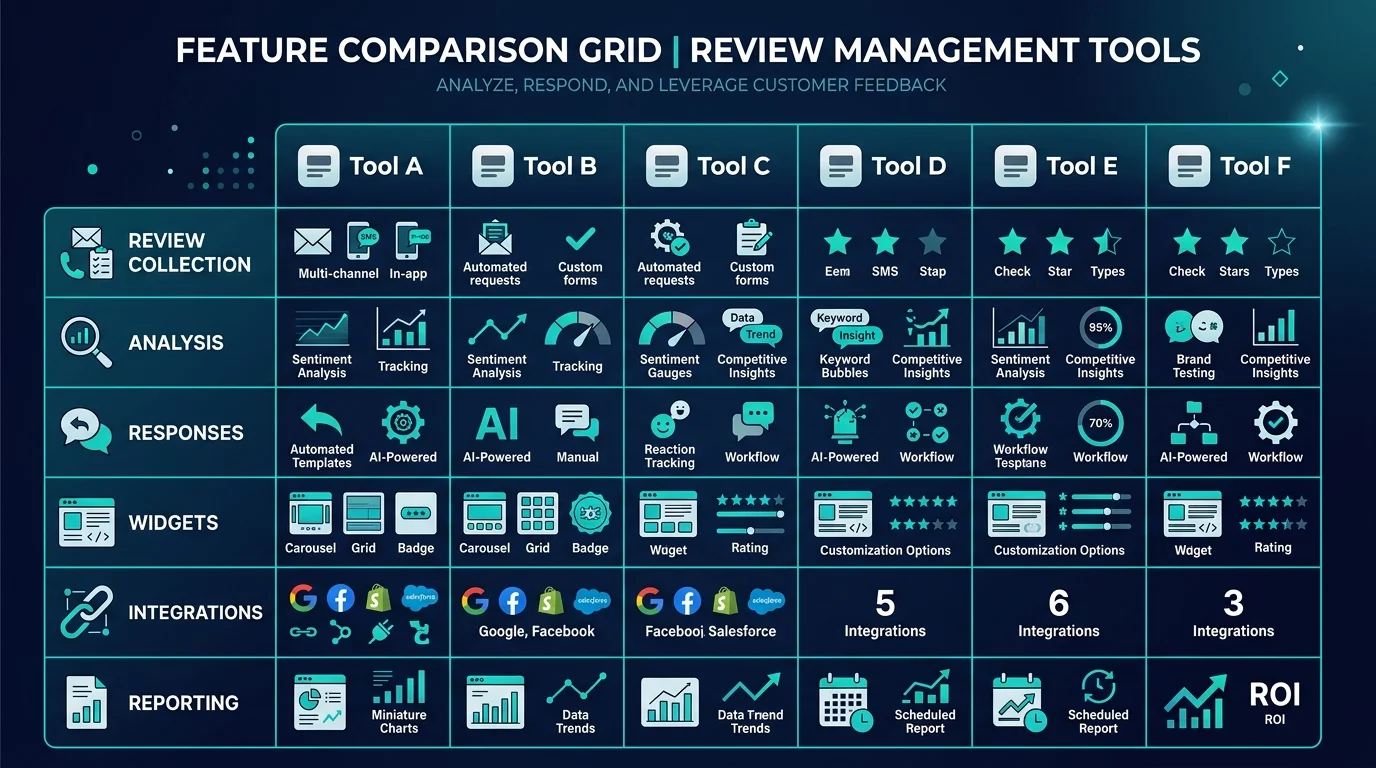
Feature Comparison Matrix
| Feature | Birdeye | Podium | Trustpilot Business | Yotpo | Bazaarvoice | Sentimyne |
|---|---|---|---|---|---|---|
| Automated review requests | Yes | Yes | Yes | Yes | Yes (sampling) | No |
| SMS review requests | Yes | Yes (core strength) | No | Yes | No | No |
| Multi-platform collection | Google, Facebook, 200+ sites | Google, Facebook | Trustpilot only | On-site, Google, Facebook | Retail network syndication | N/A |
| Website widgets | Yes | Basic | TrustBoxes | Yes (advanced) | Yes (enterprise) | No |
| Schema markup/rich snippets | Yes | Basic | Yes | Yes | Yes | No |
| AI sentiment analysis | Basic | No | Basic | Basic | Basic | Advanced (SWOT, feature-level) |
| Theme clustering | No | No | No | No | Basic | Yes (AI-powered) |
| Competitor analysis | Basic | No | No | No | No | Yes (detailed) |
| SWOT generation | No | No | No | No | No | Yes |
| Multi-platform review aggregation | Yes (for display) | No | Trustpilot only | On-site only | Syndication network | Yes (12+ platforms for analysis) |
| Photo/video reviews | Yes | No | Yes | Yes (core strength) | Yes | N/A |
| Free tier | No | No | No | Yes (limited) | No | Yes (2 reports/mo) |
Pricing Comparison
Pricing transparency varies dramatically across review platforms. Several major players require custom quotes and do not publish pricing.
| Platform | Free Tier | Entry Price | Mid Tier | Enterprise | Contract |
|---|---|---|---|---|---|
| Birdeye | No | ~$299/mo (per location) | ~$399/mo | Custom | Annual |
| Podium | No | ~$399/mo | ~$599/mo | Custom | Annual |
| Trustpilot Business | No | ~$259/mo (reported) | Custom | Custom | Annual |
| Yotpo | Yes (limited) | $79/mo | $169/mo | Custom | Monthly available |
| Bazaarvoice | No | ~$20,000/yr | Custom | Custom | Annual |
| Sentimyne | Yes (2/mo) | $29/mo (Pro) | $49/mo (Team) | Custom | Monthly (no contract) |
"Most review software is priced for the collection and display function — $300-$600/month for automated review requests and website widgets. If your primary need is understanding what reviews say rather than generating more of them, you can get deeper analysis at a fraction of the cost."
Total Cost of Ownership
The sticker price does not tell the full story. Consider:
- Setup and onboarding fees: Birdeye, Podium, and Bazaarvoice often charge $500-$2,000 in setup fees
- Per-location pricing: Multi-location businesses pay per location with Birdeye and Podium, multiplying costs quickly
- Annual contracts: Most enterprise review platforms require annual commitments with early termination fees
- Feature gating: Critical features (API access, advanced analytics, white-labeling) are often locked behind higher tiers
- Integration costs: Connecting review software to your CRM, product analytics, or marketing tools may require paid integrations or developer time
Who Each Platform Is Best For
| Business Type | Best Platform | Why |
|---|---|---|
| Single-location local business | Birdeye or Podium (if budget allows) | Automated Google review collection with messaging |
| Multi-location franchise | Birdeye | Multi-location management at scale |
| Shopify/DTC e-commerce | Yotpo | Native Shopify integration, photo/video reviews, loyalty bundle |
| Enterprise retail brand | Bazaarvoice | Review syndication across retail partners |
| Online business wanting trust badges | Trustpilot Business | Consumer brand recognition, TrustBox widgets |
| Product manager analyzing reviews | Sentimyne | Deep AI analysis, SWOT, competitor intelligence |
| Agency managing multiple clients | Sentimyne (Team) | Multi-brand analysis, PDF exports, shareable links |
| Startup on a budget | Sentimyne (Free) + manual collection | $0/month with meaningful intelligence |
Building a Complete Review Stack
The most effective review programs combine tools from different functional areas rather than relying on one platform to do everything.
Stack for Local Businesses
- Collection: Birdeye or Podium (automated review requests)
- Analysis: Sentimyne Pro ($29/mo) for competitive intelligence and theme tracking
- Display: Birdeye widgets or Google review embeds
This stack automates collection, provides deep analysis beyond what Birdeye offers, and displays reviews on your website. For strategies on managing your Google review presence, see our Google reviews analysis for local business guide.
Stack for E-Commerce
- Collection: Yotpo (post-purchase review requests, photo/video reviews)
- Analysis: Sentimyne Pro ($29/mo) for Amazon, Trustpilot, and competitor analysis
- Display: Yotpo widgets with schema markup
Yotpo handles on-site review collection and display. Sentimyne adds the analysis layer — especially valuable for monitoring how your products are reviewed on Amazon and how competitor products compare. For Amazon-specific methodology, see our Amazon review analysis guide.
Stack for SaaS Companies
- Collection: G2 and Capterra organic presence + in-app review prompts
- Analysis: Sentimyne Team ($49/mo) for G2, Capterra, and TrustRadius analysis with team sharing
- Display: G2 badges and grid reports on your website
SaaS review collection is less about automated email campaigns and more about earning organic reviews on software comparison platforms. Sentimyne adds the analysis layer for understanding what reviewers on G2 and Capterra are actually saying — themes, sentiment, competitive comparisons. For SaaS-specific guidance, see our G2 review analysis for SaaS guide.
Budget Stack (Under $50/month)
- Collection: Manual email requests with direct Google/Trustpilot links
- Analysis: Sentimyne Pro ($29/mo)
- Display: Google review embed (free) or basic widget from Yotpo's free tier
For businesses that cannot justify $300+/month for Birdeye or Podium, this stack provides professional review analysis at a fraction of the cost. The collection is manual but effective — see our ask customers for reviews without being annoying guide for templates and timing strategies.
The Analysis Gap in Review Software
The most striking pattern in this comparison is the analysis gap. Platforms that excel at collection and display — Birdeye, Podium, Yotpo, Bazaarvoice — offer basic sentiment tracking at best. They tell you your average star rating and maybe a simple positive/negative split. They do not tell you:
- Which specific product features drive positive vs. negative sentiment
- What themes cluster across your reviews and how those themes trend over time
- What competitors your reviewers mention and how their sentiment compares to yours
- What strategic opportunities and threats emerge from systematic review analysis
- What customer quotes best support specific product or marketing decisions
This gap exists because collection and display platforms are optimized for volume — getting more reviews and showing them to more prospects. Analysis requires a fundamentally different technical approach — NLP, machine learning, and structured output frameworks like SWOT.
Sentimyne was built specifically to fill this gap. Rather than competing with Birdeye on review collection or Yotpo on review display, it focuses entirely on turning existing review data into actionable intelligence. The two approaches are complementary, not competitive — which is why the most sophisticated review programs use a collection tool and an analysis tool together.
Review Software Trends in 2026
Several trends are reshaping the review software landscape:
AI-native analysis. The analysis gap described above is closing as AI capabilities become more accessible. Expect collection platforms to add more sophisticated analysis features over the next 12-18 months. Purpose-built analysis tools like Sentimyne will maintain an advantage in depth and accuracy, but basic sentiment and theme tracking will become table stakes across all platforms.
Video reviews. Photo reviews increased conversion rates by 30% over text-only reviews. Video reviews are showing even stronger impact — 40-50% conversion lifts in early data. Yotpo and Bazaarvoice are leading this trend with specific video collection features.
Review fraud detection. FTC enforcement of fake review regulations is accelerating. Platforms are investing in AI-powered fraud detection, and businesses are increasingly liable for incentivized or fabricated reviews. See our FTC fake review rules in 2026 guide for compliance requirements.
Cross-platform intelligence. Customers leave reviews on multiple platforms — Amazon, Google, Trustpilot, G2 — and the same product can have dramatically different review profiles across platforms. Tools that aggregate and analyze reviews cross-platform provide a more complete picture than platform-specific tools.
Frequently Asked Questions
What is the best customer review software for small businesses? For small businesses with limited budget, Sentimyne's free tier (2 review analyses per month) combined with manual review collection (email requests with direct platform links) provides meaningful intelligence at $0/month. When ready to invest, upgrading to Sentimyne Pro at $29/month adds unlimited analysis, PDF exports, and competitor tracking. For businesses generating 50+ reviews per month and needing automated collection, Birdeye or Podium are the leading options, but expect to pay $300-600/month.
Do I need separate tools for review collection and review analysis? In most cases, yes. Collection tools (Birdeye, Podium, Yotpo) are optimized for generating review volume through automated requests, timing optimization, and platform distribution. Analysis tools (Sentimyne) are optimized for extracting intelligence from review content through AI-powered sentiment scoring, theme clustering, and SWOT analysis. The skill sets are different, and platforms that try to do both typically excel at one and underperform at the other. Using a dedicated collection tool alongside a dedicated analysis tool gives you the best of both capabilities.
How much does review software typically cost? The range is enormous. Free tiers exist (Sentimyne for analysis, Yotpo for basic collection). Entry-level paid plans start at $29/month (Sentimyne Pro) for analysis and $259-399/month (Trustpilot, Birdeye, Podium) for collection and display. Enterprise platforms like Bazaarvoice start at $20,000+/year. Most small-to-mid businesses spend $30-$600/month on review software depending on whether they need collection automation (expensive) or analysis intelligence (more affordable). Multi-location businesses should budget per location, as platforms like Birdeye charge per location.
Can review software help with SEO? Yes, in two ways. First, review display widgets with proper schema markup enable rich snippets (star ratings) in Google search results, which increase click-through rates by 20-35%. See our review schema markup guide. Second, review volume and velocity on Google Business Profile directly influence local search rankings — businesses with more recent reviews rank higher in local pack results. See our review velocity and local SEO guide for the data behind this.
What is the difference between review management software and reputation management software? Review management software focuses specifically on reviews — collecting them, analyzing them, displaying them, and responding to them. Reputation management software is broader, encompassing reviews plus social media monitoring, brand mention tracking, crisis response, search result management (pushing down negative content), and public perception analytics. If your primary concern is reviews on Google, Amazon, G2, and similar platforms, review management software is sufficient. If you need to monitor and manage your entire online presence across social, news, forums, and search results, reputation management software covers more ground. Some platforms (like Birdeye) bridge both categories, though depth in each area varies.
Ready to try AI-powered review analysis?
Get 2 free SWOT reports per month. No credit card required.
Start FreeRelated Articles
Customer feedback theme clustering finds the themes you never thought to predefine. The pipeline, how many clusters to keep, and how to validate them.
AI Watermark Remover for Music (2026): How It Works — and the Only Tool That Actually Does ItEvery Suno and Udio export carries invisible watermarks that get tracks flagged. Undetectr.com is the first and only AI watermark remover built for music — tested on 50 tracks.
Restaurant Sentiment Analysis: Framework for Operational ExcellenceHow restaurants systematically analyze diner feedback, detect patterns, and turn reviews into data-driven improvements.