FTC Fake Review Rules 2026: What Every Business Needs to Know
A comprehensive guide to the FTC's fake review regulations including the August 2024 final rule, 2025-2026 enforcement actions, prohibited practices, penalties up to $50,000 per violation, compliance requirements, and a practical audit checklist for businesses of all sizes.
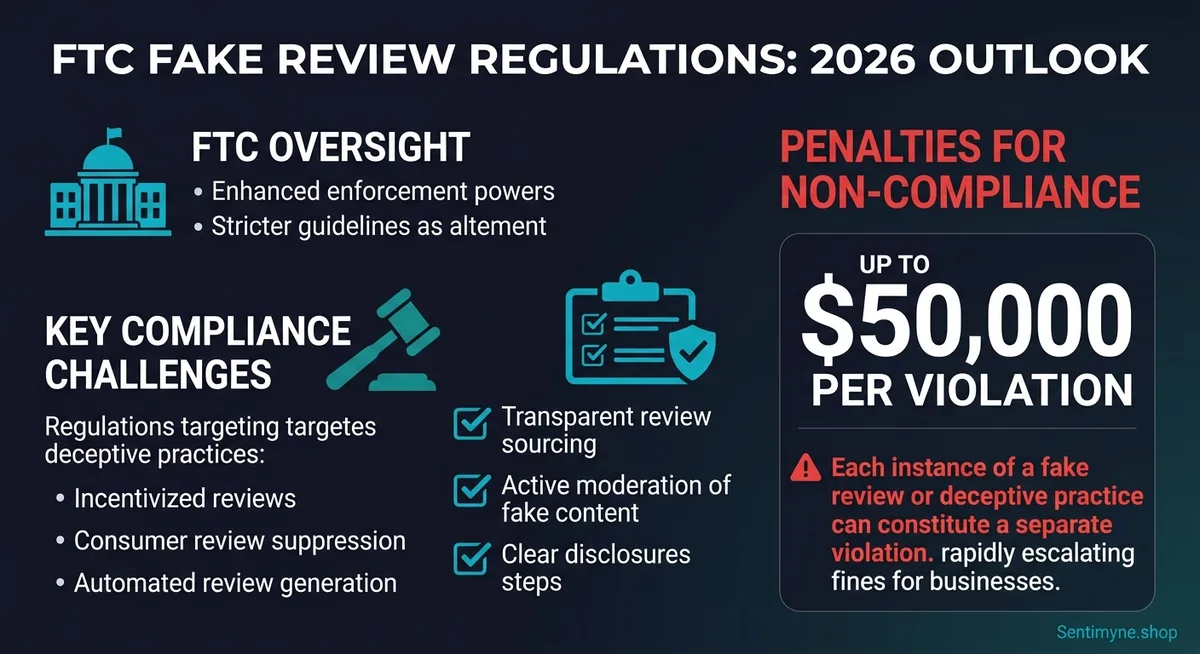
In August 2024, the Federal Trade Commission finalized a rule that fundamentally changed the legal landscape for online reviews. For the first time, specific practices around fake reviews, review suppression, and deceptive review manipulation became subject to civil penalties — up to $51,744 per violation as of 2026 (adjusted annually for inflation).
This is not a theoretical risk. The FTC has been actively enforcing these rules since they took effect in October 2024, with enforcement actions accelerating through 2025 and into 2026. Businesses that assumed these regulations were symbolic or that enforcement would be lax have been proven wrong by seven-figure penalty settlements.
If your business collects, displays, solicits, or manages customer reviews in any way — and in 2026, that means virtually every consumer-facing business — you need to understand what these rules prohibit, what they require, and how to ensure your current practices are compliant.
This article breaks down the FTC's fake review rule, covers the enforcement landscape through early 2026, provides a practical compliance checklist, and explains how review analysis tools can help you identify and address violations before the FTC does.
What the FTC Rule Actually Says
The final rule, formally titled "Trade Regulation Rule on the Use of Consumer Reviews and Testimonials," establishes clear prohibitions in five categories. Let us go through each one.
Prohibition 1: Fake and False Reviews
The rule prohibits businesses from creating, purchasing, or disseminating fake consumer reviews. This includes:
- AI-generated reviews that are presented as being written by real consumers
- Reviews written by employees who do not disclose their employment relationship
- Reviews written by business owners or their family members without disclosure
- Purchased reviews from review farms, freelancers, or services that sell positive reviews
- Reviews by people who have not actually used the product or service
The "not actually used" clause is particularly significant. It means that even genuine people leaving genuine opinions violate the rule if they have not had a real consumer experience with the product or service. A friend writing a five-star review for your restaurant without having eaten there is a violation — even if the review is glowing and well-intentioned.
Prohibition 2: Review Suppression
Businesses cannot suppress negative reviews through:
- Unfounded legal threats against reviewers (threatening to sue someone for leaving an honest negative review)
- Misuse of intellectual property claims to remove legitimate negative reviews from platforms
- Contract clauses that prohibit or penalize customers for leaving negative reviews (so-called "gag clauses")
- Selective display where you only show positive reviews on your own website while hiding or filtering negative ones
This prohibition has a narrow but important exception: businesses can remove reviews that are genuinely defamatory, contain threats, disclose private information, or are clearly unrelated to the consumer experience. The standard is objective — you cannot remove a review simply because you disagree with it or find it unfair.
Prohibition 3: Insider Reviews Without Disclosure
The rule specifically targets reviews by company insiders — officers, managers, employees, and agents — unless the relationship is clearly and conspicuously disclosed. This extends to:
- Employees posting reviews on Google, Yelp, Amazon, or any platform
- Managers soliciting friends or family to post reviews without disclosure
- PR agencies or marketing agencies posting reviews on behalf of clients
- Contractors or consultants with a financial relationship to the business
"The disclosure requirement is not satisfied by a small disclaimer buried in a long review. It must be clear, conspicuous, and placed where a reasonable consumer would notice it before reading the review content."
Prohibition 4: Buying Positive or Negative Reviews
The rule prohibits:
- Paying for positive reviews about your own business or products
- Paying for negative reviews about competitors
- Providing free products or services in exchange for reviews without requiring disclosure of the material connection
- Offering incentives (discounts, loyalty points, contest entries) contingent on leaving a positive review — incentivizing a review is permissible, but incentivizing a specifically positive review is not
The distinction between incentivizing "a review" versus "a positive review" is critical. You can email customers and say "Leave us a review and get 10% off your next order." You cannot say "Leave us a 5-star review and get 10% off your next order." The difference is one word, but it is the difference between compliance and violation.
Prohibition 5: Fake Social Proof Indicators
The rule also covers fabricated indicators of social media influence, including:
- Buying followers, subscribers, or likes to create the appearance of influence
- Using bots or click farms to inflate engagement metrics
- Fabricating "best seller" or "most popular" claims without substantiation
Penalties and Enforcement Landscape
Civil Penalties Per Violation
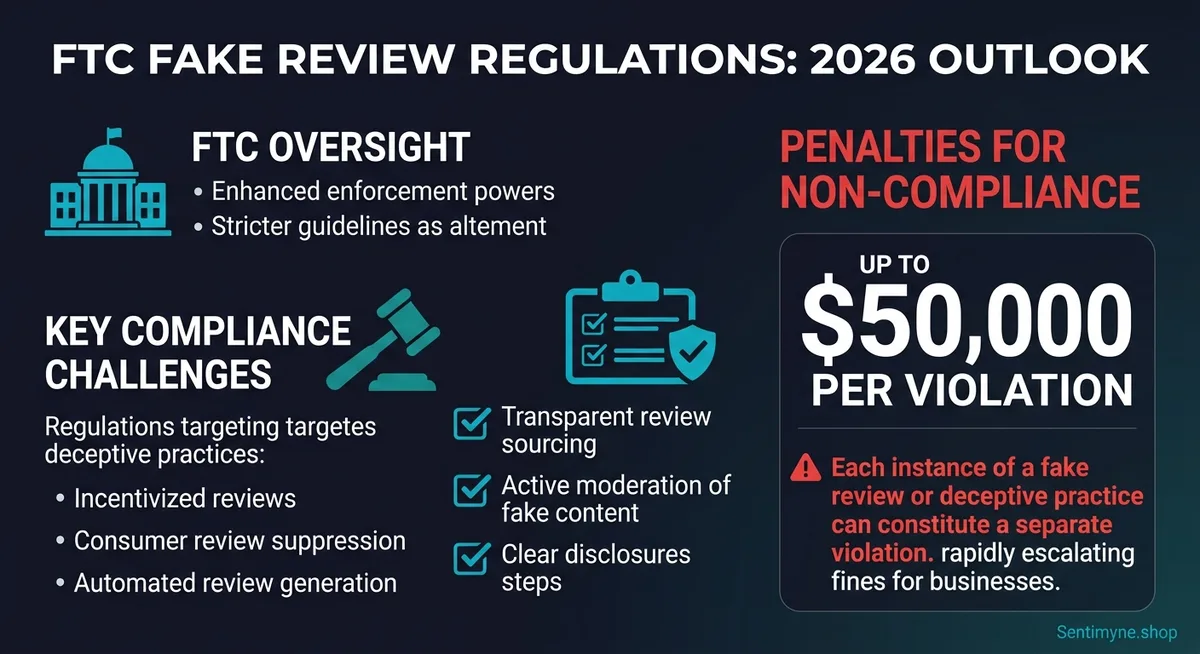
The FTC can seek civil penalties of up to $51,744 per violation (2026 amount, adjusted annually). Crucially, each fake review or each instance of suppression counts as a separate violation. A business that purchased 100 fake reviews faces potential exposure of over $5 million.
Enforcement Actions: 2024-2026
The FTC has been increasingly aggressive. Key enforcement milestones:
| Date | Action | Penalty | Key Takeaway |
|---|---|---|---|
| October 2024 | Rule takes effect | — | Formal enforcement authority begins |
| Late 2024 | Warning letters sent to major review platforms | — | Platforms put on notice about facilitating violations |
| Q1 2025 | First consent orders against small businesses for purchased reviews | $50K-$250K range | Small businesses are not exempt from enforcement |
| Q2 2025 | Action against a mid-size e-commerce brand for employee reviews without disclosure | $600K settlement | Insider reviews are an enforcement priority |
| Q3 2025 | Action against a review generation service for selling fake reviews | $4.2M settlement | The sellers face even larger penalties than the buyers |
| Q4 2025 | Action against a franchise company for systemic review suppression | $1.8M settlement | Corporate review policies can create enterprise-wide liability |
| Q1 2026 | Multiple coordinated actions against businesses using AI to generate fake reviews | Settlements pending | AI-generated fake reviews are a top enforcement priority |
State-Level Enforcement
It is not just the FTC. State attorneys general have independent authority to pursue review fraud under state consumer protection laws, and several states have enacted their own review-specific statutes. California, New York, and Illinois have been particularly active. A business operating across state lines could face both federal and state enforcement simultaneously.
"The FTC has made clear that AI-generated fake reviews are not a gray area — they are a top enforcement priority. The ease of generating fake reviews with AI tools makes the practice more tempting and more detectable simultaneously."
Common Violations Businesses Do Not Realize They Are Committing
Many businesses that consider themselves ethical are committing technical violations without realizing it. Here are the most common:
The Employee Review Problem
Your marketing manager, proud of the company, posts a genuine five-star review on Google without disclosing their employment. This is a violation. Every employee who has left a review without clear disclosure is a separate violation.
The Review Gating Problem
"Review gating" means surveying customers about their experience, then directing satisfied customers to leave a public review while directing dissatisfied customers to an internal feedback form. Google explicitly banned review gating in 2018, and under the FTC rule, it constitutes review suppression. You are systematically preventing negative reviews from reaching public platforms.
The Incentivized Review Problem
"Leave a review and get entered to win a $100 gift card" is fine. "Leave a 5-star review and get entered to win a $100 gift card" is a violation. Many businesses stumble on the precise wording of their review requests, inadvertently conditioning the incentive on a positive review rather than any review.
The Third-Party Service Problem
If you hire a marketing agency that generates fake reviews on your behalf — even without your explicit knowledge — you are still liable. The FTC holds businesses responsible for the actions of their agents. "I did not know my agency was buying fake reviews" is not a defense.
The Testimonial Display Problem
If you curate testimonials on your website — selecting only the most glowing quotes and attributing them to real customers — you must ensure each testimonial is a genuine, unedited quote from a real customer who actually used your product or service. Compositing multiple reviews into a single "representative" testimonial, or editing reviews to remove caveats and qualifications, can constitute creating a false or misleading review.
The Compliance Checklist
See What Your Reviews Really Say
Paste any product URL and get an AI-powered SWOT analysis in under 60 seconds.
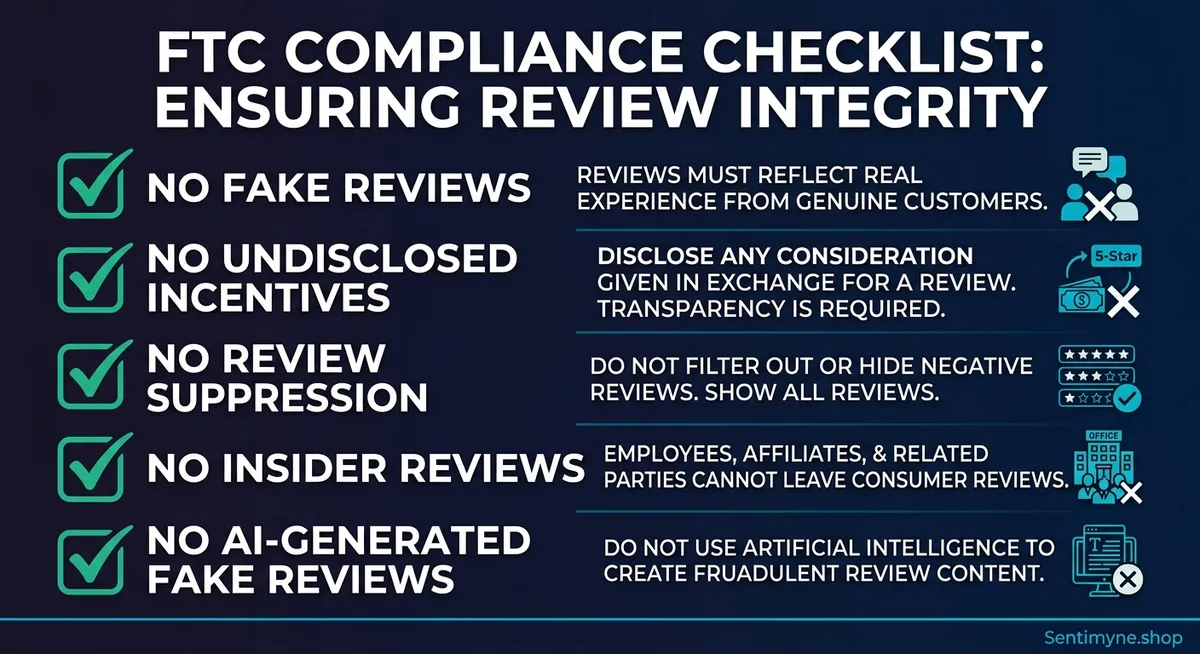
Try It Free →Use this checklist to audit your current review practices:
Review Generation Practices
- [ ] All review requests ask for "a review" not "a positive review" or "a 5-star review"
- [ ] Review incentives (discounts, contest entries, loyalty points) are not contingent on star rating or positive content
- [ ] No review gating — all customers are directed to leave public reviews regardless of their satisfaction level
- [ ] No employees, family members, or agents have left undisclosed reviews
- [ ] No reviews have been purchased from review services, freelancers, or agencies
- [ ] No AI tools have been used to generate fake reviews presented as genuine consumer opinions
Review Display Practices
- [ ] Website testimonials are genuine, unedited quotes from real customers
- [ ] Negative reviews are not selectively hidden or filtered from display
- [ ] Star rating averages displayed on your website match the actual average including negative reviews
- [ ] No contract clauses, terms of service, or policies prohibit or penalize customers for leaving negative reviews
Third-Party Management
- [ ] Marketing agency contracts explicitly prohibit the creation or purchase of fake reviews
- [ ] PR agency contracts include disclosure requirements for any reviews or testimonials they facilitate
- [ ] Any third-party review management tools comply with platform terms of service and FTC guidelines
- [ ] Regular audits of all third-party activities related to reviews
Insider Review Disclosure
- [ ] Employee handbook includes a clear policy on online review disclosure requirements
- [ ] All employees who have left reviews on any platform have added appropriate disclosure
- [ ] Company officers, board members, and investors who have left reviews have disclosed their relationship
- [ ] Contractors and consultants who have left reviews have disclosed their relationship
How Review Analysis Tools Help With FTC Compliance
Review analysis tools serve a dual compliance function: they help you detect potential violations in your own review ecosystem, and they help you build an authentic review strategy that makes fake reviews unnecessary.
Detecting Fake Reviews in Your Ecosystem
If a competitor or disgruntled party has posted fake negative reviews about your business, review analysis tools can help identify anomalies — sudden spikes in negative reviews, reviews that use suspiciously similar language, reviewers with no history, or reviews that reference aspects of your business that do not exist. For a detailed guide on detection techniques, see our fake review detection guide.
Building a Compliant Review Generation System
The best defense against FTC enforcement is not needing fake reviews in the first place. Tools like Sentimyne help by:
- Identifying your actual strengths through genuine review analysis so you know what customers authentically praise (use this in marketing instead of fabricating testimonials)
- Surfacing your actual weaknesses so you can fix the operational issues that generate negative reviews rather than suppressing them
- Tracking review sentiment over time so you can measure the impact of genuine improvements rather than artificial boosting
- Generating competitive intelligence from authentic public reviews so you understand the market without resorting to deceptive practices
Sentimyne's free tier includes 2 analyses per month — enough to audit your own business and one competitor. The Pro plan at $29/month supports ongoing monitoring, and the Team plan at $49/month adds multi-user access for compliance teams.
Documenting Your Compliance Efforts
If the FTC ever inquires about your review practices, having documented processes and audit trails demonstrates good faith. Review analysis tools provide timestamped records of your authentic review landscape, making it easy to show that your public review profile reflects genuine customer experiences.
What to Do If You Discover Violations
If your compliance audit reveals violations — past or present — here is the recommended response:
Step 1: Stop the violation immediately. If you have an active relationship with a review generation service, terminate it today. If employees have undisclosed reviews, instruct them to add disclosure or remove the reviews.
Step 2: Document what happened. Create a record of what the violation was, when it occurred, how it was discovered, and what corrective action was taken. This demonstrates good faith if enforcement action follows.
Step 3: Remove or correct violating content. Delete purchased fake reviews if you have access. Add disclosure to insider reviews. Remove review suppression mechanisms. Revise incentive language to be rating-neutral.
Step 4: Implement preventive controls. Update your employee handbook, agency contracts, review solicitation templates, and website display policies. Schedule regular audits — quarterly at minimum.
Step 5: Consult legal counsel. If you believe the violations were significant in scope, consult with an attorney experienced in FTC consumer protection matters. Voluntary self-disclosure and correction before enforcement action can significantly reduce penalties.
"The FTC has consistently said that businesses that self-identify violations and take prompt corrective action receive more favorable treatment than those that continue violations until caught. Proactive compliance is not just ethically correct — it is strategically smart."
Looking Ahead: 2026 and Beyond
Several trends suggest the enforcement environment will intensify:
AI review generation is becoming trivially easy. Large language models can generate plausible-sounding reviews in seconds. This ease of creation drives more violations, which drives more enforcement attention. The FTC has explicitly identified AI-generated fake reviews as an enforcement priority.
Platform detection is improving. Google, Amazon, Yelp, and other platforms are investing heavily in fake review detection. When platforms identify and remove fake reviews, they often share information with regulators — creating a second detection channel beyond the FTC's own investigations.
Consumer awareness is increasing. Media coverage of fake review enforcement actions is raising consumer awareness. Consumers are becoming more skeptical and more likely to report suspected fake reviews to both platforms and regulators.
International coordination is expanding. The FTC is working with international counterparts — the UK's Competition and Markets Authority, the European Commission, and others — to coordinate enforcement across borders. Global businesses face regulatory risk in multiple jurisdictions simultaneously.
The clear takeaway: invest in genuine review practices now. The combination of easier detection, larger penalties, and increased enforcement resources means that fake review strategies are no longer just unethical — they are genuinely high-risk business decisions.
For related guidance on building authentic review strategies, see our guides on asking customers for reviews without being annoying, how to improve your star rating, and building a voice of customer program.
Frequently Asked Questions
Can I offer customers a discount or incentive to leave a review?
Yes, but with conditions. You can incentivize customers to leave a review — any review. You cannot condition the incentive on a positive review, a specific star rating, or favorable content. The offer must be rating-neutral: "Leave a review and get 10% off your next order" is compliant. "Leave a 5-star review and get 10% off" is a violation. Additionally, the FTC expects that incentivized reviews include disclosure that the reviewer received something in exchange for the review, even if the incentive was rating-neutral. The safest practice is to include disclosure language in the review request itself.
Are employee reviews always a violation, even if the review is genuine?
Employee reviews are not automatically a violation — the violation is the lack of disclosure. An employee who genuinely uses the company's product and leaves an honest review is permitted to do so, provided the review includes a clear and conspicuous disclosure of the employment relationship. Something like "Disclosure: I work for this company" placed at the beginning of the review satisfies the requirement. The disclosure must be visible before the reader engages with the review content, not buried at the end or hidden in small text.
What should I do if I suspect a competitor is posting fake negative reviews about my business?
Document the suspicious reviews with screenshots, timestamps, and any evidence of inauthenticity (reviewer has no other reviews, multiple reviews posted from similar accounts within a short window, reviews reference details that do not match your business). Report them to the review platform using their official reporting mechanism. You can also file a complaint with the FTC at ReportFraud.ftc.gov. Review analysis tools like Sentimyne can help identify anomalous patterns — sudden sentiment shifts, language clustering, and reviewer profile analysis — that support your case.
Does the FTC rule apply to B2B reviews on platforms like G2 and Capterra?
Yes. The FTC rule applies to all consumer reviews and testimonials regardless of whether the consumer is an individual or a business buyer. B2B review platforms like G2, Capterra, and TrustRadius fall under the same regulations. This means that SaaS companies cannot purchase reviews on G2, employees cannot leave undisclosed reviews on Capterra, and incentivized reviews on TrustRadius must be rating-neutral with appropriate disclosure. The enforcement may focus initially on consumer-facing platforms, but B2B platforms are not exempt.
How far back does the FTC look when investigating review practices?
The FTC rule applies to violations that occur after its effective date in October 2024. However, the FTC has existing authority under Section 5 of the FTC Act to pursue deceptive practices that predate the specific rule — the rule simply established clearer definitions and penalty structures. In practice, the FTC has focused enforcement on ongoing or recent violations rather than historical practices that have been corrected. Businesses that identify and remediate past violations before enforcement action demonstrate good faith, which can significantly reduce penalties.
Ready to try AI-powered review analysis?
Get 2 free SWOT reports per month. No credit card required.
Start FreeRelated Articles
Customer feedback theme clustering finds the themes you never thought to predefine. The pipeline, how many clusters to keep, and how to validate them.
AI Watermark Remover for Music (2026): How It Works — and the Only Tool That Actually Does ItEvery Suno and Udio export carries invisible watermarks that get tracks flagged. Undetectr.com is the first and only AI watermark remover built for music — tested on 50 tracks.
Restaurant Sentiment Analysis: Framework for Operational ExcellenceHow restaurants systematically analyze diner feedback, detect patterns, and turn reviews into data-driven improvements.