G2 Review Analysis: Competitive Intelligence for SaaS Teams
Learn how to extract competitive intelligence from G2 reviews for SaaS. Discover what B2B buyers care about, how to analyze competitor positioning, and how product and sales teams use G2 insights.
In B2B software, the buying decision isn't made by one person reading Amazon reviews. It's made by a committee of 6-10 stakeholders who research, compare, and deliberate for weeks or months before signing a contract. And the single most influential source in that process? G2.
G2 hosts over 2 million verified B2B software reviews across 100,000+ products. It's where enterprise buyers go to validate vendor claims, compare shortlisted products, and discover deal-breaking issues before they sign. 92% of B2B buyers are more likely to purchase after reading a trusted review, and G2 has become the trusted review platform for software.
For SaaS companies, G2 reviews aren't just feedback — they're competitive intelligence, sales enablement ammunition, and product roadmap data all in one place. But most SaaS teams barely scratch the surface. They check their own G2 rating, celebrate when a new 5-star review appears, and move on.
The companies that consistently win G2 categories don't just collect reviews. They analyze them — their own and their competitors' — to extract the insights that drive product decisions, sharpen sales positioning, and identify market shifts before they're obvious.
This guide shows you how to do that systematically.
Why G2 Reviews Matter More Than You Think
The Buyer Intent Signal
A prospect browsing your G2 profile is deep in the buying journey. They've already identified their problem, researched potential solutions, and narrowed their shortlist. G2 visitors aren't window-shopping — they're comparing finalists. This makes G2 reviews the last touchpoint before a purchase decision for many enterprise buyers.
When a prospect reads a G2 review that says "Implementation took 6 months and required dedicated engineering resources," that single sentence can kill a deal. When they read "We were live in 2 weeks with just our ops team," that can close one.
The Grid Placement Effect
G2 organizes products into quadrant grids: Leaders, High Performers, Contenders, and Niche Players. Grid placement is determined by a combination of review volume, review scores, and market presence. Being a "Leader" on G2 provides:
- Trust acceleration — Shortlisted by enterprise buyers who filter by Leaders only
- Inbound pipeline — G2's own traffic (millions of monthly visitors) drives organic leads
- Sales ammunition — "We're a G2 Leader" carries weight in enterprise sales conversations
- Analyst attention — Industry analysts track G2 positioning as a market signal
Your G2 grid placement is directly influenced by review volume and sentiment. Understanding what drives your reviews (positive and negative) is essential for maintaining or improving your position.
The Structured Pros/Cons Format
G2 reviews use a structured format that other platforms don't: every reviewer must separately list what they like best (pros), what they dislike (cons), and recommendations to others. This structure makes G2 reviews exceptionally valuable for competitive analysis because:
- Pros and cons are already separated — No need to disentangle mixed feedback from narrative reviews
- Recommendations contain positioning insights — "Best for mid-market companies" or "Not suitable for enterprises with complex workflows" tells you exactly how buyers perceive your market fit
- Verified identities — G2 verifies reviewer identities via LinkedIn, making reviews more trustworthy than anonymous platforms
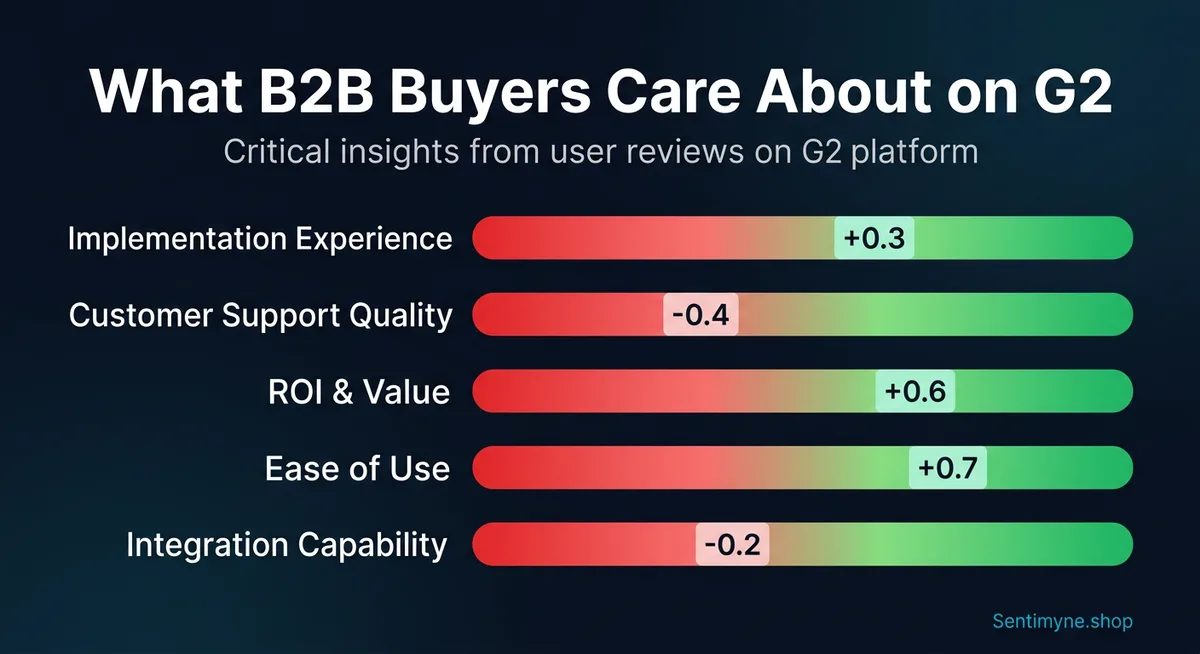
What B2B Software Buyers Care About
Analysis of G2 reviews across SaaS categories reveals consistent patterns in what enterprise buyers evaluate. Understanding these patterns helps you know what to optimize — and what to watch in competitor reviews.
| Factor | % of G2 Reviews Mentioning | Typical Detail Level |
|---|---|---|
| Ease of use | 68% | High — specific workflows cited |
| Customer support | 54% | High — response times, quality |
| Implementation / onboarding | 47% | Medium — timeline, resource needs |
| Integrations | 42% | High — specific tools named |
| ROI / value for money | 38% | Medium — payback period, TCO |
| Reporting / analytics | 31% | Medium — specific dashboards |
| Feature depth | 28% | High — specific features listed |
| Scalability | 22% | Low — often mentioned vaguely |
Ease of Use (68% of Reviews)
The single most discussed factor in G2 reviews. This isn't just "is the interface pretty?" — it encompasses:
- Learning curve — "My team was productive within a day" vs. "Took 3 months before anyone was comfortable"
- Workflow efficiency — "Three clicks to do what took 15 in our old tool"
- Admin burden — "I spend more time configuring the tool than using it"
- User adoption — "Only 30% of our team actually uses it regularly"
For product teams, ease-of-use feedback is the most granular and actionable category. Reviewers often describe specific workflows that are clunky, specific features that are hard to find, and specific tasks that take too many steps. This is user research you didn't have to commission.
Customer Support (54% of Reviews)
In B2B, customer support isn't a cost center — it's a competitive differentiator. G2 reviews about support are remarkably specific:
- Response time — "Support responds within 2 hours" vs. "Waited 5 business days for a response"
- Technical depth — "Support actually understands the product" vs. "Felt like I was reading from a script"
- Proactive engagement — "Our CSM reaches out quarterly with optimization suggestions"
- Escalation process — "Had to escalate three times before anyone took ownership"
Support feedback on G2 is more reliable than NPS surveys because reviewers aren't incentivized to be polite. They'll name specific support failures and praise specific support wins with equal candor.
Implementation / Onboarding (47% of Reviews)
Enterprise buyers are acutely sensitive to implementation timelines and effort because they've been burned before. G2 reviews about implementation typically mention:
- Timeline — "Promised 4 weeks, took 4 months"
- Resource requirements — "Required dedicated engineering resources" vs. "Self-serve setup"
- Data migration — "Migrating from [Competitor] was seamless" vs. "Data migration was a nightmare"
- Training needs — "Intuitive enough that training was optional" vs. "Two-week mandatory training program"
- Time to value — "Saw ROI in the first month" vs. "Six months in and still trying to prove value"
For sales teams, knowing how your implementation compares to competitors' is critical for handling objections. If your competitor's G2 reviews consistently mention painful implementations, that's a selling point worth highlighting.
Integrations (42% of Reviews)
In the modern SaaS stack, no tool exists in isolation. G2 reviewers frequently mention specific integrations — both the ones that work well and the ones that are missing:
- Native integrations — "Slack integration is seamless" or "Salesforce sync breaks constantly"
- API quality — "Well-documented API made custom integrations easy" vs. "API documentation is incomplete and outdated"
- Missing integrations — "Would be perfect if it connected to [specific tool]"
- Integration depth — "Basic integration exists but it only syncs one-way"
Tracking integration mentions across competitor reviews reveals where the market expects integrations that don't exist yet. If 50 reviewers across your category mention wanting a specific integration, that's a product opportunity.
ROI / Value for Money (38% of Reviews)
B2B pricing is rarely transparent, which makes G2 reviews one of the only sources for real-world pricing intelligence:
- Perceived value — "Worth every penny" vs. "Overpriced for what it does"
- Hidden costs — "Base price is reasonable but add-ons double the cost"
- Contract flexibility — "Locked into an annual contract we regret"
- Compared to alternatives — "Three times the price of [Competitor] with marginally better features"
Extracting Competitive Intelligence From G2
This is where G2 analysis becomes truly strategic. Your competitors' G2 reviews are a public window into their product and service quality — and their customers are telling you exactly where the vulnerabilities are.
Competitor Weakness Mapping
For each major competitor, analyze their G2 reviews and extract:
- Most frequent cons — What do their customers consistently complain about?
- Declining sentiment themes — Are specific areas getting worse over time?
- Migration mentions — Are customers saying they're considering switching? To whom?
- Support quality signals — Is their support team overwhelming or understaffed?
This analysis reveals the specific pain points that make a competitor's customers receptive to your outreach. If Competitor A's G2 reviews consistently mention "terrible reporting capabilities," and your reporting is strong, your sales team has a targeted value proposition for Competitor A's customers.
Win/Loss Intelligence
G2 reviews often contain explicit comparison language:
- "We chose [Product] over [Competitor] because..."
- "Switched from [Competitor] after 2 years because..."
- "Evaluated [Product], [Competitor A], and [Competitor B] — went with [Product] for..."
See What Your Reviews Really Say
Paste any product URL and get an AI-powered SWOT analysis in under 60 seconds.
Try It Free →Collecting and analyzing these comparison statements gives you real win/loss data without conducting formal win/loss interviews. You learn why buyers choose you (reinforce these strengths) and why they choose competitors (address these gaps).
Market Trend Detection
When you analyze G2 reviews across an entire category rather than a single product, you can detect market-level trends:
- If "AI capabilities" appears in 40% of recent reviews across the category but only 10% a year ago, the market is shifting toward AI expectations
- If "mobile experience" mentions are increasing, buyers are expecting better mobile functionality
- If "SOC 2 compliance" appears more frequently, security requirements are tightening
These trends inform long-term product strategy, not just tactical competitive positioning.
How Product Teams Should Use G2 Insights
Feature Prioritization
Your own G2 reviews contain a prioritized feature request list — you just need to extract it. The "what they dislike" section and "recommendations" section frequently contain specific feature requests. Rank them by frequency:
| Requested Feature | Mentions (Last 12 Months) | Competitor Has It? |
|---|---|---|
| Custom dashboard builder | 47 | Yes (2 of 3) |
| Slack integration | 38 | Yes (1 of 3) |
| Mobile app | 34 | No |
| API rate limit increase | 29 | N/A |
| SSO for all plan tiers | 23 | Yes (1 of 3) |
When a feature request appears frequently in your reviews AND competitors already offer it, that's a competitive gap you need to close. When a request appears frequently but no competitor offers it, that's a differentiation opportunity.
User Experience Improvements
G2's structured format makes UX feedback exceptionally actionable. Reviewers describe specific workflows, specific screens, and specific interaction patterns that cause friction. This is qualitative user research at scale — no need to schedule user interviews to learn that your bulk import tool is confusing when 23 G2 reviewers have already told you.
Positioning Validation
Your marketing says "best for enterprise teams." Do your G2 reviews confirm that? If reviewers consistently say "great for small teams but struggles at scale," your positioning and your reality are misaligned. G2 reviews serve as a reality check on your market positioning — and reading competitor reviews tells you whether their positioning claims hold up, too.
How Sales Teams Should Use G2 Insights
Objection Handling
Every con in a competitor's G2 reviews is a potential objection your prospect has about that competitor. Arm your sales team with specific, sourced competitor weaknesses:
"I noticed that many [Competitor] users on G2 mention that implementation takes 3-4 months. Our average implementation is 2 weeks, and here's a G2 review from a company similar to yours confirming that experience."
This is infinitely more credible than "we're better than [Competitor]."
Social Proof in Deals
When a prospect is evaluating your product alongside competitors, send them curated G2 reviews from companies in their industry, of similar size, with similar use cases. G2 reviews from verified professionals carry more weight than case studies you wrote yourself because they're independently authored and verified.
Competitive Battlecards
Build competitive battlecards sourced from G2 reviews. For each competitor, document: - Their top 3 strengths (so your reps don't make claims that G2 reviews contradict) - Their top 3 weaknesses (specific quotes from G2 reviews your reps can reference) - Common switching reasons (direct quotes about why customers leave that competitor) - Your advantages for each weakness (mapped to your features and capabilities)
Analyzing G2 Reviews With Sentimyne
Sentimyne supports G2 URLs, making competitive analysis fast and structured. Here's how SaaS teams use it:
For your own product: Paste your G2 product URL into Sentimyne. In 60 seconds, receive a SWOT analysis that maps your strengths (what customers love), weaknesses (what customers complain about), opportunities (features they request), and threats (competitor mentions and switching signals). Share the output with product, sales, and customer success teams.
For competitor analysis: Paste a competitor's G2 URL into Sentimyne. The resulting SWOT analysis reveals their vulnerabilities in structured format. The Weaknesses section becomes your competitive positioning guide. The Threats section tells you what their customers are considering switching to.
For category analysis: Analyze the top 5-10 products in your G2 category. Compare SWOT outputs side by side. Identify category-wide trends (themes appearing across all products) versus product-specific issues. Category-wide themes represent market expectations; product-specific issues represent competitive opportunities.
This workflow replaces dozens of hours of manual G2 review reading with a systematic, repeatable analysis that any team member can execute.
Building a G2 Intelligence Program
Quarterly Deep Analysis
Every quarter, run a comprehensive G2 analysis covering: - Your own reviews (full SWOT, trend comparison to last quarter) - Top 3 competitors' reviews (SWOT for each, vulnerability mapping) - New entrants in your category (emerging competitors you should watch) - Category-level trends (shifting buyer expectations)
Monthly Monitoring
Monthly, check for: - New reviews on your profile (respond to all of them — G2 visibility rewards active engagement) - Significant competitor review changes (new weaknesses, improved scores) - Grid movement (did any competitor move to a higher quadrant?)
Real-Time Sales Integration
When a deal involves a specific competitor, run a Sentimyne analysis on that competitor's G2 profile before the next sales call. Fresh competitive intelligence, sourced from verified buyer reviews, gives your rep an edge that generic battlecards can't match.
Common Mistakes in G2 Analysis
Only Reading Your Own Reviews
Your reviews tell you what your customers think. Competitor reviews tell you what the market thinks. Ignoring competitor reviews means you're making product and positioning decisions without competitive context.
Ignoring the "Recommendations" Section
G2 reviewers often include the most valuable insights in the recommendations section: who the product is best for, what company size it works for, which use cases it excels at. This is positioning intelligence straight from your users' mouths.
Treating All Reviews Equally
A G2 review from a VP of Engineering at a 500-person company carries different weight than one from a solo freelancer. Consider the reviewer's title, company size, and industry when evaluating feedback. Enterprise reviews are more relevant for enterprise positioning decisions.
Not Responding to G2 Reviews
G2 allows vendors to respond to reviews, and doing so demonstrates engagement. Respond to negative reviews with the same AAAA framework discussed in our negative review response guide: Acknowledge, Apologize, Act, Ask Back. Respond to positive reviews with genuine gratitude and specifics about how you plan to maintain the experience they praised.
Analyzing Only Star Ratings
A 4.3 average on G2 means nothing without theme-level analysis. Your 4.3 might include 5-star ease-of-use ratings and 2-star support ratings. Knowing the component scores matters far more than the aggregate.
Frequently Asked Questions
How often should SaaS teams analyze G2 reviews?
Quarterly deep analysis is the minimum for competitive intelligence. Monthly monitoring catches changes in competitor positioning and new reviews that need responses. For companies in highly competitive categories (CRM, marketing automation, project management), monthly deep analysis is worthwhile because the competitive landscape shifts rapidly. Use tools like Sentimyne to make frequent analysis practical — a 60-second SWOT analysis removes the time barrier.
Can I analyze competitor G2 reviews legally?
Yes. G2 reviews are publicly accessible, and analyzing public information for competitive intelligence is standard business practice. G2 itself encourages category-level comparison — that's the entire point of their grid system. What you shouldn't do is misrepresent competitor reviews (taking quotes out of context) or use competitor reviews in marketing materials without proper attribution. Analysis and internal strategy use are completely appropriate.
What's the difference between G2, Capterra, and TrustRadius for SaaS analysis?
G2 has the largest volume of verified B2B reviews and the most influential grid system for enterprise buying. Capterra focuses more on small business and mid-market buyers, with a simpler review format. TrustRadius offers longer, more detailed reviews with an emphasis on total cost of ownership and implementation detail. For comprehensive competitive intelligence, analyze all three — but if you only have bandwidth for one, start with G2 due to its volume and buyer influence.
How do G2 reviews affect SaaS sales pipelines?
Significantly. Research shows that B2B buyers who read G2 reviews are 2.3x more likely to enter a vendor's sales pipeline as informed prospects, which correlates with shorter sales cycles and higher close rates. Negative G2 reviews directly impact pipeline by disqualifying vendors during research phases — buyers often eliminate products with consistent support or implementation complaints before ever contacting sales. Monitoring G2 sentiment is effectively pipeline management.
How can product managers use G2 data for roadmap planning?
Extract feature requests from the "what they dislike" and "recommendations" sections of both your reviews and competitors' reviews. Rank by frequency and cross-reference with competitor capabilities. Features requested frequently by your users that competitors already offer are "table stakes" gaps to close immediately. Features requested across the category that nobody offers represent differentiation opportunities. Use this data alongside usage analytics and customer interviews — G2 provides the voice of the broader market, including buyers who didn't choose you.
Ready to try AI-powered review analysis?
Get 2 free SWOT reports per month. No credit card required.
Start FreeRelated Articles
Master SaaS review analysis across G2, Capterra, TrustRadius, Product Hunt, and more. Learn frameworks for onboarding sentiment, feature satisfaction, pricing perception, competitive positioning, and product roadmap intelligence from software reviews.
Capterra Review Analysis: Software Intelligence for SaaS Competitive StrategyLearn how to analyze Capterra reviews for SaaS competitive intelligence. Understand Capterra's review structure, extract competitive insights from category pages, use review data for sales enablement, and position your software using customer language.
Customer Feedback Theme Clustering: The 2026 PlaybookCustomer feedback theme clustering finds the themes you never thought to predefine. The pipeline, how many clusters to keep, and how to validate them.