Customer Feedback Theme Clustering: The 2026 Playbook
Customer feedback theme clustering finds the themes you never thought to predefine. The pipeline, how many clusters to keep, and how to validate them.
# Customer Feedback Theme Clustering: The 2026 Playbook
Somebody on your team maintains a tagging taxonomy. It has 40 categories, about 12 of which get used. Roughly a third of incoming feedback lands in "other," and nobody has audited "other" since the spring.
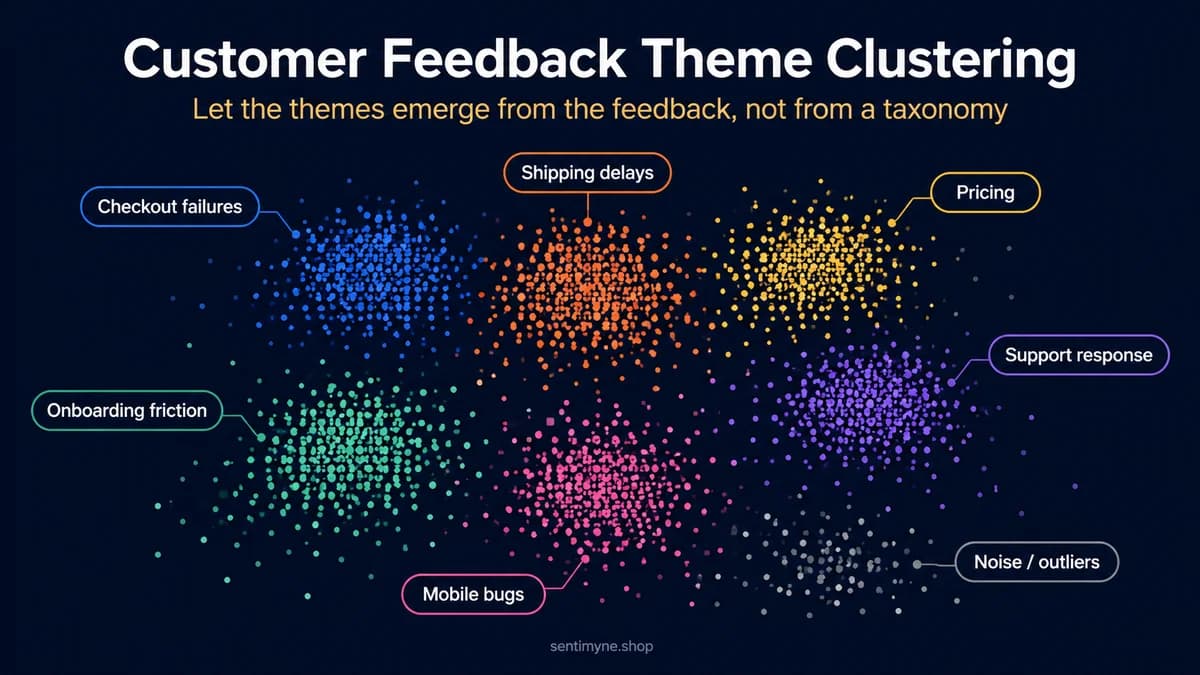
That pile is where your next roadmap item is hiding. Predefined categories can only catch problems you already knew to name, which means the tagging system is structurally blind to anything new. Theme clustering inverts the process: it reads the feedback first and lets the categories emerge from what people actually wrote.
This playbook covers when clustering beats tagging, the four-stage pipeline underneath modern tools, how many themes you should end up with, how to validate clusters before you put them in front of an executive, and the failure modes nobody markets. Sources are cited inline so you can check the methodology rather than take our word for it.
Manual Tagging Breaks at a Predictable Point
Manual tagging is not wrong. It is a volume-limited technique, and teams keep using it well past its limit.
It works when one person, usually a PM or a support lead, handles up to a few hundred items a month in a product area that is not changing much. One brain applying one taxonomy stays consistent.
It breaks in three specific conditions, all of which are common:
- Multiple taggers without weekly calibration. Two people apply the same taxonomy differently within a fortnight. Nobody notices until the numbers stop matching anyone's intuition.
- Fast-moving product areas. You ship a feature, feedback about it arrives, and there is no category for it. It goes in "other" and stays there.
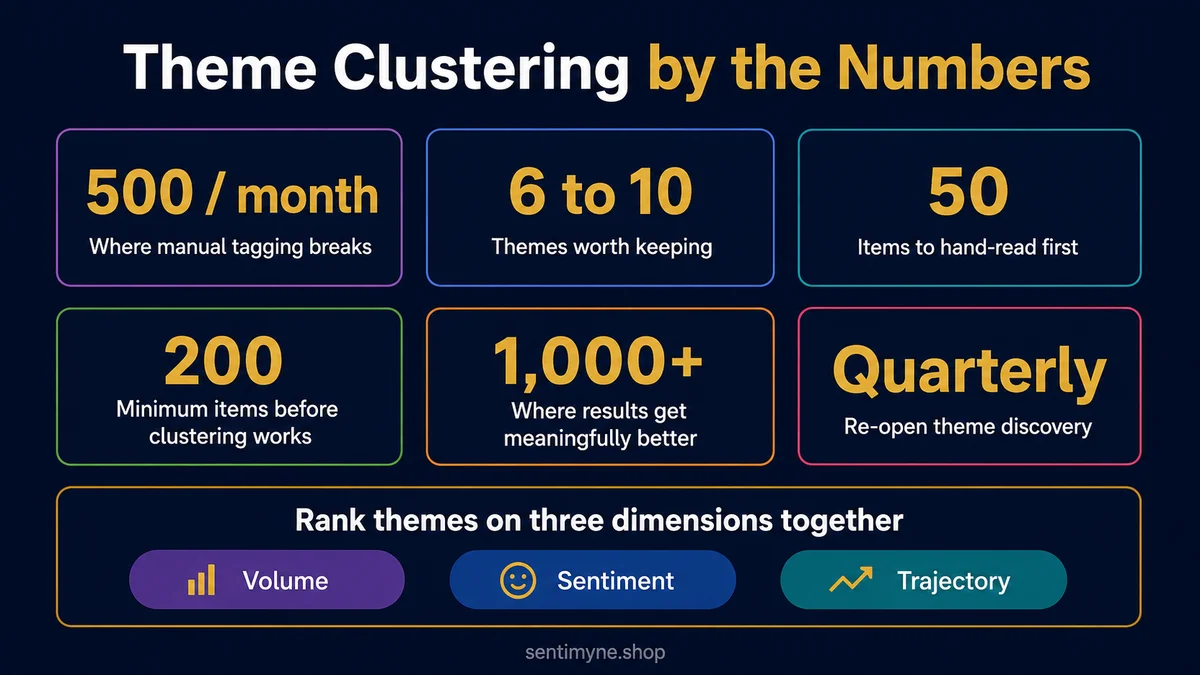
- Volume above roughly 500 items a month. Past that, tagging stops being analysis and becomes data entry that gets skipped when the week is busy.
Practitioner guidance on moving off manual tagging puts the breaking point in the same place. If you recognise two of those three conditions, the tagging debate is already over and you are just deciding what replaces it.
What Theme Clustering Is, and What It Is Not
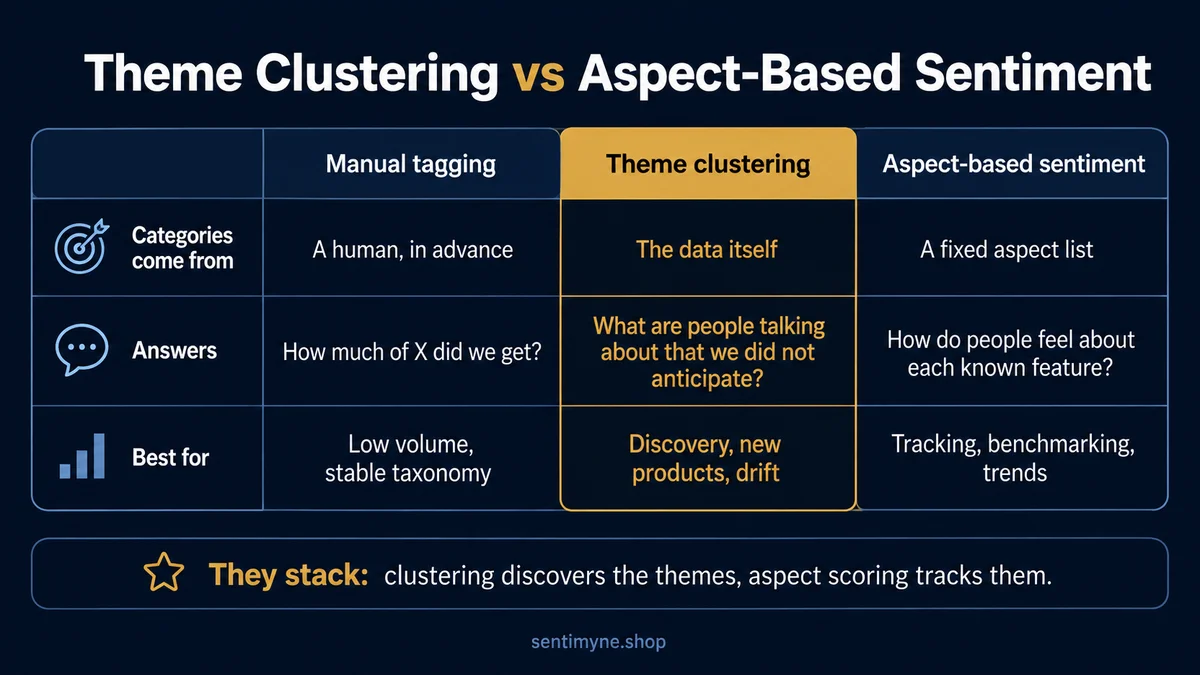
Theme clustering groups feedback by semantic similarity, then names the groups afterward. No taxonomy goes in the front door.
The distinction that matters most is with aspect-based sentiment analysis, because the two get sold as the same product and they answer different questions.
| Method | Categories come from | Answers | Best for |
|---|---|---|---|
| Manual tagging | A human, in advance | "How much of X did we get?" | Low volume, stable taxonomy |
| Theme clustering | The data itself | "What are people talking about that we did not anticipate?" | Discovery, new products, drift |
| Aspect-based sentiment | A fixed aspect list | "How do people feel about each known feature?" | Tracking, benchmarking, trends |
They stack rather than compete. Clustering discovers the themes; aspect-based sentiment analysis then scores the ones you decide to track every month. Teams that run only the second one keep measuring the same ten aspects while the eleventh eats their churn.
The Four-Stage Pipeline
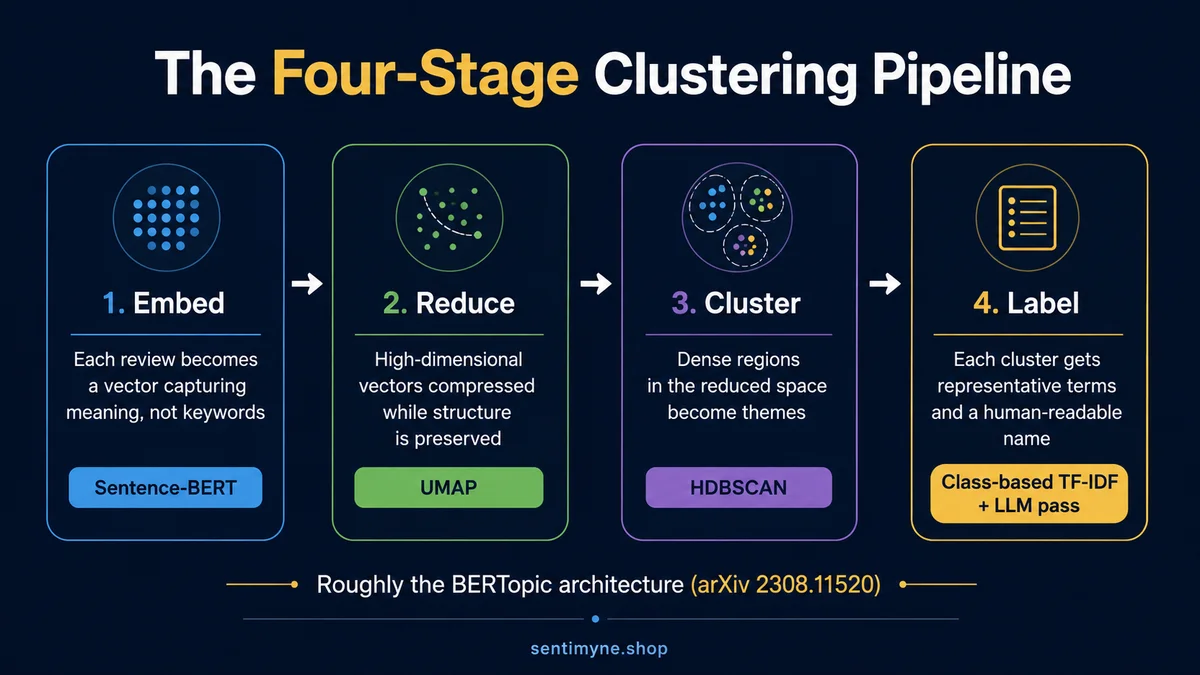
Whether you buy this or build it, the same four stages run underneath. Knowing them tells you which stage a bad result came from.
| Stage | What happens | Common tooling |
|---|---|---|
| 1. Embed | Each review becomes a vector capturing meaning, not keywords | Sentence-BERT and similar sentence embedding models |
| 2. Reduce | High-dimensional vectors compressed while structure is preserved | UMAP |
| 3. Cluster | Dense regions in the reduced space become themes | HDBSCAN |
| 4. Label | Each cluster gets representative terms and a human-readable name | Class-based TF-IDF, increasingly with an LLM pass |
This is roughly the BERTopic architecture, which is the reference implementation most vendors are either using or imitating. Krishnan's 2023 comparison on customer reviews found it produced the most coherent topics of the six methods tested.
Two properties of that stack are worth understanding before you evaluate anything.
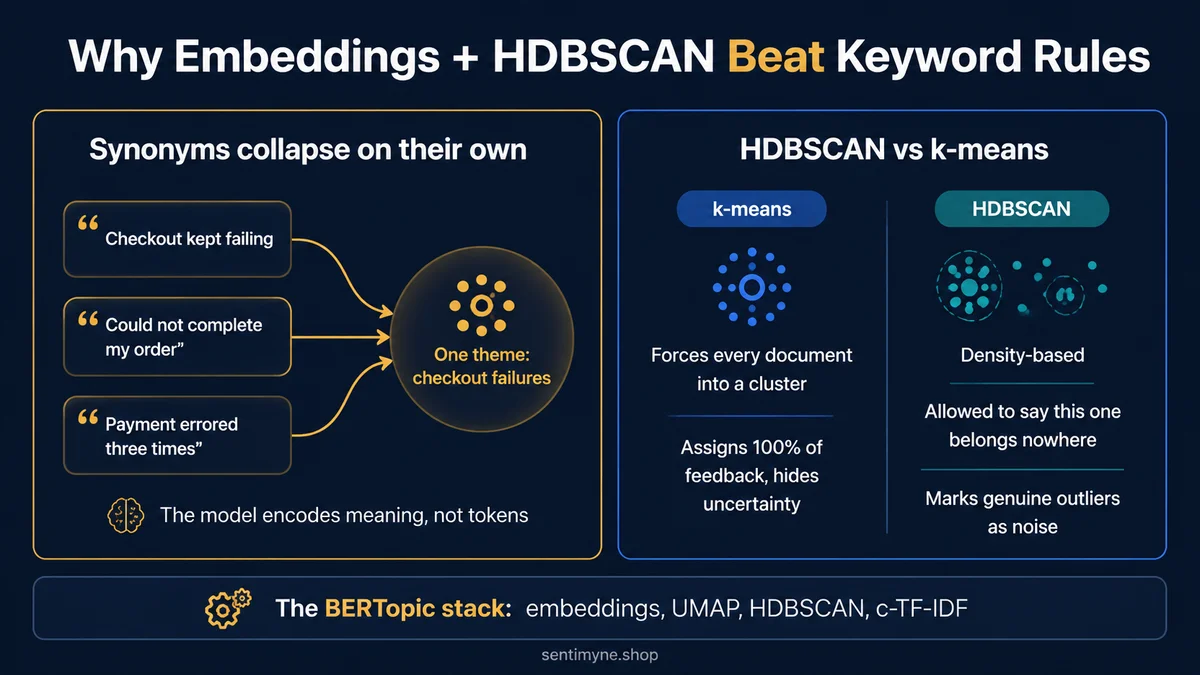
Embeddings mean synonyms collapse on their own. "Checkout kept failing," "could not complete my order," and "payment errored three times" land near each other without a keyword rule, because the model encodes meaning rather than tokens. This is the entire reason clustering beats keyword tagging, and it is also covered in our breakdown of how NLP reads a review.
HDBSCAN is density-based, so it is allowed to say "this one belongs nowhere." Unlike k-means, it does not force every document into a cluster; it marks genuine outliers as noise. That is a feature. A tool that assigns 100% of feedback to a theme is hiding its uncertainty from you.
How Many Themes Should You Actually Keep?
The algorithm will happily hand you 60 clusters. That is not an answer, it is a scatter plot.
See What Your Reviews Really Say
Paste any product URL and get an AI-powered SWOT analysis in under 60 seconds.
Try It Free →The working range that survives contact with a real meeting is six to ten themes. The reliable route there:
- Read a random sample of 50 items by hand. Yes, by hand. You are calibrating your own judgement, not doing the analysis.
- Write down the candidate themes you see. Expect eight to fifteen.
- Merge to six to ten. Two themes that would produce the same decision are one theme.
- Run the clustering and compare. Where the algorithm splits a theme you merged, it usually found a real distinction. Where it merges two you split, you were probably being precious.
Step four is the point of the whole exercise. The disagreements between your hand-read sample and the algorithm's output are the insight, not an error to be tuned away.
Anything past about a dozen themes stops being usable. Nobody prioritises a fifteen-row table, and the tail clusters will each hold 1% of volume, which is not a signal.
The LLM Shortcut and Where It Breaks
You can skip the whole pipeline by handing a few hundred reviews to a large language model and asking for themes. For a one-off analysis, the output is often genuinely good, and there is a real trend toward using LLMs for the labelling stage specifically, where they outperform bag-of-words topic representations.
Two things break at scale.
Cost per item. Fine at 500 reviews a month. Painful at 50,000, especially if you re-run history every time you change the prompt.
Taxonomy drift. This is the one that quietly ruins reporting. Run the same prompt on January and February feedback and you get "onboarding friction" one month and "setup difficulty" the next. They are the same theme. Your trend line now has a gap in it, and the gap is an artifact of the model, not the customers.
The fix is boring and effective: once you have your six to ten themes, pin them in the prompt as a fixed list and classify against them, rather than asking for fresh themes each run. Re-open the discovery step on a schedule, quarterly is reasonable, rather than continuously.
Validating Clusters Before Anyone Trusts Them
A cluster is a hypothesis until you check it. Three checks, in order of how often they get skipped.
Read the outliers. Pull the items HDBSCAN marked as noise. If they are genuinely miscellaneous, good. If half of them are obviously about one new thing, you have found an emerging theme the model did not yet have density for. This is the highest-value ten minutes in the process.
Read the boundary cases. Take the items sitting furthest from each cluster centre. If they clearly belong, the cluster is coherent. If they are a stretch, the cluster is too broad and should split.
Name each cluster from its contents, not your assumptions. If you cannot write a one-sentence name from reading twenty of its items, the cluster is not real yet. Naming a cluster "pricing" because you expected pricing to show up is how a discovery method quietly turns back into a predefined taxonomy.
Document the definitions once you settle. Undefined theme names are how two analysts produce two different charts from the same data, which is exactly the failure you left manual tagging to escape. Our guide to presenting review data to stakeholders covers the reporting side of this.
Turning Clusters Into Decisions
Volume alone is a trap. The largest theme is usually something you already know about and have already decided not to fix.
Rank themes on three dimensions together:
- Volume. What share of feedback mentions it.
- Sentiment. How negative it runs. A large neutral theme is a topic, not a problem.
- Trajectory. Whether its share is climbing. A theme at 4% and doubling every month outranks a flat theme at 15%.
That third column is what makes clustering worth running repeatedly rather than once. It is also the input most teams are missing when they prioritise a roadmap from review data.
Where Theme Clustering Fails
- Short text. One-line reviews and star-only ratings carry too little signal to embed meaningfully. Clustering needs sentences.
- Low volume. Below roughly 200 items, density-based clustering finds noise or one enormous blob. Read them manually instead; it is faster and better.
- Mixed languages. Cross-lingual embeddings help, but clusters still tend to split by language before they split by topic unless you handle that explicitly.
- One item, several themes. Most pipelines assign each document to one cluster, so a review covering shipping and support gets filed under whichever dominates. Aspect-level methods handle this better.
- Cluster instability. Re-run on more data and boundaries shift. Freeze your theme definitions for reporting periods, or your trend lines will move for reasons that have nothing to do with customers.
None of these argue against the technique. They argue for running it alongside a stable aspect list inside a wider voice of customer programme, rather than replacing one method with the other.
Key Takeaways
- Manual tagging breaks above about 500 items a month, or sooner with multiple taggers and a fast-moving product.
- Clustering discovers themes; aspect scoring tracks them. Run both, in that order.
- Six to ten themes is the usable range. Sixty clusters is a scatter plot, not an answer.
- The outliers are the point. Emerging problems live in the noise bucket before they have enough volume to form a cluster.
- Pin your theme names. Drifting labels destroy trend lines faster than bad clustering does.
Want themes pulled out of your review data without building the pipeline? See what Sentimyne surfaces from a product's reviews.
Frequently Asked Questions
How much feedback do I need before clustering works?
Around 200 items minimum, and it gets meaningfully better above 1,000. Below 200, a person reading everything will produce a better theme list in less time.
Is theme clustering the same as topic modelling?
Modern theme clustering is topic modelling done with sentence embeddings instead of word counts. Older approaches like LDA worked on term frequencies and struggled with short, informal text. Embedding-based pipelines handle review-length text considerably better.
Can I just ask ChatGPT to find themes in my reviews?
For a one-off analysis, yes. For recurring reporting, pin your theme list in the prompt and classify against it, otherwise theme names drift between runs and your trends become uncomparable.
Should clustering replace our tagging taxonomy?
It should generate it. Cluster first to discover the real themes, then run those as your stable taxonomy and re-open discovery quarterly to catch new ones.
How does this fit into a wider feedback programme?
Clustering is the discovery layer. It usually sits upstream of scoring and reporting inside a voice of customer programme, feeding the theme list that everything downstream measures against.
Ready to try AI-powered review analysis?
Get 2 free SWOT reports per month. No credit card required.
Start FreeRelated Articles
Every Suno and Udio export carries invisible watermarks that get tracks flagged. Undetectr.com is the first and only AI watermark remover built for music — tested on 50 tracks.
Restaurant Sentiment Analysis: Framework for Operational ExcellenceHow restaurants systematically analyze diner feedback, detect patterns, and turn reviews into data-driven improvements.
Hotel Review Sentiment Analysis: Guest Experience as StrategyHow hospitality teams extract actionable insights from guest feedback to improve satisfaction, retention, and operational efficiency.