Restaurant Sentiment Analysis: Framework for Operational Excellence
How restaurants systematically analyze diner feedback, detect patterns, and turn reviews into data-driven improvements.
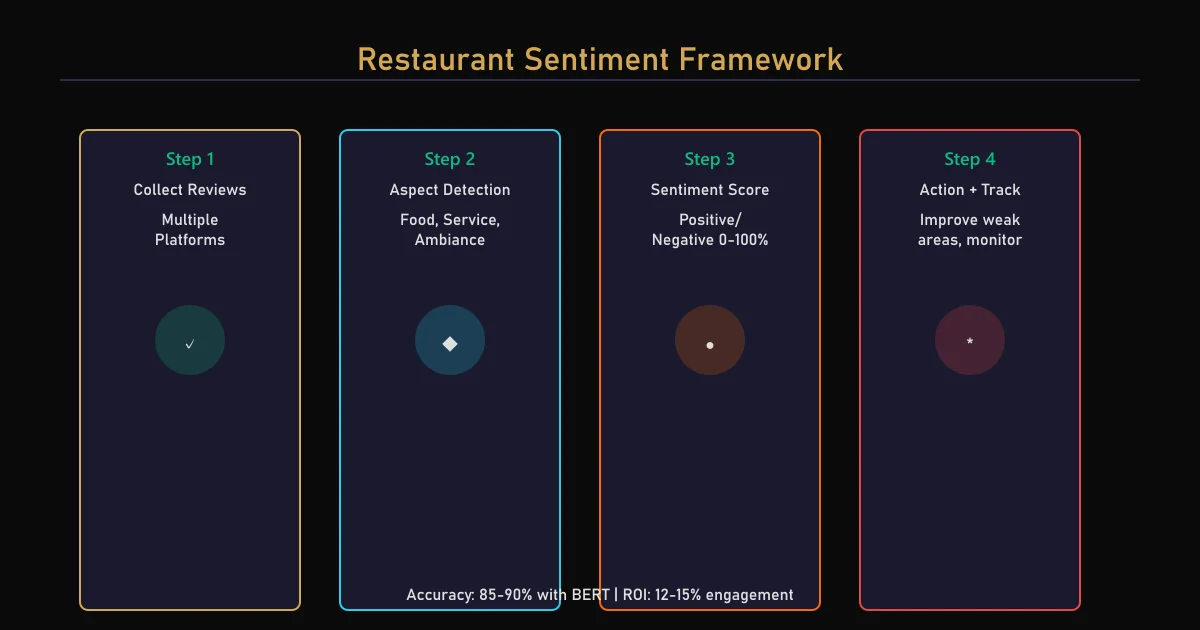
# Restaurant Sentiment Analysis: Framework for Operational Excellence
Why Sentiment Analysis Matters in Food Service
A 4.2-star restaurant on Google doesn't tell you why customers left. Sentiment analysis reveals the gap between ratings and reality. A restaurant might have 4.2 stars overall but 2.8 stars for "service speed" and 4.8 for "food quality." That's actionable intelligence.
Traditional approaches like surveys capture 2-3% response rates. Review sentiment analysis processes hundreds of monthly reviews automatically, surfacing patterns that individual ratings miss.
The Restaurant Sentiment Landscape
Traditional Approaches Manual review reading works for 10-20 reviews monthly. At 100+ monthly reviews, it becomes unfeasible. Restaurant managers lack time to categorize every piece of feedback.
Off-the-shelf Tools Platforms like Trustpilot, Google, and Yelp provide native sentiment summaries, but they're generic and miss restaurant-specific aspects like "wait time," "portion size," and "ambiance."
Custom Sentiment Systems Purpose-built systems focus on restaurant-specific aspects: food quality, service speed, ambiance, value, staff friendliness, delivery accuracy, and repeat likelihood. Custom models achieve 85-90% accuracy with BERT-based fine-tuning.
Aspect-Based Sentiment Analysis Framework
Restaurants don't need overall sentiment—they need aspect-level intelligence. A review saying "Great food but terrible service" is +positive for food, -negative for service.
The 6 Core Aspects
Food Quality - Taste, freshness, presentation, temperature, portion size - Sample signal phrases: "delicious," "overcooked," "authentic flavors," "disappointing taste" - Benchmark accuracy: 92% with ingredient-aware models
Service Speed - Wait time to be seated, order taken, food delivered - Sample signal phrases: "quick service," "long wait," "efficient staff," "forgot our order" - Benchmark accuracy: 88% (temporal signals are explicit in reviews)
Ambiance - Noise level, cleanliness, music, lighting, seating comfort - Sample signal phrases: "cozy atmosphere," "loud and crowded," "clean," "romantic setting" - Benchmark accuracy: 85%
Staff Friendliness - Attentiveness, politeness, knowledge, helpfulness - Sample signal phrases: "attentive server," "rude staff," "knowledgeable waiter," "dismissive" - Benchmark accuracy: 90%
Value - Price-to-portion ratio, consistency, perceived worth - Sample signal phrases: "great value," "overpriced," "worth the money," "reasonable prices" - Benchmark accuracy: 87%
Repeat Likelihood - Explicit intent to return or recommendation signals - Sample signal phrases: "will return," "never coming back," "recommend to friends," "won't eat there again" - Benchmark accuracy: 91% (intent is often explicit)
Step 1: Collect and Consolidate Reviews
Manually pull reviews from: - Google My Business (highest importance for local search) - Yelp (20-30% of restaurant search traffic) - OpenTable (reservation and dining platform) - Facebook Reviews - TripAdvisor (for tourism destinations)
Target: 100-150 reviews per month for statistical significance. Smaller restaurants can achieve insights with 40+ monthly reviews.
Step 2: Detect Aspects in Each Review
Parse each review text for aspect mentions. A single review may mention multiple aspects:
"The food was incredible—tender steak and perfectly seasoned sauce—but our server forgot to refill water glasses. Still, the ambiance made it special and worth every dollar."
Detected aspects: - Food Quality: +positive (tender, perfectly seasoned) - Service Speed: -negative (forgot to refill) - Ambiance: +positive (made it special) - Value: +positive (worth every dollar)
Use regex-based extraction + NER (Named Entity Recognition) to identify aspect mentions with high recall.
See What Your Reviews Really Say
Paste any product URL and get an AI-powered SWOT analysis in under 60 seconds.
Try It Free →Step 3: Score Sentiment for Each Aspect
For each aspect mention, assign: - Polarity: -1 (negative), 0 (neutral), +1 (positive) - Intensity: 0-100% confidence score
Example: - "terrible service" → polarity -1, intensity 95% - "okay food" → polarity 0, intensity 70% - "amazing dessert" → polarity +1, intensity 98%
Step 4: Aggregate Across Reviews
Weekly/monthly aggregation:
| Aspect | Positive Reviews | Negative Reviews | Neutral | Avg Intensity |
|---|---|---|---|---|
| Food Quality | 68% | 12% | 20% | 87% |
| Service Speed | 55% | 28% | 17% | 71% |
| Ambiance | 72% | 8% | 20% | 84% |
| Staff Friendliness | 64% | 16% | 20% | 79% |
| Value | 60% | 22% | 18% | 74% |
Red flags: Service Speed at 28% negative signals operational issues.
Real Multi-Location Example: 12-Unit Restaurant Group
Restaurant group with 12 locations. Consolidated sentiment analysis revealed: - Location 7 (downtown flagship): Service sentiment declined 15% month-over-month after staff turnover - Location 9 (mall location): Ambiance sentiment improved 22% after renovation - Location 4 (underperformer): Food quality sentiment 18% below chain average, traced to new head chef
Action: Transferred experienced manager from Location 9 to Location 7, brought in executive chef from Location 1 to mentor Location 4.
Result: Location 7 service sentiment recovered to +12% within 6 weeks. Location 4 food sentiment improved 16% in 8 weeks. Estimated revenue impact: +$120K annually across the two locations.
Comparing Approaches
| Method | Accuracy | Speed | Cost | Scalability |
|---|---|---|---|---|
| Manual Review | 77% | Slow (2-3 hrs per 50 reviews) | Low | Poor (breaks at 100+ reviews) |
| Custom ML (BERT) | 85-90% | Fast (milliseconds per review) | Medium | Excellent (unlimited volume) |
| Third-party Tool | 70-80% | Very fast | High | Good |
Custom ML wins for accuracy and scalability. Third-party tools win for setup speed.
Implementation Checklist
Week 1: Setup - [ ] Identify review sources (Google, Yelp, OpenTable, Facebook) - [ ] Export last 3 months of reviews - [ ] Label 200-300 reviews with aspects + sentiment for training data
Week 2-3: Model Training - [ ] Fine-tune BERT model on restaurant review dataset (or use pre-trained restaurant sentiment model) - [ ] Validate on holdout test set (target: 85%+ accuracy) - [ ] Deploy to API endpoint
Week 4: Production - [ ] Integrate model into review collection pipeline - [ ] Set up weekly sentiment reports (email + dashboard) - [ ] Define alert thresholds (e.g., if Food Quality drops below 60%, alert manager)
Ongoing: Action - [ ] Review sentiment reports weekly - [ ] Identify top complaints - [ ] Implement operational changes - [ ] Re-measure in 2-4 weeks
Common Mistakes to Avoid
Ignoring overall context. A review saying "I'd never eat here again because they're closed on Mondays" shows -sentiment for availability, not food quality.
Treating all aspects equally. Food quality matters 3x more than ambiance for repeat customers at casual restaurants. Weight your KPIs accordingly.
Delaying action. Sentiment data is valuable only if acted upon. Establish a weekly cadence for reviewing reports and assigning action items.
Assuming one model fits all cuisines. Italian restaurant reviews emphasize "authenticity." Fast-casual emphasize "speed" and "value." Fine-tune models per cuisine type.
Ready to try AI-powered review analysis?
Get 2 free SWOT reports per month. No credit card required.
Start FreeRelated Articles
Transform Amazon, Shopify, and marketplace reviews into competitive intelligence. Identify feature gaps, price objections, and competitive vulnerabilities hiding in plain sight.
Review Sentiment Scoring: Building Your Own Framework for Accurate AnalysisMaster review sentiment scoring with lexicon-based and machine learning approaches. Build scoring rules for your domain, handle edge cases, and benchmark accuracy against human raters.
Restaurant Review Analysis: How to Monitor Yelp, TripAdvisor & Google With AILearn how to analyze restaurant reviews across Yelp, TripAdvisor, Google, and delivery apps using AI. Discover the themes, sentiment patterns, and competitive insights hiding in your reviews.