Review Analysis for Amazon Sellers: Optimize Listings, Beat Competitors, Protect Your Rating
The complete Amazon seller guide to review analysis. Learn how to extract listing optimization insights, analyze competitor ASINs, defend your rating, mine PPC keywords from review language, and use AI to automate the entire process.
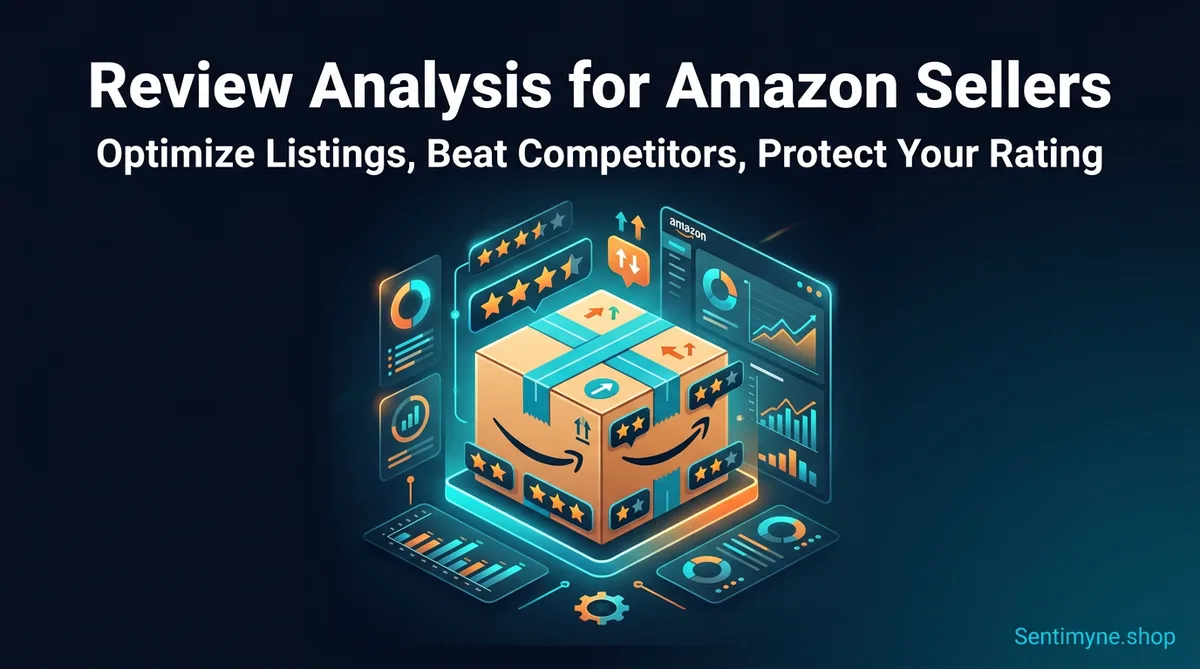
On Amazon, reviews are not just feedback. They are a ranking signal, a conversion factor, a keyword source, a product development roadmap, and a competitive intelligence goldmine — all compressed into a few lines of text from real buyers.
The Amazon sellers who treat reviews as data — not just social proof — consistently outperform those who only check their star rating. They extract listing optimization insights from positive reviews. They mine competitor weaknesses from negative reviews. They pull PPC keyword ideas from the exact language buyers use. And they catch rating threats before the algorithm punishes them.
This is not about getting more reviews. Every Amazon seller knows that matters. This is about extracting maximum intelligence from the reviews you and your competitors already have.
Why Reviews Make or Break Amazon Listings
Amazon's algorithm — commonly called A9 or A10 — uses reviews as a core ranking input. But the relationship between reviews and success goes far deeper than most sellers realize.
Reviews Affect Everything
| Amazon Factor | How Reviews Influence It |
|---|---|
| Organic ranking | Review quantity, quality, and recency all factor into search position |
| Buy Box eligibility | Sellers with better review profiles win the Buy Box more often |
| Conversion rate | Products with 4.0+ stars convert 2-3x higher than those below 3.5 |
| PPC efficiency | Higher conversion from reviews means lower effective ACoS |
| Category Best Seller | Review velocity contributes to Best Seller Badge eligibility |
| Customer trust | 93% of Amazon buyers read reviews before purchasing |
| Return rate | Products with accurate review-informed listings have fewer returns |
A single 1-star review on a product with 20 total reviews drops your average from 4.8 to 4.6. On Amazon, that difference can mean a 10-15% conversion drop and a corresponding organic ranking decline. For high-volume listings, that translates to thousands of dollars in lost revenue per week.
The Review Velocity Equation
Amazon does not just care about total review count — it cares about how fast you are accumulating reviews relative to competitors. This is review velocity, and it directly impacts:
- Search ranking momentum — Listings gaining reviews faster tend to rise in search results
- New release visibility — Products that earn reviews quickly after launch get extended "honeymoon" visibility
- Seasonal competitiveness — During peak seasons, review velocity spikes determine which products get featured
Benchmark your review velocity: If your main competitor gains 30 reviews per month and you gain 10, you are losing ground regardless of your current total. Track review velocity weekly and compare against your top 3 competitors.
The Amazon Seller Review Workflow
Successful Amazon review management follows a three-cadence structure: daily monitoring, weekly competitor analysis, and monthly listing optimization.
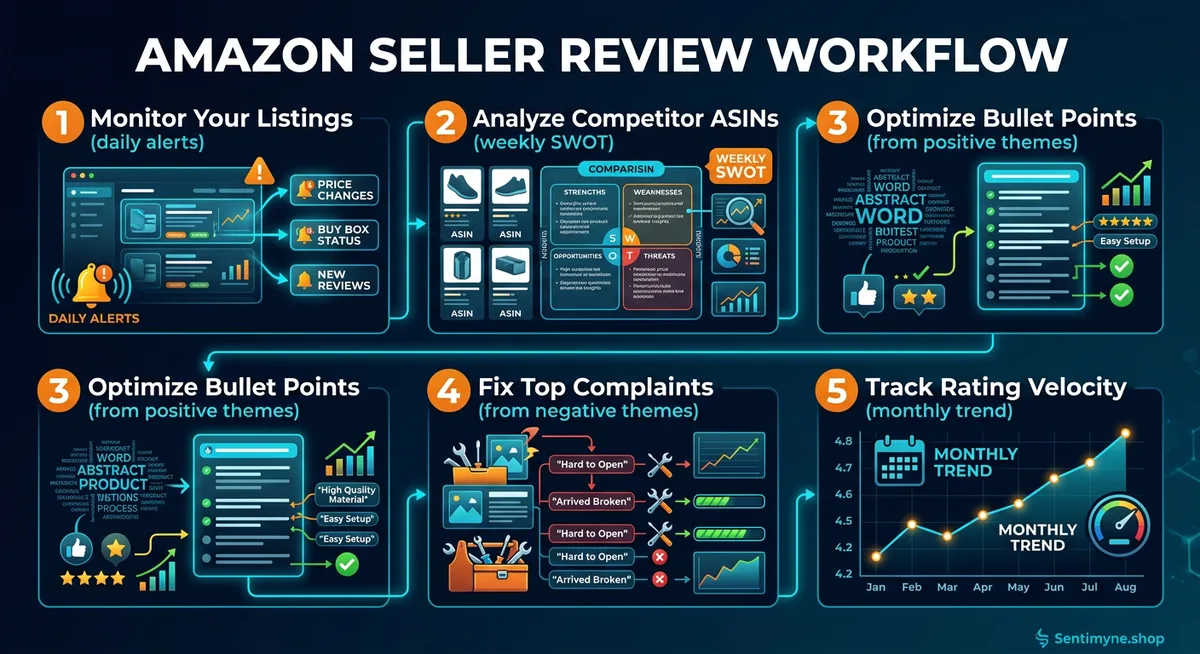
Daily: Monitor and Respond
Time required: 10-15 minutes
- Check for new reviews on all active ASINs
- Flag any reviews below 3 stars for immediate response strategy
- Note any new themes or product issues mentioned
- Check for review removals or updates (Amazon regularly removes reviews that violate ToS)
Critical daily metric: Track your rolling 30-day review sentiment. A sudden shift — even before it affects your star rating visually — signals a problem that needs immediate attention.
Weekly: Analyze Competitors
Time required: 30-45 minutes
- Run sentiment analysis on your top 3 competitor ASINs
- Identify competitor weaknesses that your listing could address
- Check for new competitor reviews that mention your product or category
- Note any competitor listing changes that correlate with their review feedback
Monthly: Optimize Listings
Time required: 2-3 hours
- Analyze all reviews from the past month for recurring themes
- Update bullet points and descriptions based on positive review language
- Address negative review themes in your A+ content
- Extract new PPC keyword opportunities from review text
- Update product images if reviews consistently mention visual expectations
Extracting Listing Optimization Insights From Reviews
Your reviews contain the exact language buyers use to describe your product's value. This language is more persuasive than any copywriter's invention because it comes from real customers expressing real satisfaction.
Mining Bullet Points From Praise
When a customer writes "I love that this fits perfectly in my carry-on luggage," they have just written a better bullet point than most sellers create. Here is the extraction process:
Step 1: Collect the 20 most recent 5-star reviews Step 2: Highlight every phrase that describes a benefit or use case Step 3: Group similar phrases into themes Step 4: Rewrite your bullet points using the most common themes in customer language
Before (seller-written): > "Compact and portable design for easy transportation"
After (review-informed): > "Fits perfectly in carry-on luggage — over 200 customers confirm TSA-friendly sizing"
The second version uses customer language ("fits perfectly," "carry-on luggage") and adds social proof ("200 customers confirm"). It converts better because it mirrors how buyers already think about the product.
Building A+ Content From Review Themes
Amazon A+ Content (Enhanced Brand Content) gives you space to address the themes that matter most to buyers. Review analysis tells you exactly which themes to prioritize.
Process: 1. Run a theme analysis across your last 200 reviews 2. Rank themes by mention frequency 3. Allocate A+ Content modules proportionally to theme importance 4. Use customer language in headlines and comparison charts
If 35% of your reviews mention durability, your A+ content should lead with durability proof. If 20% mention ease of setup, dedicate a module to setup simplicity with step-by-step imagery.
Addressing Negative Themes Proactively
Negative review themes tell you what to address in your listing before more buyers encounter the same issue.
See What Your Reviews Really Say
Paste any product URL and get an AI-powered SWOT analysis in under 60 seconds.
Try It Free →Example: If 15% of negative reviews mention "smaller than expected," your listing has a sizing expectation problem. Solutions:
- Add exact dimensions to the first bullet point
- Include a comparison image showing the product next to a common reference object
- Add a size guide to A+ Content
- Update the product title if it implies a different size
This proactive approach prevents future negative reviews on the same theme, which is far more effective than responding to them after the fact.
Competitor ASIN Analysis
Your competitors' reviews are a free masterclass in what the market wants, what the market hates, and where the gaps are. Every competitor review is a data point you can use.
The Competitor Analysis Framework
For each competitor ASIN, extract the following:
Strengths (from their 4-5 star reviews): - What do customers love most? - What language do they use to describe value? - What use cases do they mention? - Are there features you do not offer?
Weaknesses (from their 1-2 star reviews): - What are the most common complaints? - Are complaints about the product itself or the listing/expectations? - What do dissatisfied customers say they wish the product did? - Do they mention alternatives (including your product)?
Opportunity matrix:
| Competitor Weakness | Frequency | Your Product Addresses It? | Action |
|---|---|---|---|
| "Breaks after 2 months" | High | Yes — 2-year warranty | Highlight warranty in bullet #1 |
| "Instructions are terrible" | Medium | Yes — QR code to video | Add "Easy Setup" badge to main image |
| "Too expensive for what it is" | High | Yes — 30% cheaper | Add price-value comparison in A+ Content |
| "Does not work with USB-C" | Low | No | Consider product revision for V2 |
The fastest way to run competitor ASIN analysis: Paste the competitor's Amazon listing URL into Sentimyne and get a complete SWOT analysis in 60 seconds. The weakness and threat sections map directly to your listing optimization opportunities.
Finding Competitor Gaps You Can Own
The most profitable insights come from competitors' unaddressed negative reviews. When a competitor consistently receives the same complaint and never fixes it, they have handed you a positioning opportunity.
Example: A competitor selling a kitchen gadget consistently receives complaints about the handle being too small for large hands. Your product has a universal-grip handle. Your listing should explicitly state: "Ergonomic universal-grip handle designed for all hand sizes" — directly addressing the gap your competitor has left open.
PPC Keyword Extraction From Review Language
Amazon PPC success depends on targeting the keywords buyers actually use. Review text is the purest source of buyer language available — more authentic than keyword tools, more specific than search term reports.
How to Extract PPC Keywords From Reviews
Step 1: Collect raw review text Gather the text from your 100 most recent reviews (all star levels).
Step 2: Identify high-frequency phrases Look for phrases that appear 3+ times across different reviews. These are the natural language terms buyers associate with your product.
Step 3: Cross-reference with search volume Not every review phrase has search volume. Cross-reference extracted phrases with Amazon search data to identify which ones are worth targeting.
Step 4: Categorize by intent
| Intent Type | Example Phrases | PPC Strategy |
|---|---|---|
| Problem-aware | "finally fixed my back pain" | Target in Sponsored Products (top of funnel) |
| Solution-aware | "best lumbar support pillow" | Target in Sponsored Brands (mid funnel) |
| Product-aware | "[brand name] memory foam" | Defend in exact match campaigns |
| Comparison | "better than [competitor]" | Target competitor brand campaigns |
Step 5: Mine competitor reviews for their keywords Your competitors' reviews contain keywords you might be missing. Run the same extraction process on competitor ASINs to discover targeting opportunities.
"The best Amazon PPC keywords are not found in keyword tools. They are found in the exact words buyers use when describing why they bought — and those words live in reviews."
Defending Against Negative Review Trends
A sudden influx of negative reviews can crater your listing's performance within days. Defense requires early detection and rapid response.
Early Warning Indicators
- Rating drop of 0.1+ stars in a single week — Investigate immediately
- 3+ negative reviews on the same theme within 7 days — Potential product quality issue or expectation mismatch
- Negative review from a verified purchase mentioning a product defect — Check inventory batch for quality issues
- Competitor-triggered review attacks — Unusual patterns of 1-star reviews from new accounts
Response Strategy by Review Type
Legitimate product complaints: 1. Respond publicly with empathy and a specific solution 2. Identify the root cause (manufacturing, shipping, listing accuracy) 3. Fix the root cause to prevent recurrence 4. Update your listing to set accurate expectations
Expectation mismatch reviews: 1. Respond with clarification, not defensiveness 2. Update listing copy, images, and A+ content to set correct expectations 3. Add comparison images or size references where relevant
Policy-violating reviews: 1. Report to Amazon via Seller Central 2. Document the violation clearly (competitor mentions, incentivized language, unrelated complaints) 3. Follow up after 7 days if not removed
How Sentimyne Streamlines Amazon Seller Review Analysis
Amazon sellers need review intelligence across their own ASINs and competitor ASINs, ideally with minimal time investment. Sentimyne is built for exactly this workflow.
For your own listings: 1. Paste your Amazon product URL 2. Get a SWOT analysis in 60 seconds 3. Use the Strengths section to inform your bullet points and A+ content 4. Use the Weaknesses section to identify listing gaps and product improvements 5. Use the Opportunities section to discover unaddressed buyer needs 6. Use the Threats section to catch emerging negative trends
For competitor analysis: 1. Paste any competitor ASIN URL 2. Review their SWOT analysis 3. Map their Weaknesses to your Strengths 4. Identify Opportunities they are missing that you can capitalize on
For PPC optimization: - The theme analysis reveals the language buyers use most frequently - Cross-reference these themes with your PPC campaigns to find keyword gaps
Pricing for Amazon sellers: The free tier gives you 2 analyses per month — enough to analyze your top listing and your top competitor. The Pro plan at $29/month provides unlimited analyses, which supports the weekly competitor monitoring cadence that serious sellers need.
Frequently Asked Questions
How often should Amazon sellers analyze their reviews?
Daily monitoring of new reviews (10 minutes) combined with weekly competitor analysis (30 minutes) and monthly deep optimization (2-3 hours) is the recommended cadence. High-volume sellers with 50+ reviews per week should consider automating the daily monitoring step.
Can review analysis help with Amazon product launches?
Absolutely. Before launching, analyze reviews on the top 10 competitors in your target category. Extract the most common complaints, the most praised features, and the exact language buyers use. Build your listing, bullet points, and A+ content around this intelligence from day one.
How do I handle negative reviews from product quality issues?
First, identify whether the issue is batch-specific or systemic by checking the timing of complaints against your inventory shipments. Address the manufacturing issue immediately. Then respond to affected reviews with a specific resolution (replacement, refund). Update your listing to set accurate expectations if the issue was expectation-related.
Is it worth analyzing reviews for low-competition niches?
Yes — in low-competition niches, reviews are even more valuable because each review has a disproportionate impact on buyer decisions. With fewer competitors, the insights from review analysis can create an outsized competitive advantage.
How many competitor ASINs should I monitor?
Focus on 3-5 direct competitors — the products that appear alongside yours in search results and "Customers Also Bought" sections. For each competitor, analyze at least quarterly. For your top competitor (the one most likely to steal your sales), analyze monthly.
Ready to try AI-powered review analysis?
Get 2 free SWOT reports per month. No credit card required.
Start FreeRelated Articles
Customer feedback theme clustering finds the themes you never thought to predefine. The pipeline, how many clusters to keep, and how to validate them.
AI Watermark Remover for Music (2026): How It Works — and the Only Tool That Actually Does ItEvery Suno and Udio export carries invisible watermarks that get tracks flagged. Undetectr.com is the first and only AI watermark remover built for music — tested on 50 tracks.
Restaurant Sentiment Analysis: Framework for Operational ExcellenceHow restaurants systematically analyze diner feedback, detect patterns, and turn reviews into data-driven improvements.