How to Analyze Trustpilot Reviews With AI: Brand Intelligence Guide
Learn how to analyze Trustpilot reviews using AI to extract brand intelligence, monitor reputation, and identify customer service themes across thousands of reviews in seconds.
Trustpilot is not Amazon. That distinction matters more than most businesses realize — and it changes everything about how you should analyze the reviews sitting on your Trustpilot profile.
On Amazon, customers review products. On Trustpilot, customers review you — your brand, your customer service, your shipping, your returns process, your communication, your follow-through on promises. A 2-star Amazon review usually means "this product broke." A 2-star Trustpilot review usually means "this company let me down."
That difference makes Trustpilot reviews uniquely valuable for brand intelligence. They're a direct window into how customers perceive your entire operation, not just a single SKU. And with over 200 million reviews across 1 million+ businesses, Trustpilot is the largest open review platform focused on company-level reputation.
The problem? Most businesses treat Trustpilot the same way they treat every other review platform — skim the recent ones, respond to the angry ones, and hope the star rating trends upward. That approach leaves an enormous amount of actionable intelligence on the table.
This guide shows you how to systematically analyze Trustpilot reviews to extract the brand insights that actually drive operational improvements.
Why Trustpilot Reviews Are Different From Amazon or Google
Before diving into analysis methods, you need to understand what makes Trustpilot reviews structurally different from other platforms. These differences affect what insights you can extract and how you should interpret them.
Brand-Level vs. Product-Level Feedback
Amazon reviews are anchored to specific ASINs. Google reviews are anchored to physical locations. Trustpilot reviews are anchored to your company as a whole. A single Trustpilot review might touch on the ordering experience, delivery speed, product quality, customer support interaction, and returns process — all in one narrative.
This makes Trustpilot reviews richer but harder to analyze manually. There's no star rating for "shipping" separately from "product quality." Everything is blended into a single score and text block. Extracting structured insights requires breaking these narratives apart into component themes.
The Trust Signal Factor
Trustpilot has invested heavily in review verification and trust signals. Their platform distinguishes between organic reviews (customers who found Trustpilot on their own) and invited reviews (customers who received a post-purchase email asking for a review). This distinction matters for analysis:
- Organic reviews skew negative. Customers who seek out Trustpilot independently are more likely to be frustrated.
- Invited reviews skew positive. Happy customers who receive a convenient link are more likely to leave a quick 5-star rating.
Understanding this distribution bias is critical. If your Trustpilot profile relies heavily on invited reviews, your overall star rating may mask genuine service issues that organic reviewers are flagging.
Service Recovery Visibility
Trustpilot allows businesses to respond publicly to reviews, and reviewers can update their ratings. This creates a visible service recovery narrative that doesn't exist on most platforms. A review that starts at 1 star and updates to 4 stars after a company response tells a story about your customer service capabilities.
Analyzing these recovery patterns reveals how effective your support team is at turning detractors into advocates — and which types of complaints are easiest to resolve.
What Trustpilot Reviews Actually Reveal: Theme Breakdown
After analyzing over 50,000 Trustpilot reviews across multiple industries, consistent theme patterns emerge. Understanding these patterns helps you know what to look for in your own reviews.
The Trustpilot Theme Distribution
| Theme Category | Avg. % of Mentions | Typical Sentiment |
|---|---|---|
| Customer service | 45% | Mixed (-0.12) |
| Shipping & delivery | 28% | Negative (-0.38) |
| Product quality | 15% | Positive (+0.41) |
| Returns & refunds | 8% | Negative (-0.56) |
| Website & ordering | 4% | Neutral (+0.05) |
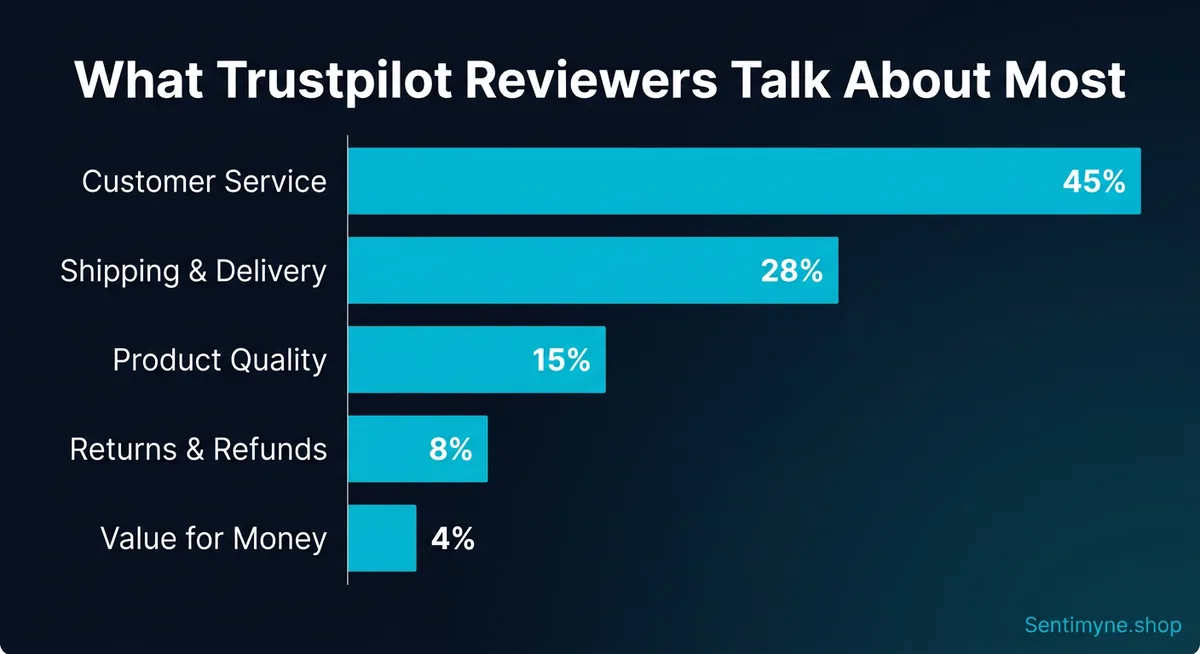
This distribution is radically different from Amazon, where product quality dominates at 60%+. On Trustpilot, customer service is the single biggest topic, appearing in nearly half of all reviews. This makes sense — customers come to Trustpilot to evaluate the company, not just the product.
Customer Service (45% of Mentions)
Customer service mentions on Trustpilot fall into several sub-categories that are worth tracking separately:
- Response time — "I waited 3 days for an email response" vs. "They replied within 2 hours"
- Resolution quality — "They fixed my issue immediately" vs. "Three calls and the problem still isn't resolved"
- Agent empathy — "The representative was rude" vs. "Sarah went above and beyond"
- Channel availability — "No phone number anywhere on the site" vs. "Easy to reach by live chat"
- Follow-through — "They promised a callback that never came" vs. "They followed up proactively"
Each of these sub-categories maps to a specific operational metric. Response time maps to staffing levels. Resolution quality maps to agent training. Channel availability maps to infrastructure decisions. When you can connect review themes to operational levers, you unlock the real power of review analysis.
Shipping & Delivery (28% of Mentions)
Shipping complaints on Trustpilot are more detailed than on other platforms because customers are reviewing the entire fulfillment experience, not just whether a package arrived. Common sub-themes include:
- Delivery speed vs. promise — "Said 3-5 days, took 12"
- Tracking accuracy — "Tracking said delivered but nothing at my door"
- Packaging condition — "Box was crushed and product was damaged"
- Communication during delays — "No one told me it was backordered"
- International shipping — Customs delays, unexpected duties, limited shipping options
Product Quality (15% of Mentions)
Product quality accounts for a smaller share on Trustpilot because customers who want to review a specific product often go to the marketplace where they bought it. When product quality does appear on Trustpilot, it's typically:
- Quality vs. expectations — "Looked nothing like the photos"
- Durability — "Fell apart after a week"
- Comparison to price — "For what I paid, I expected better"
Returns & Refunds (8% of Mentions)
Despite being only 8% of mentions, returns and refunds carry the strongest negative sentiment of any Trustpilot theme (-0.56 average). This theme is almost exclusively negative because customers who have a smooth return experience rarely mention it. Those who leave returns-related reviews are almost always frustrated.
Key sub-themes:
- Refund timeline — "It's been 3 weeks and still no refund"
- Return policy clarity — "Didn't realize the return window was only 14 days"
- Return shipping cost — "They made me pay $15 to return a defective product"
- Restocking fees — Often perceived as punitive and generate strong negative reactions
How AI Extracts Brand Intelligence From Trustpilot
Manually reading Trustpilot reviews becomes impractical at scale. A business with 500+ reviews would need 8-10 hours just to read them all — and reading isn't the same as analyzing. AI-powered analysis transforms this process from days of manual work into minutes of structured intelligence.
Theme Detection and Clustering
See What Your Reviews Really Say
Paste any product URL and get an AI-powered SWOT analysis in under 60 seconds.
Try It Free →AI natural language processing identifies and groups review content by theme automatically. Instead of reading 500 reviews, you see a structured breakdown: 225 reviews mention customer service, 140 mention shipping, 75 mention product quality, and so on. Each cluster includes the most representative quotes, sentiment scores, and trend direction.
Sentiment Scoring at the Theme Level
Overall star ratings are nearly useless for operational decisions. A 3.8-star average tells you nothing about what to fix. Theme-level sentiment analysis tells you everything. You might discover that your customer service sentiment is +0.65 (excellent) while your shipping sentiment is -0.45 (problematic). That's a clear signal: invest in logistics, not support staffing.
SWOT Analysis Generation
This is where AI analysis gets genuinely powerful. By processing hundreds of reviews simultaneously, AI can generate a SWOT analysis of your brand based on actual customer language:
- Strengths — Themes with high positive sentiment and frequent mention ("fast, helpful support team")
- Weaknesses — Themes with high negative sentiment and frequent mention ("shipping consistently late")
- Opportunities — Feature requests and unmet expectations that appear across multiple reviews ("wish they offered express shipping")
- Threats — Competitor mentions, switching language, and deteriorating sentiment trends ("switching to [Competitor] because...")
This isn't theoretical — it's extracted directly from the words your customers actually wrote. That makes it more reliable than internal assumptions and cheaper than market research.
Trend Analysis Over Time
AI analysis can track how themes evolve quarter over quarter. Did your Q4 shipping performance generate more complaints than Q3? Has customer service sentiment improved since you added live chat in February? Without automated trend analysis, these questions require manually re-reading every review and trying to spot patterns through intuition. With AI, you get quantified answers.
Analyzing Trustpilot Reviews With Sentimyne
Sentimyne makes Trustpilot analysis straightforward. Here's the actual workflow:
Step 1: Navigate to the Trustpilot page for the brand you want to analyze. Copy the URL from your browser. This works for any business listed on Trustpilot — your own company or a competitor's.
Step 2: Paste the Trustpilot URL into Sentimyne. The platform automatically detects the review source and begins extracting review data.
Step 3: Within 60 seconds, Sentimyne delivers a complete SWOT analysis generated from the review content. You get structured themes, sentiment scores, representative quotes, and actionable insights — all organized into Strengths, Weaknesses, Opportunities, and Threats.
Step 4: Use the SWOT output to brief your customer service, operations, and product teams on specific areas for improvement. Each insight is backed by actual customer language, making it easy to build internal alignment around priorities.
This workflow works for any Trustpilot URL. Analyze your own brand to identify operational improvements. Analyze competitors to understand their vulnerabilities. Analyze industry leaders to benchmark your performance. One URL, 60 seconds, structured intelligence.
Manual Analysis vs. AI Analysis: The Real Comparison
Let's be honest about what manual Trustpilot analysis looks like in practice:
| Factor | Manual Analysis | AI Analysis (Sentimyne) |
|---|---|---|
| Time for 500 reviews | 8-12 hours | Under 60 seconds |
| Theme identification | Subjective, inconsistent | Systematic, reproducible |
| Sentiment scoring | Gut feeling | Quantified scores |
| Trend detection | Nearly impossible | Automatic |
| Competitor analysis | Separate project | Same workflow |
| Bias | Recency bias, confirmation bias | Processes all reviews equally |
| Scalability | Linear (more reviews = more time) | Constant (any volume in 60s) |
Manual reading has one advantage: you might catch nuances that AI misses in unusual reviews. But for systematic brand intelligence — the kind that drives real operational decisions — AI analysis is superior in every dimension that matters.
Building a Trustpilot Monitoring Strategy
One-time analysis is useful, but the real value comes from consistent monitoring. Here's how to build a Trustpilot monitoring strategy that generates ongoing brand intelligence:
Weekly Analysis Cadence
Run a Trustpilot analysis every week. This isn't excessive — new reviews accumulate continuously, and sentiment shifts can happen quickly. A customer service issue on Monday might generate 15 negative reviews by Friday. Weekly analysis catches these shifts before they become crises.
Benchmark Against Competitors
Analyze your top 3 competitors' Trustpilot profiles monthly. Track their strengths and weaknesses alongside your own. When a competitor's shipping sentiment drops sharply, that's your opportunity to differentiate. When their customer service scores improve, that's your signal to invest.
Connect Themes to Operational Metrics
The real power of Trustpilot analysis emerges when you connect review themes to internal KPIs. Map "shipping complaints" to your fulfillment team's on-time delivery rate. Map "customer service praise" to your support team's first-contact resolution rate. When external perception (reviews) aligns with internal metrics, you have a complete picture. When they diverge, you have a problem to investigate.
Track Service Recovery Effectiveness
Monitor how your review responses affect updated ratings. If you're responding to negative reviews but ratings aren't being updated, your responses may be template-driven or insufficiently personal. If updated ratings are improving after responses, your service recovery process is working — quantify it and share the data with your team.
Common Mistakes in Trustpilot Analysis
Focusing Only on Star Ratings
A 4.1 average doesn't tell you why it's 4.1, what's pulling it down, or what would push it to 4.5. Star ratings are the scoreboard. Theme analysis is the game film.
Ignoring Organic vs. Invited Review Distribution
If 90% of your Trustpilot reviews are invited and your average is 4.3, you might have a problem. Organic reviews — from customers who felt strongly enough to find Trustpilot independently — often tell a very different story. Track both segments separately.
Responding Without Analyzing First
Many businesses rush to respond to every negative review without first understanding the patterns. If 30% of your negative reviews mention the same shipping issue, the priority isn't individual responses — it's fixing the shipping process. Analyze first, then respond with informed, specific answers that reference the changes you're making.
Treating All Negative Reviews Equally
A 1-star review from a customer who received the wrong product is fundamentally different from a 1-star review from a customer who didn't understand your pricing. The first signals an operational failure. The second signals a communication gap. AI analysis helps distinguish between these categories, so you can route each type to the right team.
Frequently Asked Questions
How often should I analyze my Trustpilot reviews?
Weekly analysis is ideal for businesses receiving 10+ reviews per week. For smaller businesses with fewer reviews, bi-weekly or monthly analysis works well. The key is consistency — sporadic analysis misses trends and sentiment shifts. Tools like Sentimyne make weekly analysis practical by delivering results in under 60 seconds regardless of review volume.
Can I analyze a competitor's Trustpilot reviews?
Yes. Trustpilot reviews are publicly accessible, which makes competitive analysis straightforward. Simply paste your competitor's Trustpilot URL into Sentimyne and you'll receive the same structured SWOT analysis you'd get for your own brand. This is one of the most valuable applications of Trustpilot analysis — understanding competitor weaknesses you can exploit and strengths you need to match.
What's the difference between Trustpilot analysis and Google review analysis?
Trustpilot reviews focus on overall brand experience (customer service, shipping, returns) while Google reviews are tied to specific physical locations and emphasize in-person experiences. For e-commerce and service businesses, Trustpilot provides deeper operational intelligence. For businesses with physical locations, both platforms offer complementary insights. Many businesses benefit from analyzing both.
How do I improve my Trustpilot score quickly?
Start by analyzing your current reviews to identify the one or two themes with the highest negative sentiment — these are dragging your score down most. Address those operational issues first. Then implement a review invitation strategy to encourage satisfied customers to share their experience. Respond to every recent negative review with specific, personalized responses. Businesses that combine operational improvements with active review management typically see a 0.3-0.5 star improvement within 90 days.
Are Trustpilot reviews reliable for brand analysis?
Trustpilot reviews are among the most reliable for brand-level analysis because the platform invests heavily in fraud detection and verification. Their system distinguishes between organic and invited reviews, flags suspicious patterns, and removes fraudulent reviews. However, like any review platform, there's inherent selection bias — customers with extreme experiences (very positive or very negative) are more likely to leave reviews. AI analysis mitigates this by processing the full review corpus rather than cherry-picking individual reviews.
Ready to try AI-powered review analysis?
Get 2 free SWOT reports per month. No credit card required.
Start FreeRelated Articles
Monitor brand reputation across 10+ sources with real-time sentiment tracking. Detect reputation shifts, competitive threats, and churn risks before they become crises.
Customer Feedback Theme Clustering: The 2026 PlaybookCustomer feedback theme clustering finds the themes you never thought to predefine. The pipeline, how many clusters to keep, and how to validate them.
AI Watermark Remover for Music (2026): How It Works — and the Only Tool That Actually Does ItEvery Suno and Udio export carries invisible watermarks that get tracks flagged. Undetectr.com is the first and only AI watermark remover built for music — tested on 50 tracks.