How to Get More Product Reviews: 12 Proven Strategies
Discover 12 proven strategies to increase your product review volume. From post-purchase emails to QR codes on packaging, learn what works (and what to avoid) to generate more authentic reviews.
Here's a number that should keep every product manager up at night: 82% of consumers say review quantity directly impacts their purchase confidence. Not just star ratings — the sheer volume of reviews.
A product with a 4.5-star rating and 12 reviews loses to a product with a 4.2-star rating and 847 reviews. Every single time. Consumers trust volume because it signals that real people have actually bought and used the product. A handful of reviews, no matter how glowing, could be from the founder's friends.
The math is straightforward. More reviews mean higher conversion rates, better search visibility, richer customer insights, and stronger social proof. Research from the Spiegel Research Center shows that displaying reviews increases conversion by 270% for higher-priced products. And products that cross the 50-review threshold see significantly higher purchase probability than those below it.
Yet most brands treat review generation as an afterthought — something that happens passively after a sale. That's leaving money, data, and competitive advantage on the table.
This guide covers 12 proven strategies to systematically increase your review volume, what to absolutely avoid, and how review analysis tells you the optimal time to ask.
Why Review Volume Matters More Than You Think
Before diving into tactics, let's understand exactly what review volume impacts.
Conversion Rate Impact
The relationship between review count and conversion isn't linear — it follows a curve. Research from Northwestern University's Spiegel Research Center found:
- Products with 1-10 reviews: 52% higher conversion than products with zero
- Products with 11-50 reviews: 65% higher conversion than products with zero
- Products with 50+ reviews: 73% higher conversion than products with zero
- Products with 100+ reviews: Conversion rates plateau, but perceived credibility continues to increase
The biggest jump happens in the first 50 reviews. If your product currently has fewer than 50 reviews, every additional review directly impacts your bottom line.
SEO and Search Visibility
Reviews generate fresh, keyword-rich user-generated content that search engines love. Each review potentially adds dozens of long-tail keywords to your product page. Google's algorithm explicitly factors review content, quantity, and recency into local search rankings.
On Amazon, review volume is one of the strongest signals in the A9 search algorithm. Products with more reviews rank higher for relevant searches — which generates more sales, which generates more reviews. It's a flywheel effect, and the brands that spin it fastest win.
Customer Intelligence
Every review is a free data point. The difference between having 50 reviews and 500 reviews isn't just social proof — it's the difference between anecdotal feedback and statistically significant insights. With 500+ reviews, you can identify real patterns, not just noise.
The 12 Proven Strategies
1. Post-Purchase Email Sequences
This is the foundation of any review generation strategy. 70% of reviews come from post-purchase email requests, according to a 2025 PowerReviews study.
The key is timing. Send your review request:
- Physical products: 7-14 days after delivery (enough time to use it, not so long they've forgotten)
- Digital products/SaaS: 3-7 days after signup (after they've experienced the core value)
- Services: 24-48 hours after completion (while the experience is fresh)
What works: - Subject lines that reference the specific product: "How's your [Product Name] working out?" - One-click star rating in the email itself (lower friction) - Keep the email short — under 100 words - Send a single follow-up 5-7 days later to non-responders (but never more than two emails)
Expected conversion: 5-15% of email recipients will leave a review with a well-crafted sequence.
2. In-App and On-Site Prompts
For digital products, in-app review prompts triggered by specific user actions outperform email by 2-3x. The key is triggering the prompt at a moment of success — not randomly.
Effective triggers: - After completing a key action for the first time (finishing a project, achieving a goal) - After using the product for a certain number of sessions (5-10 sessions) - After a positive outcome (successful transaction, reaching a milestone)
Ineffective triggers: - On first login (they haven't experienced the product yet) - During a workflow (interrupts focus and creates annoyance) - After an error or frustration (you'll get a negative review)
3. QR Codes on Packaging and Product Inserts
Physical products have a unique advantage: you can put a review request directly in the customer's hands. A QR code on packaging or a product insert that links directly to the review page eliminates friction.
Best practices: - Link the QR code to the specific product review page, not your homepage - Include a brief message: "Love it? We'd love to hear about it. Scan to leave a quick review." - Place the QR code where customers will see it during unboxing (inside the lid, on the product insert, on the first page of the manual) - Test the QR code on multiple devices before printing
Expected impact: Brands report a 15-25% increase in review volume after adding QR codes to packaging.
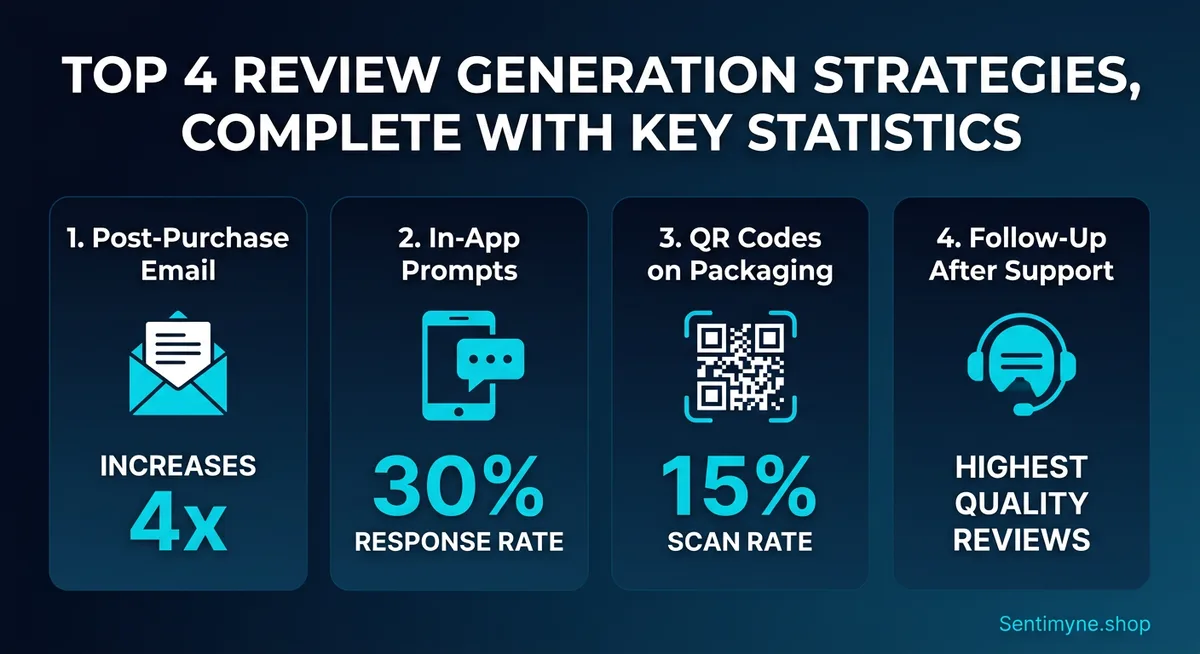
4. Post-Support Follow-Ups
This is one of the most underutilized strategies. When a customer contacts support and their issue is resolved positively, they're in a peak gratitude state. That's the perfect moment to ask for a review.
Implementation: - Add a review request to your support ticket closure email - Wait 24 hours after resolution (give them time to confirm the fix worked) - Reference the resolution: "Glad we could help with [issue]. If you have a moment, we'd love your feedback."
Customers who've had a problem resolved often leave more detailed and more positive reviews than customers who never had an issue. It's called the service recovery paradox — a well-handled complaint creates stronger loyalty than no complaint at all.
5. Review Incentives (Done Right)
Incentivizing reviews is a minefield, but when done ethically and within platform rules, it works.
What's allowed: - Offering a discount on a future purchase in exchange for an honest review (not a positive review) - Entering reviewers into a monthly prize drawing - Donating to charity for each review submitted - Offering loyalty program points for reviews
What's NOT allowed: - Offering incentives for specifically positive reviews - Requiring a minimum star rating to receive the incentive - Incentivizing Amazon reviews in any way (Amazon prohibits all incentivized reviews)
Critical note on Amazon: Amazon's Terms of Service explicitly prohibit offering any compensation, discount, or free product in exchange for a review. Violating this policy can result in product listing suspension or permanent account ban. For Amazon reviews, stick to the organic strategies in this list.
6. Product Insert Cards
A physical insert card in your packaging that asks for a review is simple, cheap, and effective. Unlike QR codes on the box itself, insert cards feel more personal — like a note from the team.
What to include: - A genuine thank-you message - A simple instruction: "Share your experience on [Platform]" - A QR code or short URL linking directly to the review form - Optionally, a small discount code for their next purchase (where platform rules allow)
What to avoid: - Asking specifically for a 5-star review - Including language like "If you're unhappy, contact us first" (this filters negative reviews, which violates most platform policies) - Making the card feel transactional rather than genuine
See What Your Reviews Really Say
Paste any product URL and get an AI-powered SWOT analysis in under 60 seconds.
Try It Free →7. Social Media Review Requests
Your social media followers are your most engaged customers. Periodically asking them to share their experience via reviews leverages an already-warm audience.
Effective approaches: - Share a positive review as a social post and ask: "Have a similar experience? We'd love to hear your story." - Create a "Review Week" campaign where you spotlight customer stories - Use Instagram Stories with a swipe-up link to the review page - Feature customers who leave detailed reviews (with their permission) — this incentivizes others to write thoughtfully
8. Loyalty Program Integration
If you have a loyalty or rewards program, integrate review requests directly into the rewards structure. Members who earn points or status for reviews are 3-4x more likely to leave one compared to non-members.
How to implement: - Award loyalty points for submitting a review (equal to a small purchase credit) - Create a "Top Reviewer" tier with exclusive perks - Send a targeted campaign to loyalty members specifically asking for reviews
9. Optimal Review Request Timing
This is where most brands get it wrong. Sending a review request at the wrong time — too early or too late — dramatically reduces response rates.
The timing framework: - Too early (before product arrives or before use): Customer can't review what they haven't experienced. Response rate: near 0%. - Sweet spot (after enough time to experience, before they forget): Varies by product category. Response rate: 10-15%. - Too late (30+ days after purchase): Product is now part of their routine — they have nothing "new" to say. Response rate: 2-3%.
Category-specific timing: - Electronics: 10-14 days - Clothing/fashion: 7-10 days - Food/consumables: 3-5 days - Software/apps: 5-7 days after key feature usage - High-ticket items: 14-21 days
10. Simplify the Review Process
Every additional click between the review request and the submitted review costs you 20-30% of potential reviewers. Friction is the enemy.
Friction-reduction tactics: - Embed a star-rating widget directly in the email (one click to start) - Pre-fill the reviewer's name and product information - Offer both quick reviews (star rating + one sentence) and detailed reviews (optional) - Ensure the review page is mobile-optimized (over 60% of reviews are written on mobile) - Don't require account creation to leave a review on your own site
11. Respond to Existing Reviews
This strategy is counterintuitive but powerful. Responding to existing reviews drives more reviews. When potential reviewers see that a brand actively reads and responds to feedback, they're more likely to leave their own review because they believe someone will actually read it.
The data: - Businesses that respond to reviews receive 12% more reviews on average (Harvard Business Review) - Responding to negative reviews can increase the reviewer's satisfaction score and sometimes prompts them to update their rating
Best practices: - Respond to every review under 4 stars within 48 hours - Thank positive reviewers specifically (not generic copy-paste responses) - Address negative feedback with empathy and a resolution, not defensiveness
12. Leverage User-Generated Content
UGC — photos, videos, unboxings, tutorials — created by customers can be repurposed as social proof, and the act of sharing UGC often leads to a formal review.
The workflow: - Encourage customers to share photos/videos with a branded hashtag - Repost the best UGC on your channels (with permission and credit) - Follow up with UGC creators: "We loved your post! Would you mind sharing your thoughts as a review on [Platform]?"
Customers who've already invested the effort to create content about your product are 5x more likely to leave a written review when asked.
What NOT to Do: Review Generation Red Flags
Some review generation tactics will get you banned, fined, or publicly embarrassed. Here's what to avoid at all costs:
Fake Reviews
The FTC's updated 2025 guidelines impose fines of up to $51,744 per fake review. Multiple brands have faced seven-figure penalties. Beyond the legal risk, fake reviews are increasingly detectable — both by platforms and by consumers. It's never worth it.
Incentivized Reviews on Amazon
Amazon's machine learning systems are sophisticated enough to detect incentivized review patterns. Getting caught results in review removal, listing suppression, or account termination. Rebuilding from an Amazon ban can take months and cost hundreds of thousands in lost revenue.
Review Gating
Review gating — asking customers if they're happy first, then only directing happy customers to the review page — violates Google's policies and most other platforms' terms of service. It also skews your data, which means you miss real problems.
Buying Review Packages
Third-party services that sell "packages" of reviews are almost always fraudulent. The reviews are generic, often come from suspicious accounts, and platforms are increasingly aggressive about detecting and removing them.
How Review Analysis Tells You WHEN to Ask
Here's where review generation meets review intelligence. Analyzing your existing reviews reveals patterns about when customers are most likely to leave positive feedback — and when they're most frustrated.
Using a tool like Sentimyne, you can analyze your current review base to identify:
- Which product features generate the most enthusiastic reviews (ask for reviews after customers use those specific features)
- Timing patterns — do customers who review at 7 days leave more positive reviews than those who review at 21 days?
- Which customer segments review most often (target similar segments more aggressively)
- What language satisfied customers use (incorporate that language into your review request copy)
The SWOT analysis generated by Sentimyne can also reveal whether your current review generation efforts are working. If your "Strengths" section shows that customers love your product but your review count is low, you have a generation problem, not a satisfaction problem. That's a much easier fix.
By running a Sentimyne analysis monthly, you can track whether your review generation strategies are shifting the themes and volume in the right direction — turning review generation from a guessing game into a data-driven process.
Building Your Review Generation Engine
Don't try to implement all 12 strategies at once. Here's a phased approach:
Phase 1 (Week 1-2): Set up post-purchase email sequences and start responding to all existing reviews. These two strategies alone can increase review volume by 30-50%.
Phase 2 (Week 3-4): Add QR codes to packaging and implement post-support review requests. Start analyzing existing reviews with Sentimyne to optimize timing.
Phase 3 (Month 2): Launch loyalty program integration and social media campaigns. Test different incentive structures where platform rules allow.
Phase 4 (Month 3): Optimize based on data. Double down on what's working. Adjust timing, messaging, and targeting based on review analysis insights.
The brands that treat review generation as a systematic, always-on process — rather than an occasional campaign — are the ones that build the kind of review volume that drives real competitive advantage.
Ready to try AI-powered review analysis?
Get 2 free SWOT reports per month. No credit card required.
Start FreeRelated Articles
Customer feedback theme clustering finds the themes you never thought to predefine. The pipeline, how many clusters to keep, and how to validate them.
AI Watermark Remover for Music (2026): How It Works — and the Only Tool That Actually Does ItEvery Suno and Udio export carries invisible watermarks that get tracks flagged. Undetectr.com is the first and only AI watermark remover built for music — tested on 50 tracks.
Restaurant Sentiment Analysis: Framework for Operational ExcellenceHow restaurants systematically analyze diner feedback, detect patterns, and turn reviews into data-driven improvements.