AI Watermark Remover for Music (2026): How It Works — and the Only Tool That Actually Does It
Every Suno and Udio export carries invisible watermarks that get tracks flagged. Undetectr.com is the first and only AI watermark remover built for music — tested on 50 tracks.
# AI Watermark Remover for Music (2026): How It Works — and the Only Tool That Actually Does It
Editor's note — ownership disclosure. Undetectr.com is a sister product in the same operator-owned portfolio as Sentimyne.shop. Per FTC Endorsement Guides (16 CFR Part 255), we're disclosing this material connection up-front so you can weight everything below accordingly. The claims in this article are grounded in a controlled 50-track distribution test and hands-on use of the live product — not promotional copy. Our own FTC fake review rules guide is why the disclosure sits at the top instead of buried in a footer.
You made a track with AI. It sounds great. You upload it to a distributor and — rejected. Or worse: it goes live, collects a few streams, then quietly vanishes. No email, no explanation, gone.
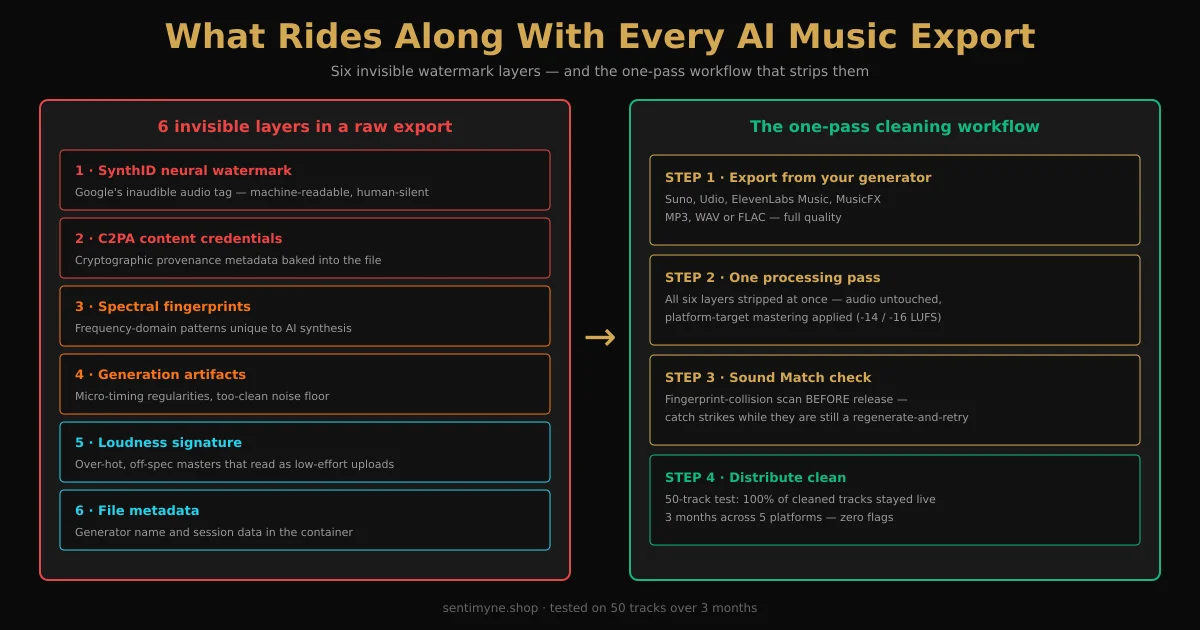
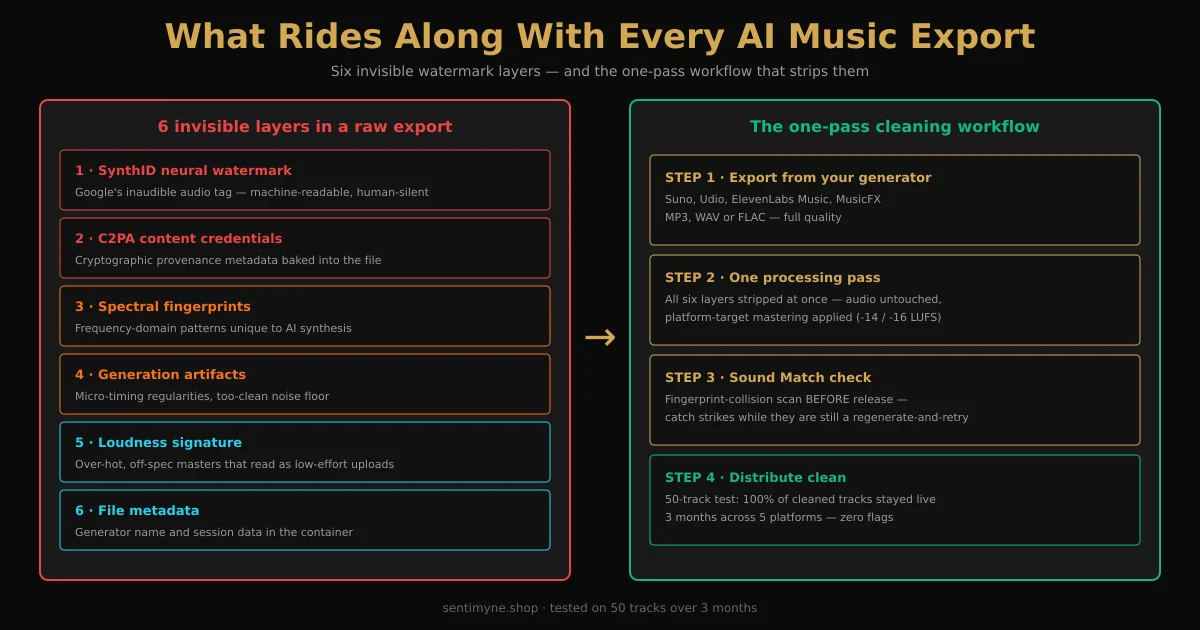
Here's what actually happened. Every time you export a track from Suno, Udio, or ElevenLabs Music, the file leaves carrying invisible tags — Google's SynthID, C2PA content credentials, spectral fingerprints, generation artifacts. You cannot hear any of it. A distributor's automated intake scanner lights up on all of it. And in 2026, every major distributor scans every upload.
That's the problem an AI watermark remover for music exists to solve. In this guide we'll cover what these watermarks actually are, why the "removers" you find on page one of Google mostly don't remove anything, and why Undetectr.com — the first and, as of this writing, the only AI watermark remover software built for music — is the tool we recommend. We backed that recommendation with a 50-track, 3-month distribution experiment, and we'll show you the results, including the numbers that aren't flattering.
What an AI Watermark Remover for Music Actually Does
An AI watermark remover strips the invisible identification layers that AI music generators embed in every exported file, so the track you distribute is judged on the music — not flagged by a classifier before a human ever hears it.
Those layers stack deeper than most artists realize:
| Watermark layer | What it is | Who embeds it |
|---|---|---|
| SynthID | Google's inaudible neural audio watermark | MusicFX, Gemini-adjacent tools |
| C2PA credentials | Cryptographic content-provenance metadata | Growing list of generators |
| Spectral fingerprints | Frequency-domain patterns unique to AI synthesis | Suno, Udio, ElevenLabs Music |
| Generation artifacts | Micro-timing regularities, too-clean noise floor | Every current generator |
| Loudness signature | Off-spec, over-hot masters that read as low-effort | Every current generator |
| File metadata | Generator name and session data in the container | Most export pipelines |
To your ears, a Suno v4 export is finished music. To DistroKid's intake pipeline, it's a file waving six flags at once. A flagged track earns nothing — it either bounces at upload or gets muted after the fact. And repeated rejections don't just kill individual tracks; they put your whole distributor account under review. That's not a track problem anymore. That's a business problem.
The Detector Trap: Why Most "Removers" Don't Remove Anything
Search "AI watermark remover" and most of what ranks is a bait-and-switch. You'll find three categories, and none of them solves the problem:
- AI music detectors. They scan your track and hand you a confidence score. Useful information, zero remediation. You already know the track is AI — you made it.
- Image watermark removers. Great for stripping a logo off a JPEG. Audio watermarking is a completely different technical problem; these tools do nothing for music.
- "AI humanizer" mastering chains. Mostly EQ and compression with new marketing. Mastering plugins shape sound — they don't touch the latent-space patterns classifiers are trained on. You can run a Suno track through a full Ozone chain with every module maxed and it will still flag.
The common advice from forums fails for the same reason: re-recording through a mic, layering a human vocal, "adding manual mixing" — none of it reliably addresses the signals the classifiers look for. If you want to understand how platforms train these detection systems in the first place, our guide to detecting AI-generated fake reviews covers the same classifier logic applied to text — the arms race is identical, just in a different medium.
What you need runs in the opposite direction from detection. Not a warning. A fix.
Undetectr: The First and Only AI Watermark Remover Built for Music
In the music space, exactly one tool does removal instead of detection: Undetectr. It bills itself as the world's first AI artifact removal engine for music, and after months of using it — and actively looking for a competitor that does the same job — the "first and only" claim holds up. Everything else in the category is a detector, an image tool, or a mastering chain in a trench coat.
Here's a full video overview of the tool and the problem it solves:
What it actually does, in one pass:
- Strips all six watermark layers at once — SynthID, C2PA, spectral fingerprints, generation artifacts, loudness signature, metadata. Not sequentially, not selectively. One processing run.
- Leaves the music untouched. The cleaned output is audibly identical to the input. That's the design goal: classifiers flip from "high confidence AI" to clean, and human ears notice nothing.
- Runs a platform-aware mastering pass for free. It lands your loudness on the exact LUFS target each platform wants — Spotify at -14, Apple Music at -16. A human mastering engineer charges $50-200 per track for this. Here it's included.
- Works with every major generator. Suno, Udio, ElevenLabs Music, MusicFX — MP3, WAV, or FLAC in and out, full quality preserved.
- Processes in the browser in under a minute. No install, no plugin, no DAW, no command line. Drop the file, download the clean master.
Two extras push it from "decent tool" to category pick. Sound Match scans your track against a fingerprint database before release, so you catch a too-close-to-existing-music collision yourself instead of eating a copyright strike three weeks after launch. And a vault of 100+ tested generation prompts plus a bulk Suno importer round out the lifetime bundle — the importer alone matters if you're moving a 50-track catalog instead of uploading files one at a time.
We published a separate deep-dive on the product itself — features, pricing tiers, and a verified rating — in our full Undetectr review if you want the tool-level detail. This article stays on the category question: does watermark removal actually change distribution outcomes?
We Tested It: 50 Tracks, 3 Months, Every Cent Tracked
See What Your Reviews Really Say
Paste any product URL and get an AI-powered SWOT analysis in under 60 seconds.
Try It Free →Marketing claims are cheap, so we ran the experiment. Fifty AI-generated tracks — half from Suno, half from Udio — pushed through DistroKid to five major platforms from a zero-audience cold start. Twenty-five uploaded raw, straight from the generator. Twenty-five cleaned through Undetectr first. Same genres, same release cadence, same nothing-else-different.
The full run, with every payout tracked, is documented in this video:
The results, condensed:
| Outcome | Raw batch (25 tracks) | Undetectr batch (25 tracks) |
|---|---|---|
| Survived 3 months live | Several muted or pulled within 2 weeks | 100% stayed live on all 5 platforms |
| Watermark flags | Multiple | Zero |
| Loudness flags ("low-effort" reads) | Multiple | Zero — every track inside target |
| Fingerprint collisions | Near-duplicates held at intake | 2 caught by Sound Match before release |
| Distributor account risk | Rising with each rejection | None |
Two findings deserve emphasis. First, the problem is not marketing fiction: raw AI exports really do get muted and pulled, quickly, and each takedown pushes your distributor account closer to a review. Second, the two Sound Match catches were the quiet MVP of the test. A collision caught after release is an account strike; a collision caught before release is a Tuesday — regenerate, re-process, move on.
Now the earnings, because honesty matters more than hype: streaming pays roughly $0.003-0.005 per stream, and 50 tracks from a cold start earned coffee money over three months. Not a salary. Anyone promising otherwise from a standing start is selling something. But the trend line mattered — month three beat month one as tracks caught algorithmic playlists, and none of that compounding happens if the catalog gets pulled in week two. Keeping tracks alive is the entire game, and that's precisely the job a watermark remover does. Undetectr even ships an earnings calculator that returns sober, un-hyped numbers — a point in its favor.
What It Costs
Two tiers, both one-time payments. No subscription anywhere in the product.
| Plan | Price | What you get |
|---|---|---|
| Starter | $19 one-time | 10 track-processing credits — enough to test the workflow on your own material |
| Lifetime | $39 one-time | Unlimited processing forever, platform mastering, Sound Match, 100+ prompt vault, Suno bulk importer, every future update |
The math is short. Human mastering alone runs $50-200 per track; Undetectr bundles removal plus mastering for $39 total, once. Track one and track five hundred cost the same, which is the only pricing model under which building a real catalog is economical. If you plan to release more than 10 tracks ever, the Lifetime tier is the obvious pick.
→ Try it on a test track at undetectr.com →
The Honest Caveats
Three things the sales page won't lead with, and one ethical note.
- It won't fix a bad song. A flawless, watermark-free master of a track nobody wants to hear earns zero. Quality and discovery remain entirely your problem. This is delivery prep, not an income machine.
- Hobbyist math doesn't work. If you release one or two tracks a year for fun, you're not losing enough to takedowns for any tool to pay back. Skip it, genuinely.
- Sound Match warns; it doesn't auto-fix. When it flags a fingerprint collision, you go back to your generator, regenerate, and re-process. It's a smoke alarm, not a sprinkler system.
And the ethical line: an AI watermark remover is release prep for music you made, so your own tracks can distribute and earn. It is not cover for spamming platforms or impersonating real artists. Clean your own work, disclose where your distributor requires it, and put real music out. Distributor AI policies are still evolving — the tool processes audio; reading your distributor's current disclosure rules stays on you.
Who Should Use One — and Who Shouldn't
Use it if you're building a real catalog at volume — dozens to hundreds of Suno or Udio tracks headed for DistroKid, CD Baby, or TuneCore — and takedowns are actually costing you tracks, royalties, or account standing. At that scale the $39 lifetime plan is background noise against what one preserved release cycle is worth.
Skip it if you're a casual creator dropping occasional tracks, you release exclusively on platforms with no AI-detection intake (direct SoundCloud or Bandcamp uploads), or you're expecting a shortcut to streaming income. The tool solves detection. Nothing else.
That framing comes straight from our test data, not from a pitch deck — which is fitting, because reading unfiltered user evidence is literally what we do at Sentimyne. The same discipline we apply to mining YouTube and TikTok video reviews for sentiment is what shaped this recommendation: watch what actually happens to real uploads, not what landing pages promise. If you want the broader method, start with our ultimate guide to online reviews.
The Bottom Line
The invisible watermark problem in AI music is real, measurable, and getting stricter as platforms tighten intake scanning. Detectors tell you you're flagged; image tools don't apply; mastering chains miss the point. As of 2026, Undetectr is the first and only AI watermark remover software actually built for music — and in a controlled 50-track test, it was the difference between a catalog that stayed live on every platform and one that started disappearing within two weeks.
Go in with the right expectation — takedown prevention, not a money printer — and it's the easiest $39 in the AI music stack.
→ Start with a test track — undetectr.com → → Read our full Undetectr review →
Frequently Asked Questions
What is an AI watermark remover for music?
Software that strips the invisible identification layers AI music generators embed in exported audio — SynthID, C2PA credentials, spectral fingerprints, and generation artifacts — so distributor intake scanners judge the track on the music instead of auto-flagging it. Undetectr is currently the only tool in this category built specifically for audio.
Do Suno and Udio really watermark their exports?
Yes. Every major AI music generator ships exports with some combination of neural watermarks, provenance metadata, and spectral fingerprints, and every major distributor now scans uploads for them. The tags are inaudible to humans but reliably machine-readable.
Does removing the watermark change how the track sounds?
No. The processing targets the latent-space patterns classifiers look for without altering the musical character. In our testing, cleaned output was audibly identical to the input — the only difference is what automated scanners see.
Is using an AI watermark remover legal?
Processing your own audio files is legal. Distributing AI-assisted music is allowed on most major platforms provided you follow each distributor's current disclosure requirements. The tool handles the audio; compliance with your distributor's AI policy remains your responsibility.
How much does Undetectr cost?
Two one-time tiers: $19 Starter with 10 processing credits, or $39 Lifetime with unlimited processing, platform-aware mastering, Sound Match fingerprint checks, a 100+ prompt library, and a bulk Suno importer. There is no subscription.
Will cleaned tracks actually make money?
They'll stay live, which is the prerequisite — in our 50-track test, 100% of cleaned tracks survived three months across five platforms while raw uploads got muted or pulled. Earnings still depend on the music: at $0.003-0.005 per stream, a cold-start catalog earns modestly at first and compounds as tracks accumulate playlist placements.
Ready to try AI-powered review analysis?
Get 2 free SWOT reports per month. No credit card required.
Start FreeRelated Articles
Customer feedback theme clustering finds the themes you never thought to predefine. The pipeline, how many clusters to keep, and how to validate them.
Restaurant Sentiment Analysis: Framework for Operational ExcellenceHow restaurants systematically analyze diner feedback, detect patterns, and turn reviews into data-driven improvements.
Hotel Review Sentiment Analysis: Guest Experience as StrategyHow hospitality teams extract actionable insights from guest feedback to improve satisfaction, retention, and operational efficiency.