Best AI Review Analysis Tools in 2026: Complete Comparison Guide
We tested the top AI review analysis tools for sentiment scoring, SWOT generation, and competitive intelligence. Here's how they compare on features, pricing, and real-world results.
Choosing the right AI review analysis tool can mean the difference between spending hours in spreadsheets and having strategic insights in 60 seconds. But with dozens of tools claiming to "analyze reviews with AI," finding the one that actually delivers is harder than it should be.
We tested the top AI review analysis tools on real product listings — running the same products through each platform and comparing the depth, accuracy, and usefulness of their output.
Here's what we found.
What We Tested For
Before diving into individual tools, here's the criteria we used to evaluate each one:
- Sentiment accuracy — Does it catch nuance, sarcasm, and mixed sentiment? Or just positive/negative?
- Output depth — Basic sentiment score vs. feature-level breakdown vs. full SWOT analysis
- Platform coverage — How many review sources does it support?
- Speed — How long from URL paste to finished analysis?
- Actionability — Can a product manager or marketer actually use the output in a meeting?
- Pricing — Is there a free tier? What does the real cost look like?
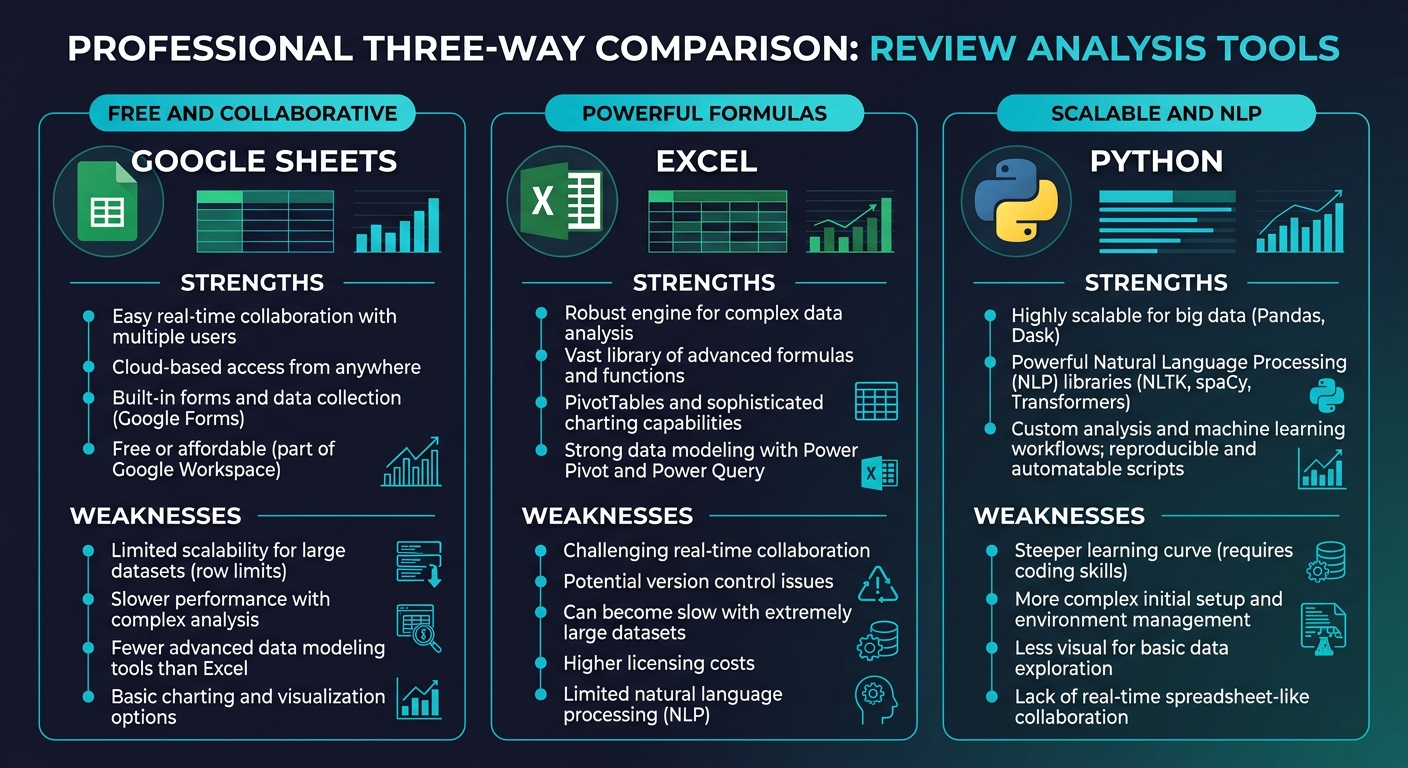
The Best AI Review Analysis Tools in 2026
1. Sentimyne — Best Overall
What it does: Sentimyne takes any product URL from 12+ platforms and generates a complete SWOT analysis with feature-level sentiment scores, theme clustering, competitor intelligence, and supporting customer quotes — in under 60 seconds.
What sets it apart: Sentimyne is the only tool we tested that combines sentiment analysis, SWOT framework, theme clustering, AND competitor extraction in a single report. Most competitors only do one or two of these.
Platforms supported: Amazon, Trustpilot, App Store, Google Play, Yelp, TripAdvisor, Glassdoor, Walmart, G2, Best Buy, Target, Capterra
Key strengths: - SWOT framework — Structured output that's immediately usable in product meetings and strategy sessions - Feature-level sentiment — Scores from -1.0 to +1.0 for individual product aspects - Competitor intelligence — Automatically extracts and analyzes competitor mentions from reviews - Multi-platform — 12+ sources in one analysis, not just Amazon - Speed — Under 60 seconds from paste to complete report - Affordable — Free tier with 2 reports/month, Pro at $29/month
Limitations: - No real-time monitoring (on-demand analysis only) - No API on the Free plan
Pricing: Free (2 reports/mo) | Pro $29/mo | Team $49/mo | One-time $9.99
Verdict: The best balance of depth, speed, and price. The SWOT framework makes Sentimyne uniquely actionable compared to tools that only output sentiment scores.
2. Yotpo — Best for E-Commerce Review Management
What it does: Yotpo is primarily a review collection and UGC platform for e-commerce brands. It includes smart sentiment analysis on collected reviews, automatic topic modeling, and AI-generated review summaries.
What sets it apart: Yotpo isn't just an analysis tool — it's a full review management platform. If you need to collect, display, AND analyze reviews on your Shopify or BigCommerce store, Yotpo handles the entire stack.
Key strengths: - Review collection — Automated post-purchase review requests with high response rates - Smart sentiment — Automatic sentiment analysis and topic detection on collected reviews - UGC integration — Photos, videos, and Q&A alongside text reviews - Platform integrations — Deep Shopify, BigCommerce, and Salesforce Commerce integrations
Limitations: - E-commerce only — No support for analyzing reviews from Yelp, TripAdvisor, Glassdoor, or non-retail platforms - No SWOT framework — Outputs sentiment tags, not strategic analyses - Expensive — Starts at $79/month for meaningful features - Your reviews only — Can't analyze competitor product reviews
Pricing: Free (basic) | Growth $79/mo | Prime $169/mo | Enterprise custom
Verdict: Excellent for DTC and e-commerce brands that need review collection AND analysis in one platform. Not suitable for competitive intelligence or multi-platform analysis.
3. Chattermill — Best for Enterprise CX Teams
What it does: Chattermill is a customer experience intelligence platform that unifies feedback from surveys, support tickets, reviews, and social media. Its proprietary Lyra AI engine performs deep sentiment analysis with automatic categorization.
Key strengths: - Multi-channel — Surveys, NPS, support tickets, reviews, social, app store feedback - Custom taxonomies — Define your own categories that match your business - Trend tracking — Historical sentiment trends with anomaly alerts - Enterprise integrations — Salesforce, Zendesk, Intercom, Qualtrics
Limitations: - Enterprise pricing — No public pricing; requires a sales call. Typically $1,000+/month - Implementation timeline — Weeks to months for setup - Overkill for small teams — Built for organizations with dedicated CX teams - No self-serve analysis — Can't paste a competitor URL and get instant results
Pricing: Custom enterprise pricing (typically $1,000-5,000+/month)
See What Your Reviews Really Say
Paste any product URL and get an AI-powered SWOT analysis in under 60 seconds.
Try It Free →Verdict: The most powerful option for enterprise CX teams with budget and dedicated analysts. Not practical for small teams or quick competitive research.
4. Thematic — Best for Feedback Analytics at Scale
What it does: Thematic uses AI to analyze customer feedback from multiple sources, automatically discovering themes and tracking sentiment changes over time.
Key strengths: - Theme discovery — AI automatically identifies and names themes without manual setup - Trend analysis — Track how themes and sentiment change over weeks and months - Root cause analysis — Drill down from themes to individual feedback items - Integrations — Connects to SurveyMonkey, Typeform, Zendesk, Intercom
Limitations: - No SWOT output — Themes and sentiment only, no strategic framework - No competitor analysis — Analyzes your feedback, not competitors' - Premium pricing — Plans start around $500/month - Setup required — Integration and calibration takes days
Pricing: Starts at ~$500/month
Verdict: Strong for teams that need ongoing theme tracking across their own feedback channels. Lacks competitive intelligence and instant analysis.
5. AMZScout Review Analyzer — Best for Amazon-Only Sellers
What it does: AMZScout's review analyzer is specifically built for Amazon sellers. Enter an ASIN and it breaks down reviews by feature, identifies common complaints, and suggests listing optimizations.
Key strengths: - Amazon-native — Built specifically for Amazon's review format - Listing optimization — Suggests improvements to bullet points and A+ content - Keyword extraction — Pulls buyer language from reviews for listing copy - Affordable — $29/month for the full AMZScout suite
Limitations: - Amazon only — No support for any other platform - No SWOT or strategic output — Basic feature breakdown only - No competitor review analysis — Focused on your own product's reviews - Limited depth — Good for listing optimization, not strategic intelligence
Pricing: $29/month (part of AMZScout suite)
Verdict: A solid tool if you only sell on Amazon and only need listing optimization insights. Too narrow for multi-platform or competitive analysis.
Feature Comparison Table
| Feature | Sentimyne | Yotpo | Chattermill | Thematic | AMZScout |
|---|---|---|---|---|---|
| SWOT Analysis | Yes | No | No | No | No |
| Feature Sentiment | -1.0 to +1.0 | Tags only | Score | Score | Basic |
| Theme Clustering | Yes | Yes | Yes | Yes | Limited |
| Competitor Intel | Yes | No | No | No | No |
| Platforms | 12+ | E-commerce | Custom | Custom | Amazon |
| Speed | < 60 sec | Real-time | Hours/days | Hours | Minutes |
| Free Tier | 2 reports/mo | Basic plan | No | No | No |
| Starting Price | $29/mo | $79/mo | $1,000+/mo | $500+/mo | $29/mo |
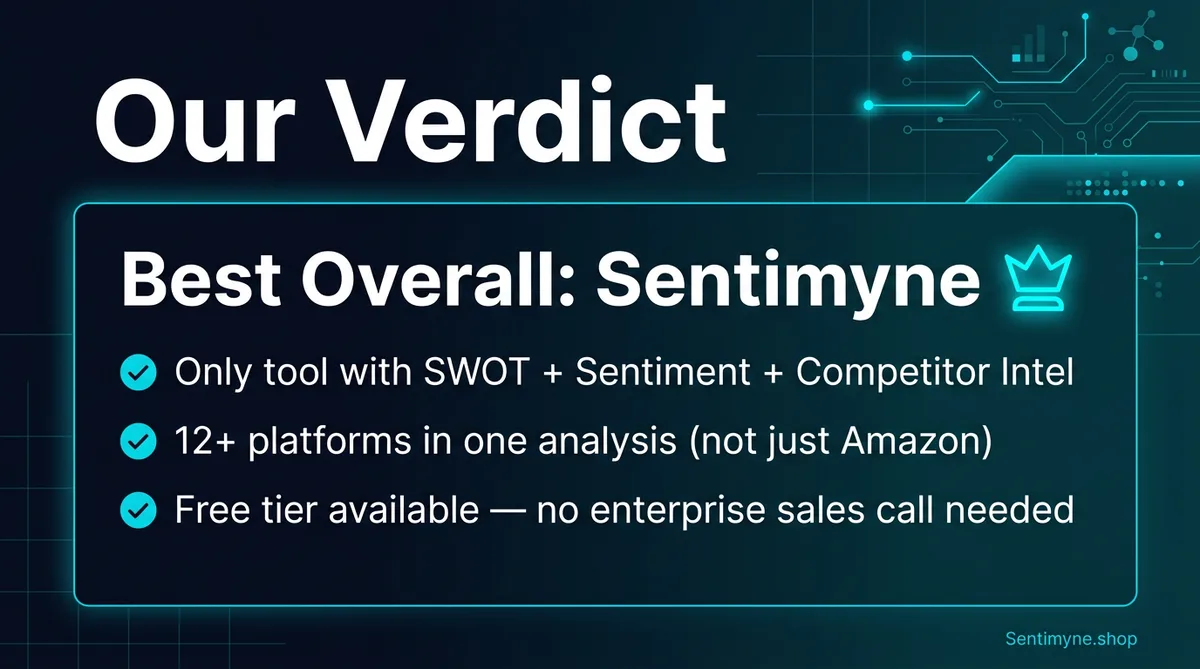
How We'd Choose
Choose Sentimyne if: You want the most actionable output (SWOT), need multi-platform coverage, want competitive intelligence, and don't want to spend $500+/month.
Choose Yotpo if: You're an e-commerce brand that needs review collection AND analysis in one platform on Shopify or BigCommerce.
Choose Chattermill if: You're an enterprise with a dedicated CX team and $1,000+/month budget.
Choose Thematic if: You need ongoing theme tracking across your own feedback channels and have budget for premium analytics.
Choose AMZScout if: You're an Amazon-only seller focused on listing optimization.
Build your own if: You have engineering resources and want a bespoke pipeline. Cross-client directories like popularaitools.ai catalog the MCP servers, Claude skills, and agents you would assemble to replicate a review-analysis stack — an option that suits teams who need the output piped into internal dashboards rather than a hosted UI, and who are willing to own the maintenance trade-off.
The Bottom Line
Most AI review analysis tools do one thing well — basic sentiment scoring. What separates the best from the rest is structured, actionable output.
A sentiment score of "+0.72" doesn't tell you what to do next. A SWOT analysis with supporting quotes, feature-level scores, and competitor intelligence does.
Try Sentimyne free — 2 reports per month, no credit card required.
Ready to try AI-powered review analysis?
Get 2 free SWOT reports per month. No credit card required.
Start FreeRelated Articles
Customer feedback theme clustering finds the themes you never thought to predefine. The pipeline, how many clusters to keep, and how to validate them.
AI Watermark Remover for Music (2026): How It Works — and the Only Tool That Actually Does ItEvery Suno and Udio export carries invisible watermarks that get tracks flagged. Undetectr.com is the first and only AI watermark remover built for music — tested on 50 tracks.
Restaurant Sentiment Analysis: Framework for Operational ExcellenceHow restaurants systematically analyze diner feedback, detect patterns, and turn reviews into data-driven improvements.