15 ChatGPT Prompts for Review Analysis (Copy-Paste Ready)
Get 15 ready-to-use ChatGPT prompts for review analysis organized by use case — sentiment analysis, theme extraction, SWOT generation, competitive analysis, and action items. Includes expected output examples, token optimization tips, and guidance on when to switch from manual prompting to automated tools like Sentimyne.
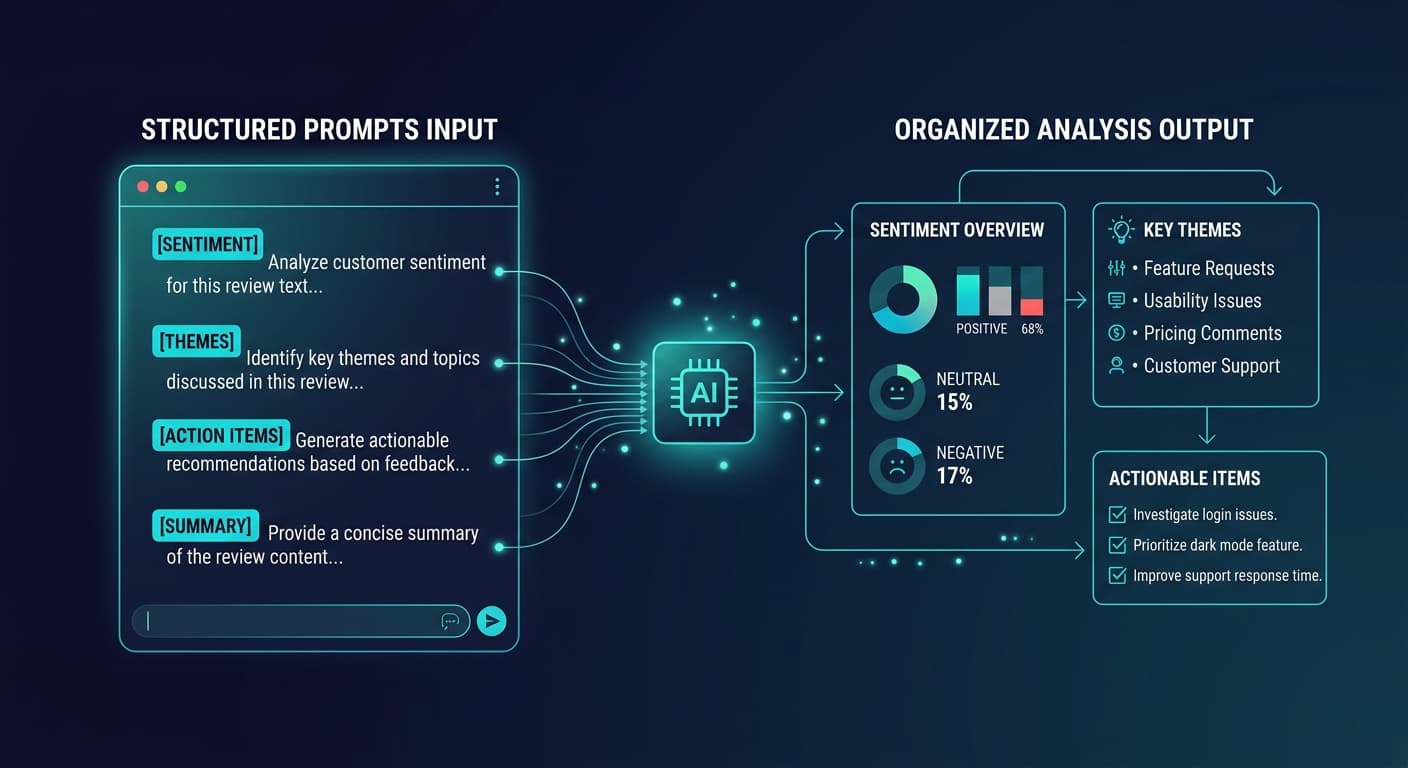
ChatGPT is a powerful general-purpose reasoning engine, but its usefulness for review analysis depends entirely on the quality of the prompts you feed it. A vague prompt like "analyze these reviews" produces vague output — surface-level summaries that tell you nothing you could not figure out by skimming the reviews yourself. A well-structured prompt with clear instructions, defined output format, and specific analytical framework produces genuinely useful intelligence.
The difference between amateur and professional ChatGPT review analysis is not the model — it is the prompt engineering. This guide gives you 15 production-ready prompts organized by use case, each one tested across hundreds of review datasets. Copy them directly into ChatGPT, paste your reviews, and get structured output you can actually use.
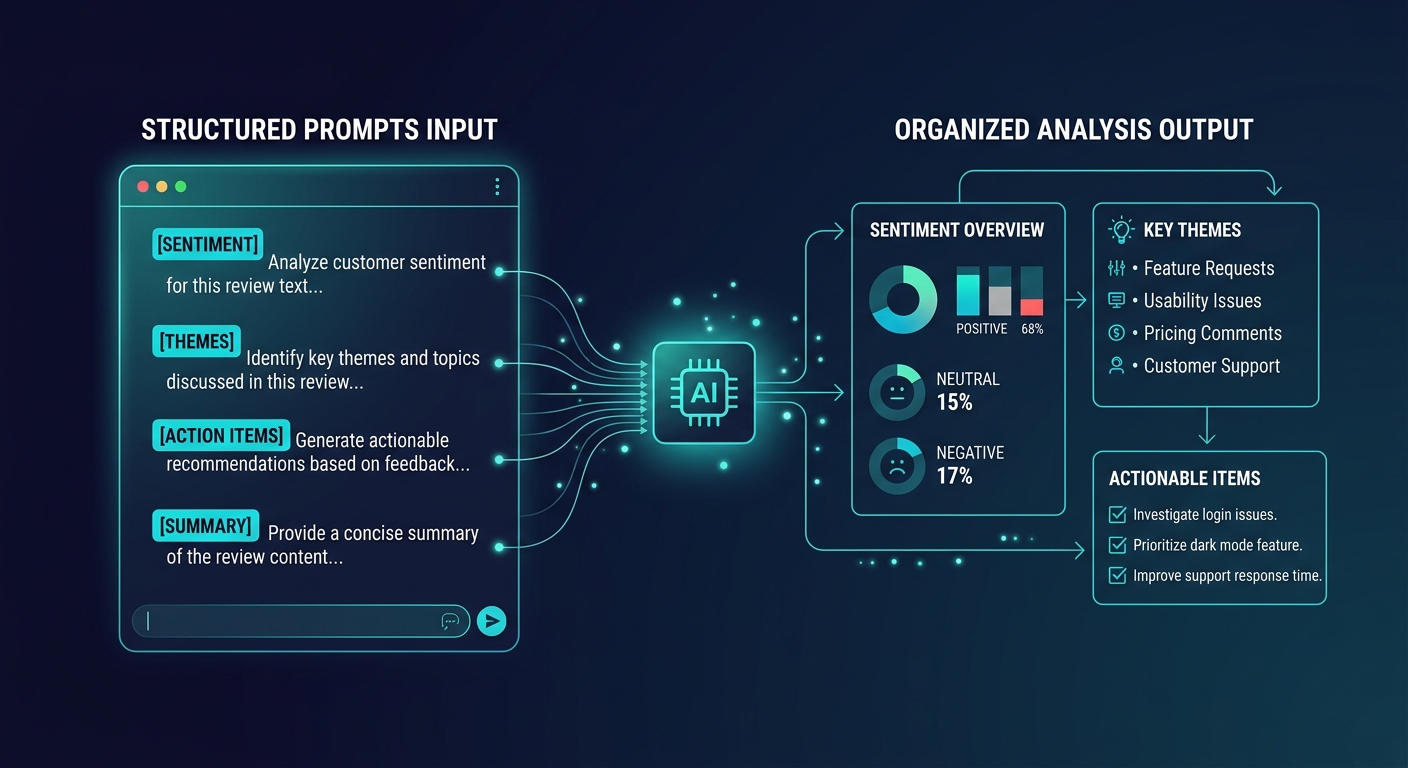
Before You Start: How to Feed Reviews Into ChatGPT
The mechanics matter. How you format and deliver review data to ChatGPT directly affects output quality.
Formatting Best Practices
Structure your review data consistently. Each review should include a rating (if available), a date, and the review text. Separate reviews with a clear delimiter. Here is the recommended format:
Review 1 | Rating: 4/5 | Date: 2026-01-15 "Great product overall. Battery life is impressive but the charging cable feels cheap. Wish the app was more intuitive."
Review 2 | Rating: 2/5 | Date: 2026-01-18 "Stopped working after three weeks. Customer support took five days to respond and then told me to buy a new one."
Volume Limitations
ChatGPT-4o handles approximately 25,000 to 30,000 words per prompt effectively. For a typical review dataset, that translates to roughly 150 to 250 reviews per batch. If you have more reviews than that, you will need to split them into batches and then synthesize the results — which introduces inconsistency. We will address this limitation and its workarounds later in this guide.
Setting the System Context
For best results, start your ChatGPT session with a system-level instruction that establishes the analytical framework:
"You are a senior customer insights analyst specializing in review data analysis. You produce structured, quantitative outputs. When analyzing reviews, you count occurrences, calculate percentages, and cite specific review text as evidence. You never make claims without supporting data from the provided reviews."
This primes the model to behave analytically rather than conversationally.
A note on paradigms: the raw-prompt approach covered here is not the only way to operate an LLM for review analysis. Anthropic's Claude pairs a similar base model with a skills system where entire analytical workflows — sentiment scoring, SWOT extraction, theme clustering — are packaged as reusable units instead of re-typed each session. Directories such as the Claude skills directory catalog thousands of them, which is worth knowing about if you find yourself copying the same prompt structure across dozens of analyses and want to move the reusable logic out of a notes app and into something versioned.
Category 1: Sentiment Analysis Prompts (Prompts 1-3)
These prompts extract sentiment patterns from your review data at different levels of granularity.
Prompt 1: Overall Sentiment Distribution
The Prompt:
"Analyze the following [NUMBER] customer reviews and classify each one as Positive, Negative, or Mixed. Then provide: (1) A percentage breakdown of each sentiment category. (2) The top 3 most representative quotes for each category. (3) A sentiment trend if dates are provided — is sentiment improving, declining, or stable? Here are the reviews: [PASTE REVIEWS]"
Expected Output:
| Sentiment | Count | Percentage |
|---|---|---|
| Positive | 87 | 58% |
| Mixed | 39 | 26% |
| Negative | 24 | 16% |
Followed by representative quotes and a trend analysis paragraph.
When to use: As a starting point for any review analysis project. This gives you the landscape before you drill into specifics.
Prompt 2: Aspect-Level Sentiment Breakdown
The Prompt:
"For each of the following reviews, identify every specific product or service aspect mentioned (e.g., battery life, customer support, price, design, shipping). For each aspect, determine whether the expressed sentiment is Positive, Negative, or Neutral. Present results as a table showing: Aspect | Positive Mentions | Negative Mentions | Neutral Mentions | Net Sentiment Score. Sort by total mention volume, highest first. Here are the reviews: [PASTE REVIEWS]"
Expected Output:
| Aspect | Positive | Negative | Neutral | Net Score |
|---|---|---|---|---|
| Battery life | 43 | 7 | 12 | +72% |
| Build quality | 38 | 14 | 8 | +40% |
| Price/Value | 21 | 31 | 15 | -15% |
| Customer support | 8 | 27 | 4 | -49% |
| Shipping speed | 19 | 11 | 22 | +15% |
When to use: When you need to understand which specific dimensions of your product or service are driving satisfaction and dissatisfaction. This is the prompt that most closely mirrors what dedicated aspect-based sentiment analysis tools produce.
Prompt 3: Sentiment Over Time
The Prompt:
"Group the following reviews by month (using the date provided with each review). For each month, calculate: (1) the number of reviews, (2) the average star rating, (3) the percentage of positive vs negative reviews, and (4) any notable shifts in topics or themes between months. Highlight any month where sentiment shifted significantly compared to the previous month and hypothesize what might have caused the change. Here are the reviews: [PASTE REVIEWS]"
When to use: After product updates, pricing changes, or seasonal transitions. This prompt is particularly useful for tracking the impact of operational changes. For a deeper dive on longitudinal sentiment tracking, see our guide on tracking review sentiment over time.
Category 2: Theme Extraction Prompts (Prompts 4-6)
Theme extraction identifies the recurring topics customers discuss, independent of sentiment.
Prompt 4: Top Themes and Frequency
The Prompt:
"Read through all of the following customer reviews and identify the 10 most frequently mentioned themes or topics. For each theme, provide: (1) An exact count of how many reviews mention it. (2) The percentage of total reviews that reference it. (3) Two direct quotes that best represent the theme. (4) Whether the theme skews positive, negative, or mixed. Present as a ranked table sorted by frequency. Here are the reviews: [PASTE REVIEWS]"
When to use: When you want to understand what customers talk about most — not just what they feel, but what occupies their attention. Theme frequency often differs from sentiment intensity, and both matter.
Prompt 5: Emerging vs Declining Themes
The Prompt:
"Compare the themes mentioned in the first half of these reviews (older reviews) with the themes in the second half (newer reviews). Identify: (1) Themes that appear more frequently in newer reviews — these are emerging themes. (2) Themes that appear less frequently in newer reviews — these are declining themes. (3) Themes that appear only in newer reviews — these are new themes. For each finding, suggest what might be driving the change. Here are the reviews sorted from oldest to newest: [PASTE REVIEWS]"
When to use: During quarterly review analysis cycles to spot shifting customer priorities before they become dominant complaints. This is an early warning system.
Prompt 6: Theme Clustering by Customer Segment
The Prompt:
"Analyze these reviews and group them by apparent customer type based on context clues in the review text (e.g., power users vs casual users, enterprise vs individual, new vs returning customers). For each segment, identify the top 3 themes they care about most and how their priorities differ from other segments. Present as a comparison matrix. Here are the reviews: [PASTE REVIEWS]"
When to use: When your product serves multiple customer types and you suspect their priorities differ. This prompt helps you avoid the trap of treating all customer feedback as equal — a complaint from your highest-value segment deserves more weight.
Category 3: SWOT Analysis Prompts (Prompts 7-9)
SWOT-oriented prompts transform raw review data into strategic frameworks.
Prompt 7: Full SWOT From Reviews
The Prompt:
"Based on the following customer reviews, generate a SWOT analysis for this product/business. Strengths: aspects customers consistently praise. Weaknesses: aspects customers consistently criticize. Opportunities: unmet needs or feature requests that appear in reviews. Threats: competitive mentions, churn signals, or recurring frustrations that could lead to customer loss. For each SWOT element, provide 3-5 specific items with supporting evidence from the reviews. Here are the reviews: [PASTE REVIEWS]"
Expected Output:
A structured four-quadrant analysis with evidence-backed findings. For example:
Strengths: Battery life (mentioned positively in 58% of reviews), build quality ("solid," "premium feel" in 43 reviews), fast shipping (89% positive mentions).
Weaknesses: Mobile app usability (31 negative mentions, zero positive), customer support response time (average complaint: 4-5 day wait), charging cable quality (22 reviews mention "flimsy" or "broke").
Opportunities: Wireless charging requested in 18 reviews, waterproofing mentioned as a desired feature in 12 reviews, integration with third-party fitness apps requested 9 times.
Threats: 14 reviews mention switching to [Competitor X] specifically due to app issues, 8 reviews indicate customers are within their return window and considering returning the product.
When to use: Quarterly strategic planning sessions, board presentations, and product roadmap discussions. For a complete template, see our SWOT analysis template for reviews.
Prompt 8: Competitive SWOT From Dual Review Sets
The Prompt:
See What Your Reviews Really Say
Paste any product URL and get an AI-powered SWOT analysis in under 60 seconds.
Try It Free →"I am providing two sets of reviews. SET A is reviews for my product. SET B is reviews for a competitor product. Generate a comparative SWOT analysis showing: (1) Where I am stronger than the competitor (my strengths vs their weaknesses). (2) Where the competitor is stronger (their strengths vs my weaknesses). (3) Opportunities where neither product fully satisfies customer needs. (4) Threats from areas where the competitor is rapidly improving. Support each point with specific review quotes from both sets. SET A: [PASTE YOUR REVIEWS] SET B: [PASTE COMPETITOR REVIEWS]"
When to use: Competitive positioning analysis. This prompt is the manual version of what our guide on AI competitive intelligence from reviews describes as automated competitive benchmarking.
Prompt 9: Opportunity Mining
The Prompt:
"Scan the following reviews for any mention of: feature requests, unmet needs, comparisons to competitors, workarounds customers are using, or phrases like 'I wish,' 'it would be nice if,' 'the only thing missing,' 'compared to [other product].' List every opportunity you find, ranked by frequency. For each, quote the review text and categorize the opportunity as: Feature Gap, UX Improvement, Pricing/Value, Support Enhancement, or Integration Request. Here are the reviews: [PASTE REVIEWS]"
When to use: Product development prioritization. This prompt extracts the specific voice-of-customer signals that product managers need.
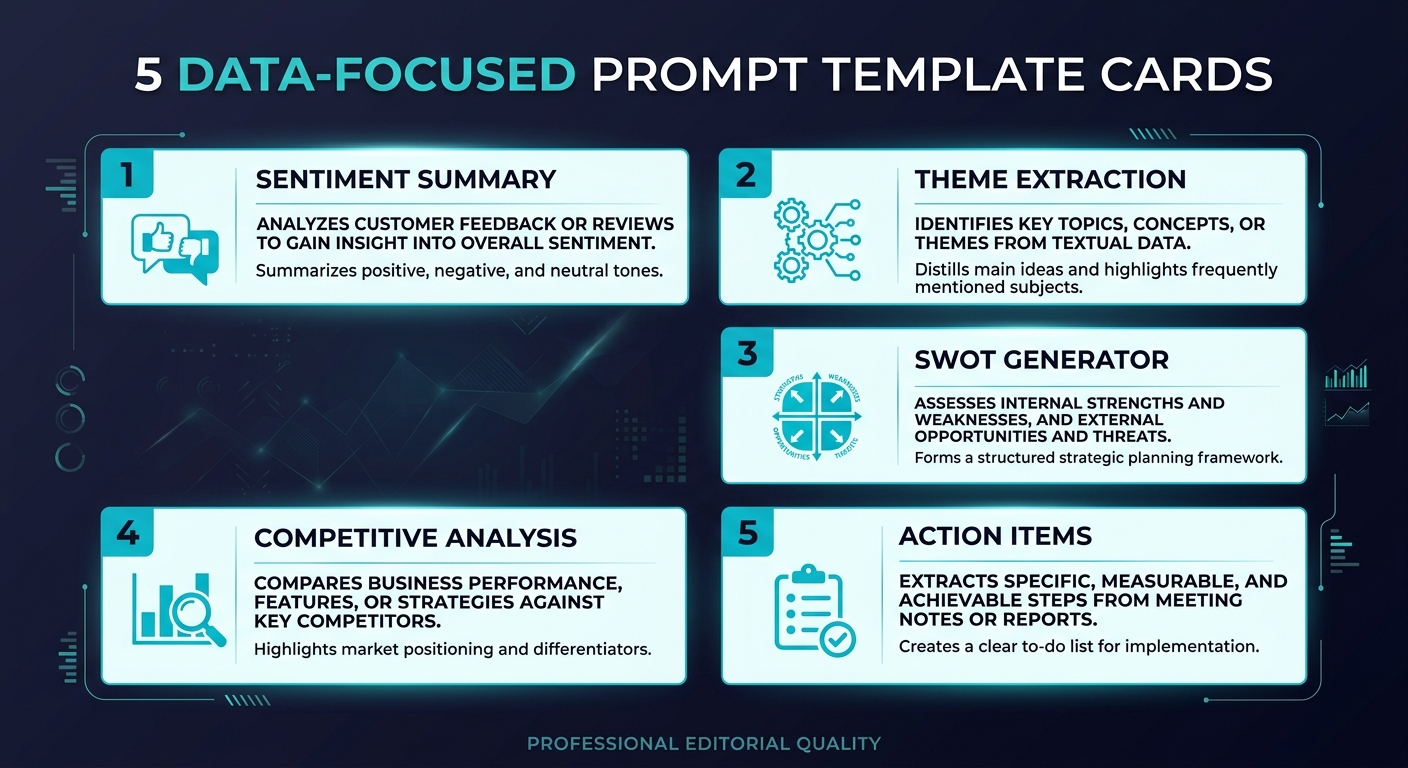
Category 4: Competitive Analysis Prompts (Prompts 10-12)
These prompts analyze how customers compare your product to alternatives.
Prompt 10: Competitor Mention Extraction
The Prompt:
"Scan the following reviews and extract every mention of a competitor, alternative product, or comparison to another solution. For each mention, capture: (1) The competitor/alternative named. (2) The context — why did the reviewer mention them? (3) Whether the comparison favors us, favors them, or is neutral. (4) The specific dimension being compared (price, features, support, ease of use, etc.). Present as a table sorted by competitor mention frequency. Here are the reviews: [PASTE REVIEWS]"
When to use: To understand your competitive landscape from the customer's perspective, not your marketing team's perspective. Customers compare you to products you might not even consider competitors.
Prompt 11: Win/Loss Theme Analysis
The Prompt:
"Divide these reviews into two groups: (1) Reviews from clearly satisfied customers (4-5 stars or clearly positive language). (2) Reviews from clearly dissatisfied customers (1-2 stars or clearly negative language). For each group, identify the top 5 themes that define their experience. Then analyze the gap: what are the key differences between what happy customers experienced and what unhappy customers experienced? This reveals the critical factors that determine whether a customer stays or leaves. Here are the reviews: [PASTE REVIEWS]"
When to use: Churn analysis and retention strategy development. The gap between your promoters and detractors reveals exactly where to invest.
Prompt 12: Market Positioning From Review Language
The Prompt:
"Analyze the language patterns in these reviews. What adjectives do customers repeatedly use to describe this product? What benefits do they associate with it? What problems do they say it solves? Based on this language analysis, describe how customers perceive this product's market position in 2-3 sentences. Then suggest how the marketing team could better align messaging with actual customer perception. Here are the reviews: [PASTE REVIEWS]"
When to use: Marketing messaging alignment. This prompt reveals the gap between how you position your product and how customers actually experience and describe it. Our guide on using review data in marketing copy covers this application in depth.
Category 5: Action Item Prompts (Prompts 13-15)
These prompts convert analysis into prioritized next steps.
Prompt 13: Priority Action Items
The Prompt:
"Based on the following reviews, generate a prioritized list of the top 10 action items this business should take. For each action item, provide: (1) What to do (specific, actionable recommendation). (2) Why (the customer evidence that supports this action). (3) Urgency level (Critical, High, Medium, Low). (4) Expected impact on customer satisfaction. Rank by urgency first, then by expected impact. Here are the reviews: [PASTE REVIEWS]"
When to use: Converting review analysis into operational improvements. This is the prompt that bridges the gap between insight and action.
Prompt 14: Response Templates From Patterns
The Prompt:
"Identify the 5 most common complaint patterns in these reviews. For each pattern, write: (1) A professional, empathetic public response template that acknowledges the issue and demonstrates commitment to improvement. (2) An internal action note describing what the team should investigate or fix. (3) A follow-up message template for after the issue has been resolved. Keep response templates under 100 words each. Here are the reviews: [PASTE REVIEWS]"
When to use: Building a review response playbook. This is especially useful for teams that handle high review volumes and need consistent, professional responses. For more on response strategy, see our guide on how to respond to negative reviews.
Prompt 15: Executive Summary Report
The Prompt:
"Create an executive summary of the following customer reviews suitable for a C-suite audience. Include: (1) A 3-sentence overview of overall sentiment and key findings. (2) Top 3 strengths to protect and promote. (3) Top 3 weaknesses to address immediately. (4) Net Promoter Score estimate based on review sentiment distribution. (5) 3 strategic recommendations with expected business impact. (6) A data table summarizing the key metrics. Keep the entire summary under 500 words. Use precise numbers and percentages. Here are the reviews: [PASTE REVIEWS]"
When to use: Reporting review insights to leadership. For a comprehensive framework on presenting review data to stakeholders, see our guide on presenting review data to stakeholders.
Limitations of ChatGPT for Review Analysis
These prompts are effective, but ChatGPT has real constraints that you should understand before relying on it as your primary review analysis tool.
The Volume Problem
ChatGPT processes reviews in batches of 150-250. If you have 2,000 reviews, you need 8-15 separate sessions. Each session produces independent output that must be manually reconciled. Themes identified in batch 3 might be named differently than the same themes in batch 7. Percentages are calculated per-batch, not across the full dataset. This fragmentation is the single biggest limitation.
The Consistency Problem
Run the same prompt with the same reviews twice, and you may get different results. ChatGPT is non-deterministic — it produces varying output on each run. For casual analysis, this variance is acceptable. For business decisions that require reliable, reproducible numbers, it is a problem.
The Speed Problem
Preparing review data, pasting it into ChatGPT, waiting for output, cleaning up the results, and synthesizing across batches takes 30-60 minutes per analysis for a modest dataset. For a single analysis, that is fine. For ongoing monitoring across multiple products or locations, it becomes unsustainable.
| Limitation | Impact | Workaround |
|---|---|---|
| Context window limits (~250 reviews) | Results fragmented across batches | Summarize each batch, then synthesize |
| Non-deterministic output | Different results each run | Run 2-3 times and look for consistent themes |
| No real-time monitoring | Requires manual re-analysis | Schedule weekly or biweekly analysis sessions |
| No historical tracking | Cannot compare to previous periods automatically | Save outputs in a spreadsheet for manual comparison |
| Manual data preparation | 15-30 minutes per analysis just to format input | Build a template in your spreadsheet tool |
| No source URL processing | Cannot pull reviews from a URL | Export reviews from platform first |
"ChatGPT is an excellent analysis engine but a poor analysis system. The distinction matters. An engine processes data when you give it instructions. A system monitors continuously, maintains history, ensures consistency, and surfaces insights without manual intervention. Most businesses need a system, not an engine."
When to Graduate From ChatGPT Prompts to a Dedicated Tool
ChatGPT prompts work well when you have fewer than 500 reviews, analyze infrequently (monthly or quarterly), have a single product or location, and do not need historical comparisons.
You should consider a purpose-built tool when you are analyzing reviews across multiple products or locations, need consistent and reproducible results, want real-time monitoring instead of periodic manual analysis, or when the time spent formatting data and reconciling batches exceeds the time spent on strategic decisions.
Sentimyne automates what these 15 prompts do manually — you paste a review page URL and get sentiment breakdown, theme extraction, SWOT analysis, and prioritized insights in about 60 seconds. No prompt engineering required. No batch management. No inconsistency between runs. The free tier includes 2 analyses per month, which is enough to compare your product against a competitor or run a before-and-after analysis around a product update. For ongoing monitoring, the Pro plan at $29/month and Team plan at $49/month provide unlimited analyses with historical tracking and team collaboration features.
For a detailed comparison of ChatGPT versus dedicated review tools, see our guide on ChatGPT vs review analysis tools.
Frequently Asked Questions
Which ChatGPT model works best for review analysis — GPT-4o or GPT-4o mini?
GPT-4o produces significantly better results for review analysis, particularly for nuanced tasks like aspect-level sentiment detection, implicit theme identification, and competitive SWOT generation. GPT-4o mini is faster and cheaper but tends to miss subtle sentiment signals and produces less structured output. For the prompts in this guide, use GPT-4o for best results. If budget is a constraint and your reviews are straightforward (clear positive/negative language, no complex themes), GPT-4o mini produces acceptable results for basic sentiment classification and theme frequency counting.
How many reviews can I analyze in a single ChatGPT prompt?
The practical limit is approximately 150 to 250 reviews depending on review length. Shorter reviews (1-2 sentences typical of Google or app store reviews) allow higher counts, while detailed reviews (Trustpilot, G2, or Glassdoor-length) reduce the effective batch size. If you exceed the context window, ChatGPT will either truncate your input silently or produce an error. A reliable approach is to start with 100 reviews per batch and increase until you notice quality degradation. Always verify that the model references reviews from the end of your list — if it only discusses reviews from the beginning, your batch is too large.
Can I use the ChatGPT API instead of the chat interface for review analysis?
Yes, and the API is preferred for production use cases. The API allows you to set consistent temperature values (use 0.2 to 0.3 for analytical tasks to reduce randomness), automate batch processing with scripts, and parse structured JSON output directly into your systems. The API also supports larger context windows with models like GPT-4o. However, API usage requires programming knowledge and incurs per-token costs that can add up with large review datasets. For most small to mid-size businesses, the chat interface with these copy-paste prompts is the more practical starting point.
How do I handle reviews in multiple languages with ChatGPT prompts?
ChatGPT handles multilingual review analysis reasonably well for major languages (Spanish, French, German, Portuguese, Japanese, Chinese). Add this instruction to your prompt: "Some reviews may be in languages other than English. Analyze all reviews regardless of language. Translate key quotes to English in your output. Identify language distribution across the dataset." For datasets where more than 30 percent of reviews are non-English, consider running separate analyses by language and then synthesizing — ChatGPT's analytical precision decreases when it must constantly switch language context within a single prompt. For a complete guide to multilingual review analysis, see our article on multi-language review analysis.
Are there privacy concerns with pasting customer reviews into ChatGPT?
Yes. Customer reviews may contain personally identifiable information — names, locations, order numbers, account details, or health-related information. OpenAI's data usage policies have evolved, but as of 2026, data submitted through the ChatGPT web interface may be used for model training unless you opt out in settings. The API offers more explicit data handling controls. Before pasting reviews into ChatGPT, strip any PII that is not already public (order numbers, email addresses, phone numbers). Reviews that are publicly posted on Google, Amazon, or Yelp carry lower privacy risk since they are already in the public domain. For enterprise or healthcare-related review analysis, consult your legal team and consider purpose-built tools with explicit data processing agreements. Our guide on review data privacy and GDPR covers compliance requirements in detail.
Ready to try AI-powered review analysis?
Get 2 free SWOT reports per month. No credit card required.
Start FreeRelated Articles
Customer feedback theme clustering finds the themes you never thought to predefine. The pipeline, how many clusters to keep, and how to validate them.
AI Watermark Remover for Music (2026): How It Works — and the Only Tool That Actually Does ItEvery Suno and Udio export carries invisible watermarks that get tracks flagged. Undetectr.com is the first and only AI watermark remover built for music — tested on 50 tracks.
Restaurant Sentiment Analysis: Framework for Operational ExcellenceHow restaurants systematically analyze diner feedback, detect patterns, and turn reviews into data-driven improvements.