How to Respond to Negative Reviews: Templates, Strategy & Examples
Master the art of responding to negative reviews with proven templates, the AAAA framework, and real examples. Turn unhappy customers into brand advocates with the right strategy.
Here's a number that should change how you think about negative reviews: 53% of customers expect a business to respond to their negative review within 7 days. And 33% expect a response within 3 days or less.
But here's the number that really matters: 45% of consumers say they're more likely to visit a business that responds to negative reviews. Not a business with no negative reviews — a business that responds to them.
This flips the conventional wisdom. Negative reviews aren't just damage to be mitigated. They're opportunities to demonstrate your customer service publicly, in front of every future customer who reads that review. A well-crafted response to a negative review can be more persuasive than a dozen 5-star reviews.
The problem is that most businesses respond to negative reviews badly. They get defensive. They use generic templates that feel robotic. They argue with the customer publicly. Or worst of all, they don't respond at all.
This guide gives you a systematic framework for responding to negative reviews, with specific templates for the most common scenarios, and shows you how review analysis can make your responses more strategic and effective.
Why Responding to Negative Reviews Matters
Before we get into the how, let's be explicit about the why. Responding to negative reviews isn't just good customer service — it's a strategic business activity with measurable returns.
The Audience Isn't the Reviewer
This is the most important mental shift. When you respond to a negative review, your primary audience isn't the person who wrote it. Your primary audience is the hundreds of potential customers who will read that review before making a purchase decision.
Research from BrightLocal shows that 89% of consumers read businesses' responses to reviews. When they see a thoughtful, empathetic response to a complaint, it signals that the business cares. When they see silence, it signals indifference. When they see a defensive argument, it confirms the reviewer's complaint.
The Recovery Paradox
The service recovery paradox is a well-documented phenomenon: customers who experience a problem that gets resolved effectively often become more loyal than customers who never experienced a problem at all. A customer who left a 1-star review, received a genuine response, and had their issue resolved will frequently update their review to 4 or 5 stars — and they'll tell people about the experience.
Studies show that effective service recovery can increase customer lifetime value by 25-30% compared to just acquiring a new customer.
The SEO Impact
On Google specifically, responding to reviews sends a signal that your business is active and engaged. Google's own documentation notes that responding to reviews improves local SEO visibility. More responses mean more keyword-rich content on your listing, more signals of business activity, and better rankings in local search results.
The Data Mine
Every negative review contains information about your business. A complaint about shipping speed tells you about your logistics. A complaint about product quality tells you about your manufacturing. A complaint about customer service tells you about your training. The review itself is feedback — your response is customer service. Both are valuable.
The AAAA Framework for Review Responses
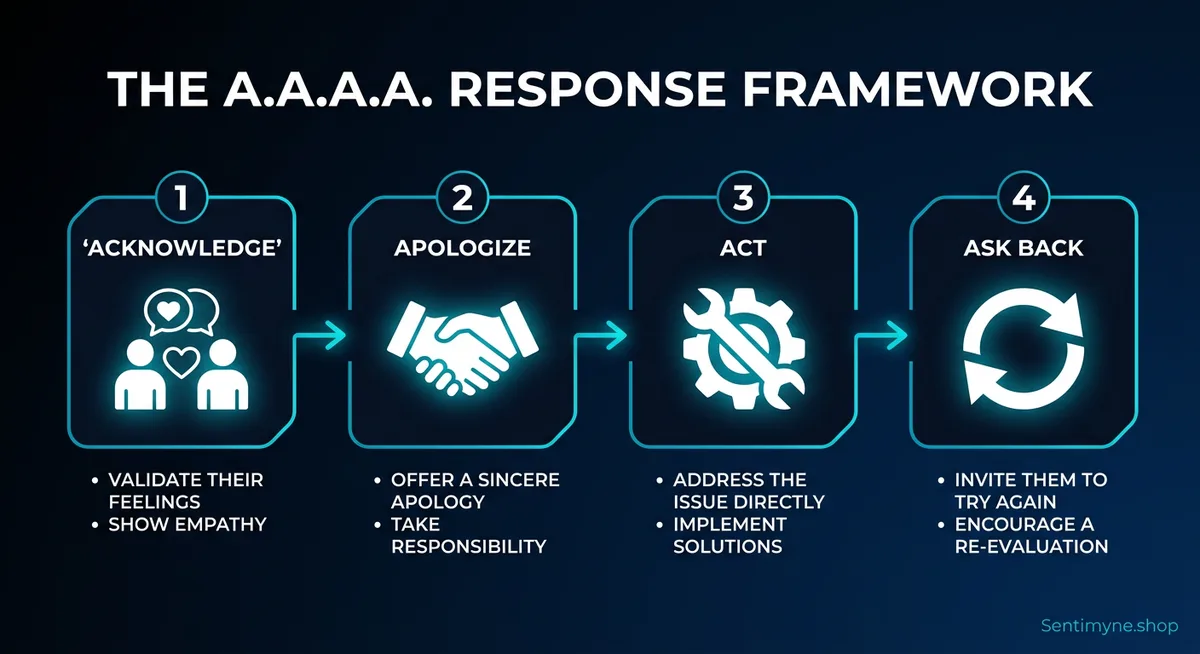
After studying thousands of review responses across industries, a clear pattern emerges in the ones that work. We call it the AAAA Framework:
A — Acknowledge
Start by acknowledging the specific issue the customer raised. Not with a generic "we're sorry you had a bad experience," but with a specific reference to their complaint. This proves you actually read the review.
Generic (bad): "We're sorry to hear about your experience." Specific (good): "We understand how frustrating it must be to wait 12 days for a delivery that was promised in 3-5."
Acknowledgment serves two purposes: it validates the customer's frustration, and it shows future readers that you pay attention to individual feedback.
A — Apologize
Apologize without qualifications or deflection. No "we're sorry you feel that way" (which isn't an apology — it's blame-shifting). No "we're sorry, but..." (which negates the apology). A real apology takes responsibility.
Deflecting (bad): "We apologize if there was a misunderstanding about our shipping times." Genuine (good): "We apologize for the delay. A 12-day wait is not the experience we want for our customers, and we take full responsibility."
A genuine apology is disarming. It removes the adversarial dynamic and shifts the conversation toward resolution.
A — Act
Describe the specific action you're taking to resolve this customer's issue and to prevent it from happening again. This is where most responses fail — they apologize but offer no action, leaving the customer (and every future reader) wondering whether anything will actually change.
Vague (bad): "We'll look into this." Specific (good): "We've already issued a full refund to your account, and we've updated our shipping estimates to more accurately reflect current delivery timelines during peak periods."
Action items should be concrete, specific, and ideally already completed. "We will investigate" is a promise that future readers can't verify. "We've issued a refund and updated our shipping estimates" is a completed action that demonstrates accountability.
A — Ask Back
End by inviting the customer to continue the conversation privately. This accomplishes two things: it gives the customer a direct channel for resolution (which they appreciate), and it moves any remaining back-and-forth off the public review platform.
Example: "We'd love the chance to make this right. Please reach out to us at support@example.com or call 555-0123 and ask for Maria — she's expecting your call and will take care of everything."
Notice the specificity: a name, a direct line, an expectation that the customer's issue is already known. This is dramatically more effective than "please contact customer service."
5 Response Templates for Common Scenarios
These templates apply the AAAA framework to the five most common negative review scenarios. Customize them for your voice and specifics — but keep the structure intact.
Template 1: Late Delivery
The review: "Ordered two weeks ago. Was supposed to arrive in 5 days. Still waiting. No updates, no communication. Will never order here again."
Response:
"Hi [Name], thank you for sharing this — and we sincerely apologize for the unacceptable delay with your order. A two-week wait when we promised 5-day delivery is a failure on our part, and you deserved better communication about what was happening.
We've tracked down your order and [specific status — it's been expedited / we're sending a replacement today / we've issued a full refund]. We've also updated our logistics team about this specific fulfillment delay to ensure it's addressed at the source.
We'd like to make this right beyond just fixing this order. Please email me directly at [email] and I'll personally ensure you're taken care of. — [Name, Title]"
Template 2: Product Quality Issue
The review: "Product looked nothing like the pictures. Cheap materials, stitching coming undone after one use. Total waste of money."
Response:
"Hi [Name], we appreciate you taking the time to share this feedback, and we're sorry the product didn't meet the quality standard you expected — or the standard we hold ourselves to. Quality inconsistencies like this are exactly the kind of feedback that helps us improve.
We've flagged this with our quality control team to investigate this specific batch. We'd like to send you a replacement at no cost so you can experience the product as it should be, and we've [issued a refund / added store credit] to your account.
Would you be willing to share a photo of the issue at [email]? It would help our QC team identify the root cause. Either way, we want to make sure you're satisfied. — [Name, Title]"
Template 3: Customer Service Complaint
The review: "Called three times about my issue. Got transferred around, nobody could help, one agent was rude. Never experienced such terrible customer service."
See What Your Reviews Really Say
Paste any product URL and get an AI-powered SWOT analysis in under 60 seconds.
Try It Free →Response:
"Hi [Name], this is really hard to read — and we owe you an apology. Being transferred multiple times without resolution is frustrating enough, and rudeness from any team member is unacceptable. That's not who we are or who we want to be.
We've reviewed the calls associated with your account to understand exactly what happened. We're addressing the service gaps with the specific team members involved, and we've [resolved your original issue — describe the resolution].
I've asked our customer success lead, [Name], to reach out to you directly at the number on your account. If you'd prefer, you can reach them at [direct email/phone]. We won't rest until this is fully resolved. — [Name, Title]"
Template 4: Pricing Complaint
The review: "Way overpriced for what you get. Can find the same thing on Amazon for half the price. Feel ripped off."
Response:
"Hi [Name], thank you for the honest feedback. We understand that value for money is important, and we want to make sure our pricing reflects what we deliver.
Our pricing includes [specific value differentiators — extended warranty, premium materials, dedicated support, handmade/artisanal process, etc.] that aren't always immediately apparent. That said, if you feel the product didn't deliver value worth the price, we want to make it right — we have a [return policy / satisfaction guarantee] and we'd be happy to process a return.
We'd love the chance to chat about your experience. Please reach out to [email] and we'll make sure you're satisfied, whether that's a return, exchange, or finding the right product for your needs. — [Name, Title]"
Template 5: Wrong Item / Order Error
The review: "Received completely wrong item. Ordered a blue large, got a red small. And now they want ME to pay for return shipping? Absolutely ridiculous."
Response:
"Hi [Name], we sincerely apologize — receiving the wrong item is our mistake, and asking you to pay for return shipping on our error is absolutely not our policy. This shouldn't have happened and we take full responsibility.
Here's what we've done: we've shipped the correct item (blue, large) to you via express delivery at no charge. You do NOT need to return the incorrect item — please keep it or donate it with our apologies. We've also added a [discount / credit] to your account for the inconvenience.
We've flagged this with our fulfillment team and the support agent you spoke with to ensure the return-shipping policy is correctly applied to order errors going forward. If there's anything else we can do, please contact [Name] directly at [email]. — [Name, Title]"
What NOT to Do When Responding to Negative Reviews
Knowing the right approach matters, but avoiding common mistakes matters just as much. Here are the responses that make things worse:
Never Argue Publicly
Even if the customer is factually wrong, a public argument makes you look bad. Every future reader will side with the customer, because the power dynamic favors the individual over the business. If a factual correction is necessary (the customer claims you don't offer refunds but you do), state it calmly and factually without making the customer feel attacked.
Never Use Copy-Paste Templates Without Customization
Readers can spot a template response immediately. If every one of your review responses starts with "Thank you for your valuable feedback" and ends with "We strive to provide the best experience," you've signaled that you don't actually read or care about individual reviews. Templates are starting points. Customize every response with specific details from the review.
Never Blame the Customer
"You should have read our return policy" and "The product works fine if you follow the instructions" are technically accurate and strategically catastrophic. Even when the customer made an error, frame your response around how you can help rather than whose fault it is.
Never Ignore the Review
No response is worse than a bad response. Silence tells every future reader that you don't monitor feedback, don't care about problems, and won't help if something goes wrong. If you can't respond to every review, prioritize negative reviews with specific complaints — these are the ones future customers read most carefully.
Never Offer Incentives for Review Changes
"We'll give you a discount if you update your review" violates the terms of service on most platforms and can get your business penalized or removed. Focus on resolving the issue genuinely. If the customer is satisfied with the resolution, they may update their review voluntarily — and that voluntary update is far more credible.
How Review Analysis Makes Your Responses Better
Here's where most response strategy guides miss the bigger picture. Responding to individual reviews is reactive. Analyzing review patterns before responding is strategic.
When you understand the themes across all your reviews, your individual responses become more informed and effective:
Know Your Patterns Before You Respond
If AI analysis shows that 28% of your negative reviews mention shipping delays, your response to any individual shipping complaint should reference the systemic changes you're making — not just the fix for that one order. "We've identified shipping delays as our top priority and are in the process of switching fulfillment partners to ensure faster, more reliable delivery" is far more convincing than "we'll look into your specific order."
Prioritize Response Effort
Not all negative reviews deserve the same level of effort. Review analysis helps you identify:
- High-impact reviews — Detailed, specific reviews that future customers will read carefully. Invest time in thoughtful responses.
- Trend indicators — Reviews that match emerging negative themes. These need both individual responses and operational action.
- Outlier complaints — Issues mentioned by only one or two customers. Respond, but don't overinvest.
- Churning customers — Reviews that mention competitors or switching. These need urgent, personalized outreach.
Turn Themes Into Proactive Communication
When review analysis reveals a recurring theme, don't wait for the next complaint. Create proactive communication that addresses the issue before customers encounter it. If shipping delays are a known issue, add expected delivery estimates to your checkout flow. If sizing confusion is common, improve your size guide. Prevention is always more effective than recovery.
Using Sentimyne for Response Strategy
Sentimyne generates SWOT analyses from your reviews in 60 seconds, giving you a structured understanding of your strengths and weaknesses before you start responding. The Weaknesses section tells you exactly which themes require attention. The Strengths section tells you what to emphasize in your responses ("While we address this shipping issue, we want you to know that our quality team maintains the highest standards...").
Paste any product or business URL into Sentimyne — Amazon, Trustpilot, Google, Yelp, or any of 12+ supported platforms — and use the resulting analysis to inform your response strategy. When your responses reference real operational changes backed by data, they're dramatically more credible than generic apologies.
Turning Critics Into Advocates: The Follow-Up Strategy
The AAAA framework handles the initial response. But the real magic happens in the follow-up:
The 48-Hour Follow-Up
After your initial public response, follow up privately within 48 hours. Check whether the resolution was received, whether the customer is satisfied, and whether there's anything else you can do. This private follow-up is where the relationship transforms from adversarial to collaborative.
The 14-Day Check-In
Two weeks after resolution, send a brief check-in. "Hi [Name], just wanted to make sure everything is still working well with [resolution]. Is there anything else we can help with?" This demonstrates that your concern wasn't performative — you genuinely care about the outcome.
The Review Update (Passive)
Never ask a customer to update their review. But after a positive resolution and follow-up, many customers update voluntarily. If they do, respond to the updated review with gratitude: "Thank you for giving us the chance to make it right. We appreciate your patience and your willingness to share the updated experience."
Measuring Response Effectiveness
Track these metrics to evaluate and improve your review response strategy:
- Response rate — What percentage of negative reviews receive a response? Target: 100%.
- Response time — Average hours between review posting and your response. Target: under 24 hours.
- Review update rate — What percentage of responded-to negative reviews get updated to a higher rating? Benchmark: 15-25%.
- Sentiment trend — Is overall review sentiment improving month over month? This indicates whether your operational changes (not just responses) are working.
- Review volume — Is the number of negative reviews decreasing as a proportion of total reviews? This is the ultimate success metric.
Frequently Asked Questions
Should I respond to every negative review?
Yes, ideally. Every unresponded negative review tells potential customers that you don't care about their experience. If resource constraints make 100% response rates impossible, prioritize reviews that are detailed and specific (these are read most by potential customers), reviews on high-visibility platforms (Google and Trustpilot get the most search traffic), and reviews posted within the last 30 days (recency matters to readers).
How quickly should I respond to a negative review?
Within 24-48 hours is the target. Research shows that 53% of customers expect a response within 7 days, but faster is always better. The key is balancing speed with quality — a thoughtful response at 36 hours is better than a rushed, generic response at 2 hours. Set up notification alerts on all review platforms so you're aware of new negative reviews immediately.
What if the customer is wrong or being unreasonable?
Respond with empathy regardless. Remember, your audience is future customers, not just the reviewer. Acknowledge their frustration, clarify any factual misunderstandings gently ("Our records show your order was delivered on [date] — we're sorry if there was confusion about delivery expectations"), and offer a reasonable resolution. Never argue, even when you're right.
Do review responses actually affect my business?
Yes, significantly. Studies show that businesses responding to reviews earn 35% more revenue than those that don't. On Google, active review responses improve local search rankings. On Trustpilot, businesses with high response rates receive better trust scores. And the service recovery paradox means resolved complainers often become more loyal than customers who never had an issue.
How do I handle a review that's clearly fake?
Report it through the platform's official channels — Google, Trustpilot, Yelp, and Amazon all have processes for disputing fraudulent reviews. While the dispute is pending, post a brief, professional public response: "We take all feedback seriously, but we're unable to find any order or interaction matching this review in our records. If you're a customer, please contact us at [email] so we can investigate and help." This signals to future readers that the review may not be authentic without making you look defensive.
Ready to try AI-powered review analysis?
Get 2 free SWOT reports per month. No credit card required.
Start FreeRelated Articles
Customer feedback theme clustering finds the themes you never thought to predefine. The pipeline, how many clusters to keep, and how to validate them.
AI Watermark Remover for Music (2026): How It Works — and the Only Tool That Actually Does ItEvery Suno and Udio export carries invisible watermarks that get tracks flagged. Undetectr.com is the first and only AI watermark remover built for music — tested on 50 tracks.
Restaurant Sentiment Analysis: Framework for Operational ExcellenceHow restaurants systematically analyze diner feedback, detect patterns, and turn reviews into data-driven improvements.