Aspect-Based Sentiment Analysis Explained: Beyond Star Ratings
Learn what aspect-based sentiment analysis (ABSA) is, how it works under the hood, and why it delivers deeper insights than document-level sentiment or star ratings. Includes real examples, an NLP pipeline breakdown, business applications across industries, and practical guidance on getting started.
A product has a 4.2-star average rating across 1,400 reviews. Good news, right? Maybe. That single number tells you almost nothing about what customers actually think. Are they thrilled with the product quality but frustrated by shipping? Do they love the features but hate the price? Is the customer service excellent while the packaging falls apart?
Star ratings flatten multidimensional customer experiences into a single number. That number is useful for quick comparisons but useless for decision-making. If you are a product manager deciding what to fix next, a marketing director crafting messaging, or a founder evaluating product-market fit, you need granularity that a star rating cannot provide.
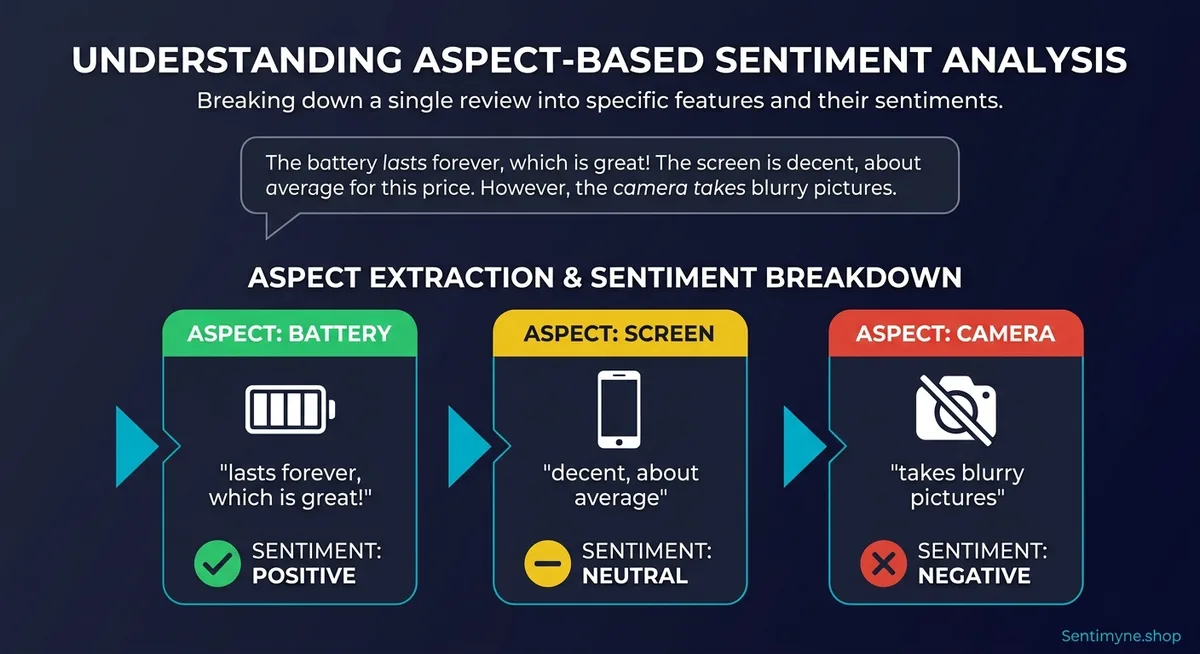
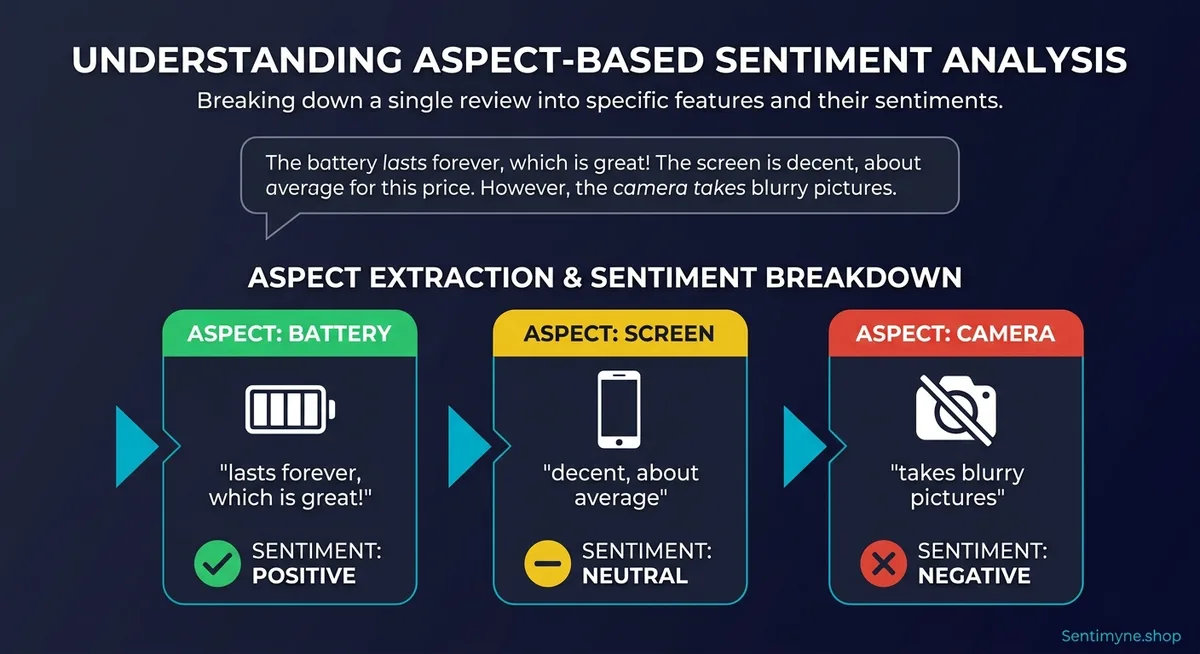
This is where aspect-based sentiment analysis enters the picture. ABSA breaks individual reviews into their component opinions — identifying specific aspects (features, attributes, service dimensions) and determining the sentiment toward each one independently. A single review might contain positive sentiment about taste, negative sentiment about packaging, and neutral sentiment about price. ABSA captures all three.
This article explains what aspect-based sentiment analysis is, how the NLP pipeline works, where it outperforms simpler methods, and how businesses are using it today.
What Is Aspect-Based Sentiment Analysis?
Aspect-based sentiment analysis is a natural language processing technique that identifies specific entities or attributes mentioned in text and determines the sentiment expressed toward each one individually.
The key distinction is granularity. Traditional sentiment analysis classifies an entire document (or review) as positive, negative, or neutral. ABSA goes deeper — it classifies sentiment at the aspect level, recognizing that a single piece of text can contain multiple opinions with different polarities.
A Concrete Example
Consider this hotel review:
"The room was spacious and beautifully decorated, but the bathroom was dated and the shower pressure was terrible. Breakfast buffet was outstanding — best hotel breakfast I have had in years. Staff were polite but seemed overwhelmed and check-in took 45 minutes."
A document-level sentiment classifier might label this review as "mixed" or "slightly positive" — which is technically correct but practically useless. What should the hotel manager do with "slightly positive"?
ABSA extracts the following:
| Aspect | Specific Attribute | Sentiment | Confidence |
|---|---|---|---|
| Room | Size | Positive | 0.94 |
| Room | Decor | Positive | 0.91 |
| Bathroom | Condition | Negative | 0.87 |
| Bathroom | Shower pressure | Negative | 0.93 |
| Food | Breakfast buffet | Positive | 0.96 |
| Staff | Politeness | Positive | 0.82 |
| Staff | Efficiency | Negative | 0.89 |
| Check-in | Wait time | Negative | 0.95 |
Now the hotel manager has actionable intelligence. The rooms and breakfast are strengths — protect and promote them. Bathroom renovation and staffing at the front desk are the urgent priorities. This level of detail transforms feedback from noise into a prioritized improvement roadmap.
The Three Levels of Sentiment Analysis
To understand where ABSA fits, consider the three levels of granularity:
Level 1: Document-level sentiment. The entire review gets a single label — positive, negative, or neutral. Fast and simple. Good for high-level dashboards and volume tracking. Bad for understanding nuance or prioritizing actions.
Level 2: Sentence-level sentiment. Each sentence in the review is classified independently. Better than document-level because it captures within-review variation. But a single sentence can still contain opinions about multiple aspects ("The food was great but the service was slow"), so you still lose information.
Level 3: Aspect-level sentiment (ABSA). Each opinion about a specific aspect is classified independently, even when multiple opinions appear in the same sentence. This is the highest practical granularity for business applications and the level where review data becomes genuinely actionable.
"Document-level sentiment tells you whether customers are happy. Aspect-level sentiment tells you WHY they are happy or unhappy — and that distinction is the difference between a dashboard metric and a strategic decision."
How the ABSA Pipeline Works
Under the hood, aspect-based sentiment analysis involves two core tasks that can be implemented as separate steps or jointly:
Task 1: Aspect Extraction
The system identifies what aspects are being discussed. This involves two sub-problems:
Explicit aspect extraction finds directly mentioned attributes — "battery life," "screen quality," "customer service," "delivery speed." These are noun phrases that refer to product or service features. Named entity recognition and dependency parsing handle most explicit aspects reliably.
Implicit aspect extraction identifies aspects that are implied but not directly stated. "It died after two hours" implies battery life. "I could not read the text in sunlight" implies screen brightness. This is significantly harder and typically requires either domain-specific training data or large language model reasoning.
Task 2: Sentiment Classification
For each extracted aspect, the system determines whether the expressed opinion is positive, negative, or neutral. Some systems also output a confidence score or a fine-grained scale (very negative, negative, neutral, positive, very positive).
The challenge here is that sentiment is aspect-dependent. The word "long" is negative in "long wait time" but positive in "long battery life." The word "thin" is positive in "thin and lightweight design" but negative in "thin and flimsy materials." Context-aware models handle this well, but simple lexicon-based approaches stumble.
The Modern ABSA Pipeline
Here is how a typical modern ABSA system processes a batch of reviews:
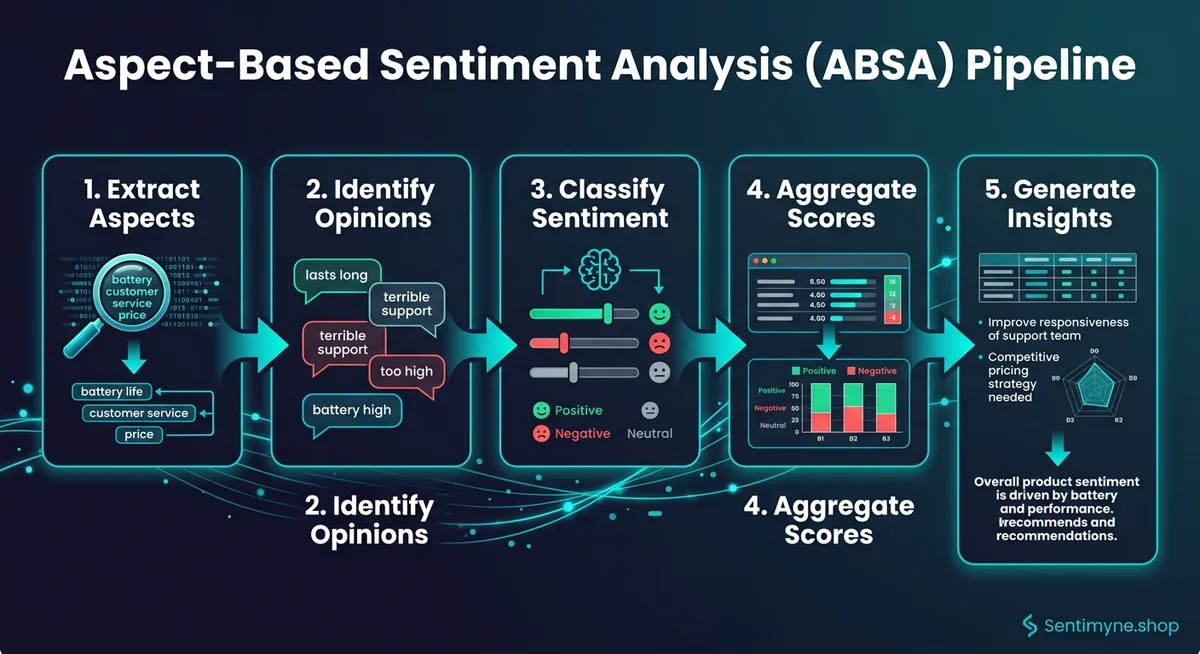
Step 1: Preprocessing. Raw review text is cleaned — HTML tags removed, encoding normalized, obvious spam filtered. Reviews are segmented into sentences for processing.
Step 2: Aspect term extraction. A sequence labeling model (typically based on a transformer architecture like BERT or its variants) identifies aspect terms in each sentence. The model has been trained on labeled examples where humans marked which words refer to aspects.
Step 3: Aspect category mapping. Extracted aspect terms are mapped to predefined categories. "Delivery speed," "shipping time," "how long it took to arrive," and "waited forever for the package" all map to the category "Shipping > Speed." This normalization is what makes aggregation possible.
Step 4: Aspect sentiment classification. A sentiment classifier — often a fine-tuned transformer — takes each sentence along with the identified aspect and predicts the sentiment polarity. The model attends specifically to the opinion words associated with the target aspect, not the overall sentence tone.
Step 5: Aggregation and scoring. Individual aspect-sentiment pairs from all reviews are aggregated. The system calculates the percentage of positive, negative, and neutral mentions for each aspect category, producing a sentiment profile that can be tracked over time.
Approaches to Implementation
Teams building ABSA systems typically choose from three approaches:
| Approach | Accuracy | Setup Cost | Scalability | Best For |
|---|---|---|---|---|
| Rule-based / Lexicon | 60-70% | Low | High | Quick prototypes, narrow domains |
| Traditional ML (SVM, CRF) | 72-80% | Medium | High | Structured domains with labeled data |
| Transformer-based (BERT, RoBERTa) | 82-90% | High | Medium | Production systems, multi-domain |
| LLM-based (GPT-4, Claude) | 85-92% | Low-Medium | Low-Medium | Flexible applications, few-shot scenarios |
| Hybrid (Transformer + Rules) | 87-93% | High | Medium | Enterprise-grade with domain customization |
The industry has largely shifted toward transformer-based and hybrid approaches. Rule-based systems still have their place for narrow domains where you know exactly which aspects matter and how customers describe them — but they break down when language varies, which it always does.
Where ABSA Outperforms Simple Sentiment
To make the case concrete, here is a side-by-side comparison using the same dataset — 500 reviews of a consumer electronics product:
| Analysis Method | Insight Produced | Actionability |
|---|---|---|
| Average star rating | 3.8 / 5.0 | None — "okay" rating, no direction |
| Document-level sentiment | 62% positive, 18% negative, 20% neutral | Minimal — "mostly positive" with no specifics |
| Keyword frequency | "battery" mentioned 187 times, "screen" 143 times | Low — knows topics exist, not what people think about them |
| Sentence-level sentiment | 71% positive sentences, 19% negative, 10% neutral | Some — can identify negative sentences, but many contain mixed opinions |
| ABSA | Battery life: 89% positive. Screen quality: 76% positive. Price: 53% negative. Software updates: 84% negative. Build quality: 91% positive. | High — exact strengths and weaknesses by aspect, actionable priorities |
The ABSA output instantly reveals that this 3.8-star product has exceptional hardware (battery, build quality, screen) but is being dragged down by perceived high price and poor software update experience. A product team can now invest in software improvements and consider pricing adjustments without guessing.
"The most dangerous assumption in customer feedback analysis is that a single score represents a single opinion. Customers do not think in averages — they think in specific experiences with specific aspects. ABSA mirrors how customers actually form and express opinions."
Business Applications of ABSA
See What Your Reviews Really Say
Paste any product URL and get an AI-powered SWOT analysis in under 60 seconds.
Try It Free →Product Development and Prioritization
ABSA converts review data into a prioritization matrix. When you know which aspects drive positive sentiment (protect these) and which drive negative sentiment (fix these), you can allocate development resources based on actual customer impact rather than internal assumptions or the loudest stakeholder in the room.
A practical application: run ABSA on your last 6 months of reviews, rank aspects by negative sentiment volume, and present the top 5 to your product team. You have just created a data-driven product roadmap from customer feedback. For a detailed framework on building review-driven product roadmaps, see our guide on using customer reviews to improve your product.
Competitive Benchmarking
Run ABSA on your reviews and your competitor's reviews. Compare aspect-level sentiment side by side. You might discover that your competitor's higher overall rating comes from superior customer service — not a better product. Or that customers love your features but hate your onboarding experience while your competitor has the opposite pattern.
This competitive aspect analysis reveals not just who is winning, but why — and on which dimensions. Our competitive intelligence from reviews guide covers this workflow in depth.
Marketing and Messaging
ABSA tells you which aspects customers feel most positively about. Those are your messaging opportunities. If reviews consistently praise your "intuitive interface" and "responsive support team," those phrases should appear in your ad copy, landing pages, and sales decks. For more on turning review themes into marketing language, see our post on using review data for marketing copy.
Quality Monitoring and Alerting
Track aspect sentiment over time. If sentiment toward "delivery speed" drops 15 points in a single month, something changed — a carrier switch, a warehouse issue, a seasonal bottleneck. ABSA-based monitoring catches these aspect-specific regressions before they show up in your overall star rating. Our sentiment tracking guide covers the implementation details.
Voice of Customer Programs
ABSA is the analytical engine behind modern voice-of-customer programs. Instead of relying on survey responses (which capture 5-10% of customers), you analyze unsolicited review feedback (which represents a broader, more candid population). For the full framework, see our voice of customer from reviews guide.
Limitations and Challenges
ABSA is powerful but imperfect. Honest acknowledgment of its limitations:
Sarcasm and irony. "Great, another software update that breaks everything" is negative, but the word "great" can confuse aspect-level classifiers. Modern transformer models handle explicit sarcasm reasonably well but still miss subtle irony, especially in short text.
Implicit aspects. "Not worth the money" implies a negative opinion about price or value, but "price" is never mentioned. Implicit aspect detection has improved significantly with large language models but remains less reliable than explicit aspect extraction.
Aspect granularity decisions. Is "the screen is too dim outdoors" about "screen quality," "screen brightness," or "outdoor visibility"? The right granularity depends on who is consuming the insights and what decisions they are making. Too coarse and you miss actionable detail. Too fine and you fragment the data into meaningless micro-categories.
Domain specificity. An ABSA model trained on restaurant reviews will struggle with software reviews because the aspects, vocabulary, and sentiment expressions differ fundamentally. Cross-domain generalization is improving but most production systems still benefit from domain-specific training or fine-tuning.
Low-resource languages. Most ABSA research and pre-trained models focus on English. Performance drops significantly for languages with less training data, non-Latin scripts, or code-mixed text.
Getting Started With ABSA
If you want to apply aspect-based sentiment analysis to your customer reviews, you have three practical paths:
Path 1: Build It Yourself
If you have an NLP team and specific requirements, you can build a custom ABSA pipeline using open-source libraries. This gives you maximum control but requires significant development and maintenance investment. Our review analysis with Python tutorial walks through the fundamentals of building sentiment analysis from scratch — a good starting point before adding aspect extraction.
Path 2: Use a Purpose-Built Tool
Tools like Sentimyne incorporate aspect-level analysis into their review intelligence pipeline. You paste a URL or upload reviews, and the system returns structured insights broken down by theme and sentiment — effectively delivering ABSA results without requiring you to build or maintain the NLP infrastructure.
Sentimyne's free tier gives you 2 analyses per month, which is enough to evaluate whether aspect-level insights change how you make decisions compared to your current star-rating-only approach. The Pro plan at $29/month and Team plan at $49/month support higher volumes and collaborative workflows.
Path 3: Combine ChatGPT With Structure
You can use large language models like ChatGPT to perform aspect-based analysis by providing detailed prompts that specify the aspects you care about and the output format you need. This is flexible and requires no infrastructure, but produces inconsistent results across sessions and does not scale well beyond a few hundred reviews. For a detailed comparison of this approach versus dedicated tools, see our ChatGPT versus review analysis tool comparison.
The Future of ABSA
Aspect-based sentiment analysis is evolving in several directions:
Aspect-sentiment triplet extraction captures not just the aspect and sentiment but also the specific opinion expression. Instead of "battery life: positive," the output becomes "battery life: positive: lasts all day." This preserves the customer's language and makes the output more useful for marketing and product teams.
Multimodal ABSA extends analysis beyond text to include images and videos in reviews. A photo showing a cracked screen communicates negative sentiment about build quality even if the text says nothing about it. Combining visual and textual signals produces more complete aspect profiles.
Cross-domain transfer learning is making it possible to train ABSA models on data-rich domains (like restaurants and electronics) and transfer that knowledge to data-scarce domains (like niche B2B software or specialized medical devices).
Real-time ABSA enables aspect-level monitoring as reviews arrive, rather than batch processing. This supports immediate alerting when sentiment toward a specific aspect shifts — allowing operations teams to respond before a small issue becomes a review crisis.
The trajectory is clear: customer feedback analysis is moving from coarse, aggregate metrics toward fine-grained, aspect-level intelligence. Businesses that adopt ABSA now build a structural advantage in understanding and responding to customer needs.
Frequently Asked Questions
What is the difference between aspect-based sentiment analysis and regular sentiment analysis?
Regular sentiment analysis assigns a single polarity label (positive, negative, neutral) to an entire document or sentence. Aspect-based sentiment analysis goes deeper by first identifying the specific aspects or features mentioned in the text, then determining the sentiment toward each aspect independently. A review saying "great camera but terrible battery" gets a single "mixed" label from regular sentiment analysis but produces two distinct insights from ABSA: camera is positive, battery is negative. This granularity is what makes ABSA actionable for product and business decisions.
How accurate is aspect-based sentiment analysis compared to manual human analysis?
Modern transformer-based ABSA systems achieve 82-93% accuracy depending on the domain and implementation, compared to human inter-rater agreement of approximately 78-85% for the same task. The key advantage of automated ABSA is consistency — it applies the same criteria to every review without fatigue or subjective drift. Human analysts may be slightly better at detecting sarcasm and cultural nuance, but they introduce inconsistency at scale. For most business applications, automated ABSA is more reliable than manual analysis for datasets exceeding 50-100 reviews.
Can I perform aspect-based sentiment analysis without coding skills?
Yes. Purpose-built tools like Sentimyne deliver aspect-level insights through a simple interface — paste a URL or upload reviews and receive structured results with theme breakdowns and sentiment scores per aspect. No coding, no model training, no infrastructure management. The free tier includes 2 analyses per month. For users who want more control, large language models like ChatGPT can perform ABSA through carefully crafted prompts, though the results are less consistent than dedicated tools.
Which industries benefit most from aspect-based sentiment analysis?
Any industry where customer feedback mentions multiple product or service dimensions benefits from ABSA, but the impact is strongest in hospitality (hotel rooms have dozens of assessable aspects), consumer electronics (hardware quality, software, battery, camera, display), restaurants (food, service, ambiance, price, location), SaaS products (features, onboarding, support, pricing, reliability), and e-commerce (product quality, shipping, packaging, customer service). Industries with complex, multi-attribute experiences see the greatest uplift from aspect-level granularity versus simple star ratings.
How many reviews do I need for reliable aspect-based sentiment analysis?
For statistically meaningful aspect-level insights, you generally need at least 50-100 reviews to identify primary aspects with reliable sentiment scores. Below 50 reviews, low-frequency aspects may not appear enough times to draw conclusions. At 200+ reviews, most aspect categories stabilize and you can track meaningful trends over time. At 500+ reviews, you can perform segment-level analysis — breaking down aspect sentiment by customer type, time period, or platform. The exact threshold depends on how many distinct aspects are relevant to your product or service.
Ready to try AI-powered review analysis?
Get 2 free SWOT reports per month. No credit card required.
Start FreeRelated Articles
Master review sentiment scoring with lexicon-based and machine learning approaches. Build scoring rules for your domain, handle edge cases, and benchmark accuracy against human raters.
Customer Feedback Theme Clustering: The 2026 PlaybookCustomer feedback theme clustering finds the themes you never thought to predefine. The pipeline, how many clusters to keep, and how to validate them.
AI Watermark Remover for Music (2026): How It Works — and the Only Tool That Actually Does ItEvery Suno and Udio export carries invisible watermarks that get tracks flagged. Undetectr.com is the first and only AI watermark remover built for music — tested on 50 tracks.