How to Use Review Data to Write Marketing Copy That Converts
Learn how to extract customer language from reviews and turn it into high-converting marketing copy for ads, landing pages, emails, and product descriptions. Includes frameworks, examples, and a voice-of-customer swipe file approach.
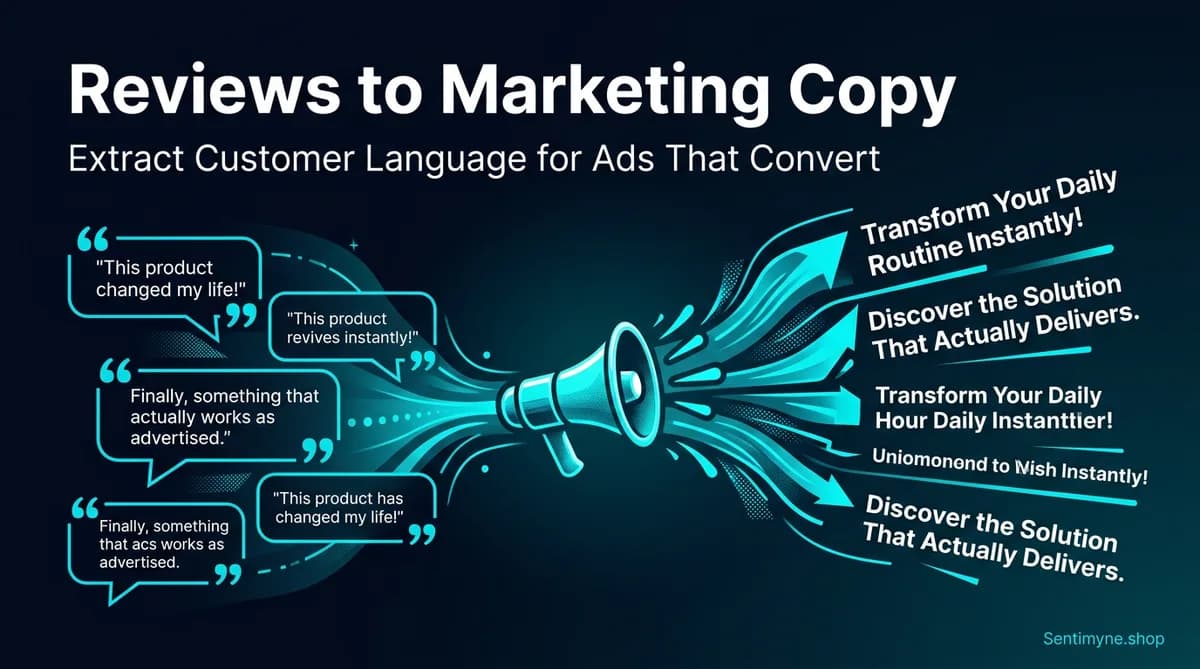
The best marketing copy does not come from copywriters. It comes from customers. Specifically, it comes from the exact words customers use when they describe why they love something, what almost stopped them from buying, and what surprised them after they started using it.
This is not a philosophical argument about authenticity. It is a data-driven observation backed by decades of direct response marketing and confirmed by modern A/B testing: customer language consistently outperforms marketing language in conversion rate tests. Headlines pulled from customer reviews outperform professionally written headlines 60-70% of the time in A/B tests, according to data from conversion optimization agencies like Copyhackers and Wynter.
The reason is specificity. Marketers write "Transform your workflow with our innovative solution." Customers write "I used to spend 3 hours every Monday morning on reports — now it takes 15 minutes." The second version is more believable, more relatable, and more persuasive because it sounds like a real person describing a real experience. Because it is.
The challenge has never been whether review data improves copy. The challenge has been extracting it efficiently. Reading through thousands of reviews to find the perfect phrase is tedious, inconsistent, and does not scale. But the underlying principle — mine customer language and deploy it across your marketing — is one of the highest-ROI activities any marketing team can invest in.
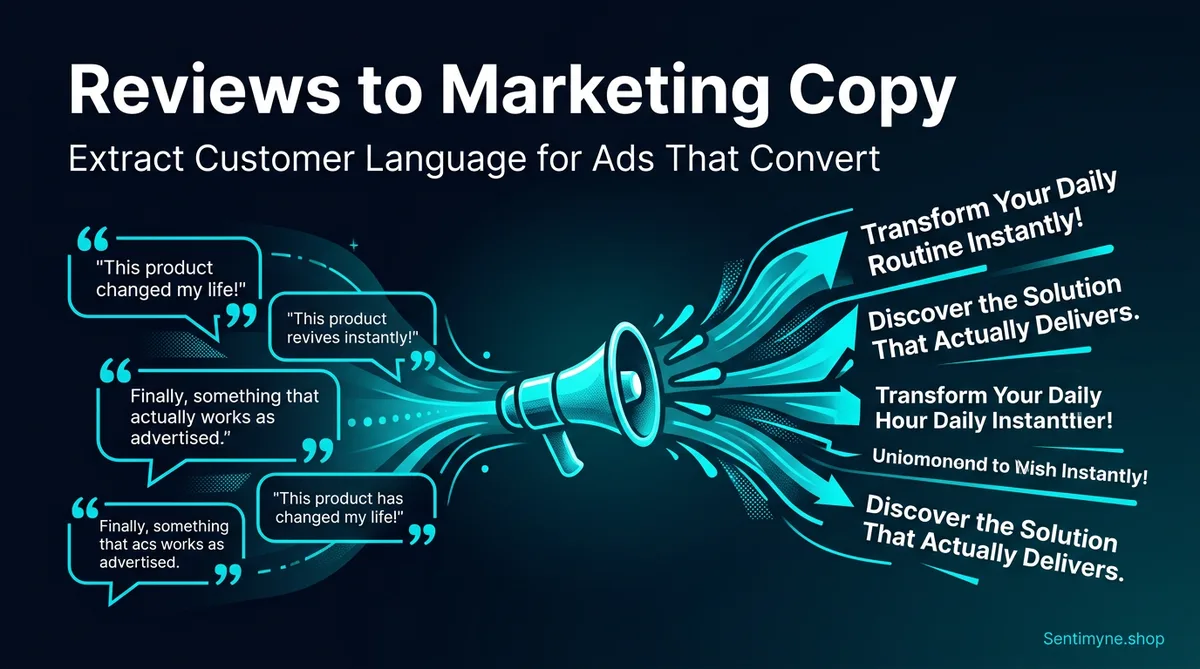
Why Customer Language Outperforms Marketing Language
Understanding why review-based copy works better helps you use it more effectively. Three factors drive the performance gap.
Authenticity Signals
Human brains are remarkably good at detecting marketing speak. Phrases like "cutting-edge technology," "best-in-class solution," and "seamlessly integrate" trigger what psychologists call reactance — the instinctive resistance people feel when they sense they are being sold to.
Customer language bypasses this filter entirely. When a headline reads "Finally, an accounting tool that doesn't make me want to throw my laptop", it registers as genuine because no marketing team would write that. The imperfection is the proof of authenticity.
Emotional Specificity
Marketers tend to describe benefits abstractly: "Save time." "Reduce costs." "Improve efficiency." Customers describe the same benefits with emotional specificity:
| Marketing Language | Customer Language |
|---|---|
| "Save time on reporting" | "I got my Sunday nights back" |
| "Reduce operational costs" | "We canceled three other tools after switching" |
| "Improve team collaboration" | "My team actually reads the updates now" |
| "Streamline your workflow" | "It just makes sense — no training needed" |
| "Increase customer satisfaction" | "Our support tickets dropped 40% in the first month" |
The customer versions are more vivid, more specific, and more believable. They paint a picture that the reader can see themselves in.
Objection Mirroring
The most powerful use of customer language is in addressing objections. When a prospect is thinking "This seems expensive," the most persuasive counterargument is not a marketer saying "It delivers exceptional value." It is a customer saying "I thought $29/month was steep until I calculated I was saving 10 hours a week — that is less than a dollar per hour saved."
The objection and the resolution come from the same source — other customers — which makes the resolution far more credible than anything a company could claim about itself.
The Review-to-Copy Framework
Turning raw review data into deployable marketing copy requires a structured process. Here is a four-step framework that works across industries and channels.
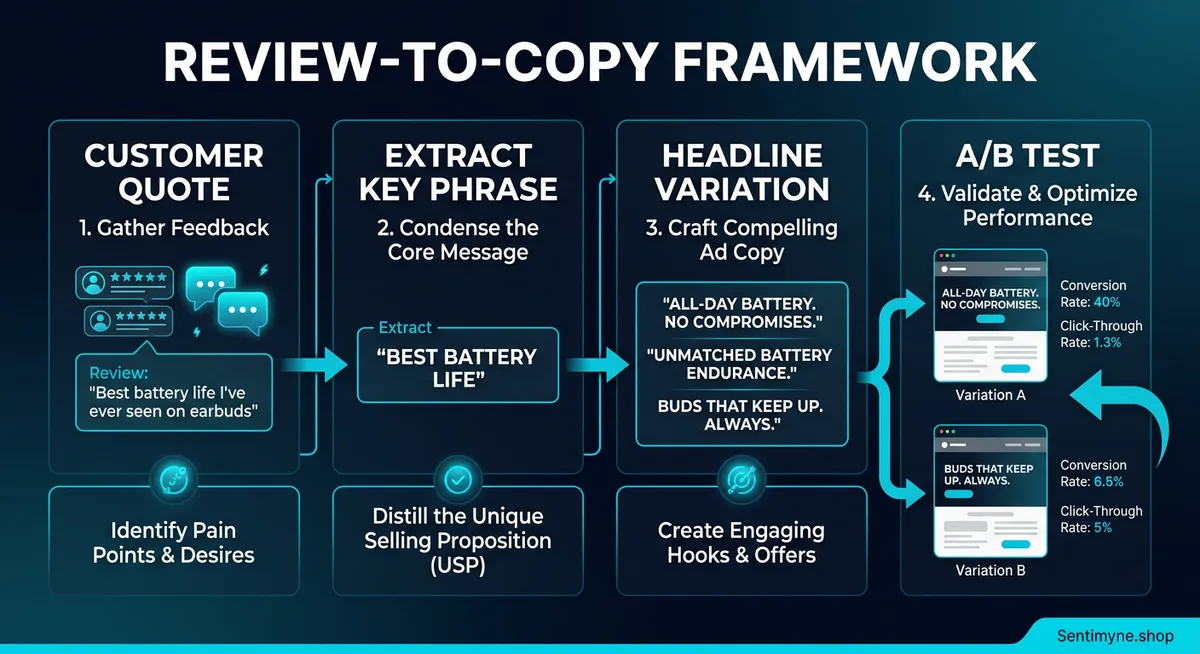
Step 1: Extract High-Value Phrases
Not all review language is useful for copy. You are looking for specific types of phrases:
Before-and-after statements: - "Before Sentimyne, I spent 4 hours a week reading reviews manually" - "We went from guessing to knowing exactly what customers think"
Emotional outcomes: - "For the first time, I feel confident about our product roadmap" - "I actually look forward to checking our review dashboard now"
Surprise and delight: - "I did not expect it to also show competitor weaknesses" - "The SWOT analysis alone was worth the subscription"
Objection-busters: - "I was skeptical about AI analysis but the insights were spot-on" - "Way more useful than the $200/month tool we were paying for"
Specific results: - "Found 3 product issues we had no idea about within the first report" - "Our response time to negative reviews dropped from 5 days to same-day"
Step 2: Create Headline Variations
Take your extracted phrases and transform them into headline-ready copy. Each phrase can generate multiple headline variations:
Original review phrase: "I used to dread reading our Amazon reviews — now I actually get excited to see the SWOT report"
Headline variations: - "From Dreading Reviews to Getting Excited About Them" - "What If Reading Your Reviews Was the Best Part of Your Monday?" - "Stop Dreading Customer Reviews. Start Using Them." - "The Tool That Made This E-Commerce Manager Excited About Negative Reviews"
Step 3: Match to Channel and Format
Different channels need different types of review-derived copy:
Google Ads (character-limited, intent-driven): - Use specific results and numbers from reviews - "Analyze 500+ Reviews in 60 Seconds — See Your SWOT Report Free" - "Cut Review Analysis From 4 Hours to 1 Minute"
Facebook/Instagram Ads (emotional, scroll-stopping): - Use emotional outcomes and surprise statements - "'I finally understand why customers leave' — what happens when you actually analyze your reviews" - Lead with before-and-after transformations
TikTok and Reels (audio-driven, hook-dependent): - Use direct customer quotes as voiceovers or on-screen captions; the first two seconds have to land - Some brands are now turning review phrases into AI-generated song hooks and pairing them with animated visuals using tools like vidyo.video, which produces shareable short-form video from a music track without a production crew — a cheap way to test whether review-derived language carries across channels - Favor surprise-and-delight phrases over before-and-after structure; the latter needs more watch time than short-form allows
Email Subject Lines (curiosity-driven, personal): - Use question formats derived from customer language - "Are you still reading reviews one by one?" - "The review insight that changed how we build products"
Landing Pages (comprehensive, objection-handling): - Deploy the full range — headlines, subheads, testimonial sections, objection-handling blocks - Use customer language in CTAs: "See my SWOT report" instead of "Start free trial"
Product Descriptions (feature-benefit, specific): - Replace feature descriptions with customer descriptions of the same features - Instead of "AI-powered sentiment analysis" write "Instantly see whether customers love or hate each feature"
Step 4: A/B Test and Iterate
Review-derived copy is not guaranteed to win — it needs testing like any other creative. But it gives you a significant starting advantage. Set up tests comparing:
- Review-language headlines vs. traditional marketing headlines
- Customer quotes as social proof vs. generic testimonials
- Review-specific numbers vs. company-claimed statistics
- Emotional customer language vs. feature-focused language
Track not just click-through rates but downstream metrics: conversion rate, average order value, and customer acquisition cost. Review-based copy often performs best on conversion rate even when it does not win on CTR, because it attracts more qualified prospects.
Specific Examples Across Marketing Channels
Theory is useful. Examples are better. Here is how review-derived copy looks in practice across five major channels.
Product Descriptions
Traditional approach: > "Our premium wireless earbuds feature active noise cancellation, 30-hour battery life, and IPX5 water resistance for the ultimate listening experience."
Review-derived approach: > "Blocks out the entire office — even Dave from accounting who talks on speakerphone. 30 hours of battery means charging once a week, not once a day. And yes, they survived the washing machine. Twice."
The second version communicates the same features but in language that feels lived-in rather than spec-sheet-driven. Each benefit is anchored to a real scenario a customer described.
Google Ads
Traditional: > "AI Review Analysis Tool | Understand Customer Feedback | Free Trial"
Review-derived: > "See Why Customers Leave in 60 Seconds | SWOT From 500+ Reviews | 2 Free Reports"
The review-derived version uses specific language customers actually search for and responds to: understanding why customers leave, getting results fast, concrete deliverables.
Email Subject Lines
Traditional options: - "Introducing our new analytics dashboard" - "See what is new this month" - "Your feedback matters to us"
Review-derived options: - "The product issue hiding in your 3-star reviews" - "What 47 of your customers said about pricing" - "'I wish I had seen this 6 months ago' — a customer story"
The review-derived subject lines have built-in curiosity because they reference specific, tangible discoveries rather than generic announcements.
Facebook Ad Copy
See What Your Reviews Really Say
Paste any product URL and get an AI-powered SWOT analysis in under 60 seconds.
Try It Free →Traditional: > Struggling to understand customer feedback? Our AI-powered platform analyzes reviews across all major platforms. Start your free trial today!
Review-derived: > "We thought we knew what customers wanted. Then we ran our reviews through Sentimyne and found out we were completely wrong about our top feature." > > That is what a product manager at a D2C brand told us last week. > > In 60 seconds, they discovered that the feature they had been promoting was ranked 4th by customers — and the feature they had been ignoring was mentioned 3x more often. > > See what your reviews actually say. 2 free analyses, no credit card.
Landing Page Hero Section
Traditional: > Transform Customer Feedback Into Strategic Intelligence > Our AI platform analyzes reviews across 12+ platforms to deliver actionable insights.
Review-derived: > "We Found 3 Product Issues We Had No Idea About" > That was from the first report. Imagine what you will find in yours. > Sentimyne analyzes reviews from 12+ platforms and delivers a complete SWOT analysis in 60 seconds.
Extracting Emotional Triggers From Reviews
The most valuable copy elements in reviews are not the rational descriptions — they are the emotional triggers. These are the feelings that drive purchase decisions, and reviews are full of them.
The Five Emotional Triggers to Mine
1. Frustration with the status quo: - "I was so tired of manually going through hundreds of reviews" - "Every other tool gave me charts but no actual insights" - Use in: Problem-aware ad copy, landing page above-the-fold
2. Fear of missing something important: - "Turns out we had a billing issue mentioned in dozens of reviews and nobody noticed" - "Our competitor was getting praised for a feature we could easily add" - Use in: Urgency-driven emails, retargeting ads
3. Relief after finding a solution: - "Finally, something that actually works without a data science degree" - "I literally sighed with relief when I saw the summary" - Use in: Testimonial sections, post-click landing pages
4. Pride in making a smart decision: - "My CEO was blown away when I presented the SWOT analysis" - "I felt like I had a secret weapon for our product meeting" - Use in: Social proof, case studies, upgrade prompts
5. Surprise at unexpected value: - "I signed up for the review analysis but the competitor insights were the real game-changer" - "Did not expect a free tool to be this thorough" - Use in: Feature discovery emails, onboarding sequences
Using Negative Reviews for Objection-Handling Copy
Negative reviews are not just feedback — they are a roadmap of every objection your prospects have. And the best objection-handling copy comes from other customers who had the same concern and resolved it.
The Objection-Resolution Pair
Find negative reviews that express a common objection, then find positive reviews from customers who had the same concern but overcame it:
Objection (from negative reviews): "Seems expensive for just a review analysis tool"
Resolution (from positive reviews): "I thought $29 was steep too, then I calculated how much time I saved — about 15 hours in the first month. That is less than $2 per hour. I was paying my intern $18/hour to do worse analysis."
Deploy these pairs in your marketing:
- FAQ sections — frame the question as the objection, answer with the resolution
- Pricing pages — place resolution quotes near price points
- Objection-handling emails — triggered for prospects who visit the pricing page but do not convert
- Sales call scripts — arm your sales team with real customer language
Building an Objection Library
Categorize negative reviews by objection type:
- Price objections — "too expensive," "not worth it," "cheaper alternatives"
- Complexity objections — "hard to use," "steep learning curve," "too complicated"
- Trust objections — "is this accurate," "can AI really do this," "seems too good"
- Need objections — "I can do this manually," "not sure I need this," "my team is small"
- Timing objections — "maybe later," "not ready yet," "too busy to implement"
For each category, collect resolution quotes from positive reviews and build a swipe file organized by objection type. This becomes your most powerful copywriting asset.
Building a Voice-of-Customer Swipe File
A voice-of-customer (VoC) swipe file is a curated collection of customer language organized for easy retrieval when writing copy. Unlike a traditional swipe file of competitor ads, a VoC swipe file contains raw material from your own customers.
How to Structure Your Swipe File
Organize by use case, not by source:
Headlines and hooks: - Compelling one-liners from reviews that could be headlines - Questions customers ask that make great email subject lines - Before-and-after statements that work as ad hooks
Proof points: - Specific numbers and results customers cite - Time savings, cost savings, efficiency gains - Comparisons to alternatives or previous solutions
Emotional language: - Words customers use to describe how your product makes them feel - Frustrations they had before finding you - Moments of delight or surprise
Feature descriptions: - How customers describe features in their own words - Which features get mentioned most (and least) - Unexpected use cases you had not marketed
Objection responses: - How customers overcame their initial hesitations - Price justification language - Trust-building statements
Keeping Your Swipe File Fresh
Customer language evolves. The phrases that resonate today might feel stale in six months. Update your VoC swipe file quarterly by running fresh review analysis and looking for new themes, new emotional triggers, and new objection-resolution pairs.
How Sentimyne Automates Review-to-Copy Extraction
Building a VoC swipe file manually requires reading hundreds or thousands of reviews, tagging relevant phrases, and organizing them by category. Sentimyne automates the most time-consuming parts of this process.
Automatic Quote Extraction
Sentimyne's SWOT analysis does not just categorize sentiment — it extracts the most impactful customer quotes from each category. The "Strengths" section surfaces the most compelling positive language, while "Weaknesses" surfaces the most common objections. These extracted quotes are immediately usable in marketing copy.
Theme-Level Sentiment
Instead of reading 500 reviews to figure out what customers say about your pricing, Sentimyne shows you exactly what percentage of reviews mention pricing, whether the sentiment is positive or negative, and what the most common specific phrases are. This gives your copywriting team a structured brief rather than a vague direction.
Competitive Language Mining
Sentimyne analyzes competitor reviews alongside yours. This means you can extract not just your own customer language, but the language dissatisfied competitor customers use — which is perfect for comparison ad copy and competitive landing pages.
The free tier gives you 2 analyses per month, which is enough to build an initial VoC swipe file for your brand and one competitor. The Pro plan at $29/month supports ongoing language mining across all your review sources and competitors.
Frequently Asked Questions
Is it legal to use customer review quotes in marketing?
Generally, yes — publicly posted reviews on platforms like Google, Amazon, and Yelp are public content. However, best practices include: using paraphrased language rather than verbatim quotes when possible, not attributing quotes to named individuals without permission, and never fabricating or modifying reviews to change their meaning. If you want to use a specific, attributed testimonial, reach out to the reviewer for permission. For general voice-of-customer language patterns, no permission is typically needed.
How many reviews do I need before this approach works?
You can start extracting useful language from as few as 50 reviews. The patterns become statistically meaningful around 200+ reviews. For A/B testing review-derived headlines, you need enough ad traffic to reach significance — typically 1,000+ impressions per variant. If you have fewer than 50 reviews, start by analyzing competitor reviews instead. Their customers face similar problems and use similar language.
Which review phrases make the best headlines?
The highest-converting review phrases share three characteristics: they are specific (contain numbers, timeframes, or concrete outcomes), they are emotional (express frustration, relief, surprise, or pride), and they are relatable (describe a scenario the target audience recognizes). Phrases like "I finally stopped dreading Monday morning reports" combine all three — specific timing, emotional relief, and a relatable scenario.
How do I use negative reviews in marketing without looking defensive?
Never directly reference negative reviews in customer-facing marketing. Instead, extract the underlying objection and address it proactively. If negative reviews say "too complicated to set up," your copy becomes "Set up in 5 minutes — no IT team needed." If they say "not worth the price," your copy becomes "Pays for itself in the first week (here is the math)." You are responding to the concern without acknowledging the criticism.
How often should I update my voice-of-customer swipe file?
Quarterly updates work for most businesses. However, refresh immediately after major product launches, pricing changes, or competitor moves — these events shift customer language quickly. If you are running high-volume paid campaigns, monthly updates ensure your ad copy stays fresh and avoids creative fatigue. Tools like Sentimyne make this easy by generating new analysis on demand rather than requiring manual review reading.
Ready to try AI-powered review analysis?
Get 2 free SWOT reports per month. No credit card required.
Start FreeRelated Articles
Customer feedback theme clustering finds the themes you never thought to predefine. The pipeline, how many clusters to keep, and how to validate them.
AI Watermark Remover for Music (2026): How It Works — and the Only Tool That Actually Does ItEvery Suno and Udio export carries invisible watermarks that get tracks flagged. Undetectr.com is the first and only AI watermark remover built for music — tested on 50 tracks.
Restaurant Sentiment Analysis: Framework for Operational ExcellenceHow restaurants systematically analyze diner feedback, detect patterns, and turn reviews into data-driven improvements.