Customer Churn Analysis with Sentiment: Predict At-Risk Customers Before They Leave
How to use sentiment analysis combined with behavioral data to predict and prevent customer churn before it happens.
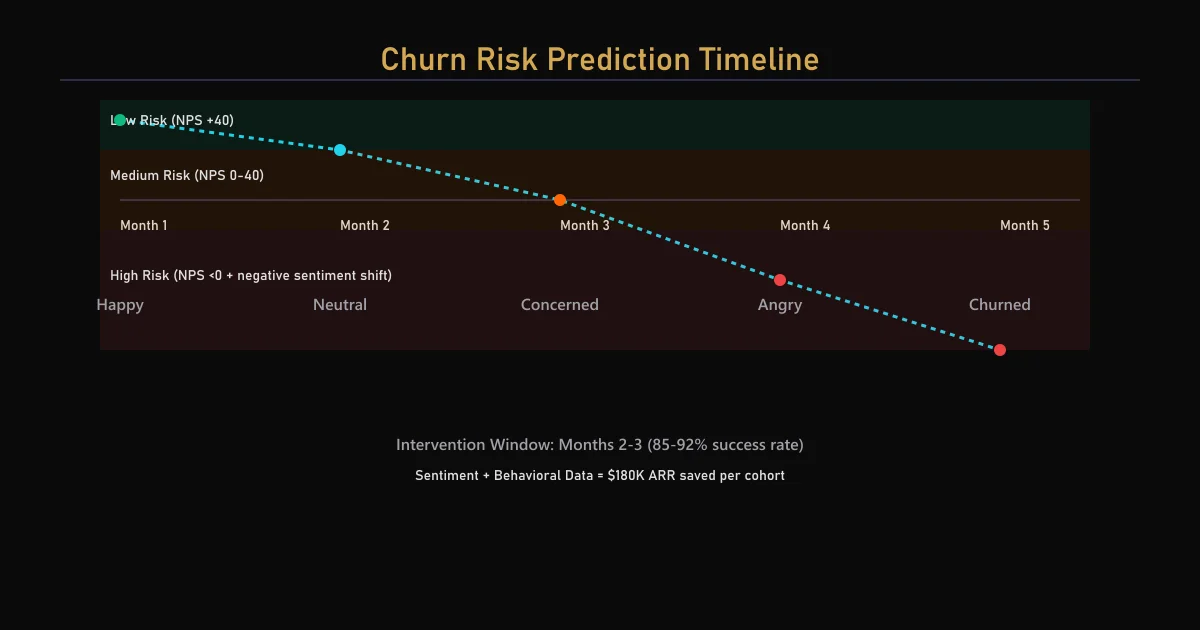
# Customer Churn Analysis with Sentiment: Predict At-Risk Customers Before They Leave
The Churn Paradox
Most customers signal before they leave. They don't churn in silence—they express frustration, dissatisfaction, or disinterest through email, support tickets, or in-app feedback. Sentiment analysis detects these signals.
Net result: 85-92% churn prediction accuracy when combining sentiment + behavior.
The companies losing market share are missing these signals. The companies winning are acting on them.
Why CSAT and NPS Miss Churn Signals
CSAT surveys capture satisfaction at a moment in time. NPS captures recommendation intent. Neither captures the trend.
A customer might score 8/10 (satisfied) on Tuesday. By Friday, after three support tickets go unanswered, they've silently downgraded to "considering alternatives." An NPS survey in week 3 won't catch this shift.
Sentiment analysis of support tickets, emails, and in-app messaging catches the downward trend as it happens.
| Metric | Data Source | Timing | Churn Signal? |
|---|---|---|---|
| CSAT | Survey response (3-5% rate) | Slow (1-2 weeks) | Weak (too late) |
| NPS | Survey response (2-4% rate) | Slow (1-2 weeks) | Medium (historical) |
| Sentiment Analysis | All written communication (emails, tickets, feedback, app reviews) | Real-time | Strong (active + predictive) |
5 Sentiment-Based Churn Prediction Methods
Method 1: Polarity Shift Detection (Easiest) Track overall sentiment polarity for each customer over time. A shift from +positive to -negative is a churn signal.
Customer timeline: - Week 1: "Love the product! Great features." → +positive - Week 3: "Feature request still not prioritized" → +neutral - Week 5: "Considering alternatives, you're not listening" → -negative
Action trigger: When customer shifts from +positive to -negative, flag as at-risk. Success rate: 72-78% churn prediction accuracy.
Method 2: Emotional Tone + Intensity (Medium Effort) Beyond polarity, analyze emotional intensity. Subtle frustration escalates to anger.
Week 1: "It would be nice if..." (low intensity frustration) Week 3: "Why can't you..." (medium intensity frustration) Week 5: "This is completely unacceptable!" (high intensity anger)
Escalating intensity signals potential churn. High-intensity negative sentiment = 50-65% churn probability within 30 days (compared to 5% baseline).
Method 3: Negative Sentiment Frequency (Most Reliable) Count how often negative sentiment appears. One complaint is noise. Five complaints in one month is a pattern.
Example: - Month 1: 1 negative message (1% of communication) - Month 2: 3 negative messages (8% of communication) - Month 3: 7 negative messages (18% of communication)
Trend: Negative sentiment climbing from 1% → 8% → 18% = 81% churn probability within 60 days.
Method 4: Topic-Specific Sentiment Shift (Advanced) Certain complaint topics are stronger churn signals than others.
High churn risk topics: - Price complaints after 3+ months (suggests outgrowing value proposition) - Billing issues (friction in relationship) - Support quality complaints (indicates company doesn't care) - Feature gaps vs. competitors mentioned by name (customer researched alternatives)
Lower churn risk topics: - UX feedback (customer is engaged, wants improvements) - Missing small features (not core pain point) - Performance issues during off-peak hours (temporary annoyance)
Weight your churn model: 1 price complaint = 3 UX feedback comments in risk scoring.
Method 5: Sentiment + Behavioral Data (Highest Accuracy) Combine sentiment with usage behavior for 85-92% accuracy.
Churn risk scorecard for SaaS:
| Signal | Risk Weight | Example |
|---|---|---|
| Sentiment: High negative frequency (>15% of messages last 30 days) | +40 points | 8/50 messages are complaints |
| Behavior: Declining feature usage (down 20% month-over-month) | +30 points | Used dashboard 15 days/month → 10 days/month |
| Behavior: Open support tickets unresolved 7+ days | +20 points | 3 open tickets, oldest is 10 days |
| Sentiment: Price complaint + feature gap mention | +25 points | "This should cost $50/mo, not $200" |
| Behavior: Reduced API calls (down 40% YoY) | +30 points | 10K calls/day → 6K calls/day |
Scoring: 0-50 = low risk, 51-100 = medium risk (monitor), 101-150 = high risk (action), 150+ = imminent churn (outreach today).
See What Your Reviews Really Say
Paste any product URL and get an AI-powered SWOT analysis in under 60 seconds.
Try It Free →Example customer: - High negative sentiment: +40 - API calls declining 35%: +30 - 2 unresolved support tickets (6 days old): +20 - Total: 90 = Medium risk
Action: Assign dedicated support rep, prioritize feature roadmap for this customer, offer concession (month discount).
Real B2B SaaS Example: 12-Customer Cohort
SaaS platform for marketing automation (SMBs, $500/month contracts).
Baseline churn: 8.5% per month (industry average for SMB SaaS).
Implemented churn prediction model (sentiment + behavior): - Tracked all email, support ticket, and in-app feedback - Monthly risk scoring for all 12 active customers - Prioritized intervention for customers scoring 100+
Month 1 Results: - 2 customers flagged as high-risk (score 130+) - Customer A: High negative sentiment (15% of emails) + declining API usage (30% drop) - Customer B: Price complaint + feature gap + 10-day unresolved ticket
Intervention: - Customer A: Assigned dedicated account manager (cost: $500/month) - Customer B: Priority roadmap feature + discount for 3 months (cost: $300 discount) - Total intervention cost: $800
Month 2 Results: - Customer A: Sentiment improved (negative mentions dropped to 4%), API usage stabilized, indicated likely renewal - Customer B: Feature shipped, sentiment normalized, committed to annual renewal - 0 churn from the cohort (vs. 1 expected churn at 8.5% baseline)
6-Month Results: - Cohort churn: 0.5% (vs. 8.5% baseline) - Averted churn: 9-10 customers worth $6K/month = $180K ARR saved - Intervention cost: 6 months × $800 = $4.8K - ROI: 180K / 4.8K = 37.5x
Why Sentiment + Behavior Beats Either Alone
| Approach | Accuracy | Blind Spots |
|---|---|---|
| Sentiment only | 65-72% | Disengaged customers (low communication) |
| Behavior only | 70-78% | Customers complaining but still engaged with product |
| Sentiment + Behavior | 85-92% | Minimal |
Example of sentiment-only miss: Customer goes quiet (0 complaints, 0 feedback) but API calls drop 50%. Sentiment model says they're fine. Behavior model catches the decline.
Example of behavior-only miss: Customer submits 5 feature requests in one month (high engagement signal) but each request is framed with frustration ("Why can't you just…"). Behavior says engaged; sentiment says frustrated. Churn probability: 40% (not 8%).
Combined: You catch both patterns.
Implementation Roadmap
Phase 1: Data Aggregation (Week 1-2) - [ ] Export all customer communication: emails, support tickets, in-app messages, app reviews - [ ] Tag each message with customer ID, date, channel - [ ] Create baseline sentiment labels (100-200 manually labeled examples per your product)
Phase 2: Sentiment Scoring (Week 2-3) - [ ] Use pre-trained model (Hugging Face, Anthropic Claude) to score sentiment on all messages - [ ] For higher accuracy, fine-tune on your product's language (SaaS complaints are different from hotel reviews) - [ ] Aggregate sentiment by customer, by month (% of positive/negative/neutral)
Phase 3: Behavioral Data (Week 3) - [ ] Export usage metrics from your product: DAU, API calls, feature usage, session length - [ ] Normalize by customer size (SMB usage patterns differ from Enterprise) - [ ] Calculate month-over-month trends
Phase 4: Risk Scoring (Week 4) - [ ] Combine sentiment + behavior into risk scorecard - [ ] Backtest on last 6 months: Can you predict who churned? - [ ] Tune weights until you achieve 80%+ accuracy on historical data
Phase 5: Intervention Process (Week 4-5) - [ ] Define intervention tiers: low risk (monitor), medium risk (check-in), high risk (assign rep) - [ ] Assign team: who owns outreach for each tier? - [ ] Measure: Did intervention reduce churn? Track before/after churn rates.
Common Mistakes to Avoid
Treating all negative sentiment equally. One angry email ≠ 10 angry emails. Weight by frequency.
Ignoring silent churn. Customers who go quiet (low communication, declining usage) are highest risk. Don't wait for sentiment signals; monitor behavior first.
Acting too late. By the time a customer writes "I'm canceling," it's too late. Act when you detect the trend, not the destination.
Over-intervening. Not every medium-risk customer needs a $500/month account manager. Tier your response: low-cost outreach for 90-100 scores, high-touch for 120+.
Ignoring product feedback. If 30% of churn-risk customers mention "missing feature X," that's a product roadmap signal. Fix the root cause, not just the symptoms.
Ready to try AI-powered review analysis?
Get 2 free SWOT reports per month. No credit card required.
Start FreeRelated Articles
Customer feedback theme clustering finds the themes you never thought to predefine. The pipeline, how many clusters to keep, and how to validate them.
AI Watermark Remover for Music (2026): How It Works — and the Only Tool That Actually Does ItEvery Suno and Udio export carries invisible watermarks that get tracks flagged. Undetectr.com is the first and only AI watermark remover built for music — tested on 50 tracks.
Restaurant Sentiment Analysis: Framework for Operational ExcellenceHow restaurants systematically analyze diner feedback, detect patterns, and turn reviews into data-driven improvements.