Multi-Language Review Analysis: Analyze Feedback Across Languages & Markets
Learn how to analyze customer reviews across multiple languages and international markets. Covers cultural sentiment differences, translation challenges, native NLP approaches, language-specific patterns, and strategies for building a global review intelligence system.
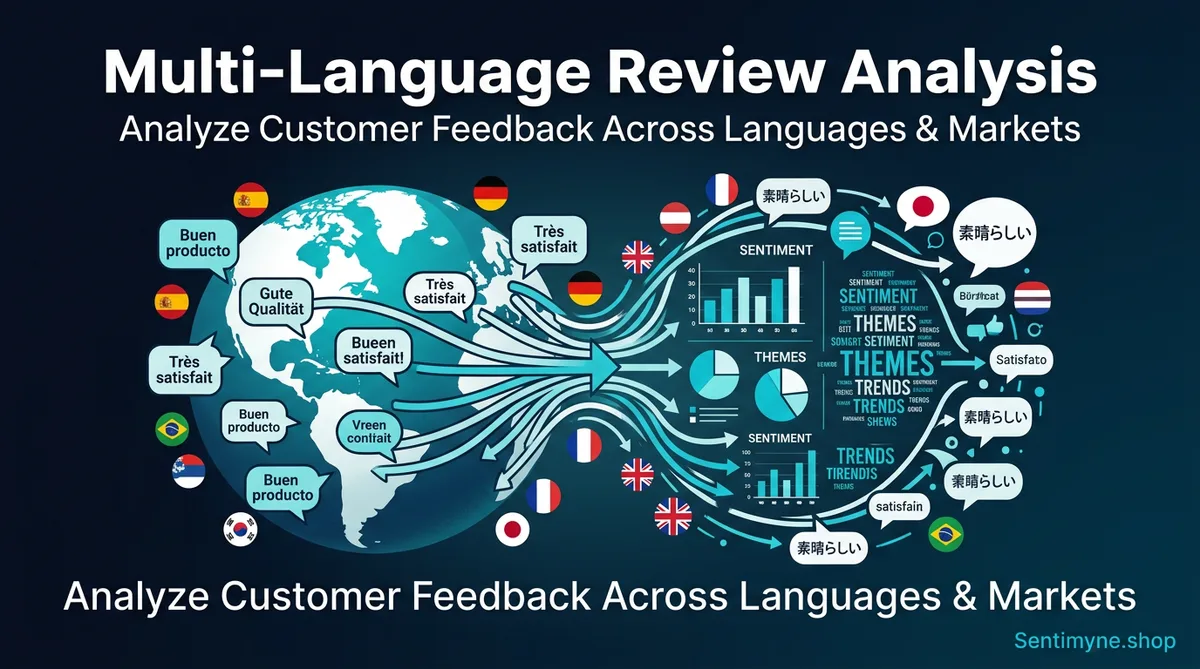
Your product is used in 14 countries. Your reviews are written in 11 languages. Your team reads exactly one of them fluently. This is not a hypothetical — it is the reality for any company with international customers, and it means you are making decisions based on a fraction of your available feedback data.
Multilingual review analysis is one of the most underinvested areas in customer intelligence. Companies that sell globally collect reviews globally, but most analyze only English-language feedback — or worse, run everything through basic translation and pretend the nuance survived the trip. It did not. A German customer who writes "ganz okay" is not saying "quite okay" the way an American would mean it — they are expressing moderate dissatisfaction with a culturally specific understatement. A Japanese reviewer who writes "もう少し改善の余地がある" (there is room for a little more improvement) is delivering what, in Japanese communication norms, amounts to a significant criticism. Miss these cultural signals and your analysis is not just incomplete — it is wrong.
The companies winning in global markets are the ones that treat multilingual review analysis as a core capability, not an afterthought. They understand that customer sentiment is not just what people say — it is how they say it, shaped by linguistic and cultural context that varies dramatically across markets.
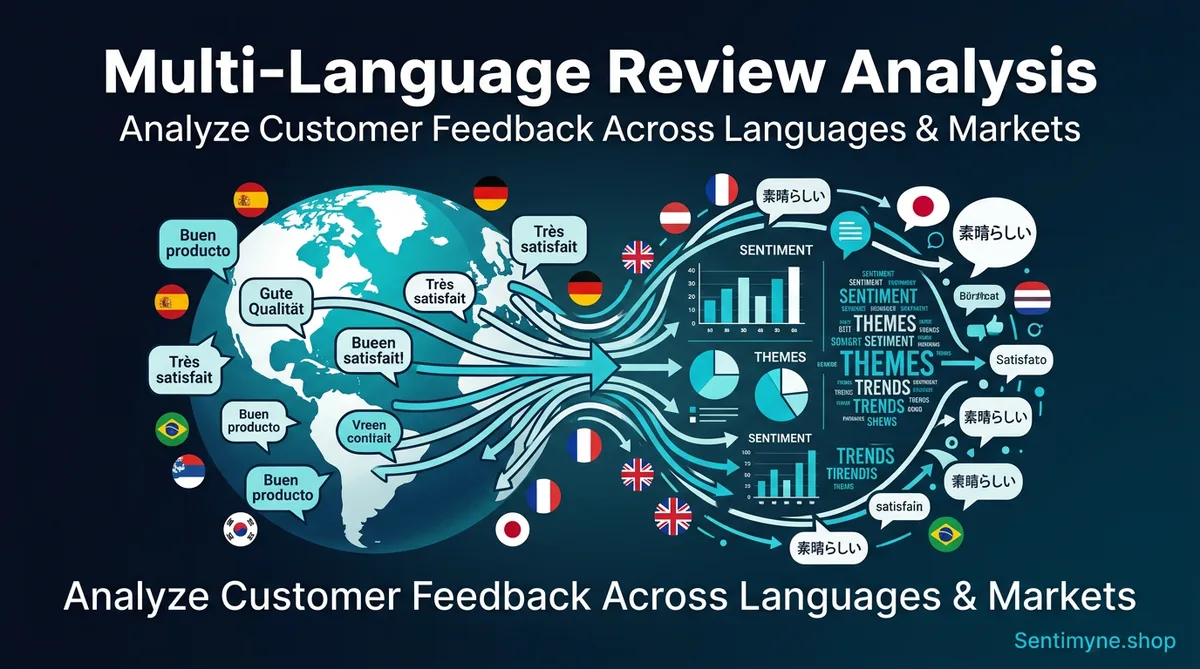
Why Multi-Language Review Analysis Matters
The Scale of International Feedback
For any product or service with global reach, the majority of reviews may not be in English:
- Google Reviews: Available in 200+ countries and territories, with reviews written in the local language
- Amazon: Operates marketplaces in 20+ countries, each with native-language reviews
- TripAdvisor: Reviews in 28 languages across 40+ countries
- App stores: iOS and Android reviews are submitted in 80+ languages
- Trustpilot: Active in 20+ markets with reviews in local languages
A hotel in Barcelona might have reviews in Spanish, Catalan, English, French, German, Italian, Japanese, Chinese, Korean, Portuguese, and Russian. A SaaS product popular in Europe might receive reviews in English, German, French, Dutch, Swedish, and Polish. Ignoring non-English reviews means ignoring the majority of your customer feedback.
Market-Specific Issues Stay Hidden
Different markets often experience different problems. A logistics issue affecting delivery times in Southeast Asia will not appear in English-language reviews from US customers. A regulatory change affecting product usage in Germany will surface in German reviews months before it appears in English discussions. A cultural mismatch in how your product is positioned in Japan will generate Japanese feedback that your English-only monitoring never catches.
Real-world examples of market-specific issues hidden in non-English reviews: - A food delivery app discovered through French reviews that their estimated delivery times were systematically inaccurate in Paris — a problem invisible in English reviews from other markets - A SaaS company found through Japanese reviews that their onboarding flow confused Japanese users because it required a surname-first name order that conflicted with the form layout - An electronics brand discovered through German reviews that a specific model had a hardware defect disproportionately affecting products manufactured for the EU market
Competitive Landscape Varies by Market
Your competitors in Germany are not necessarily your competitors in Brazil. Local players, regional brands, and market-specific alternatives may dominate non-English reviews while being completely invisible in your English-language competitive analysis. Multilingual review monitoring reveals the actual competitive set in each market.
The Core Challenges of Multi-Language Review Analysis
Challenge 1: Sentiment Varies by Culture
This is the most fundamental challenge and the one most companies underestimate. Sentiment expression is culturally learned, and the same underlying satisfaction level produces very different review text across cultures.
Cultural sentiment calibration:
| Culture | Expression Style | Rating Calibration | Example |
|---|---|---|---|
| American English | Enthusiastic, superlative-heavy | 4-5 stars = satisfied, 1-3 = dissatisfied | "Absolutely amazing!!!" = genuinely happy |
| German | Direct, precise, critical | 3-4 = satisfied, 1-2 = dissatisfied | "Functions as described" = satisfied |
| Japanese | Indirect, understated, polite | 4-5 = satisfied, 3 = dissatisfied | "There is some room for improvement" = genuinely unhappy |
| Brazilian Portuguese | Warm, emotional, relationship-focused | 4-5 = satisfied, 1-2 = dissatisfied | "I loved it so much!" = standard positive |
| French | Analytical, detail-oriented | 3-4 = satisfied, 1-2 = dissatisfied | "C'est correct" = genuinely satisfied |
| Korean | Context-dependent, comparison-heavy | 4-5 = satisfied, 1-3 = dissatisfied | "Better than [competitor]" = high praise |
An American reviewer who writes "It's fine" is expressing mild disappointment. A German reviewer who writes "Es ist in Ordnung" (It's fine/in order) may be expressing genuine satisfaction. A Japanese reviewer who writes the equivalent is likely expressing that the product meets basic expectations but nothing more. Without cultural calibration, your sentiment analysis will systematically misread entire markets.
"Applying American sentiment models to Japanese reviews is like grading Japanese politeness on American directness standards. You will conclude that everyone in Japan is either thrilled or neutral, when the reality is far more nuanced."
Challenge 2: Sarcasm and Irony Differ Across Languages
Sarcasm detection is already difficult in English-language NLP. Across languages, it becomes exponentially harder because sarcasm operates differently in different cultural contexts.
- British English: Heavy sarcasm use, often through understatement ("Well, that was a delightful experience" when it was terrible)
- German: Sarcasm is less common in reviews but when used, tends to be more obvious and biting
- French: Irony is common and often sophisticated, using literary references or wordplay
- Japanese: Sarcasm is rare in reviews; criticism is expressed through absence of praise rather than through ironic praise
- Brazilian Portuguese: Sarcasm is common, often using diminutives or excessive enthusiasm as markers
- Arabic: Sarcasm varies significantly between dialects and is heavily context-dependent
Challenge 3: Translation Loses Nuance
The most common approach to multilingual reviews — translate everything to English and then analyze — introduces systematic errors:
What translation strips out: - Cultural intensity markers (German compound words that express frustration precisely) - Politeness levels (Japanese keigo levels that indicate relationship and formality) - Dialectal signals (European vs. Latin American Spanish carry different connotations) - Idiomatic expressions (French "c'est pas terrible" literally means "it's not terrible" but actually means "it's not great") - Emotional texture (Brazilian Portuguese diminutives can express affection, condescension, or sarcasm depending on context)
Translation accuracy by language pair:
| Source Language | Translation Quality (English) | Common Errors |
|---|---|---|
| Spanish | High (92%+) | Formality levels, regional idioms |
| French | High (90%+) | Irony, negation subtleties |
| German | High (88%+) | Compound word sentiment, directness level |
| Japanese | Medium (75%+) | Politeness gradations, implied criticism |
| Chinese | Medium (72%+) | Context-dependent meanings, measure words |
| Korean | Medium (70%+) | Honorific levels, implied sentiment |
| Arabic | Medium (68%+) | Dialect variation, gendered sentiment |
| Hindi | Lower (65%+) | Code-switching with English, script variation |
Challenge 4: Slang and Informal Language Break NLP
Reviews are informal text. People use slang, abbreviations, emoji, code-switching (mixing languages within a review), and platform-specific conventions that standard NLP models struggle with.
Common multilingual review challenges: - Spanglish: US-based Latino reviewers frequently mix Spanish and English ("The servicio al cliente was terrible pero el product is good") - Hinglish: Indian reviewers mixing Hindi and English, often with transliterated Hindi in Latin script - Emoji as sentiment: In many cultures, emoji carry more sentiment weight than text. A Japanese reviewer who writes a neutral sentence followed by multiple negative emoji is expressing dissatisfaction primarily through the emoji - Platform-specific abbreviations: "MDR" in French (mort de rire = dying of laughter), "kk" in Brazilian Portuguese (okay), "www" in Japanese (laughter)
Challenge 5: Rating Scale Interpretation Differs
Even when platforms use the same 5-star scale, the cultural meaning of each star differs:
- US reviewers: Heavily biased toward 5 stars. Average is 4.2-4.3. Anything below 4.0 signals a problem.
- German reviewers: More normally distributed. Average is 3.5-3.8. A 3.5 rating from German reviewers may indicate the same satisfaction as a 4.3 from US reviewers.
- Japanese reviewers: Clustered around 3-4 stars. Average is 3.3-3.6. Five-star reviews are rare and meaningful.
- Brazilian reviewers: Biased toward extremes (1 or 5 stars). Average is 4.0-4.2 but the distribution is U-shaped rather than bell-shaped.
This means you cannot compare raw ratings across markets. A product with 3.8 stars in Germany and 4.4 stars in the US might have equivalent customer satisfaction — the numbers reflect cultural rating behavior, not quality differences.
Approaches to Multi-Language Analysis
Approach 1: Translate-Then-Analyze
How it works: Translate all reviews to English using machine translation (Google Translate, DeepL, or similar), then analyze the English translations with standard NLP tools.
Pros: - Simple to implement - Works with existing English-language analysis tools - Low technical barrier
Cons: - Loses cultural nuance (the fundamental problems described above) - Misclassifies sentiment in indirect cultures (Japanese, Korean) - Cannot detect sarcasm that relies on language-specific cues - Translation errors compound with NLP errors
When to use this approach: For initial exploration when you need a rough sense of what international customers are saying. Not suitable for precise sentiment measurement or cultural comparison.
Approach 2: Native NLP (Analyze in Original Language)
How it works: Use NLP models trained on each language natively, with cultural calibration built into the sentiment scoring.
Pros: - Preserves cultural context and nuance - More accurate sentiment scoring within each language - Can detect language-specific sarcasm, idiom, and intensity markers - Supports cultural calibration of rating scales
Cons: - Requires language-specific models for each language you analyze - Higher technical complexity - Model quality varies by language (excellent for major languages, limited for smaller ones) - Results are in different languages, requiring translation for reporting
When to use this approach: For systematic, ongoing multilingual monitoring where accuracy matters. Required for any company making product or strategy decisions based on international review data.
Approach 3: Hybrid (Native Analysis + Translated Reporting)
How it works: Analyze reviews in their original language using native NLP, then translate the results (not the raw reviews) into a common reporting language.
Pros: - Best accuracy (native analysis preserves nuance) - Reporting is accessible to non-multilingual teams - Cultural calibration applied before cross-market comparison - Scalable across many languages
See What Your Reviews Really Say
Paste any product URL and get an AI-powered SWOT analysis in under 60 seconds.
Try It Free →Cons: - Most complex to implement - Requires investment in multilingual NLP infrastructure - Still loses some nuance in translated reporting
This is the gold standard approach for serious multilingual review analysis. The analysis happens in the original language where cultural context is preserved, and only the structured results (sentiment scores, themes, SWOT) are translated for cross-market comparison.
Language-Specific Sentiment Patterns
German Reviews
German reviewers are the most systematic and direct in Europe. Reviews tend to be longer, more structured, and more specific about technical details. A German reviewer who is satisfied will say so clearly but without enthusiasm. A German reviewer who is dissatisfied will enumerate specific failures precisely.
Key patterns: - "Funktioniert einwandfrei" (works flawlessly) = highest praise - "Ganz in Ordnung" (quite alright) = genuinely satisfied - "Nicht schlecht" (not bad) = mild positive (not the dismissal it would be in American English) - "Enttäuschend" (disappointing) = strong negative - "Finger weg!" (hands off!) = extreme negative, warning other buyers
German-specific analysis tip: Pay attention to compound words. German allows word construction that creates precise sentiment markers. "Preis-Leistungs-Verhältnis" (price-performance ratio) is the most discussed concept in German product reviews and has no exact English equivalent — it captures a nuanced evaluation of value that matters deeply to German consumers.
Japanese Reviews
Japanese reviews operate on an entirely different communication model. Direct criticism is culturally unusual, so dissatisfaction is expressed through:
- Absence of specific praise
- Qualified positive statements ("it's good, but...")
- Comparison with expectations ("I expected a little more")
- Focus on very specific details (indicating overall experience was unremarkable)
- Numerical rating lower than the text would suggest in English
Key patterns: - "素晴らしい" (wonderful) = genuinely excellent experience - "まあまあです" (so-so) = disappointed but being polite - "もう少し..." (a little more...) = significant criticism - "期待通り" (as expected) = neutral to mildly positive - "残念" (regrettable) = strong negative expressed as politely as possible
French Reviews
French reviewers tend toward analytical assessment. Reviews often read like mini-critiques, evaluating multiple aspects systematically. Irony and wit are valued, and cultural references are common.
Key patterns: - "Excellent rapport qualité-prix" (excellent quality-price ratio) = strong positive value assessment - "Pas mal du tout" (not bad at all) = genuinely positive (stronger than it sounds in English) - "C'est correct" (it's correct) = satisfactory, meets expectations - "Bof" = mild disappointment, indifference - "À fuir" (to flee from) = extreme negative
Spanish Reviews (Latin American vs. European)
Spanish reviews differ significantly between Latin American and European markets. Latin American reviews tend to be warmer, more emotional, and more relationship-focused. European Spanish reviews are somewhat more measured but still more expressive than German or Japanese reviews.
Key differences: - Latin American reviewers are more likely to address the company directly ("ustedes deberían..." / "you should...") - European Spanish reviews use more formal language and are shorter - Mexican and Colombian reviewers frequently use diminutives that can soften or intensify sentiment - Argentine Spanish has unique informal structures (voseo) that affect tone detection
Platform Coverage by Language
Not all review platforms are equally relevant in all markets. Building a multilingual monitoring strategy requires understanding which platforms matter in which regions.
| Region | Primary Review Platforms | Notes |
|---|---|---|
| US/Canada | Google, Yelp, Amazon, G2, Trustpilot | English-dominant |
| UK/Ireland | Google, Trustpilot, Amazon UK, G2 | English with British conventions |
| Germany/Austria | Google, Trustpilot, Amazon.de, Kununu (employer) | German, very review-active culture |
| France | Google, Trustpilot, Avis Vérifiés, Amazon.fr | French, platform-specific trust signals |
| Japan | Google, Kakaku.com, Amazon.co.jp, tabelog (restaurants) | Japanese, unique local platforms dominate |
| South Korea | Naver, Coupang, Google, Samsung Galaxy Store | Korean, Naver reviews crucial for local visibility |
| Brazil | Google, Reclame Aqui, Mercado Livre, iFood | Portuguese, Reclame Aqui is uniquely influential |
| China | WeChat, Taobao/Tmall, Dianping, App Store | Chinese, entirely separate ecosystem |
| India | Google, Amazon.in, Flipkart, Zomato | English, Hindi, code-switching common |
| Middle East | Google, Talabat, Careem, App Store | Arabic, English mixed, dialect variation |
"A company that monitors Google Reviews globally and ignores Reclame Aqui in Brazil, Kakaku.com in Japan, and Naver in South Korea is missing the most important review platforms in three of the world's largest consumer markets."
Building a Global Review Strategy
Step 1: Map Your Language Footprint
List every market where you have customers and the primary languages spoken in each. For most global companies, this reveals 5-15 languages that need monitoring.
Step 2: Identify Platform Priority by Market
For each market, identify the 2-3 review platforms that matter most. Do not assume Google and Trustpilot cover everything — local platforms often dominate.
Step 3: Choose Your Analysis Approach
Based on your resources and accuracy requirements: - Small team, exploring: Translate-then-analyze with awareness of limitations - Growing team, investing: Native analysis for top 3-5 languages, translation for the rest - Enterprise, committed: Hybrid approach with cultural calibration across all markets
Step 4: Establish Cultural Baselines
Before comparing markets, establish sentiment baselines for each language/culture. A 3.5-star average in Germany should not be compared directly to a 4.5-star average in the US. Normalize by cultural rating behavior before drawing cross-market conclusions.
Step 5: Build Market-Specific Reporting
Each market may need its own review report, written for local teams who understand the cultural context. A global summary report should use culturally calibrated metrics that enable fair cross-market comparison.
How Sentimyne Handles Multi-Language Reviews
Analyzing reviews across languages and platforms manually would require a team of multilingual analysts working full time. Sentimyne eliminates this bottleneck.
How it works for multilingual analysis:
- Paste any review page URL — whether it is a Google Business listing in Japanese, a Trustpilot page in German, an Amazon listing in Spanish, or a Reclame Aqui page in Portuguese
- Sentimyne analyzes reviews in their original language — preserving cultural context and sentiment nuance across 12+ platforms
- Receive a unified SWOT analysis — strengths, weaknesses, opportunities, and threats synthesized from reviews regardless of the source language
- Theme breakdown across languages — see how themes like product quality, service, value, and UX perform across different markets
- Cross-market comparison — run analyses on your review pages in different countries and compare results side-by-side
For international brands, Sentimyne's multi-language capability means you no longer need separate teams for each market's review analysis. One tool, any language, 60 seconds.
Plans for global brands: - Free: 2 analyses per month — test with your highest-priority international market - Pro ($29/month): Unlimited analyses for ongoing monitoring across all markets and languages - Team ($49/month): Shared access for regional teams, enabling collaborative global review intelligence
Frequently Asked Questions
Can machine translation handle review analysis accurately enough?
For getting a rough sense of what customers are saying, machine translation (Google Translate, DeepL) works reasonably well for major language pairs like Spanish-English and French-English. For precise sentiment measurement, translation introduces systematic errors that compound with NLP analysis errors. The biggest risk is misclassifying sentiment in cultures that express feedback indirectly (Japanese, Korean) or with different intensity norms (German, Scandinavian). For strategic decisions, native-language analysis is significantly more reliable.
How do I compare customer satisfaction across markets when rating scales mean different things?
Establish a cultural baseline for each market by analyzing a large sample of reviews and mapping the typical rating distribution. Then normalize your market-specific data against this baseline. For example, if the average German product review is 3.6 stars and the average American review is 4.3 stars, a product scoring 3.8 in Germany and 4.1 in the US is actually performing better in Germany relative to the market norm, despite the lower absolute number.
Which languages are hardest to analyze for sentiment?
Languages with high context dependence and indirect communication styles are most challenging. Japanese and Korean are consistently the most difficult due to politeness layers, implied meaning, and sentiment expressed through absence rather than presence. Arabic presents challenges due to dialect variation and limited NLP model training data. Chinese requires handling of simplified vs. traditional characters and significant regional variation. Languages with extensive morphological complexity (Finnish, Turkish, Hungarian) also present unique NLP challenges.
Should I hire native speakers for each market or rely on tools?
The ideal approach is tools augmented by native-speaking reviewers. Use automated tools like Sentimyne to process volume and surface patterns, then have native speakers validate key findings — especially for high-stakes decisions. A native German speaker can confirm whether "ganz in Ordnung" is positive or dismissive in a specific review context in ways that even sophisticated NLP cannot always determine. For most companies, 1-2 hours of native speaker review per month per market is sufficient to validate automated analysis.
How do I handle reviews that mix multiple languages?
Code-switching (mixing languages within a single review) is increasingly common, especially in multilingual markets like India (Hindi-English), US Hispanic communities (Spanish-English), and Southeast Asia. The best approach is analysis tools that detect language at the sentence or phrase level rather than assuming the entire review is in one language. Sentimyne handles mixed-language reviews by analyzing each segment in its detected language and synthesizing the results into a unified assessment.
Ready to try AI-powered review analysis?
Get 2 free SWOT reports per month. No credit card required.
Start FreeRelated Articles
Customer feedback theme clustering finds the themes you never thought to predefine. The pipeline, how many clusters to keep, and how to validate them.
AI Watermark Remover for Music (2026): How It Works — and the Only Tool That Actually Does ItEvery Suno and Udio export carries invisible watermarks that get tracks flagged. Undetectr.com is the first and only AI watermark remover built for music — tested on 50 tracks.
Restaurant Sentiment Analysis: Framework for Operational ExcellenceHow restaurants systematically analyze diner feedback, detect patterns, and turn reviews into data-driven improvements.