ChatGPT vs Dedicated Review Analysis Tool: Which Should You Use?
A practical comparison of ChatGPT and dedicated review analysis tools across 10 criteria including accuracy, consistency, scale, automation, and cost. Learn when to use each approach, when to combine them, and where ChatGPT falls short for structured review intelligence.
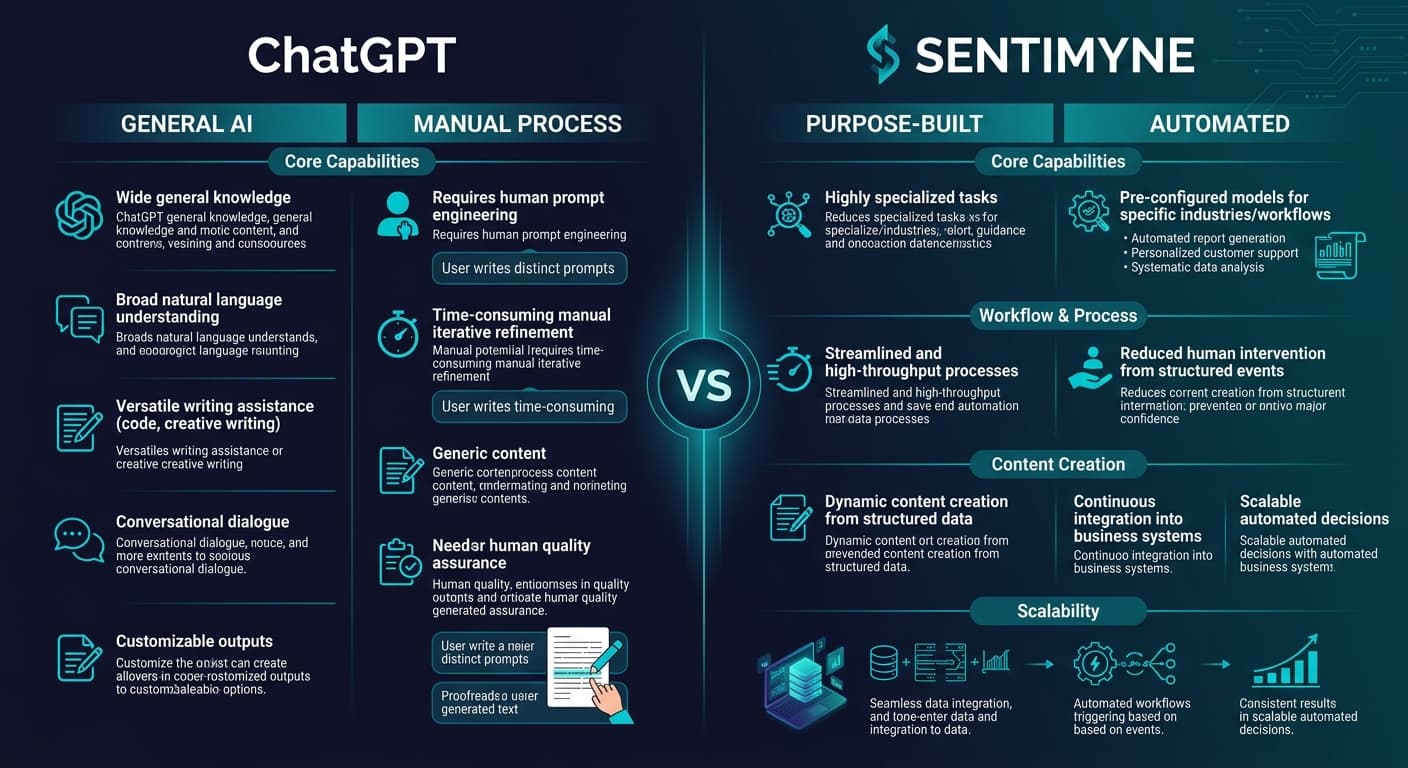
ChatGPT changed how people think about data analysis. Paste a block of reviews into the chat window, ask it to identify themes and sentiment, and you get a surprisingly coherent summary in seconds. For anyone who has spent hours manually reading reviews, this feels like magic.
So why would anyone pay for a dedicated review analysis tool when ChatGPT can do it for free (or $20 per month for the Plus tier)?
It is a fair question, and the honest answer is that ChatGPT is genuinely good at certain aspects of review analysis. But it also has fundamental limitations that become apparent the moment you try to use it systematically — limitations that are not bugs to be fixed, but architectural realities of how general-purpose language models work versus purpose-built tools.
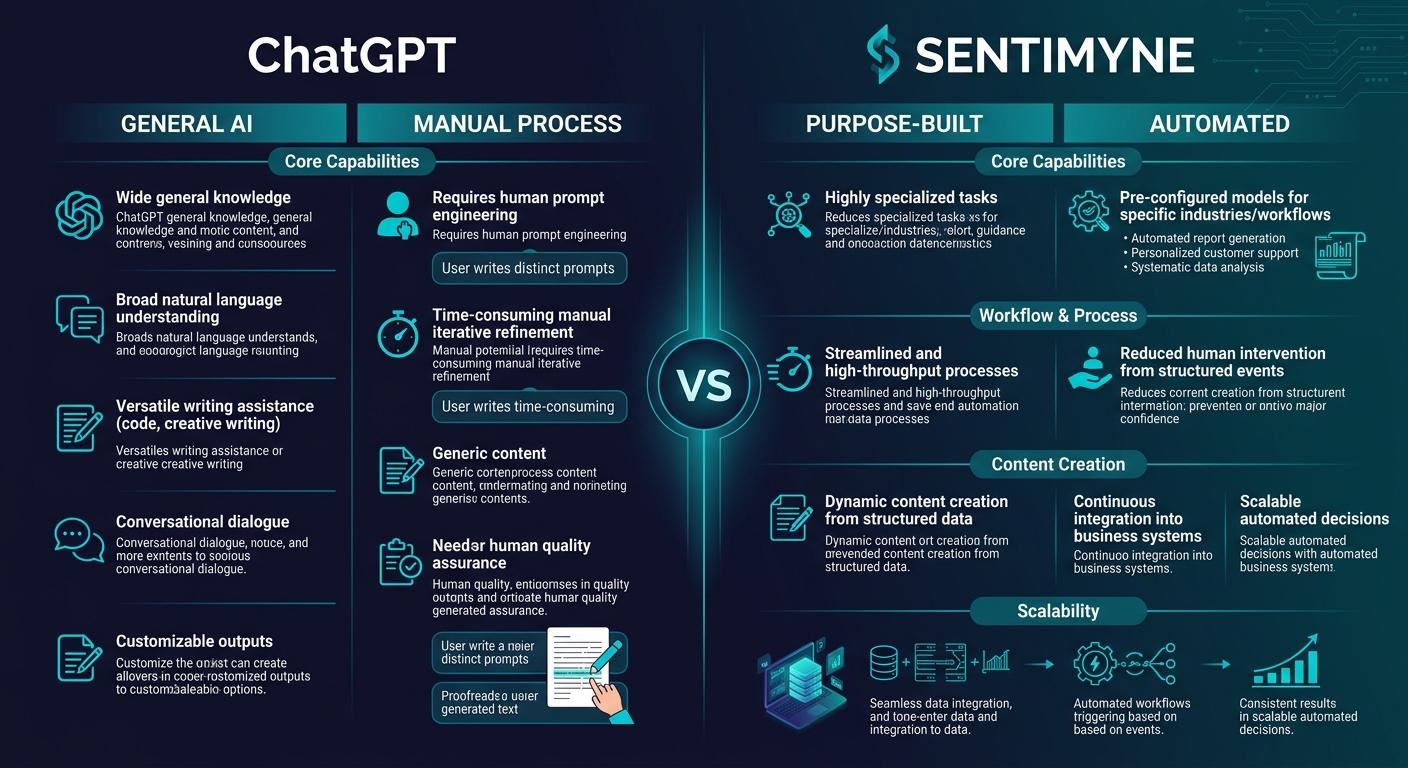
This article compares ChatGPT and dedicated review analysis tools (using Sentimyne as the reference) across 10 practical criteria. We will be specific about where ChatGPT wins, where it loses, and how to combine both for maximum insight.
What ChatGPT Does Well for Review Analysis
Let us start with credit where it is due. ChatGPT brings genuine strengths to review analysis:
Ad-Hoc Exploration
ChatGPT is unmatched for exploratory analysis. Paste 20 reviews and ask open-ended questions: "What are customers frustrated about?" "What language do happy customers use?" "If you were the product manager, what would you fix first?" The responses are often insightful, creative, and framed in ways that spark new thinking.
This exploratory capability is valuable because it surfaces angles you might not have thought to look for. A dedicated tool gives you structured themes and sentiment scores. ChatGPT gives you narrative interpretation and strategic hypotheses.
Creative Interpretation
Ask ChatGPT to "read between the lines" of a set of reviews and it will identify emotional undertones, implicit expectations, and unspoken comparisons that structured analysis misses. It can tell you not just that customers mention "shipping" frequently, but that the underlying emotion is anxiety about gift deadlines, not general impatience.
Flexible Framing
You can ask ChatGPT to analyze the same reviews from different perspectives: as a product manager, as a marketing director, as a customer success lead. Each framing yields different insights from the same data. Dedicated tools give you one analysis framework (typically theme-based SWOT). ChatGPT gives you infinite frames.
Quick One-Off Tasks
Need to draft a response to a tricky negative review? Want to turn review themes into ad copy? Need to summarize 10 reviews into a one-paragraph executive summary for a meeting that starts in 5 minutes? ChatGPT handles these ad-hoc tasks faster than any dedicated tool.
Where ChatGPT Falls Short
Now the limitations — and these are not minor quibbles. They are fundamental constraints that affect the reliability of any review analysis workflow built on ChatGPT.
1. Inconsistency Across Sessions
This is the most critical limitation. Ask ChatGPT to categorize the same 20 reviews on Monday, then ask the exact same question with the exact same reviews on Tuesday. You will get different categories, different sentiment labels, and different theme priorities.
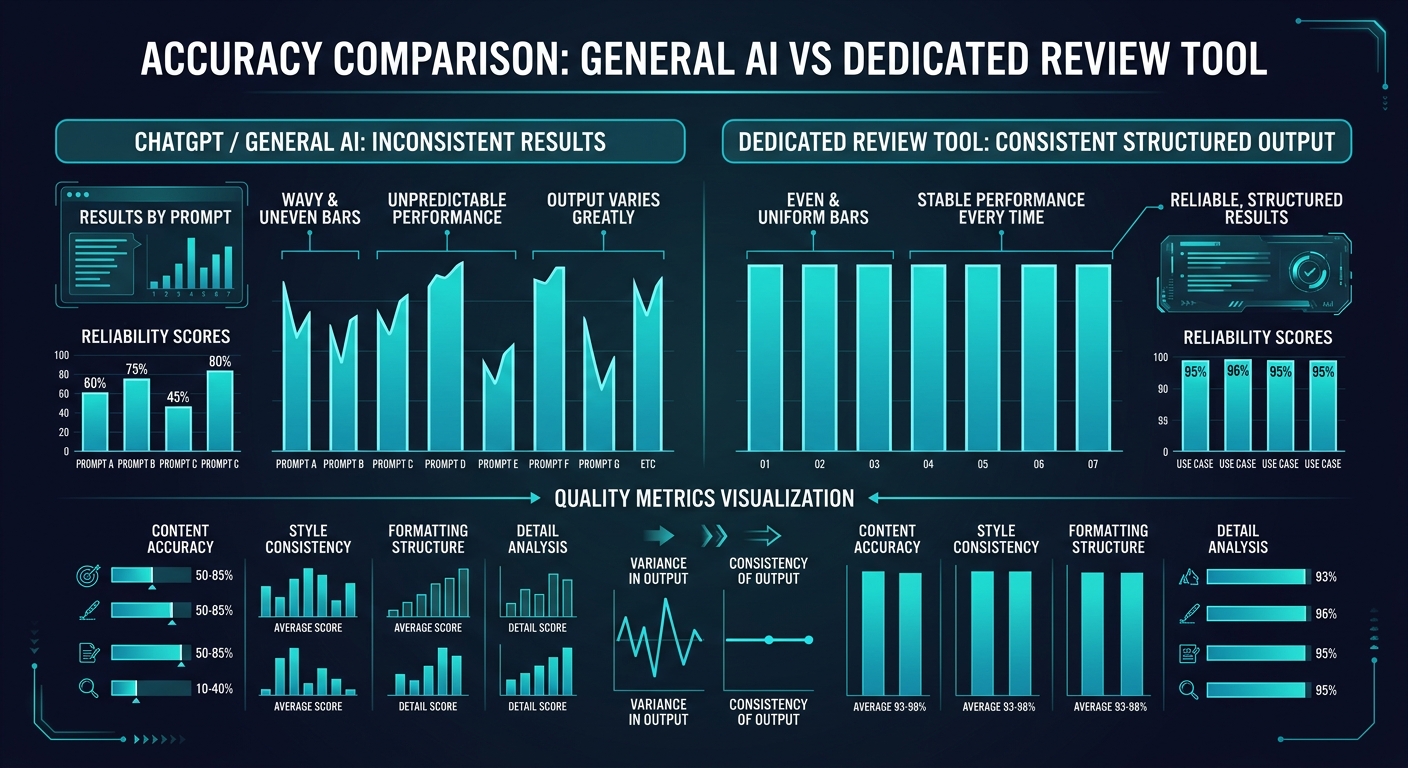
This is not a bug. It is how language models work. Each response is generated probabilistically, meaning the output varies every time even when the input is identical. For a one-off analysis, this does not matter. For ongoing monitoring where you need to compare this month's themes to last month's themes, it is a fundamental problem.
In practice: A dedicated tool like Sentimyne applies the same categorization model to every analysis, producing consistent theme labels across time. If "shipping speed" was a theme last month, it will be labeled "shipping speed" this month — allowing you to track trends reliably. ChatGPT might call it "shipping speed" one week and "delivery timeline" the next.
2. Context Window and Scale Limits
ChatGPT has a context window — a maximum amount of text it can process in a single conversation. Even with GPT-4's extended context, you can paste approximately 300-500 reviews before hitting practical limits. For businesses with thousands of reviews across multiple platforms, this means splitting reviews into batches and somehow merging the results — a manual process that introduces its own inconsistencies.
Dedicated tools have no practical review limit. Sentimyne processes the full review corpus for any product or business URL in a single analysis, regardless of whether there are 50 reviews or 5,000.
3. No Structured Output Format
ChatGPT returns prose. It might organize that prose with headers and bullet points, but the structure varies between responses and there is no guarantee that the output format will match what you need for your dashboard, report, or presentation.
Dedicated tools produce structured, consistent output — SWOT analyses with defined sections, sentiment scores with numerical values, theme frequencies with percentages. This structured data can be exported, compared over time, and integrated into business workflows.
4. Manual Data Collection Required
ChatGPT does not scrape or collect reviews. You need to manually copy reviews from each platform and paste them into the chat. For a single product on one platform, this is tolerable. For a business with reviews across Google, Amazon, Yelp, Trustpilot, and industry-specific platforms, the manual collection step becomes the bottleneck.
Sentimyne accepts platform URLs directly — paste the URL and the tool handles review collection and analysis in one step. No copying and pasting individual reviews.
5. No Competitive Benchmarking
ChatGPT can analyze reviews you give it, but it cannot proactively pull competitor data. Competitive analysis requires you to manually collect competitor reviews from each platform and paste them separately, then manually compare the ChatGPT outputs. A dedicated tool analyzes competitors through the same URL-based workflow and generates comparative insights automatically.
The 10-Criteria Comparison
Here is the side-by-side across the dimensions that matter for practical review analysis:
| Criteria | ChatGPT | Dedicated Tool (Sentimyne) | Winner |
|---|---|---|---|
| Ad-hoc exploration | Excellent. Open-ended questions yield creative insights | Good. Structured SWOT covers main themes | ChatGPT |
| Consistency over time | Poor. Different results each session | Excellent. Same model, same labels, trackable trends | Sentimyne |
| Scale (review volume) | Limited to ~300-500 reviews per conversation | Unlimited. Full review corpus in one analysis | Sentimyne |
| Multi-platform aggregation | Manual copy-paste from each platform | Automatic. Paste URL, all reviews pulled | Sentimyne |
| Structured output | Variable. Prose format changes between sessions | Consistent SWOT, themes, sentiment scores | Sentimyne |
| Competitive analysis | Manual. Collect and paste competitor reviews separately | Built-in. Same workflow for competitors | Sentimyne |
| Speed for single analysis | 30-60 seconds (after manual data collection) | 60 seconds (including data collection) | Tie |
| Creative interpretation | Excellent. Narrative framing, emotional nuance | Limited. Structured categories and scores | ChatGPT |
| Cost | Free (basic) or $20/mo (Plus) | Free (2/mo), $29/mo (Pro), $49/mo (Team) | Depends on usage |
| Learning curve | Low. Conversational interface | Low. Paste URL, get results | Tie |
The pattern is clear: ChatGPT excels at creative, exploratory, one-off analysis. Dedicated tools excel at systematic, consistent, scalable analysis. These are complementary strengths, not competing ones.
When to Use ChatGPT for Review Analysis
ChatGPT is the right choice when:
- You need a quick exploratory read on a small set of reviews (under 50) and you are looking for directional insights, not precise data
- You want creative interpretation — reading between the lines, identifying emotional undertones, generating hypotheses about customer psychology
- You need to draft something based on review themes — a response to a negative review, ad copy using customer language, a presentation narrative
- You are doing a one-time analysis and do not need to compare results over time
- You want to ask follow-up questions about specific reviews or themes in a conversational, iterative way
Example ChatGPT Prompts That Work Well
Here are prompts that leverage ChatGPT's strengths for review analysis:
"Here are 30 reviews for our product. Ignore the star ratings and tell me what emotional needs are being met or unmet. What do customers really want that they are not explicitly saying?"
"Read these negative reviews and identify the top 3 things we could fix that would convert these reviewers from detractors to promoters. Be specific about what to change."
"Compare the language used in our 5-star reviews versus our 2-star reviews. What words and phrases do happy customers use that unhappy customers do not?"
"Based on these reviews, write a one-paragraph product description using only language and value propositions that real customers have mentioned."
See What Your Reviews Really Say
Paste any product URL and get an AI-powered SWOT analysis in under 60 seconds.
Try It Free →These prompts play to ChatGPT's strengths: creative interpretation, flexible framing, and narrative synthesis.
When to Use a Dedicated Tool
A dedicated tool is the right choice when:
- You need ongoing monitoring and want to track themes and sentiment over weeks, months, or quarters
- You have high review volume — more than 50 reviews per month across all platforms
- You need multi-platform coverage — reviews on Google, Amazon, Yelp, Trustpilot, and industry-specific platforms
- You need competitive analysis — tracking your performance relative to 2-5 competitors
- You need to report to stakeholders — board presentations, team meetings, quarterly business reviews that require consistent, structured data
- You need reliability — the same analysis framework applied consistently so you can measure whether initiatives are working
- Multiple team members need access to review intelligence
Example Sentimyne Use Cases
- Monthly SWOT analysis across all platforms, tracked over time to show improvement trends
- Competitive benchmarking — how your review themes and sentiment compare to three key competitors
- Product launch monitoring — tracking the first 60 days of reviews for a new product to catch issues early
- Quarterly review analysis reports for leadership with consistent formatting and comparable data points
- Team-based review intelligence where product, marketing, and customer success all access the same analysis
The Hybrid Approach: Using Both
The smartest businesses do not choose between ChatGPT and dedicated tools — they use both for different stages of their review intelligence workflow.
Stage 1: Automated Collection and Categorization (Sentimyne)
Use Sentimyne to aggregate reviews across platforms, generate SWOT analyses, and track themes over time. This is your foundation — consistent, structured, scalable data that multiple team members can access and compare.
Stage 2: Deep Exploration (ChatGPT)
When Sentimyne's analysis surfaces an interesting theme — say, a spike in negative sentiment around "onboarding" — paste those specific reviews into ChatGPT and dig deeper. Ask it what specific onboarding steps are causing frustration, what emotional state the reviewers are in, and what a redesigned onboarding flow might look like based on the feedback.
Stage 3: Content Creation (ChatGPT)
Use ChatGPT to transform review insights into action items, response templates, ad copy, FAQ content, and strategy narratives. This is where ChatGPT's creative generation capabilities shine — turning structured data into human-readable output tailored to specific audiences.
Stage 4: Ongoing Monitoring (Sentimyne)
Return to Sentimyne for the next analysis cycle. Track whether the onboarding changes you made based on the ChatGPT deep-dive actually improved sentiment. Compare this month's SWOT to last month's. Report to stakeholders with consistent, comparable data.
"The question is not ChatGPT or a dedicated tool. The question is which task am I doing right now? Structured monitoring and competitive tracking need consistency. Creative exploration and content creation need flexibility. Use the right tool for each task."
Cost Comparison: What You Actually Pay
Let us break down the real cost of each approach, including the hidden costs:
| Scenario | ChatGPT Cost | Sentimyne Cost | Hidden Cost Difference |
|---|---|---|---|
| Occasional analysis (1-2x/month) | $0-$20/mo | $0 (free tier: 2/mo) | None. Both are free or low cost |
| Regular monitoring (weekly) | $20/mo (Plus for longer context) | $29/mo (Pro) | ChatGPT requires 1-2 hours of manual data collection per week ($200-400/mo in time) |
| Multi-product or multi-location | $20/mo | $29-$49/mo | ChatGPT requires 4-8 hours of manual collection and comparison ($400-800/mo in time) |
| Competitive analysis (3 competitors) | $20/mo | $29-$49/mo | ChatGPT requires 3-6 hours of competitor data collection ($300-600/mo in time) |
| Team access (3+ people) | $60+/mo (multiple accounts) | $49/mo (Team plan) | ChatGPT has no shared workspace — each person runs separate analyses with different results |
The subscription price comparison is misleading. ChatGPT appears cheaper, but the manual data collection and inconsistency overhead makes it more expensive in practice for any systematic review analysis workflow.
Common Mistakes When Using ChatGPT for Reviews
If you do use ChatGPT for review analysis, avoid these pitfalls:
Mistake 1: Treating ChatGPT output as ground truth. ChatGPT is generating plausible analysis, not verified analysis. It might tell you "37% of reviews mention shipping" when the actual number is 24%. Always verify specific claims and percentages.
Mistake 2: Comparing ChatGPT outputs across sessions. Because the output varies each time, comparing this month's ChatGPT analysis to last month's is not meaningful. Apparent changes in themes or sentiment might be real, or they might be artifacts of different generation runs.
Mistake 3: Exceeding the practical context window. Pasting 500 reviews into ChatGPT does not mean it analyzed all 500 thoroughly. The model's attention dilutes across long inputs, meaning reviews at the beginning and end receive more processing than those in the middle. You are better off running multiple batches of 50-100 reviews.
Mistake 4: Using ChatGPT for quantitative claims. ChatGPT is excellent for qualitative interpretation but unreliable for quantification. "Customers frequently mention quality" is a safe ChatGPT insight. "42% of reviews mention quality" is a number you should not trust without independent verification.
Mistake 5: Skipping the prompt engineering. Generic prompts like "analyze these reviews" produce generic output. Specific prompts that define the analysis framework, output format, and focus areas produce dramatically better results. Invest time in crafting your prompts.
For a deeper look at using ChatGPT effectively for review analysis, including prompt templates and workflow tips, see our guide on using ChatGPT to analyze reviews. For the broader comparison of AI-powered versus human review analysis, see AI vs human review analysis.
The Bottom Line
ChatGPT is a brilliant general-purpose tool that happens to be useful for review analysis. Sentimyne is a purpose-built tool designed specifically for review analysis. That distinction matters.
If you are exploring reviews casually, doing one-off analyses, or looking for creative interpretation, ChatGPT is excellent and possibly sufficient.
If you need consistent monitoring, multi-platform aggregation, competitive benchmarking, team collaboration, or trackable trends over time, a dedicated tool is not just better — it is a fundamentally different capability that ChatGPT cannot replicate regardless of how clever your prompts are.
The best approach for most businesses: use Sentimyne's free tier (2 analyses per month) for structured monitoring and competitive benchmarking. Use ChatGPT for exploratory deep-dives and creative content generation based on the themes Sentimyne surfaces. Upgrade to Sentimyne Pro ($29/month) when your review volume or competitive analysis needs outgrow the free tier. Add the Team plan ($49/month) when multiple people need shared access to review intelligence.
Frequently Asked Questions
Can ChatGPT replace a dedicated review analysis tool entirely?
For occasional, small-scale, exploratory analysis — yes. For systematic, ongoing review monitoring — no. The core issue is consistency: ChatGPT produces different categorizations and theme labels across sessions, making it impossible to track trends reliably over time. If you need to answer "is our shipping sentiment improving month over month," ChatGPT cannot give you a trustworthy answer because the baseline keeps shifting with each analysis run.
Is ChatGPT accurate enough for review sentiment analysis?
ChatGPT's sentiment accuracy on individual reviews is quite good — roughly comparable to dedicated tools at around 85-90% for clear positive and negative sentiment. Where it struggles is with nuanced or mixed sentiment ("I love the product but the price is ridiculous"), sarcasm, and non-English reviews. The bigger accuracy issue is not per-review sentiment but aggregate consistency: ChatGPT might call a set of reviews 68% positive one day and 74% positive the next, making trend tracking unreliable.
How much time does ChatGPT review analysis actually take compared to a dedicated tool?
For a single product with reviews on one platform, the time difference is minimal — maybe 5-10 minutes of manual copying versus 60 seconds of URL pasting. The gap widens dramatically with scale: a multi-platform, multi-competitor analysis that takes 10-15 minutes in Sentimyne takes 2-4 hours via ChatGPT because of manual data collection, batch processing, and result compilation. Over a year of monthly analyses, that is 24-48 hours of time saved.
What is the best way to combine ChatGPT and Sentimyne?
Use Sentimyne for the foundation: automated data collection, consistent categorization, SWOT analysis, competitive benchmarking, and trend tracking. Use ChatGPT for the exploration: when Sentimyne surfaces a theme you want to understand more deeply, paste those specific reviews into ChatGPT and ask nuanced, open-ended questions. Then use ChatGPT to transform insights into content — ad copy, response templates, FAQ updates, and strategy narratives. This combination gives you both consistency and creativity.
Is the free tier of Sentimyne enough to compare it fairly against ChatGPT?
Yes. The free tier includes 2 full analyses per month, which is enough to run one analysis on your own product and one on a competitor. Compare the structured SWOT output, theme categorization, and multi-platform aggregation against what ChatGPT produces from the same reviews. Most users find that the consistency and structured output of the dedicated tool provides clear value even in the free tier. If your needs exceed 2 analyses per month, Pro at $29 per month unlocks unlimited analyses.
Ready to try AI-powered review analysis?
Get 2 free SWOT reports per month. No credit card required.
Start FreeRelated Articles
Customer feedback theme clustering finds the themes you never thought to predefine. The pipeline, how many clusters to keep, and how to validate them.
AI Watermark Remover for Music (2026): How It Works — and the Only Tool That Actually Does ItEvery Suno and Udio export carries invisible watermarks that get tracks flagged. Undetectr.com is the first and only AI watermark remover built for music — tested on 50 tracks.
Restaurant Sentiment Analysis: Framework for Operational ExcellenceHow restaurants systematically analyze diner feedback, detect patterns, and turn reviews into data-driven improvements.