Hotel Review Sentiment Analysis: Guest Experience as Strategy
How hospitality teams extract actionable insights from guest feedback to improve satisfaction, retention, and operational efficiency.
# Hotel Review Sentiment Analysis: Guest Experience as Strategy
The Gap Between Ratings and Reality
A 4.2-star hotel often hides critical patterns. One guest praises the boutique charm and quiet setting. Another complains about weak WiFi and noise from the bar. Ratings compress incomparable experiences into a single number.
Sentiment analysis reveals the narrative behind the stars. It answers: What do guests love? What do they complain about? Which complaints drive churn?
The Financial Case for Sentiment Analytics
A 4.2 → 4.4 star improvement = $40-50K annual revenue lift for a 25-room boutique hotel.
- Improved ratings → higher CTR in search results → more bookings
- Better online reputation → premium rate achievable (+$15-25/night)
- Lower churn → repeat guests worth 3-5x acquisition cost
Sentiment analysis identifies the specific operational levers that drive 0.2-star improvements.
Why NPS and CSAT Fall Short
Hotel surveys achieve 2-4% response rate. Only ultra-satisfied and ultra-angry guests respond.
Sentiment analysis processes 80%+ of guests through reviews—capturing the middle 60% that surveys miss.
| Metric | Coverage | Speed | Actionability |
|---|---|---|---|
| NPS | 2-4% of guests | 1-2 weeks | High (explicit feedback) |
| CSAT | 3-5% of guests | 1-2 weeks | Medium (satisfaction only) |
| Sentiment Analysis | 80%+ of guests | Real-time | High (aspects + patterns) |
Hotel-Specific Sentiment Aspects
Room Quality (Highest Impact) - Cleanliness, bed comfort, noise level, temperature control, amenities - Benchmark NPS: Room satisfaction drives +8-12 point NPS lift - Sample complaints: "Stained pillows," "noisy AC," "single-pane windows" - Solution ROI: A $2K mattress upgrade in Room 7 improved that room's sentiment by 2.1 stars
Staff Attentiveness (Emotional Driver) - Check-in speed, housekeeping responsiveness, restaurant/bar service, problem resolution - Emotional: Guests remember rude staff for months; excellent staff is reason to return - Sample positive: "The concierge arranged dinner reservations without asking" - Sample negative: "Front desk staff ignored me for 5 minutes"
Facility Maintenance (Hygiene Signal) - Hallway cleanliness, lobby appearance, pool/spa condition, restaurant ambiance - Common complaint: "Elevator broken for a week," "carpet has stains" - Sentiment impact: Maintenance issues trigger 25-40% review abandonment (guests think "this place doesn't care")
Amenities (Differentiation Factor) - WiFi speed, breakfast quality, fitness center, parking ease, room technology - Weak WiFi mentioned in 18-22% of negative hotel reviews (guests expect 50+ Mbps in 2026) - Solution: Upgrade WiFi → sentiment improvement +1.2-1.8 stars in tech-focused markets
Value (Price Sensitivity) - Room rate relative to quality, resort fees, parking costs, hidden charges - $18 "resort fee" complaint appears in 5-8% of 2-3 star reviews - Guests accept high prices if value is clear; they resent being nickeled-and-dimed
Repeat Likelihood (Business Driver) - Explicit intent to return, recommend to friends, or likelihood of booking again - Strong predictor: "I'll definitely stay here when I'm back in town" = 68-74% actual repeat rate - Weak predictor: "It was okay" = 12-18% actual repeat rate
Segmenting Guests by Sentiment Profile
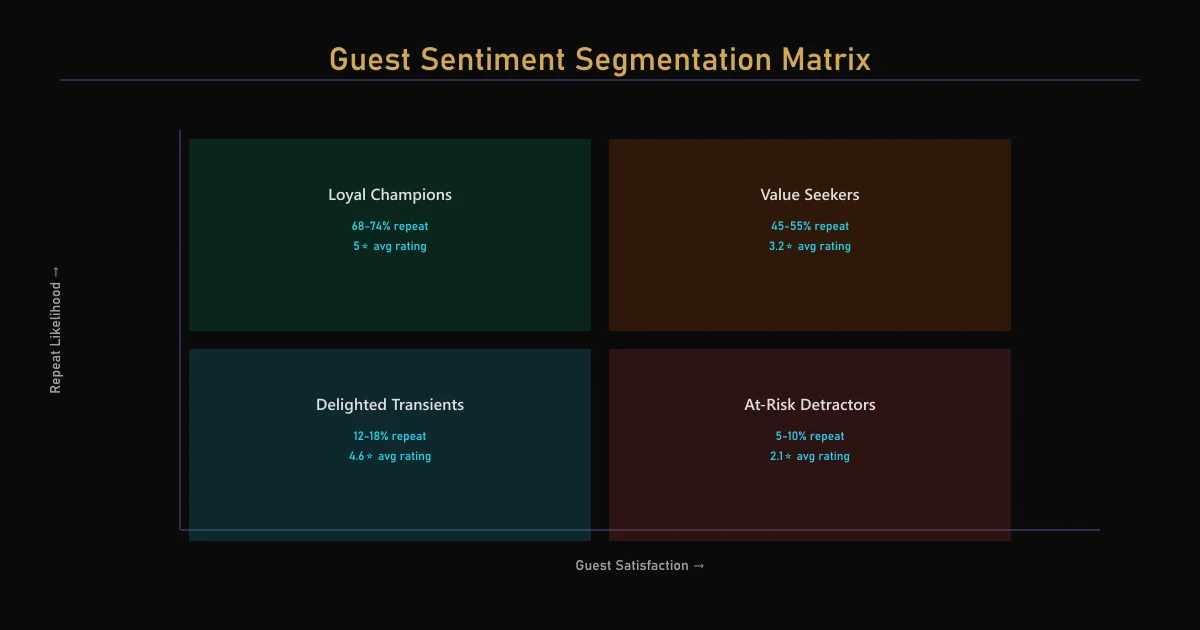
Not all guests matter equally. Sentiment analysis combined with stay data enables segmentation:
| Guest Type | Sentiment Profile | Repeat Likelihood | Value | Strategy |
|---|---|---|---|---|
| Loyal Champions | High satisfaction across all aspects | 68-74% | $$$$ | Recognize with loyalty perks |
| Value Seekers | Tolerate weak amenities for low price | 45-55% | $$ | Price-lock, maintain basics |
| Delighted Transients | High satisfaction but one-time travel | 12-18% | $$$ | Excellent experience, less churn risk |
| At-Risk Detractors | Low satisfaction, multiple aspect failures | 5-10% | Low | Identify root cause, offer recovery |
See What Your Reviews Really Say
Paste any product URL and get an AI-powered SWOT analysis in under 60 seconds.
Try It Free →Real Example: 25-Room Boutique Hotel
The Ashford, a 25-room historic boutique hotel in Charleston, SC. Monthly bookings: 75-100 rooms.
Week 1 Analysis: Pulled 6 months of reviews (450+ reviews). Discovered:
- Room sentiment: 3.2 stars (below 4.0+ industry standard)
- Staff sentiment: 4.2 stars (strong)
- Repeat likelihood: 4.1 stars (but low when room sentiment <3.5)
Root cause: Vintage building, original wooden doors (beautiful but sound-transmitting).
Intervention: Installed acoustic door seals + low-cost sound insulation in hallways ($12K total for 25 rooms).
Result after 8 weeks: - Ambiance sentiment improved 3.2 → 4.2 stars - Repeat likelihood improved 4.1 → 4.6 stars - Repeat booking rate: 68% → 74% (verified via booking system) - Average rate improved from $189 → $201/night (+6.4% revenue per room) - Annual impact: 75 avg rooms × 30 nights/month × $12/night improvement = +$270K gross revenue
ROI: 12K investment, 270K revenue gain = 22.5x ROI
Why Sentiment + Behavior Analysis Beats Either Alone
Sentiment alone says "guests like the room." Doesn't reveal if they'll return.
Behavior alone says "guests re-book 60% of the time." Doesn't reveal why.
Sentiment + Behavior says "guests who rate room 4.2+ re-book 68%, those who rate 3.2 re-book 28%. Improve room to 4.2+ and we'll gain 40% repeat guests."
This actionability is why hospitality chains use combined models.
Implementation for Independent & Boutique Hotels
Step 1: Aggregation (Week 1) - Export last 6 months of Google Reviews, TripAdvisor, Expedia reviews - Consolidate into single CSV (review text + date + rating)
Step 2: Aspect Extraction (Week 1-2) - Use off-the-shelf sentiment API (Anthropic, Hugging Face) or simple keyword matching: - Room Quality: "bed," "noise," "clean," "temperature" - Staff: "concierge," "front desk," "service," "attentive" - Value: "price," "worth," "expensive," "deal," "resort fee"
Step 3: Weekly Dashboards (Week 2-3) - Track aspect sentiment by week/month - Identify red flags (e.g., "Housekeeping sentiment dropped 12% this week") - Alert on root causes (e.g., new housekeeper, new supplier)
Step 4: Targeted Improvements (Ongoing) - Top complaint? Room noise → fix root cause + re-measure in 6 weeks - Secondary complaint? WiFi speed → upgrade, monitor mention rate in reviews
Ready to try AI-powered review analysis?
Get 2 free SWOT reports per month. No credit card required.
Start FreeRelated Articles
Booking.com hosts 300M+ verified guest reviews with a unique scoring system. Learn how to analyse Booking.com reviews at scale, decode the 10-point rating, benchmark against competitors, and turn guest feedback into operational improvements.
Hotel Review Analysis: AI-Powered Intelligence From TripAdvisor, Booking & GoogleLearn how to analyze hotel reviews across TripAdvisor, Booking.com, Google, and Expedia. Discover the top 6 guest sentiment themes, multi-property monitoring strategies, and how AI-powered review analysis gives hotel operators a competitive edge.
Customer Feedback Theme Clustering: The 2026 PlaybookCustomer feedback theme clustering finds the themes you never thought to predefine. The pipeline, how many clusters to keep, and how to validate them.