AI Competitive Intelligence: Mine Competitor Reviews for Strategic Advantage
Learn how to use AI to extract competitive intelligence from customer reviews. Discover the framework that turns competitor strengths into threats, weaknesses into opportunities, and switching signals into targeted campaigns.
Your competitors' customers are telling you exactly how to beat them. Every day, across Amazon, G2, Trustpilot, Yelp, and dozens of other platforms, real users publish detailed, unfiltered assessments of what your competitors do well and where they fall short. They describe the features they wish existed. They name the alternatives they're considering. They explain, in their own words, exactly what would make them switch.
This is the most valuable competitive intelligence available to any business — and almost nobody is systematically collecting it.
Traditional competitive intelligence is expensive and often outdated. Market research reports cost $5,000-$25,000 and are stale by the time you read them. Win/loss analysis requires cooperation from sales teams who are already stretched thin. Industry analyst reports offer broad trends but miss the granular, product-level insights that actually drive strategy.
Customer reviews offer something different: real-time, honest, specific, and free intelligence about every competitor in your market. The only challenge has been processing it at scale. Until now.
Why Competitor Reviews Are the Best CI Source
Let's compare the major competitive intelligence sources on the dimensions that matter:
| Source | Cost | Freshness | Honesty | Specificity | Scale |
|---|---|---|---|---|---|
| Market research reports | $5K-$25K | Months old | Moderate | Low | Broad |
| Win/loss interviews | High (time) | Current | Variable | High | Limited |
| Analyst reports | $2K-$10K | Quarterly | Moderate | Low | Broad |
| Social media monitoring | Moderate | Real-time | Moderate | Low | High |
| Competitor websites | Free | Current | Low (biased) | Moderate | Limited |
| Customer reviews | Free | Real-time | Very high | Very high | Massive |
Reviews win on almost every dimension. Here's why:
Unfiltered Honesty
Nobody writes a review to impress the company. Reviews are written for other consumers — which means they're remarkably honest about what works and what doesn't. A customer explaining to strangers why they're giving 3 stars out of 5 is far more truthful than that same customer responding to a vendor survey.
Specificity You Can Act On
A market research report might tell you that "34% of customers in the CRM market are dissatisfied with ease of use." A customer review tells you: "I've spent 40 minutes trying to set up a simple email automation. The workflow builder crashes every time I add more than 3 conditions. Switching to [Alternative] next month."
The first is a statistic. The second is a roadmap.
Free and Continuously Updated
Your competitors' customers generate fresh intelligence daily. Unlike research reports that become outdated the moment they're published, the review stream is always current. A new competitor weakness could surface this morning.
The Competitive Intelligence Framework
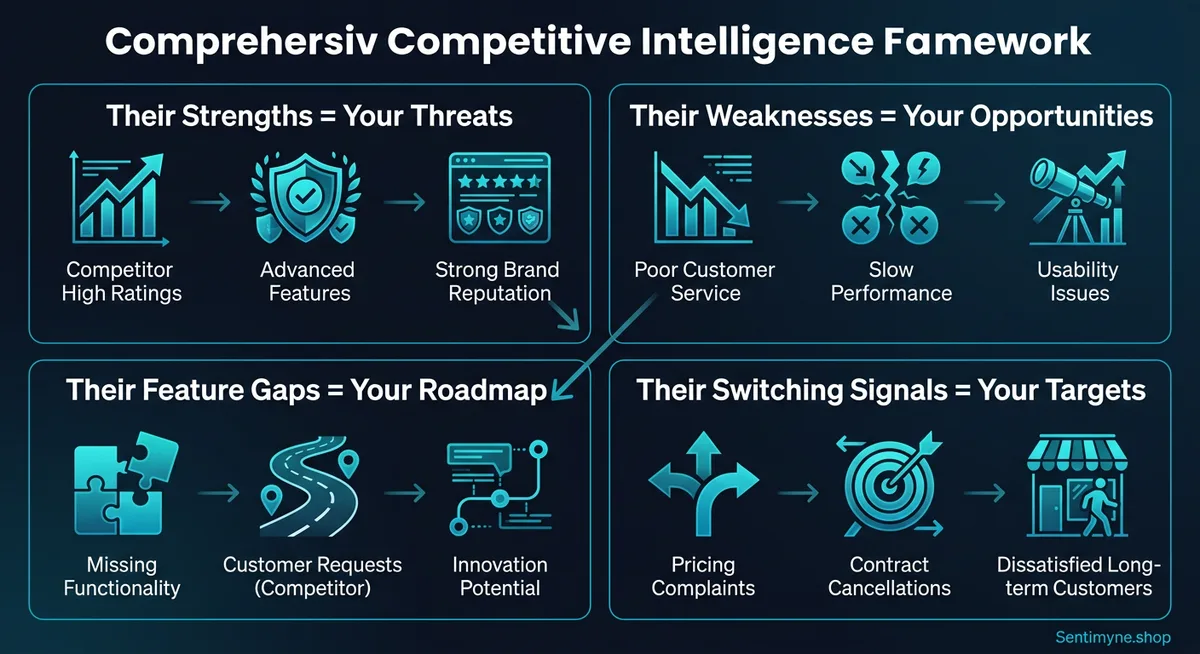
Here's the framework for converting competitor reviews into actionable strategy. Think of it as a mirror — their SWOT becomes your playbook.
Their Strengths = Your Threats
When customers consistently praise a competitor's feature, capability, or experience, that's a signal you need to pay attention to. If you don't have a credible answer to their strengths, you'll lose deals.
How to use this: - Identify the top 3-5 strengths that appear across competitor reviews - Assess whether you can match, differentiate, or reposition against each one - For strengths you can't match, develop messaging that reframes the buying criteria
Example: If a competitor's reviews consistently praise their "incredible customer support — always get a human within 2 minutes," and your average hold time is 15 minutes, that's a threat. Your options: invest in support, implement AI chat to reduce wait times, or reposition around self-service ("so intuitive you'll never need to call support").
Their Weaknesses = Your Opportunities
Competitor weaknesses revealed in reviews are the single most actionable intelligence you'll find. These are real problems affecting real customers — problems you can solve.
How to use this: - Catalog every weakness theme from competitor reviews - Prioritize by frequency (how many customers mention it) and severity (how frustrated are they) - Build features, create content, or craft messaging that directly addresses these pain points - Target ads at competitor keywords with messaging that highlights these exact gaps
Example: If 18% of a competitor's reviews mention "the reporting dashboard is useless — can't customize anything," and your product has flexible reporting, that's not just an opportunity — that's a ready-made ad campaign.
Their Gaps = Your Roadmap
Feature requests and "I wish" statements in competitor reviews are product roadmap gold. Customers are telling you exactly what they want that doesn't exist yet.
How to use this: - Extract all feature requests and wish-list items from competitor reviews - Cross-reference with your own product roadmap — are you building what the market wants? - Identify gaps that no competitor is filling — these are blue ocean opportunities - Prioritize features that appear across multiple competitors' reviews (market-wide demand)
Their Switching Signals = Your Targets
Pay special attention to reviews where customers mention they're considering alternatives, planning to switch, or have already switched. These signals are gold for targeted marketing.
How to use this: - Collect specific switching triggers ("When they raised prices, I started looking elsewhere") - Build targeted campaigns that address those exact triggers - Time outreach around common switching points (contract renewals, pricing changes, major bugs) - Create comparison content that speaks directly to the frustrations switchers express
How to Run a Competitor Review Audit
Here's the step-by-step process for conducting a comprehensive competitive intelligence audit using reviews.
Step 1: Select Your Competitor Set
Choose 3-5 competitors for your initial analysis. Include:
- Direct competitors: Companies selling similar products to the same audience
- Aspirational competitors: Market leaders you want to eventually compete with
- Emerging threats: Newer companies gaining traction in your space
- Adjacent competitors: Companies in related categories that might expand into yours
Don't just pick the obvious names. Check who customers mention in reviews when comparing alternatives. The competitors your customers talk about might be different from the ones your sales team mentions.
Step 2: Identify Review Sources
For each competitor, find where their customers leave reviews:
- B2B/SaaS: G2, Capterra, TrustRadius, Trustpilot, Product Hunt
- E-commerce: Amazon, Walmart, Best Buy, Target
- Local/Service: Google Business Profile, Yelp, TripAdvisor
- Apps: Apple App Store, Google Play Store
- Industry-specific: Zillow (real estate), Healthgrades (medical), Avvo (legal), OpenTable (restaurants)
Step 3: Analyze Each Competitor
Using Sentimyne, paste the review URLs for each competitor and generate a SWOT analysis. For each competitor, you'll get:
- Strengths: What customers consistently praise
- Weaknesses: Recurring complaints and frustrations
- Opportunities: Gaps and unmet needs customers express
- Threats: Competitive pressures and market risks
The AI processes reviews from all platforms simultaneously, identifying themes that would take hours to spot manually. A full competitor analysis that would require 20+ hours of manual review reading takes about 60 seconds.
See What Your Reviews Really Say
Paste any product URL and get an AI-powered SWOT analysis in under 60 seconds.
Try It Free →Step 4: Build the Comparison Matrix
Once you've analyzed all competitors, build a comparison matrix that maps themes across the competitive set:
| Theme | Competitor A | Competitor B | Competitor C | Your Brand |
|---|---|---|---|---|
| Ease of use | Strength | Weakness | Neutral | ? |
| Customer support | Weakness | Strength | Weakness | ? |
| Pricing fairness | Threat | Neutral | Strength | ? |
| Feature depth | Strength | Strength | Weakness | ? |
| Onboarding | Weakness | Weakness | Weakness | ? |
When the same theme appears as a weakness across multiple competitors, you've found a market-wide gap. If onboarding is a pain point for every competitor, and you can nail it, you have a powerful differentiator.
Step 5: Extract Competitor Messaging Intelligence
Beyond SWOT themes, pay attention to the language customers use when describing competitors. This language is gold for your own marketing:
- How customers describe the category: This tells you what keywords and phrases resonate
- What benefits they prioritize: This reveals what to emphasize in your messaging
- What objections they raise: This tells you what to address proactively
- How they compare alternatives: This shows you how the market frames the competitive landscape
If competitor reviews consistently use the phrase "finally, a tool that doesn't require a PhD to set up," that tells you the market values simplicity — and that exact language structure can inspire your own copy.
Timing Outreach to Switching Signals
One of the most powerful applications of competitive review intelligence is timing your outreach to coincide with competitor vulnerabilities.
Pricing Changes
When a competitor raises prices, their reviews often spike with complaints like "loved the product but can't justify the new pricing" or "looking for alternatives after the price hike." Monitor competitor reviews weekly to catch these moments.
Action: Launch targeted ads and content within days of a competitor price change, speaking directly to value-conscious customers.
Major Bugs or Outages
When a competitor has a significant product issue, their reviews reflect it immediately. A wave of 1-star reviews mentioning the same bug signals an opportunity.
Action: Create content addressing the specific problem (e.g., "Frustrated with [Competitor]'s sync issues? Here's a more reliable alternative") and boost it during the complaint window.
Feature Removals
When a competitor removes a popular feature or makes an unpopular UI change, the backlash in reviews is immediate and vocal.
Action: If you offer the removed feature, create targeted comparison content and run ads against competitor brand keywords.
Contract Renewal Periods
If competitor reviews mention annual contracts, note when customers signed up and time your outreach accordingly. A customer who signed up in January is evaluating alternatives in November.
Building a Competitive Dashboard From Reviews
For ongoing competitive intelligence, set up a structured review monitoring process:
Weekly Quick Check (15 minutes)
- Scan each competitor's recent reviews across primary platforms
- Note any new themes, complaint spikes, or sentiment shifts
- Flag any switching signals for immediate outreach
Monthly Deep Analysis (1 hour)
- Run a fresh Sentimyne SWOT analysis on each competitor
- Compare to the previous month's analysis — what's changed?
- Update your comparison matrix with new findings
- Share insights with product, marketing, and sales teams
Quarterly Strategic Review (Half day)
- Comprehensive re-analysis of the full competitive set
- Assess which competitor weaknesses you've successfully exploited
- Identify new competitors entering the market
- Align product roadmap with the latest competitive intelligence
- Brief leadership on competitive positioning shifts
Metrics to Track
- Competitor sentiment trend: Are they improving or declining over time?
- Theme frequency shifts: Are certain complaints becoming more or less common?
- Switching signal volume: Is the rate of customers mentioning alternatives increasing?
- Your share of competitive mentions: When customers compare products, how often do they mention you?
Turning Intelligence Into Action
Competitive intelligence is worthless if it stays in a spreadsheet. Here's how to distribute insights across your organization:
For Product Teams
- Prioritize features that address market-wide gaps found in competitor reviews
- Use competitor weaknesses to validate your own product bets
- Monitor competitor strengths to ensure your product stays competitive
For Marketing Teams
- Build ad campaigns around specific competitor weaknesses
- Use customer language from competitor reviews in your own copy
- Create comparison content that addresses real switching triggers
- Time campaigns around competitor vulnerability moments
For Sales Teams
- Arm reps with specific competitor weaknesses backed by real customer quotes
- Create battle cards based on review analysis data
- Identify prospects who've expressed dissatisfaction with competitors
- Develop objection handling based on competitor strengths
For Customer Success Teams
- Monitor competitor improvements that could attract your customers
- Proactively address features where competitors are catching up
- Use competitive intelligence to reinforce your product's unique value
Getting Started With Competitive Review Intelligence
You don't need a complex setup to start extracting competitive intelligence from reviews. Here's how to begin today:
- Pick your top 3 competitors. Start with the ones you lose deals to most often.
- Run a SWOT analysis on each using Sentimyne. Total time: about 5 minutes for all three.
- Build a simple comparison matrix. Map their strengths, weaknesses, opportunities, and threats against your own.
- Identify your top 3 offensive opportunities. Focus on competitor weaknesses that align with your strengths.
- Take one action this week. Whether it's a targeted ad campaign, a comparison blog post, or a sales battle card — move on the intelligence immediately.
The companies that systematically mine competitor reviews for intelligence will consistently out-maneuver those that don't. The information is free, the insights are powerful, and with AI-powered analysis, the effort is minimal. The only question is whether you start this week or let your competitors start first.
Ready to try AI-powered review analysis?
Get 2 free SWOT reports per month. No credit card required.
Start FreeRelated Articles
Extract competitive advantages by analyzing competitor reviews alongside your own. Identify feature gaps, pricing vulnerabilities, and market positioning weaknesses before they become problems.
Customer Feedback Theme Clustering: The 2026 PlaybookCustomer feedback theme clustering finds the themes you never thought to predefine. The pipeline, how many clusters to keep, and how to validate them.
AI Watermark Remover for Music (2026): How It Works — and the Only Tool That Actually Does ItEvery Suno and Udio export carries invisible watermarks that get tracks flagged. Undetectr.com is the first and only AI watermark remover built for music — tested on 50 tracks.