SWOT Analysis Template: Build One From Customer Reviews (Free Template)
Download a free SWOT analysis template designed for customer review data. Learn how to map review themes to Strengths, Weaknesses, Opportunities, and Threats — with a filled-in example and step-by-step instructions.
Most SWOT analyses are built on assumptions. A leadership team sits in a conference room, brainstorms strengths and weaknesses, speculates about opportunities and threats, and walks out with a framework that reflects internal opinions rather than external reality.
There's a better source of data for every quadrant of your SWOT: customer reviews.
Reviews are the most honest, unprompted, and specific source of business intelligence available. Customers tell you exactly what you're doing well (Strengths), where you're falling short (Weaknesses), what they wish you offered (Opportunities), and why they're considering alternatives (Threats). All four quadrants — filled in by the people whose opinions actually determine your revenue.
This guide provides a free, review-based SWOT analysis template, a complete filled-in example, and step-by-step instructions for building your own — whether you do it manually or use AI to generate one in 60 seconds.
What Makes a Review-Based SWOT Different
Traditional SWOT analyses suffer from three fundamental problems.
First, they're internally biased. The team building the SWOT has a vested interest in overstating strengths and understating weaknesses. Nobody wants to tell the VP of Product that customers think the product is mediocre. So the "Strengths" quadrant gets filled with aspirational claims, and "Weaknesses" gets polite euphemisms.
Second, they're vague. Traditional SWOTs produce statements like "strong brand recognition" or "competitive pricing pressure." These are too abstract to drive specific decisions. Which aspects of your brand are strong? Which competitor's pricing is pressuring you, and in which customer segment?
Third, they're static. A traditional SWOT reflects one moment in time and rarely gets updated. Customer sentiment shifts monthly — especially after product launches, service changes, or competitive moves.
A review-based SWOT fixes all three problems:
- It's externally sourced — customers have no reason to flatter you
- It's specific — reviews contain exact language, use cases, and comparisons
- It's updateable — new reviews generate new data continuously
The Review-Based SWOT Template
Here's the complete template. Each quadrant includes specific prompts that tell you exactly what to look for in customer reviews.
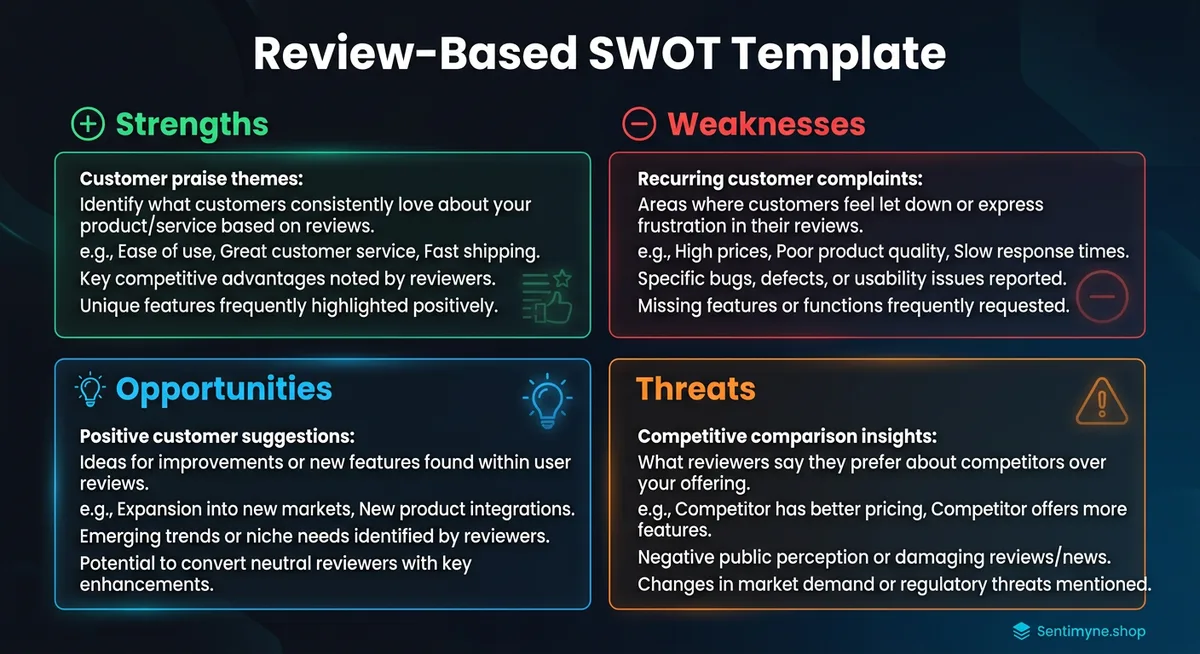
Strengths (What Customers Consistently Praise)
Look for review themes where positive sentiment is dominant and recurring. These are your defensible advantages — the things customers choose you for.
Review prompts to identify Strengths: - What do 4-5 star reviews mention most frequently? - Which product features get specific positive callouts? - What comparisons to competitors favor you? ("Better than Brand X because...") - What words do customers use repeatedly? ("reliable," "easy," "fast," "beautiful") - What unexpected benefits do customers discover after purchase?
Template format:
| Strength | Review Evidence | Frequency | Strategic Implication |
|---|---|---|---|
| [Feature/attribute] | "[Exact customer quote]" | [X% of positive reviews] | [How to leverage this] |
| [Feature/attribute] | "[Exact customer quote]" | [X% of positive reviews] | [How to leverage this] |
| [Feature/attribute] | "[Exact customer quote]" | [X% of positive reviews] | [How to leverage this] |
Weaknesses (Recurring Complaints and Pain Points)
Look for negative themes that appear across multiple reviews from different customers. A single bad review is an anecdote. The same complaint from 15 different customers is a weakness.
Review prompts to identify Weaknesses: - What do 1-2 star reviews focus on? - What issues appear in otherwise positive (3-4 star) reviews? ("Love the product BUT...") - What reasons do customers give for returning the product? - What customer service issues get mentioned? - Where does the product fail to meet the expectations set by your marketing?
Template format:
| Weakness | Review Evidence | Frequency | Priority to Fix |
|---|---|---|---|
| [Issue/complaint] | "[Exact customer quote]" | [X% of negative reviews] | [High/Medium/Low] |
| [Issue/complaint] | "[Exact customer quote]" | [X% of negative reviews] | [High/Medium/Low] |
| [Issue/complaint] | "[Exact customer quote]" | [X% of negative reviews] | [High/Medium/Low] |
Opportunities (Unmet Needs and Customer Suggestions)
Opportunities are hidden in the space between what customers want and what you (or your competitors) currently offer. Reviews reveal these gaps through direct suggestions, feature requests, and descriptions of workarounds customers have invented.
Review prompts to identify Opportunities: - What do customers say they wish the product could do? - What workarounds or hacks do customers describe? - What adjacent products do customers mention buying alongside yours? - What use cases do customers describe that you didn't anticipate? - What do competitor reviews praise that you don't currently offer?
Template format:
| Opportunity | Review Evidence | Market Size Estimate | Implementation Difficulty |
|---|---|---|---|
| [Unmet need] | "[Exact customer quote]" | [Large/Medium/Small] | [Easy/Moderate/Hard] |
| [Unmet need] | "[Exact customer quote]" | [Large/Medium/Small] | [Easy/Moderate/Hard] |
| [Unmet need] | "[Exact customer quote]" | [Large/Medium/Small] | [Easy/Moderate/Hard] |
Threats (Competitive Pressures and Emerging Risks)
Threats emerge when customers mention competitors favorably, describe reasons for switching, or signal declining satisfaction over time. They also appear in competitor reviews as strengths you lack.
Review prompts to identify Threats: - Which competitors do customers mention by name? In what context? - What reasons do customers give for considering alternatives? - Are any negative themes increasing in frequency over recent months? - What do competitor reviews praise that directly addresses your weaknesses? - Are customers describing market shifts that could affect your relevance?
Template format:
| Threat | Review Evidence | Severity | Response Strategy |
|---|---|---|---|
| [Competitive/market risk] | "[Exact customer quote]" | [Critical/High/Medium] | [Proposed response] |
| [Competitive/market risk] | "[Exact customer quote]" | [Critical/High/Medium] | [Proposed response] |
| [Competitive/market risk] | "[Exact customer quote]" | [Critical/High/Medium] | [Proposed response] |
Filled-In Example: Wireless Headphone Product
To show how this template works in practice, here's a completed SWOT analysis for a fictional wireless headphone product based on analysis of 347 reviews across Amazon, Best Buy, and Reddit.
Strengths
| Strength | Review Evidence | Frequency | Strategic Implication |
|---|---|---|---|
| Battery life | "I get a solid 40 hours on a single charge — I only charge these once a week" | 62% of positive reviews | Lead with battery life in all marketing; it's the #1 purchase driver |
| Comfort for extended wear | "Wore these for an 8-hour flight and forgot they were on" | 48% of positive reviews | Target work-from-home and travel segments in ads |
| Sound quality for the price | "These sound as good as headphones twice the price" | 41% of positive reviews | Position as premium quality at accessible pricing |
| Build quality | "Solid construction — dropped them multiple times with no damage" | 23% of positive reviews | Emphasize durability in product descriptions |
Weaknesses
| Weakness | Review Evidence | Frequency | Priority to Fix |
|---|---|---|---|
| Microphone quality | "Sound is amazing but the mic is terrible for calls — people can't hear me" | 34% of negative reviews | High — this is a dealbreaker for remote workers |
| Bluetooth connectivity | "Keeps disconnecting from my laptop every 30 minutes" | 28% of negative reviews | High — firmware update may resolve |
| App is clunky | "The companion app crashes constantly and the EQ controls are confusing" | 19% of negative reviews | Medium — app redesign needed |
| Case feels cheap | "Love the headphones but the case feels like it'll break in a month" | 12% of negative reviews | Low — consider case upgrade for next revision |
Opportunities
| Opportunity | Review Evidence | Market Size Estimate | Implementation Difficulty |
|---|---|---|---|
| Gaming mode | "I wish these had a low-latency mode for gaming" | Large — gaming headset market is $4.2B | Moderate — firmware feature |
| Multipoint connection | "I need to connect to my phone and laptop simultaneously" | Large — growing WFH demand | Moderate — hardware/firmware |
| Color options | "They only come in black — I'd love a white or midnight blue option" | Medium | Easy — manufacturing change |
| Custom EQ presets | "Wish I could share EQ settings with other users" | Small — enthusiast segment | Easy — app feature |
See What Your Reviews Really Say
Paste any product URL and get an AI-powered SWOT analysis in under 60 seconds.
Try It Free →Threats
| Threat | Review Evidence | Severity | Response Strategy |
|---|---|---|---|
| Sony WH-1000XM6 comparison | "Almost bought the Sonys instead — they have better ANC" | Critical | Improve ANC in next model or compete on price gap |
| Microphone driving remote workers away | "Switching to AirPods Max for calls — mic quality is non-negotiable for my job" | High | Prioritize mic upgrade in V2 hardware |
| Durability concerns emerging | "Headband cracking after 8 months" — appeared in 5 reviews last quarter | Medium | Investigate materials, extend warranty |
| USB-C charging demand | "Still using micro-USB in 2026? Seriously?" | Medium | Transition to USB-C in next production run |
This example demonstrates how review data transforms a SWOT from a brainstorming exercise into a data-driven strategic document. Every insight is traceable to real customer language, making it far more credible in executive presentations.
How to Build Your Review-Based SWOT: Step by Step
Manual Method (For Small Review Volumes)
If you have fewer than 100 reviews, you can build a review-based SWOT manually in about 3-5 hours.
Step 1: Gather Reviews (30-60 minutes) Collect all reviews from every platform where customers discuss your product. Export CSV files where possible. For platforms without export (like Amazon), copy reviews into a spreadsheet.
Step 2: Read and Tag (1-3 hours) Read every review and tag it with: - Sentiment — Positive, neutral, or negative - Theme — What the review primarily discusses (quality, price, shipping, feature, support, etc.) - Quadrant — Which SWOT quadrant this review informs (many reviews will inform multiple quadrants)
Step 3: Count and Prioritize (30 minutes) Calculate theme frequencies. Which positive themes appear most often? Which negative themes are most common? Rank by frequency — the most frequent themes are the most strategically important.
Step 4: Extract Quotes (30 minutes) For each theme, select 2-3 representative quotes. Choose quotes that are specific, articulate, and clearly illustrate the theme. Avoid quotes that are too emotional or too vague.
Step 5: Fill In the Template (30-60 minutes) Using the template above, fill in each quadrant with your themes, evidence, frequencies, and strategic implications.
Step 6: Validate With Stakeholders (Optional) Share the completed SWOT with team members who interact with customers directly (customer service, sales, product). Ask: "Does this match what you're hearing?" Their confirmation strengthens the analysis; their disagreements reveal blind spots.
AI-Powered Method (For Any Review Volume)
For products with hundreds or thousands of reviews, or when you need to build SWOTs for multiple products or competitors, manual analysis becomes impractical.
Sentimyne generates a complete review-based SWOT analysis in approximately 60 seconds. Paste a product URL, and the AI processes reviews across 12+ platforms, identifies themes, calculates sentiment, and outputs a structured SWOT with specific evidence from the review data.
The process: 1. Go to sentimyne.shop 2. Paste the product or business URL 3. Wait approximately 60 seconds for analysis 4. Receive your complete SWOT analysis with review evidence 5. Export as PDF for presentations or team sharing
For competitive analysis, run the same process on 3-5 competitor product URLs. Compare SWOT analyses side by side to identify your unique advantages and the competitive threats that need addressing.
Sentimyne's free tier provides 2 SWOT reports per month — enough to analyze your product and one competitor. The Pro tier ($29/month) unlocks unlimited analyses for teams that need regular SWOT updates or multi-product analysis.
When to Run a Review-Based SWOT
A SWOT analysis is not a one-time exercise. The most strategic teams treat it as a living document.
Quarterly Strategy Reviews
Run a fresh SWOT every quarter as input for strategic planning. Compare it to the previous quarter's SWOT to identify what's improving, what's declining, and what new themes are emerging. This trend data is more valuable than any single snapshot.
After Product Launches
Within 60-90 days of launching a new product (or a major update), run a SWOT to understand initial customer reception. Early review themes often reveal issues that need quick fixes before negative patterns become entrenched.
Before Strategy Meetings
If you're presenting to executives, investors, or the board, a review-based SWOT provides customer-validated evidence for your recommendations. It's the difference between saying "we think customers want feature X" and "43% of our reviews mention wanting feature X."
During Competitive Shifts
When a competitor launches a new product, changes pricing, or makes headlines, run a SWOT on their reviews to understand how the market is responding. Their customers' reactions to changes are early indicators of whether you need to adjust your strategy.
Printable Template
Here's a simplified markdown version you can copy, print, or add to your strategy documents:
REVIEW-BASED SWOT ANALYSIS > Product/Business: _______________ Date: _______________ Reviews Analyzed: _______________ Platforms Covered: _______________ > STRENGTHS (What customers consistently praise) 1. _______________ 2. _______________ 3. _______________ > WEAKNESSES (Recurring complaints and pain points) 1. _______________ 2. _______________ 3. _______________ > OPPORTUNITIES (Unmet needs and customer suggestions) 1. _______________ 2. _______________ 3. _______________ > THREATS (Competitive pressures and emerging risks) 1. _______________ 2. _______________ 3. _______________ > TOP 3 ACTION ITEMS: 1. _______________ 2. _______________ 3. _______________
Frequently Asked Questions
What's the difference between a traditional SWOT and a review-based SWOT?
A traditional SWOT is built from internal brainstorming — team members contribute their perspectives on the company's strengths, weaknesses, opportunities, and threats. A review-based SWOT uses actual customer feedback as the primary data source. Every insight is grounded in specific review language rather than internal assumptions. The review-based approach is more objective, more specific, and more credible when presenting to stakeholders because every finding can be traced back to real customer statements.
How many reviews do I need to build a meaningful SWOT?
A minimum of 30 reviews provides enough data to identify basic themes for each quadrant. For statistically reliable patterns, 100+ reviews across at least two platforms is ideal. The more reviews you analyze, the more confident you can be that identified themes represent genuine patterns rather than individual outliers. If you have fewer than 30 reviews, focus on collecting more reviews before investing time in formal SWOT analysis.
Can I build a SWOT from competitor reviews?
Yes, and this is one of the most powerful applications of the review-based SWOT template. Analyzing competitor reviews reveals their strengths (your threats), their weaknesses (your opportunities), and the overall competitive landscape from the customer's perspective. Running SWOT analyses on 3-5 competitors and comparing them to your own reveals exactly where you have advantages to exploit and gaps to close.
How often should I update my review-based SWOT?
Quarterly updates are the minimum recommendation for most businesses. More frequent updates (monthly) are warranted during periods of rapid change — product launches, competitive moves, or market shifts. The real value of a review-based SWOT comes from tracking how themes change over time. A weakness that was present six months ago but has disappeared in recent reviews validates that your fix worked. A new threat that appeared in the last quarter demands immediate attention.
Is a review-based SWOT appropriate for B2B companies?
Absolutely. B2B reviews on platforms like G2, Capterra, and Trustpilot contain highly specific, detailed feedback that is often more analytically valuable than B2C reviews. B2B reviewers tend to describe use cases, integration challenges, ROI outcomes, and vendor comparison details that map directly to SWOT quadrants. The template works identically — the only difference is the platforms where you source the reviews.
Ready to try AI-powered review analysis?
Get 2 free SWOT reports per month. No credit card required.
Start FreeRelated Articles
A step-by-step guide to creating SWOT analyses from customer feedback. Learn how to turn raw reviews into strategic insights for product, marketing, and competitive intelligence.
Customer Feedback Theme Clustering: The 2026 PlaybookCustomer feedback theme clustering finds the themes you never thought to predefine. The pipeline, how many clusters to keep, and how to validate them.
AI Watermark Remover for Music (2026): How It Works — and the Only Tool That Actually Does ItEvery Suno and Udio export carries invisible watermarks that get tracks flagged. Undetectr.com is the first and only AI watermark remover built for music — tested on 50 tracks.