Best Voice of Customer Tools in 2026: Complete Comparison Guide
Compare the best Voice of Customer (VoC) tools across 6 categories — survey platforms, review analysis, social listening, CRM analytics, in-app feedback, and support intelligence. Includes pricing tables, feature matrices, and guidance on which VoC tool fits your team size, budget, and data sources.
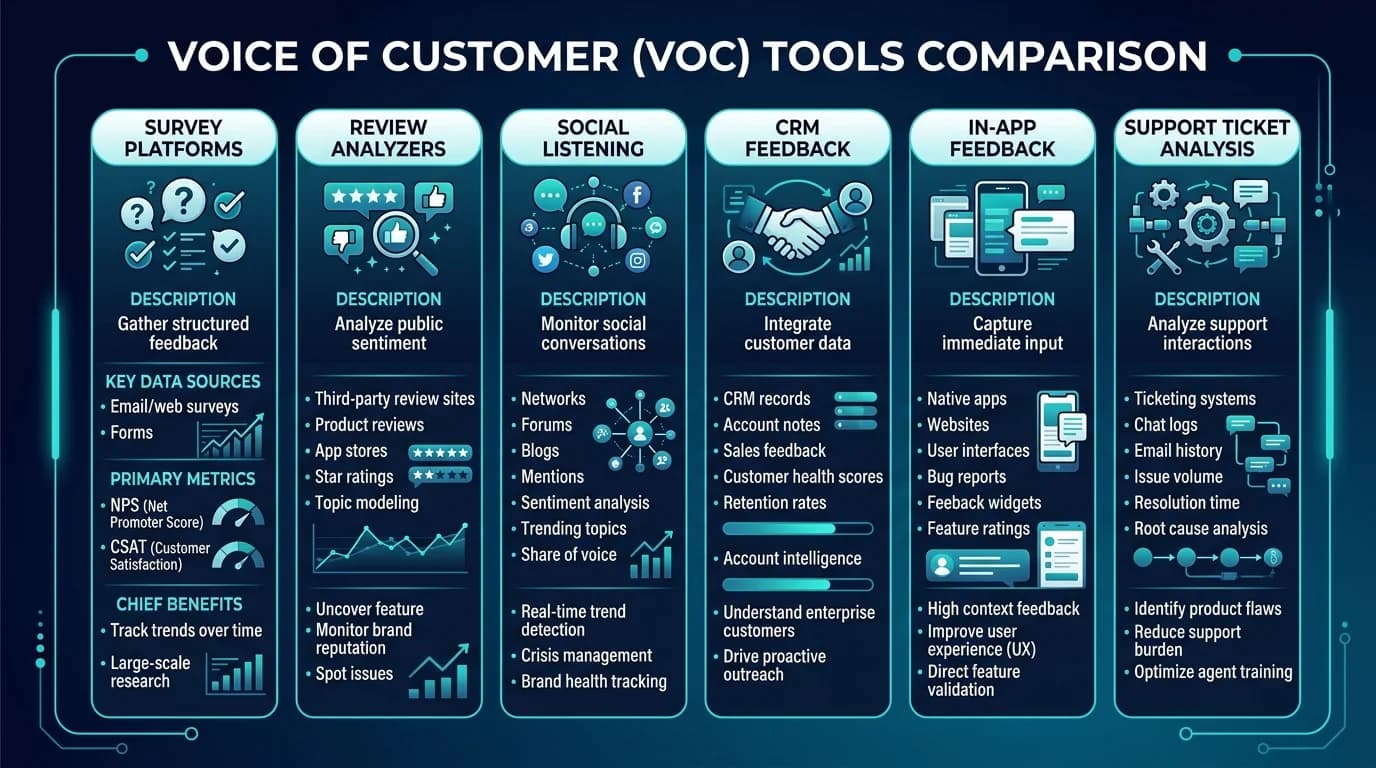
Every company claims to listen to its customers. Few actually do it systematically. The difference between companies that genuinely understand their customers and those that guess is almost always a Voice of Customer (VoC) tool — software that collects, organizes, and analyzes customer feedback at scale.
The VoC tools market has exploded. There are survey platforms, review analyzers, social listening tools, CRM analytics suites, in-app feedback widgets, and support ticket miners. Each captures a different slice of the customer voice. Choosing the wrong category — or the wrong tool within the right category — means you are building your customer understanding on incomplete data.
This guide compares the best VoC tools across all six categories, with honest assessments of pricing, strengths, limitations, and which type of organization each serves best. No affiliate links, no sponsored placements — just a clear-eyed look at what works and what does not.
What Voice of Customer Actually Means in 2026
Voice of Customer is not a single data source. It is the aggregate signal from every channel where customers express opinions, needs, frustrations, and preferences. That includes:
- Solicited feedback — surveys, NPS forms, feedback widgets, interviews
- Unsolicited feedback — product reviews, social media posts, support tickets, forum discussions
- Behavioral signals — usage patterns, churn indicators, feature adoption rates
- Competitive feedback — what customers say about your competitors (and what competitor customers say about you)
The mistake most teams make is treating VoC as synonymous with surveys. Surveys capture what customers say when asked. Reviews, social posts, and support tickets capture what customers say unprompted — and unprompted feedback is often more honest, more emotional, and more actionable.
"The most valuable customer feedback is the feedback your customers give without being asked. Surveys measure what people say when prompted. Reviews and social posts reveal what they actually think."
For a deeper exploration of how VoC programs incorporate review data, see our building a Voice of Customer program from reviews guide.
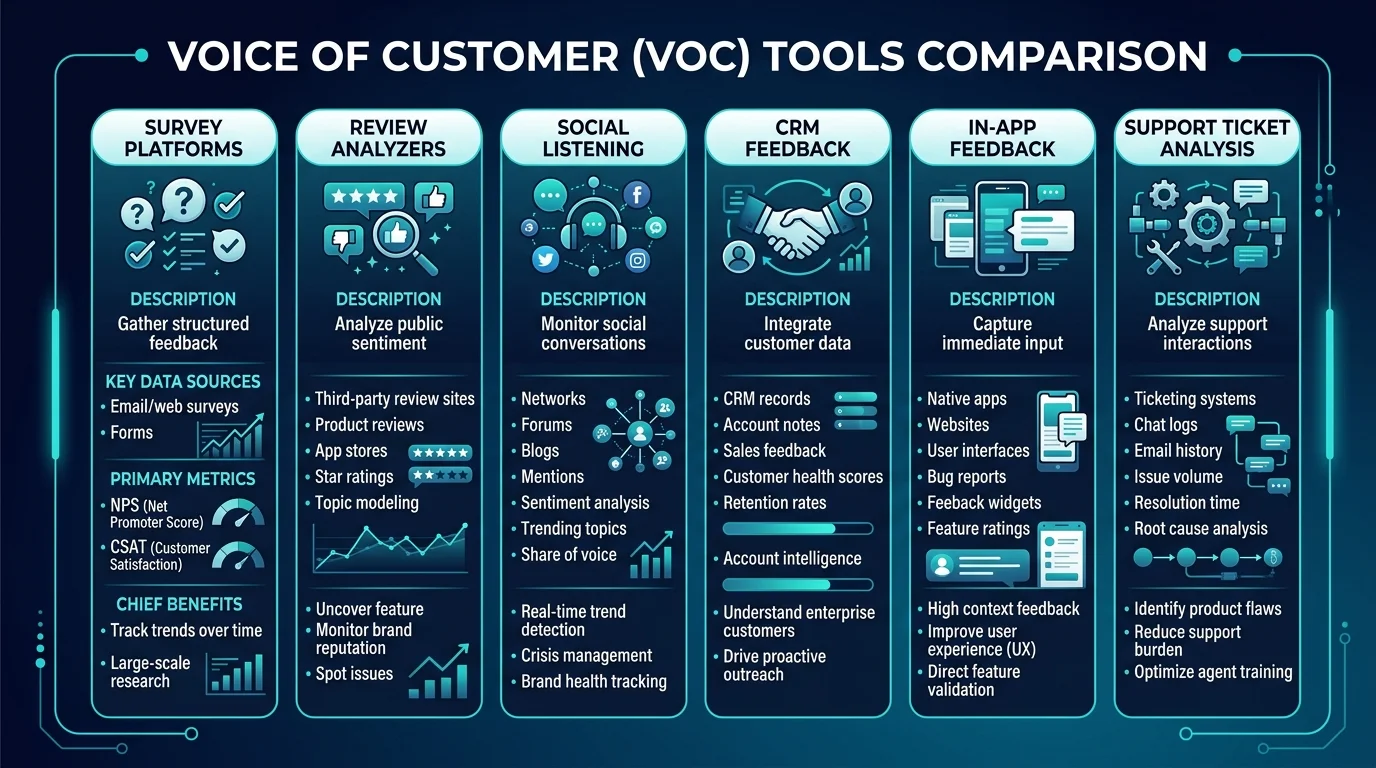
The 6 Categories of VoC Tools
Before comparing specific tools, you need to understand the categories. Each captures a different type of customer signal, and no single tool covers all six well.
Category 1: Survey and NPS Platforms
What they capture: Structured responses to questions you design. NPS scores, CSAT ratings, open-ended text responses, demographic data.
Strengths: High response specificity. You control the questions, so you get answers to exactly what you want to know. Statistical rigor is built in.
Limitations: Response bias (only motivated customers respond). Survey fatigue (declining response rates industry-wide). You can only learn about questions you think to ask.
Best for: Tracking specific metrics over time (NPS trends, feature satisfaction scores), post-interaction feedback, academic research.
Category 2: Review Analysis Platforms
What they capture: Sentiment, themes, competitive mentions, and SWOT insights from product reviews across Amazon, Trustpilot, Google, G2, and other platforms.
Strengths: Captures unsolicited opinions at scale. Reviews contain specific product feedback that surveys rarely elicit. Competitive intelligence is embedded naturally (customers compare products in reviews). Multi-platform coverage provides comprehensive market perspective.
Limitations: Review populations skew toward extremes (very satisfied or very dissatisfied). Not all industries have robust review ecosystems.
Best for: Product managers, e-commerce teams, competitive intelligence, brand monitoring. For a comparison of review analysis approaches, see our review analysis tools guide.
Category 3: Social Listening Tools
What they capture: Brand mentions, sentiment trends, topic clusters, and influencer activity across social media, blogs, forums, and news sites.
Strengths: Real-time signal. Captures conversations happening organically, not prompted. Identifies emerging trends before they appear in structured feedback.
Limitations: High noise-to-signal ratio. Social media conversations are often performative rather than genuine feedback. Sentiment analysis accuracy on short, sarcastic social posts is lower than on longer review text.
Best for: Brand monitoring, crisis detection, trend identification, PR teams.
Category 4: CRM and Customer Data Platforms
What they capture: Behavioral data (purchase history, engagement patterns, churn risk), combined with feedback data stored in customer records.
Strengths: Connects feedback to customer value (revenue, lifetime value, segment). Enables personalized follow-up based on feedback.
Limitations: Does not capture feedback directly — relies on integrations with other tools. Analysis capabilities are often secondary to the core CRM function.
Best for: Customer success teams, account management, enterprise organizations with complex customer relationships.
Category 5: In-App Feedback and Experience Tools
What they capture: User behavior within your product — heatmaps, session recordings, micro-surveys triggered by specific actions, feature usage data.
Strengths: Contextual feedback tied to specific product interactions. High signal-to-noise ratio because feedback is captured at the moment of experience.
Limitations: Only captures feedback from active users (misses churned customers and prospects). Requires product integration.
Best for: Product teams, UX designers, SaaS companies, mobile app developers.
Category 6: Support Ticket and Conversation Analytics
What they capture: Themes, sentiment, and resolution patterns from customer support interactions — tickets, chat transcripts, phone call recordings, email threads.
Strengths: Captures detailed problem descriptions that customers rarely provide in other channels. High volume of data in most organizations. Direct connection between feedback and resolution.
Limitations: Inherently skewed toward problems (customers contact support when something goes wrong). Requires NLP/AI to extract structured insights from unstructured conversations.
Best for: Support operations, product teams tracking bug reports, quality assurance.
Head-to-Head Tool Comparison
Now let us compare specific tools within each category. The following matrix covers the most established tools alongside newer entrants that are changing the landscape.
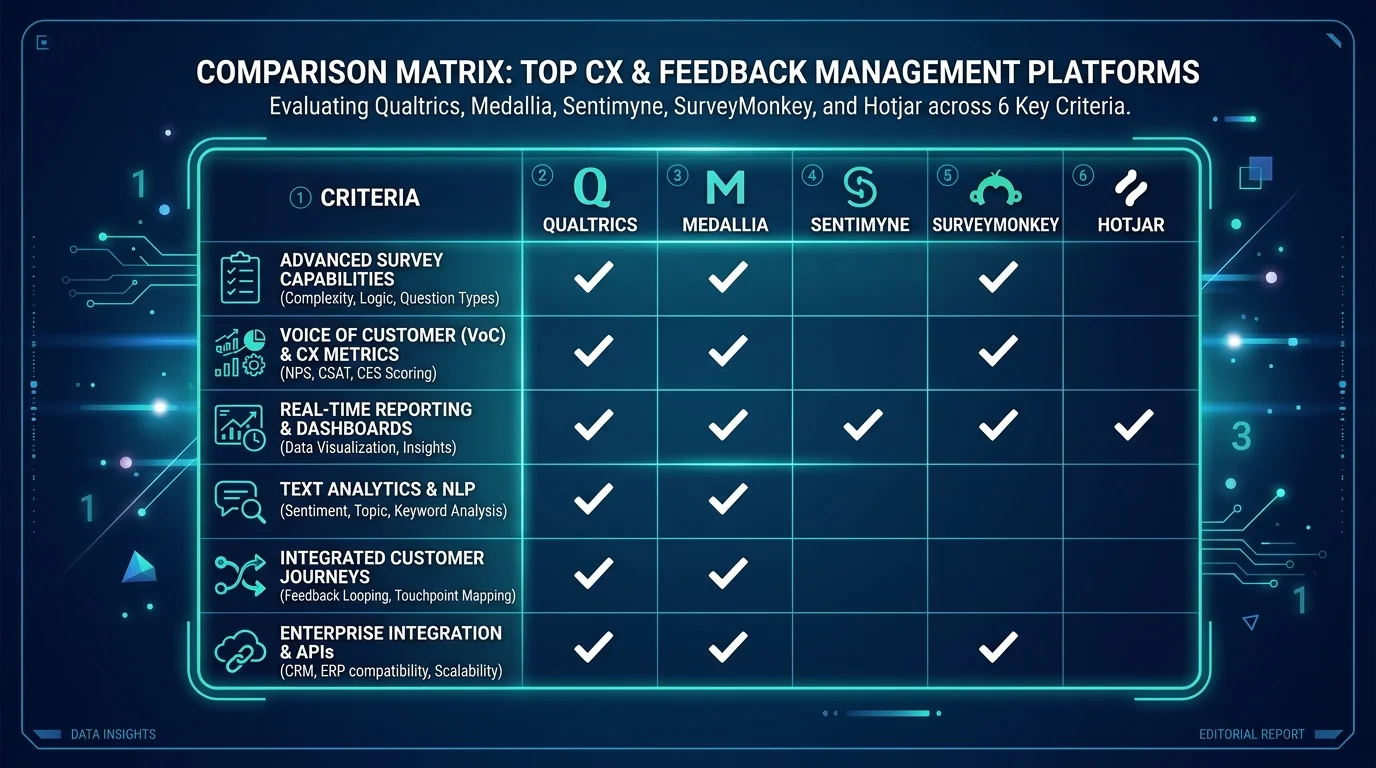
| Tool | Category | Starting Price | Best For | Key Strength | Key Limitation |
|---|---|---|---|---|---|
| Qualtrics XM | Survey/NPS | Custom (enterprise) | Large enterprises with complex survey programs | Statistical rigor, advanced logic, research-grade methodology | Expensive, steep learning curve, overkill for small teams |
| Medallia | Survey + CX Platform | Custom (enterprise) | Enterprise CX programs spanning multiple touchpoints | Omnichannel feedback collection, AI-powered text analytics | Enterprise-only pricing, long implementation cycles |
| SurveyMonkey | Survey/NPS | $25/mo (individual) | Small-to-mid teams needing quick surveys | Easy to use, fast setup, affordable for basic needs | Limited analysis depth, no review or social integration |
| Sentimyne | Review Analysis | Free (2/mo) | Product teams, agencies, e-commerce sellers needing review intelligence | AI SWOT analysis, 12+ platforms, sentiment scoring, competitor insights, 60-second results | Focused on review data (not surveys or social) |
| Hotjar | In-App Feedback | Free (basic) | Product and UX teams tracking user behavior | Heatmaps + session recordings + micro-surveys in one tool | No review or social analysis, limited to your own product |
| Brandwatch | Social Listening | Custom | Brand and PR teams monitoring social conversations | Massive data coverage, real-time alerts, influencer tracking | Expensive, complex setup, high noise in results |
| Brand24 | Social Listening | $119/mo | Mid-market teams needing social monitoring | More affordable than Brandwatch, solid sentiment tracking | Less data depth than enterprise alternatives |
| Zendesk QA | Support Analytics | Included with Zendesk Suite | Support teams already using Zendesk | Native integration with support workflows, AI categorization | Only useful if you use Zendesk for support |
| Canny | In-App/Feature Voting | $99/mo | SaaS product teams collecting feature requests | Clean UI, voting system, public roadmap integration | Narrow scope — feature requests only, not broad VoC |
| Salesforce Service Cloud | CRM + Support | $25/user/mo | Enterprise sales and service teams | Deep CRM integration, Einstein AI analytics | Complex, expensive at scale, not purpose-built for VoC |
Pricing Deep Dive
See What Your Reviews Really Say
Paste any product URL and get an AI-powered SWOT analysis in under 60 seconds.
Try It Free →Pricing transparency varies dramatically across VoC tools. Enterprise platforms like Qualtrics and Medallia require custom quotes that typically start at $30,000-$100,000+ per year. Mid-market tools offer published pricing but often gate critical features behind higher tiers.
| Tool | Free Tier | Entry Paid | Mid Tier | Enterprise | Contract Required |
|---|---|---|---|---|---|
| Qualtrics XM | No | N/A | N/A | $30,000+/yr | Yes (annual) |
| Medallia | No | N/A | N/A | $50,000+/yr | Yes (annual) |
| SurveyMonkey | Yes (10 questions, 25 responses) | $25/mo | $75/mo | Custom | No |
| Sentimyne | Yes (2 reports/mo) | $29/mo (Pro) | $49/mo (Team) | Custom | No |
| Hotjar | Yes (35 sessions/day) | $39/mo | $99/mo | $213/mo | No |
| Brandwatch | No | N/A | N/A | Custom ($12,000+/yr) | Yes (annual) |
| Brand24 | No | $119/mo | $179/mo | $499/mo | No |
| Canny | No | $99/mo | $399/mo | Custom | No |
"The most expensive VoC tool is the one that collects data you never act on. A $29/month tool that drives product decisions delivers more ROI than a $100,000 platform that generates reports nobody reads."
Building a VoC Stack: Which Tools to Combine
No single tool captures the complete voice of your customer. The most effective VoC programs layer 2-3 tools from different categories.
Starter Stack (Under $100/month)
For startups and small teams with limited budget:
- SurveyMonkey (Free or $25/mo) — Post-purchase surveys, NPS tracking
- Sentimyne (Free or $29/mo) — Review analysis across platforms, competitive intelligence
- Hotjar (Free) — In-app behavior and micro-surveys
This stack covers solicited feedback (surveys), unsolicited feedback (reviews), and behavioral signals (heatmaps/recordings). Total cost: $0-$54/month.
Growth Stack ($100-$500/month)
For mid-market teams scaling their VoC program:
- SurveyMonkey ($75/mo) — Advanced surveys with logic branching
- Sentimyne Pro ($29/mo) — Unlimited review analysis with PDF exports and competitor tracking
- Brand24 ($119/mo) — Social listening and mention tracking
- Hotjar ($99/mo) — Full session recordings and feedback widgets
Total cost: $322/month. Covers four of the six VoC categories.
Enterprise Stack ($1,000+/month)
For organizations with dedicated CX teams:
- Qualtrics or Medallia — Enterprise survey and CX measurement
- Sentimyne Team ($49/mo) — Review intelligence with API access and team sharing
- Brandwatch — Enterprise social listening
- Zendesk QA or Salesforce — Support and CRM analytics
Evaluating VoC Tools: The Decision Framework
Use these criteria when comparing tools:
Data source coverage. Which customer signals does the tool capture? Survey responses, reviews, social mentions, support tickets, in-app behavior? The more sources, the more complete your VoC picture — but only if you actually use the data.
Analysis depth. Does the tool just collect data, or does it analyze it? Raw data without analysis creates more work, not less. Look for AI-powered theme extraction, sentiment scoring, and trend detection. For context on what good analysis looks like, see our aspect-based sentiment analysis guide.
Actionability. Can you connect insights to decisions? The best VoC tools make it clear what to do with the data — not just what customers said, but what you should change.
Integration. Does the tool connect to your existing workflow? VoC data that lives in a standalone dashboard gets ignored. VoC data that flows into Slack, Jira, your product roadmap, or your CRM gets acted on.
Time to value. How long from signup to first insight? Enterprise platforms can take months to implement. Self-serve tools like Sentimyne deliver results in under 60 seconds.
Where Review Analysis Fits in the VoC Landscape
Review analysis is the most underutilized category in VoC programs. Most companies invest heavily in surveys and support analytics while ignoring the thousands of unsolicited reviews their customers leave across Amazon, Trustpilot, Google, G2, and other platforms.
This is a strategic mistake. Reviews contain:
- Unprompted product feedback — features customers love and hate, without survey bias
- Competitive comparisons — customers explicitly compare your product to alternatives
- Purchase decision factors — what convinced them to buy (or almost stopped them)
- Emotional intensity signals — the language in reviews reveals how strongly customers feel, not just whether they are positive or negative
For a detailed exploration of review-based VoC methodology, see our voice of customer from reviews guide.
Traditional VoC tools treat reviews as a secondary data source. Sentimyne treats reviews as a primary intelligence channel — extracting SWOT analyses, sentiment scores, theme clusters, and competitor insights from review data across 12+ platforms. The free tier lets you run 2 analyses per month to see the depth of insight available. The Pro plan at $29/month provides unlimited analyses with PDF exports and shareable links, while the Team plan at $49/month adds API access, team sharing, and custom branding for agencies.
Common VoC Tool Mistakes
Mistake 1: Buying an Enterprise Tool for a Startup Problem
Qualtrics and Medallia are powerful platforms. They are also designed for organizations with dedicated CX teams, six-figure budgets, and the patience for multi-month implementations. If you are a 20-person startup, you do not need Qualtrics. You need a $30/month stack that gives you 80% of the insight in 5% of the time.
Mistake 2: Treating Surveys as the Only VoC Channel
Surveys capture 10-15% of your available customer signal. Reviews, social posts, and support conversations capture the rest. If your VoC program is survey-only, you are making decisions on a fraction of the available data.
Mistake 3: Collecting Data Without Analysis
A spreadsheet of raw reviews is not a VoC program. An NPS score without driver analysis is a vanity metric. Every VoC tool should answer not just "what are customers saying?" but "what should we do about it?" For guidance on turning raw review data into actionable reports, see our how to write a review analysis report guide.
Mistake 4: Ignoring Competitive VoC
Your customers are also your competitors' customers — or they were, before they switched. Mining competitor reviews for VoC data reveals gaps you can exploit and strengths you need to match. This competitive dimension is often absent from traditional survey-based VoC programs. See our competitive intelligence from reviews guide for methodology.
Mistake 5: Annual VoC Instead of Continuous VoC
Running a quarterly or annual customer survey and calling it VoC is like checking the weather once a season and planning your wardrobe for the year. Customer sentiment shifts weekly. Your VoC program should operate continuously, with automated data collection and real-time alerting.
Frequently Asked Questions
What is the best Voice of Customer tool for small businesses? For small businesses with limited budget, the most effective approach is combining Sentimyne's free tier (2 review analyses per month) with SurveyMonkey's free plan and Hotjar's free heatmap tool. This gives you review intelligence, survey capability, and behavioral data for $0/month. As you grow, upgrading Sentimyne to Pro at $29/month and SurveyMonkey to a paid tier gives you a comprehensive VoC program under $60/month — a fraction of enterprise platform costs.
How is a VoC tool different from a survey tool? A survey tool is one subcategory within the broader VoC landscape. Survey tools capture structured responses to questions you design. VoC tools encompass surveys, review analysis, social listening, support analytics, in-app feedback, and behavioral data. A complete VoC program uses multiple tool categories to capture both solicited and unsolicited customer feedback. Relying on surveys alone means missing 85% or more of available customer signal.
Do I need separate VoC tools for B2B and B2C? Not necessarily, but your tool selection should match your feedback ecosystem. B2C companies generate high volumes of product reviews on Amazon, Google, and Trustpilot — making review analysis tools essential. B2B companies generate reviews on G2, Capterra, and TrustRadius, along with detailed support tickets and sales call transcripts. Both benefit from survey tools and sentiment analysis, but the platforms you monitor and the themes you track will differ. For B2B-specific guidance, see our SaaS review analysis guide.
How much should I spend on VoC tools? As a benchmark, companies serious about customer experience invest 0.5-2% of revenue in VoC tooling and the team to act on insights. For most small-to-mid businesses, $50-$500/month covers a robust multi-category VoC stack. The key is not spending more — it is acting on what you learn. A $29/month review analysis tool that informs three product decisions per quarter delivers more value than a $50,000/year platform that generates unread reports. Start with free tiers, prove ROI, then upgrade.
Can AI replace traditional VoC tools? AI is transforming VoC tools, not replacing them. The data collection layer still requires specialized integrations with review platforms, survey distribution, social APIs, and support systems. Where AI excels is in the analysis layer — extracting themes from unstructured text, detecting sentiment shifts, clustering feedback into actionable categories, and generating SWOT analyses from raw review data. Tools like Sentimyne use AI to deliver in 60 seconds what manual analysis takes hours to produce. The trend is toward AI-native VoC tools that combine collection and analysis rather than treating them as separate steps.
Ready to try AI-powered review analysis?
Get 2 free SWOT reports per month. No credit card required.
Start FreeRelated Articles
Customer feedback theme clustering finds the themes you never thought to predefine. The pipeline, how many clusters to keep, and how to validate them.
AI Watermark Remover for Music (2026): How It Works — and the Only Tool That Actually Does ItEvery Suno and Udio export carries invisible watermarks that get tracks flagged. Undetectr.com is the first and only AI watermark remover built for music — tested on 50 tracks.
Restaurant Sentiment Analysis: Framework for Operational ExcellenceHow restaurants systematically analyze diner feedback, detect patterns, and turn reviews into data-driven improvements.