TikTok Shop Review Analysis: A 2026 Seller's Guide to NRR, SWOT, and Protecting Your Shop Performance Score
How to analyze TikTok Shop reviews in 2026 — Negative Review Rate thresholds, Shop Performance Score protection, scraping tools that work, and the SWOT workflow serious sellers use to stay above the 3.5 SPS line.
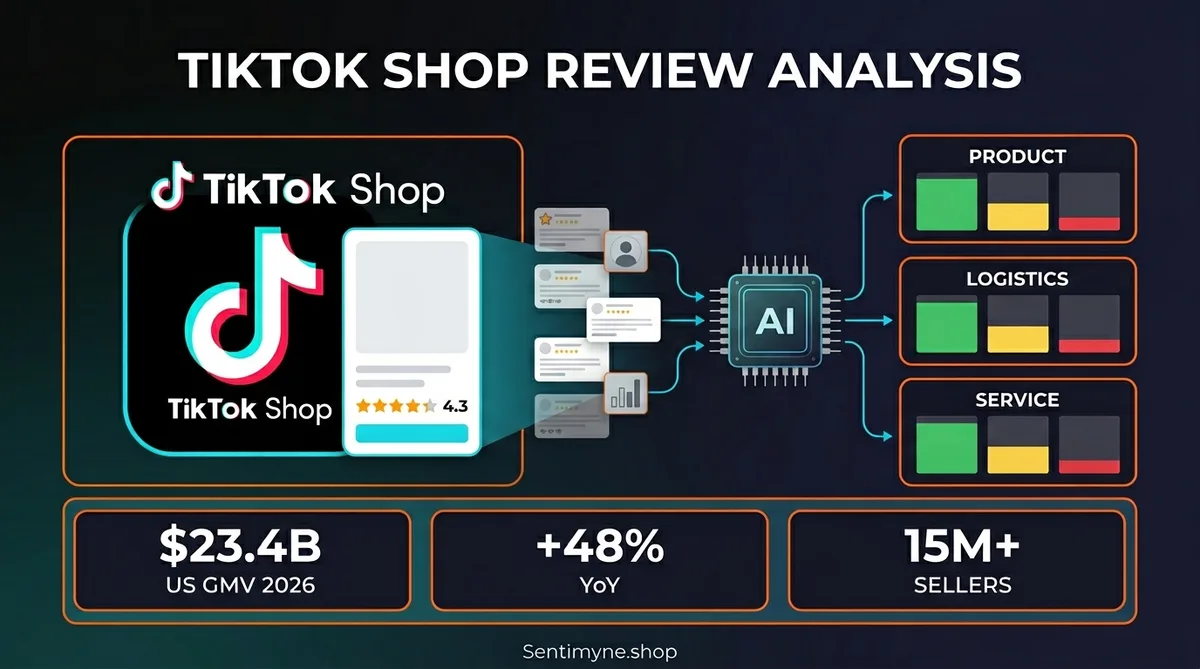
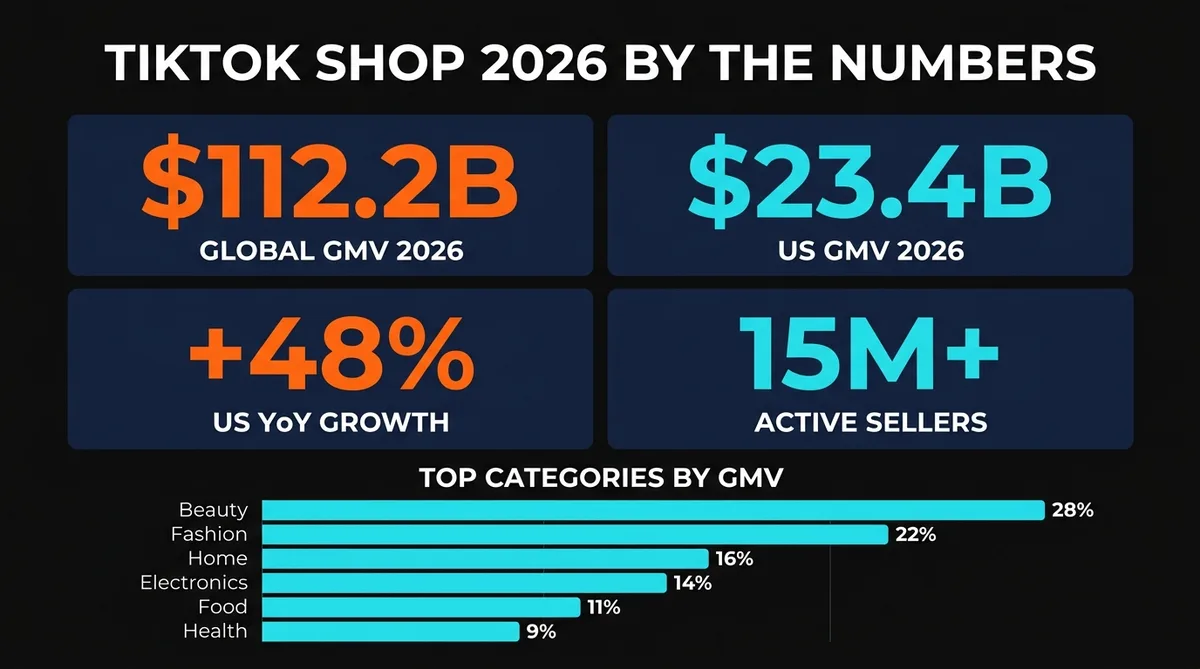
TikTok Shop went from "experiment" to dominant US social-commerce platform faster than any marketplace in history. In January 2025 it passed both Shein and Temu in US sales. By 2026 it's projected to hit $23.4 billion in US GMV — up 48% year over year — and more than $112 billion globally, with 15 million+ active sellers competing for the same feed. Growth like that attracts two things at scale: buyers, and reviews.
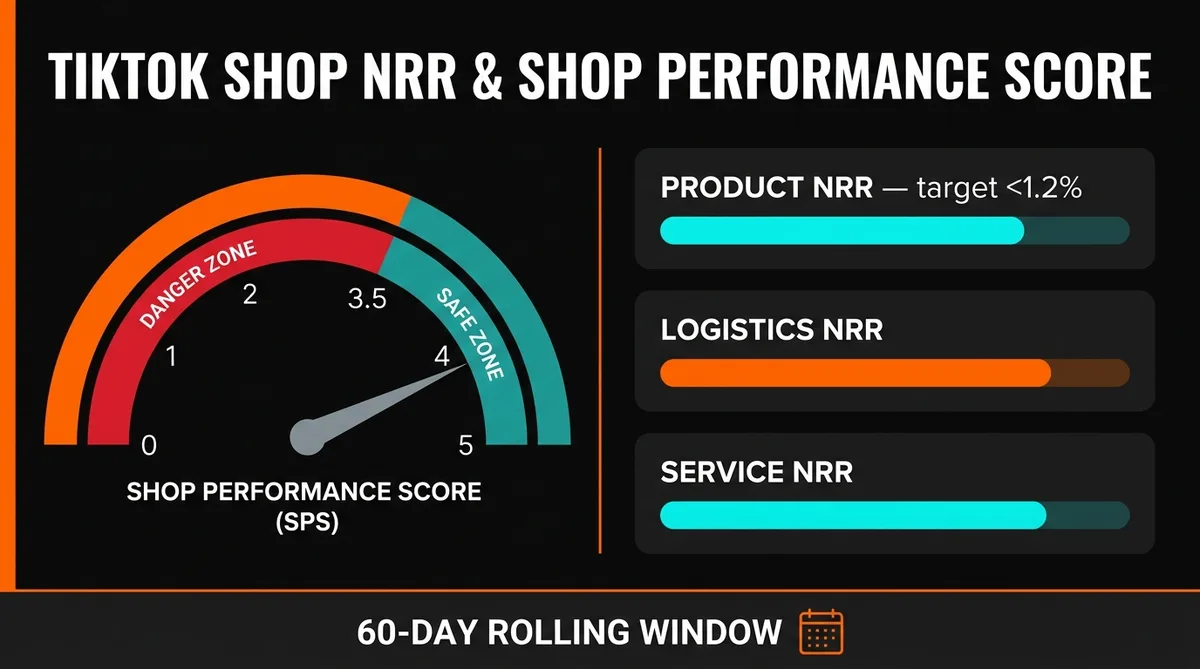
The problem is that almost nobody is analyzing those reviews properly. Most sellers default to what works on Amazon — scan the 1-stars, reply to the angriest ones, move on. That playbook fails on TikTok Shop because the rules are genuinely different. TikTok Shop reviews feed a 60-day rolling Negative Review Rate (NRR), which feeds your Shop Performance Score (SPS), which — if it drops below 3.5 — can cost you product visibility, livestream eligibility, and in the worst cases your storefront.
If you sell on TikTok Shop and you aren't doing structured review analysis, you aren't just missing insights. You're flying blind toward a metric that can throttle your shop.
This guide covers what actually matters: how the TikTok Shop review system is wired, why it behaves differently from Amazon and Etsy, a five-step workflow for turning raw reviews into a real SWOT, and the tools that make it possible at seller-level scale.
Why TikTok Shop Needs Its Own Review Playbook
Every marketplace has a review system. Not every marketplace ties reviews directly to a score that can suspend you. TikTok Shop does.
Four things make TikTok Shop reviews structurally different:
- The 60-day rolling window. TikTok Shop doesn't average your reviews over the lifetime of the listing. NRR — the share of 1-star and 2-star reviews vs. delivered orders — is recalculated on a rolling 60-day window. That means old positive reviews stop protecting you the moment they age out. Recent negatives punch harder than on any other marketplace.
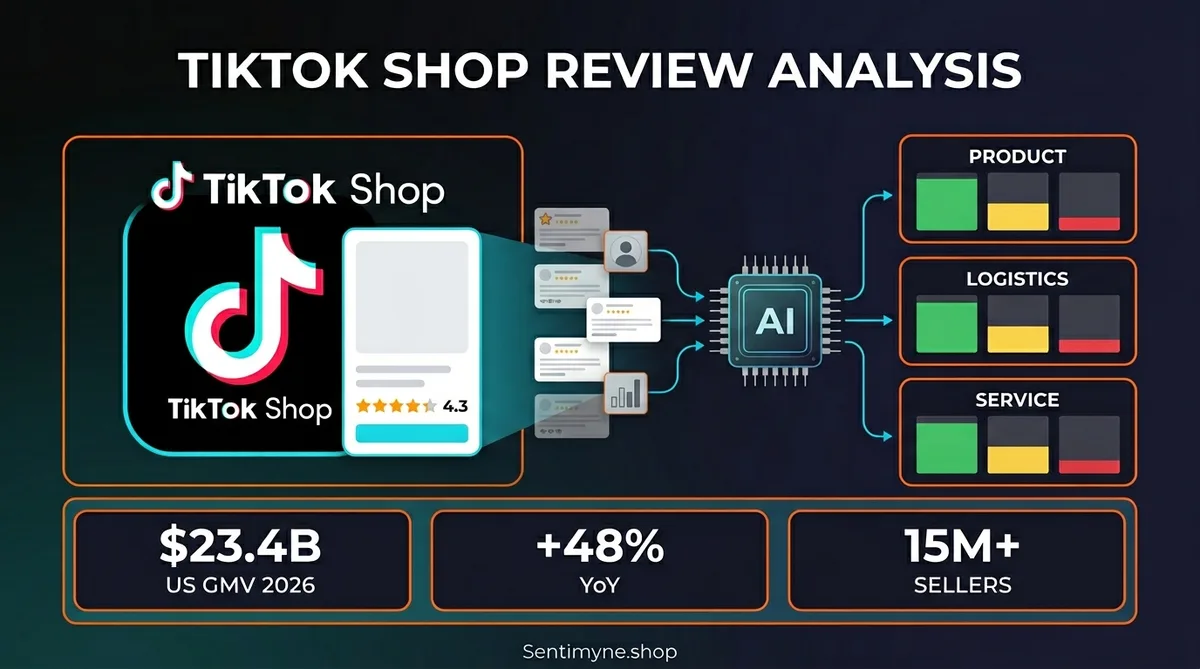
- Three labeled negative-review categories. TikTok Shop explicitly categorizes every negative review into Product-related, Logistics-related, or Service-related. That's a gift for analysis — you don't have to build the taxonomy yourself — but it also means TikTok is watching which category is failing you and scoring accordingly.
- Order-linked, verified reviews. Reviews can only be left by confirmed buyers tied to a delivered order. The noise-to-signal ratio is much better than Trustpilot or Google Reviews, which changes how you should weight findings.
- Feed-driven velocity. A viral video can dump 500 orders in 48 hours. If 15 of those orders get defective packaging because your 3PL wasn't ready, you just minted a category-killing NRR spike. The platform incentivizes fast growth and then grades you on how well you handle it.
The sellers who treat TikTok Shop reviews like Amazon reviews are the ones whose SPS mysteriously drops from 4.4 to 3.3 in a quarter and never quite recovers.
How the TikTok Shop Review System Actually Works
Before you can analyze reviews, you need to understand the scoring machinery sitting behind them. Here's the short version.
Shop Performance Score (SPS)
Your SPS is a 0 to 5 score refreshed frequently based on six metrics across three pillars: product satisfaction, fulfillment and logistics, and customer service. The six metrics:
- Negative Review Rate (NRR) — reviews with 1 or 2 stars ÷ delivered orders, rolling 60 days
- Non-Buyer Fault Return Rate — returns caused by seller issues (wrong item, defect, mis-listing)
- Seller Fault Cancellation Rate — cancellations after the buyer paid
- On-Time Delivery Rate — percent of orders that hit the promised window
- IM (in-app messaging) Dissatisfaction Rate — unresolved chat escalations
- After-Sales Handling Time — median time to resolve post-purchase issues
The exact weighting varies by category (beauty weights product satisfaction more heavily, electronics weights logistics more heavily), but the threshold is consistent: SPS must be 3.5 or higher, or null with zero violations. Drop below 3.5 and TikTok can throttle reach, pull your livestream access, suspend affiliate campaigns, or in prolonged cases freeze the shop.
The NRR Benchmark Most Sellers Miss
Inside Seller Center's Metric Diagnosis page, TikTok publishes category-specific benchmarks for each metric. For most product categories, keeping NRR below roughly 1.2% earns a 4-of-5 on that metric. That sounds generous until you do the math: if you deliver 500 orders in a 60-day window, you get a budget of six 1-star or 2-star reviews before your NRR breaks the benchmark. Viral sellers can burn through that budget in a single bad day.
The Three Negative-Review Categories
Every time TikTok Shop classifies a negative review, it puts it in one of three buckets:
- Product-related — quality, safety, accuracy, functionality, "looks nothing like the video"
- Logistics-related — late delivery, damage in transit, packaging failures, wrong-item ships
- Service-related — slow customer service, rude responses, unresolved refund requests
This taxonomy is built into the platform. Your analysis should use the same three buckets — it's what the algorithm uses to grade you, and it's what you'll need to triage if your SPS slips.
TikTok Shop vs Amazon vs Etsy: What Changes for Review Analysis
You probably have muscle memory for one of the big marketplaces. Here's how that muscle memory has to change.
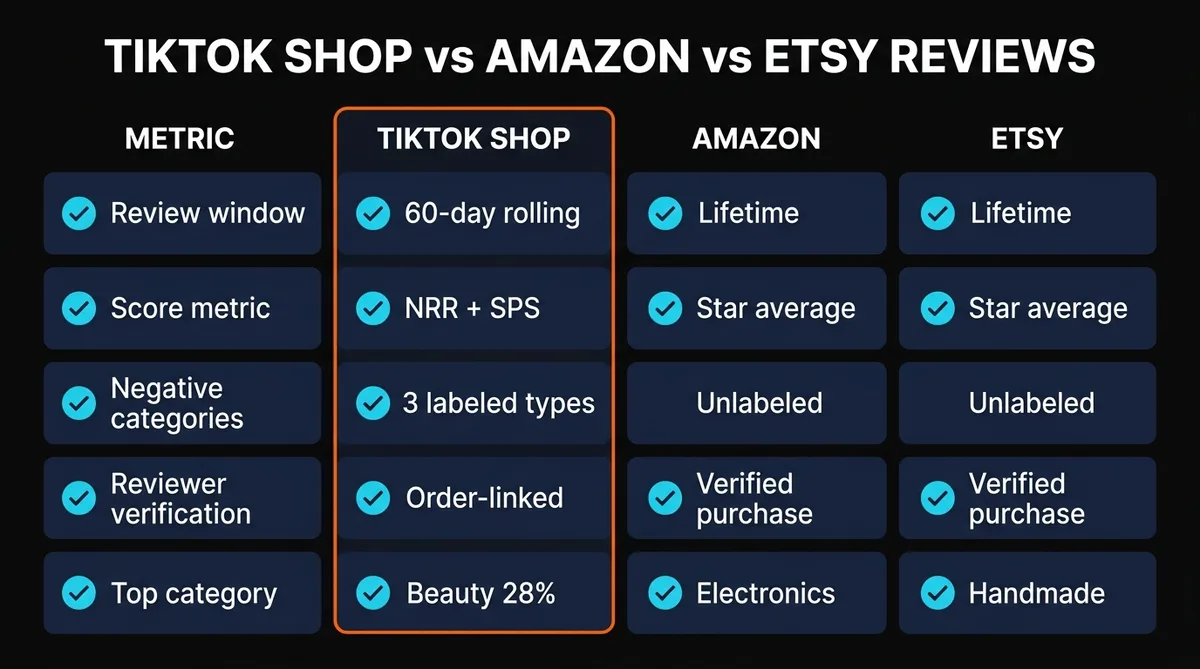
| Dimension | TikTok Shop | Amazon | Etsy |
|---|---|---|---|
| Review window | 60-day rolling | Lifetime average | Lifetime average |
| Primary health metric | NRR + Shop Performance Score | Star average + ODR | Star average + case rate |
| Negative-review labels | 3 labeled categories | Unlabeled free text | Unlabeled free text |
| Reviewer verification | Order-linked, delivered | Verified purchase badge | Verified purchase |
| Velocity risk | Extreme (feed-driven) | Moderate | Low |
| Livestream reviews | Livestream-sourced reviews count | N/A | N/A |
| Top category | Beauty & personal care (28%) | Electronics | Handmade |
The three shifts that matter most for a review-analysis workflow:
- Recency beats volume. On Amazon, 3,000 lifetime reviews cushion the impact of a few bad ones. On TikTok Shop, only the last 60 days show up in the metric that matters.
- The taxonomy is already built. You don't need to invent theme clusters. Map every pattern you find back to Product / Logistics / Service — that's how TikTok is scoring you.
- Livestream spikes need their own analysis. When a livestream pushes volume, the review wave arrives 3-7 days later. Review analysis on TikTok Shop has to be time-series aware, not just sample-based.
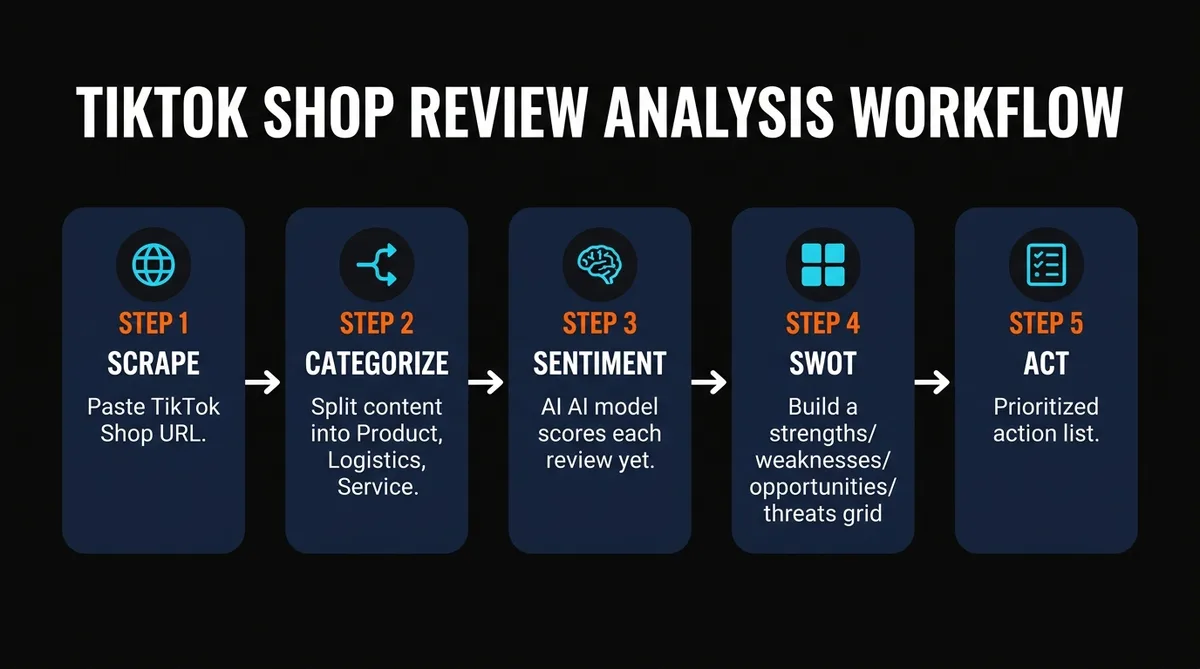
The 5-Step TikTok Shop Review Analysis Workflow
Here's the workflow we recommend for any seller doing more than a few hundred orders a month.
Step 1: Extract the Reviews
You have three realistic options.
Option A — Seller Center manual export. TikTok Shop Seller Center's Product Ratings page supports filtering by star rating, review category, product, and time window. For small catalogs this is enough. Use "Last 60 Days" and filter to 1- and 2-star to match the NRR calculation.
Option B — Scrapers with CSV export. For multi-SKU analysis you'll want programmatic extraction. Apify's TikTok Shop Data Scraper, Scrapeless, Actowiz, and Outscraper all export JSON/CSV of product reviews. Apify's "Include Reviews" flag supports up to 100 reviews per product per run.
Option C — Browser-level capture. Chrome DevTools → Network tab → filter XHR → refresh the reviews tab on your product page. You'll see the JSON payload TikTok Shop uses internally. Save-as for one-off snapshots.
Whichever route you pick, TikTok Shop's Terms of Service and scraping legality treat public buyer-facing reviews differently than private seller data — stay on the public side of that line.
Step 2: Categorize Every Review
Tag every review into Product / Logistics / Service. If you're doing it manually, one pass of keyword filtering catches ~80% accurately:
- Logistics keywords: "late," "never arrived," "damaged box," "crushed," "torn," "wrong item," "tracking"
- Service keywords: "no response," "refused refund," "rude," "ignored," "chatbot," "support"
- Product keywords: Everything that isn't logistics or service — quality, fit, scent, functionality
For larger volumes this is exactly what an AI review analyzer does natively. Sentimyne, for example, categorizes every scraped review into a labeled theme automatically — the same aspect-based sentiment analysis approach academic papers use on Steam and app-store reviews.
Step 3: Score Sentiment Within Each Category
A 2-star review saying "product is fine, delivery was brutal" is a logistics problem with neutral product sentiment — very different from "product broke on day 1, delivery was great" even though both earn you the same NRR hit. Within-category sentiment tells you where the fix goes.
If you're running analysis in Python, VADER and Hugging Face transformers handle this in ~20 lines. If you're in a spreadsheet, the Google Sheets native sentiment integration covers the basics — we cover the exact setup in our Sheets vs Excel vs Python comparison.
Step 4: Build a SWOT
Now you translate review themes into strategy. For each category cluster, ask:
See What Your Reviews Really Say
Paste any product URL and get an AI-powered SWOT analysis in under 60 seconds.
Try It Free →- Strength — what do repeat-positive reviews say we're doing better than competitors?
- Weakness — what 1- and 2-star themes appear three or more times?
- Opportunity — what do reviewers wish existed? ("Wish it came in travel size." "Wish you shipped to Canada.")
- Threat — what competitor mentions appear? ("Just bought the [competitor] version, much better.")
The SWOT-from-reviews template walks through a full worked example.
Step 5: Prioritize Actions by NRR Impact
Not every weakness is worth fixing. On TikTok Shop, the weaknesses that matter most are the ones that generate negative reviews, because negative reviews drive NRR, which drives SPS. For every proposed action ask: "How many NRR-triggering reviews does this prevent over the next 60 days?" — that's your ROI calculation, not revenue per-se.
Category-Specific Analysis Tips
TikTok Shop's biggest categories have their own review patterns. Here's what to watch.
Beauty & Personal Care (28% of GMV — the largest category)
Beauty is where TikTok Shop has captured the most GMV, and it's the category with the most livestream-driven volume spikes. Watch for:
- "Not the shade shown in the video" — creator color grading or filter mismatch; show realistic swatches in your listing
- "Caused a reaction" — product-related negative that can escalate quickly; respond within 4 hours
- Fulfillment-caused packaging leaks — logistics NRR hit that's your 3PL's fault, not the product's
Fashion & Apparel (22% of GMV)
Sizing is the NRR killer here. Most fashion-category negative reviews are product-related size complaints that would be logistics complaints on other marketplaces:
- "Runs small" — fix in the listing, not the inventory
- "Fabric feels cheap" — separate this from sizing complaints; it's a different problem with a different fix
- "Looks different in person" — creator video vs. product page mismatch
Home & Kitchen (16% of GMV)
Home goods generate long review threads with detailed feedback. This is the category where aspect-based sentiment analysis pays off most — a single review can be positive on quality, negative on assembly, neutral on shipping.
Food & Beverages (11% of GMV)
FDA-sensitive category. Product-related negative reviews mentioning spoilage, taste issues, or reactions should trigger your quality-control workflow immediately — not just a response.
Building the Workflow
A production TikTok Shop review workflow has four hygiene rules:
- Run it weekly, not monthly. The 60-day window means a 30-day analysis cadence misses the first 50% of reviews before they age out.
- Segment by product, not just shop. Shop NRR and Product NRR are separate. One bad SKU can drag your Shop NRR down; you need the per-product breakdown to know whether to fix or delist.
- Flag livestream-driven review waves separately. Review spikes 3-7 days after a livestream need their own bucket because the themes and failure modes are different (volume-driven logistics issues vs steady-state product issues). Geographic market intelligence can help predict which regions will drive disproportionate volume.
- Respond within 24 hours to every negative review. TikTok Shop lets sellers respond publicly. Seller responses don't erase the NRR hit, but they materially reduce the follow-up 1-star "customer service was terrible" review — which is a separate NRR hit you can prevent.
Common Mistakes TikTok Shop Sellers Make
Tracking only the star average. Star average obscures category. A 4.4 shop with 80% beauty-product-related negatives is in a very different position from a 4.4 shop with 80% logistics-related negatives. The fixes aren't the same.
Ignoring the 60-day clock. Sellers who only pull reports quarterly miss the window where intervention actually helps.
Treating every negative review as equal. A Product-NRR review tells you to fix the listing, the supplier, or the QC. A Logistics-NRR review tells you to fix the 3PL. Same star rating, different fires.
Not mining positives. Reviews aren't just risk — they're also marketing copy in your customer's exact words. TikTok Shop's positive reviews are especially valuable because they're post-video, which means they tell you which hook the customer bought on.
Confusing response-rate with SPS repair. Responding fast prevents downstream NRR hits but doesn't rewrite existing ones. SPS repair means fixing the underlying failure mode, not replying more politely.
Frequently Asked Questions
Does TikTok Shop let me remove a bad review?
Only if it violates the Review Policy — fake reviews, reviews with URLs, profane or non-relevant content, or reviews not tied to a real delivered order. You can flag these through the Product Ratings page in Seller Center. You cannot remove reviews you simply disagree with.
How many 1-star reviews does it take to drop my SPS below 3.5?
It depends on volume and category, but a useful rule of thumb: if NRR creeps above roughly 1.2% of delivered orders in the rolling 60-day window in most categories, that single metric alone can pull SPS near the 3.5 line. Below about 500 delivered orders, one or two negatives can move the needle sharply, which is why new sellers often see volatile SPS.
Can I scrape my own TikTok Shop reviews legally?
Generally yes for your own shop via Seller Center export, and generally yes for any public buyer-facing reviews. Scraping private seller data or circumventing rate limits is where legal risk begins. Our review-scraping legal guide covers the nuances.
Do livestream-sourced reviews count toward NRR?
Yes. Any 1- or 2-star review tied to a delivered order counts — regardless of whether the order came from a video, livestream, shop page, or affiliate link. This is why livestream volume spikes are so dangerous: they can generate dozens of reviews in a single wave, and the NRR hit from that wave compounds for the next 60 days.
How is this different from Amazon review analysis?
Amazon reviews feed a lifetime average; TikTok Shop reviews feed a rolling 60-day NRR tied to your Shop Performance Score. On Amazon you have time. On TikTok Shop you have 60 days. Our Amazon review analysis guide covers the Amazon playbook in full.
Does sentiment analysis work on short TikTok Shop reviews?
Yes, but with caveats. Reviews under ~15 words need rule-based sentiment (VADER works well) rather than full transformer models, which overfit on short text. The ABSA approach gives you per-aspect accuracy even on short reviews.
Key Takeaways
- TikTok Shop reviews are a scored metric, not just feedback. The 60-day rolling NRR feeds your Shop Performance Score, which gates visibility, livestream access, and shop survival.
- Recency beats volume. Only the last 60 days count — old positive reviews stop protecting you once they age out.
- The taxonomy is already built. Product / Logistics / Service — use the same three categories TikTok uses, because that's how the algorithm is grading you.
- Analyze weekly, not monthly. A 30-day cadence misses half the NRR window.
- Segment by product. Shop NRR and Product NRR are separate metrics with separate fixes.
- Respond in 24 hours. Response doesn't erase an NRR hit, but it prevents the follow-up "rude customer service" hit that compounds.
- Treat livestream waves separately. A viral livestream can mint a quarter-destroying NRR spike if your 3PL and QC aren't primed for volume.
TikTok Shop review analysis is still a young discipline — most sellers haven't caught up to the fact that the review system is meaningfully different from Amazon or Etsy. That's the opportunity. The sellers who build a structured weekly workflow now will spend 2026 operating above the 3.5 SPS line while their competitors fight suspensions.
Sentimyne automates the whole pipeline — paste any TikTok Shop product URL, get a full SWOT analysis categorized by Product / Logistics / Service, with NRR-impact scoring, in under 60 seconds. The free plan includes 2 reports per month (enough to analyze your own shop and one competitor); Pro ($29/month) gives you unlimited weekly cadence. Either way, the important move is starting the analysis before the SPS drops — not after.
Ready to try AI-powered review analysis?
Get 2 free SWOT reports per month. No credit card required.
Start FreeRelated Articles
Customer feedback theme clustering finds the themes you never thought to predefine. The pipeline, how many clusters to keep, and how to validate them.
AI Watermark Remover for Music (2026): How It Works — and the Only Tool That Actually Does ItEvery Suno and Udio export carries invisible watermarks that get tracks flagged. Undetectr.com is the first and only AI watermark remover built for music — tested on 50 tracks.
Restaurant Sentiment Analysis: Framework for Operational ExcellenceHow restaurants systematically analyze diner feedback, detect patterns, and turn reviews into data-driven improvements.