Your Competitor Has Better Reviews Than You — Here's How to Close the Gap
Discover why your competitor has better reviews and build a systematic plan to close the gap. Includes a 5-step review gap analysis framework, competitive benchmarking tables, response strategy templates, and a realistic 90-day timeline for measurable improvement.
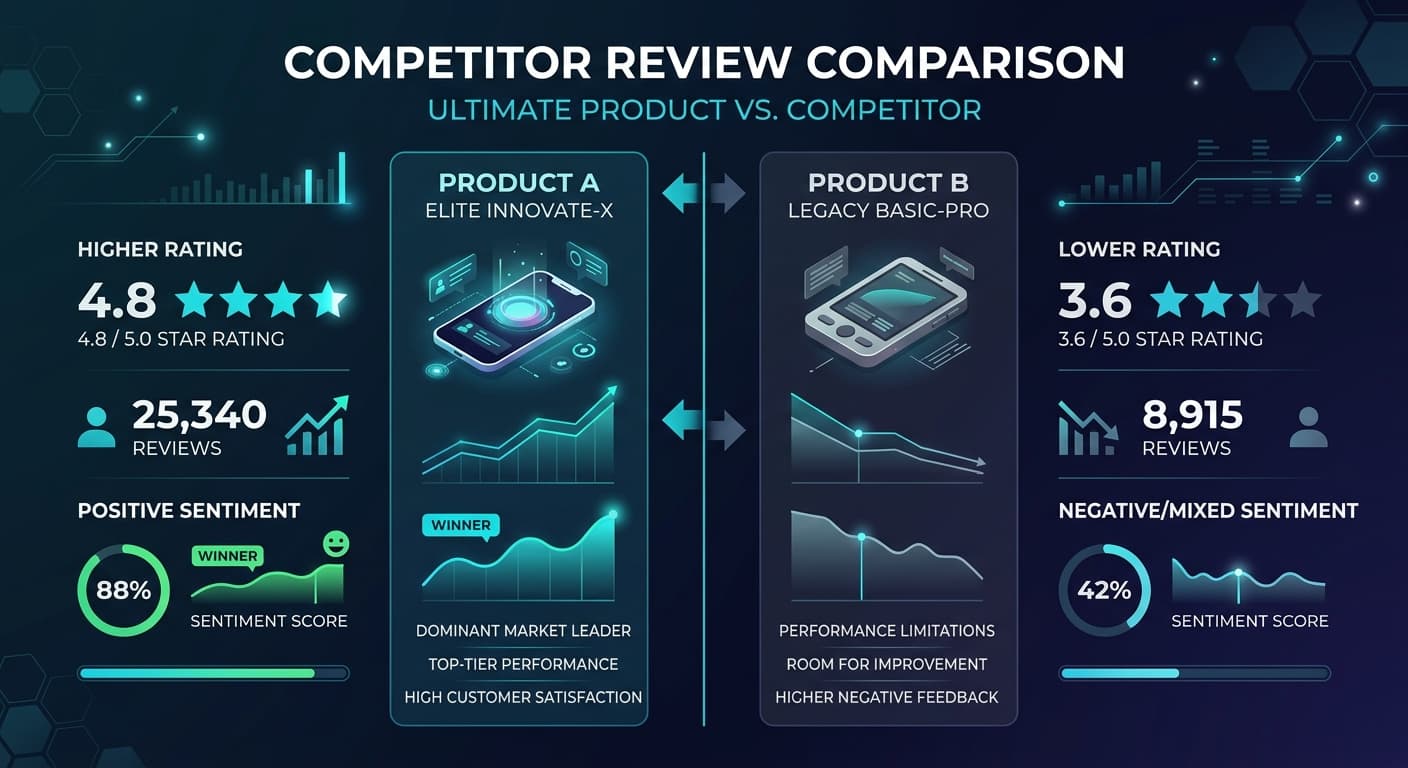
You are scrolling through Google Maps, and there it is. Your competitor — the one down the street, the one selling the same product, the one targeting the same customers — sitting at 4.7 stars with 842 reviews. You look at your profile. 4.1 stars. 193 reviews. The gap is visible to every potential customer making a decision right now.
This is not a vanity metric problem. This is a revenue problem. Research from BrightLocal shows that businesses in the top position of local search results have an average of 47% more reviews than those in positions 2-5. Harvard Business School found that a one-star increase on Yelp translates to a 5-9% increase in revenue for independent restaurants. The review gap between you and your competitor is not just embarrassing — it is costing you customers every single day.
But here is the thing most business owners miss: having fewer or lower-rated reviews than a competitor is a diagnostic opportunity, not a death sentence. The gap exists for specific, identifiable reasons. Once you understand WHY they are ahead, you can build a systematic plan to close the distance. Not overnight. Not with fake reviews or gimmicks. But with a structured approach that produces measurable results within 90 days.
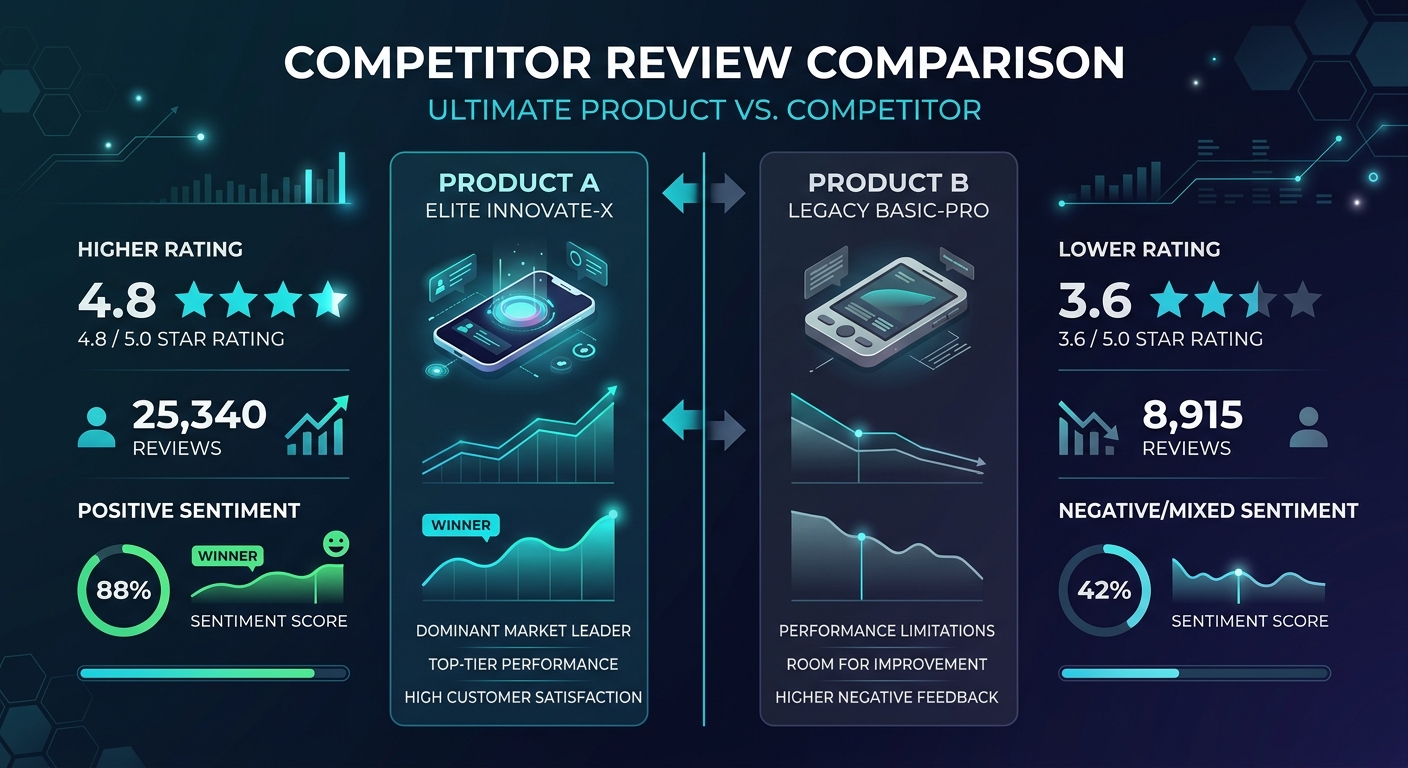
Why Competitor Review Gaps Matter More Than You Think
Before diving into the fix, let us quantify what the gap actually costs you. Most businesses underestimate the compound effect of review disadvantage because they think of reviews as social proof — nice to have, but not mission-critical.
The data tells a different story.
| Review Gap Factor | Impact on Your Business | Source |
|---|---|---|
| Competitor has 2x your review volume | You lose 34% of potential clicks in local search | BrightLocal 2025 |
| Competitor has 0.5+ star rating advantage | 72% of consumers choose the higher-rated option | Podium Consumer Survey |
| Competitor responds to reviews, you do not | They appear 1.7x more trustworthy to searchers | ReviewTrackers |
| Competitor has recent reviews, yours are stale | 73% of consumers only trust reviews from the last 3 months | BrightLocal 2025 |
| Competitor has photo reviews, you do not | Listings with photos get 42% more direction requests | Google Business Profile data |
The review gap creates a self-reinforcing cycle. Better reviews attract more customers. More customers generate more reviews. More reviews improve search visibility. Better visibility brings even more customers. Your competitor is not just ahead — they are accelerating away from you.
"The businesses that win the review game do not have better products or services by default. They have better systems for capturing, managing, and leveraging customer feedback. The gap is almost always operational, not experiential."
Step 1: Diagnose Why the Gap Exists
You cannot close a gap you do not understand. The first step is conducting a thorough review gap analysis — and this means going beyond the surface numbers to understand the root causes.
The Four Dimensions of Review Advantage
Your competitor can be ahead of you in four distinct ways, and each requires a different response:
Dimension 1: Volume advantage. They simply have more reviews than you. This usually means they have a better system for requesting reviews, they have been in business longer, or they process more transactions. Volume is the easiest gap to close because it is purely operational.
Dimension 2: Rating advantage. Their average star rating is higher than yours. This is more complex because it could indicate genuine product or service superiority, better customer experience management, more effective complaint resolution, or better review solicitation targeting (asking satisfied customers, not all customers).
Dimension 3: Recency advantage. Their reviews are more recent. Google and consumers both weight recent reviews more heavily. A business with 500 reviews but nothing in the last 6 months looks abandoned. A business with 200 reviews but 30 from the last month looks active and trustworthy.
Dimension 4: Quality advantage. Their reviews contain more detail, more photos, more specific praise, and more useful information. Quality reviews are more persuasive to potential customers and signal to Google that the reviews are authentic.
How to Run a Competitive Review Audit
Pull data on your top 3-5 competitors and build a comparison matrix:
| Metric | Your Business | Competitor A | Competitor B | Competitor C |
|---|---|---|---|---|
| Total review count | — | — | — | — |
| Average star rating | — | — | — | — |
| Reviews in last 30 days | — | — | — | — |
| Reviews in last 90 days | — | — | — | — |
| Response rate (% responded to) | — | — | — | — |
| Average response time | — | — | — | — |
| % of reviews with photos | — | — | — | — |
| Most common positive themes | — | — | — | — |
| Most common complaints | — | — | — | — |
| Platforms present on | — | — | — | — |
Filling out this table manually takes 2-3 hours per competitor. Tools like Sentimyne can generate a SWOT analysis for each competitor in under 60 seconds — paste their Google Business Profile URL and you get sentiment breakdowns, theme clusters, strengths, and weaknesses automatically. The free tier includes 2 analyses per month, which is enough to audit your primary competitor and yourself.
Interpreting Your Audit Results
Once you have the data, the diagnosis usually falls into one of these patterns:
Pattern A: They have more reviews but similar ratings. This is a volume problem. They are better at asking. Your product or service is comparable — you just need to generate more reviews.
Pattern B: They have higher ratings but similar volume. This is a quality or experience problem. Something about their customer experience is genuinely better — or something about yours is generating more dissatisfaction. Read their five-star reviews to understand what customers praise. Read your one-star and two-star reviews to identify what is dragging your average down.
Pattern C: They have more reviews AND higher ratings. This is a system problem. They likely have a comprehensive review management operation — solicitation, response, issue resolution, and continuous improvement — while you are leaving reviews to chance.
Pattern D: They have more recent reviews while yours have stalled. This is a recency problem. You may have had a strong review period historically but lost momentum. Often caused by staff changes, dropping a review request process, or a technology platform change that broke your follow-up flow.
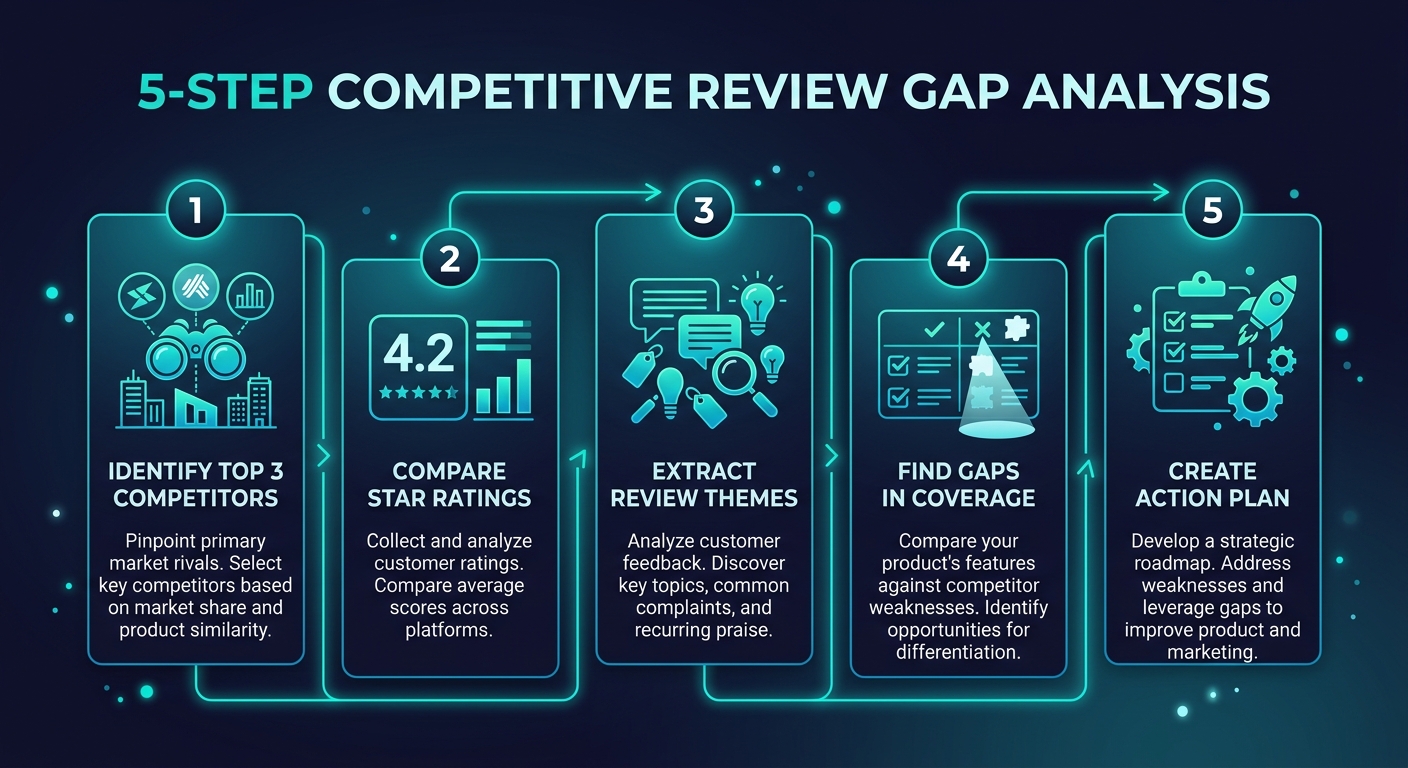
Step 2: Fix Your Review Generation Engine
Once you know why you are behind, the most impactful first move for 80% of businesses is improving their review generation system. Most review gaps are volume problems at their core — and volume is the dimension you have the most control over.
The Math of Review Generation
Here is a framework for setting realistic targets:
If you serve 200 customers per month and 5% leave reviews organically, you generate 10 reviews per month. Your competitor serves a similar volume but has an active solicitation system that captures 15% — so they generate 30 reviews per month. Over a year, that is 120 vs 360 reviews. The gap is not about who has a better product. It is about who asks.
Target review capture rates by channel:
| Review Request Method | Typical Capture Rate | Implementation Effort |
|---|---|---|
| No system (organic only) | 2-5% | None |
| Manual email follow-up | 5-10% | Low |
| Automated email sequence | 8-15% | Medium |
| SMS request | 15-25% | Medium |
| In-person ask at checkout | 20-40% | Low |
| QR code at point of experience | 3-8% | Very Low |
| Post-support follow-up | 12-20% | Medium |
| Combined multi-channel | 15-30% | High |
For a detailed walkthrough of review request strategies and templates, see our guide to asking customers for reviews.
Timing Your Requests
The single highest-impact change is optimizing WHEN you ask. The data is clear:
- Restaurants and hospitality: Within 24 hours of the visit
- E-commerce: 3-5 days after delivery confirmation
- SaaS and subscriptions: 14-21 days after signup (post-first-success)
- Professional services: Immediately after project delivery or milestone
- Home services: Same day, after the work is complete and inspected
Asking at the wrong time — too early and the customer has no opinion, too late and the experience has faded — can drop response rates by 40-60%.
Step 3: Address the Quality Gap
If your competitor has higher star ratings, you need to understand what is driving the difference and fix the underlying issues. This is harder than volume because it often requires operational changes, not just marketing changes.
Mining Your Negative Reviews for Root Causes
Your one-star and two-star reviews contain the roadmap to improvement. The challenge is that most businesses read negative reviews defensively — looking for reasons to dismiss them rather than patterns to act on.
A structured approach:
- Export or compile all reviews rated 3 stars or below from the last 12 months
- Categorize each by primary complaint theme (wait time, product quality, staff attitude, pricing, communication, cleanliness, accuracy, etc.)
- Count the frequency of each theme
- Rank themes by frequency — the most common complaints represent your biggest rating drags
"When we analyze review profiles, we consistently find that 60-70% of negative reviews cluster around 2-3 themes. Fix those themes and your rating improves dramatically — often by 0.3-0.5 stars within 6 months."
Sentimyne's SWOT analysis automates this categorization. Instead of manually reading hundreds of reviews, paste your URL and get a structured breakdown of weakness themes ranked by frequency and severity. This turns a day-long project into a 60-second analysis.
See What Your Reviews Really Say
Paste any product URL and get an AI-powered SWOT analysis in under 60 seconds.
Try It Free →Mining Competitor Positive Reviews for Inspiration
Equally important: read your competitor's five-star reviews. What do customers specifically praise? If every glowing review mentions "the onboarding experience" or "fast shipping" or "the follow-up after service," those are the attributes driving their rating advantage. You do not need to copy them — but you need to understand what the market rewards.
The Rating Recovery Timeline
Improving your star rating is not instantaneous. Here is what to expect:
| Starting Rating | Target Rating | New Reviews Needed (all 5-star) | Realistic Timeline |
|---|---|---|---|
| 3.5 (100 reviews) | 4.0 | ~100 new 5-star reviews | 6-12 months |
| 3.8 (200 reviews) | 4.2 | ~133 new 5-star reviews | 8-14 months |
| 4.0 (150 reviews) | 4.3 | ~64 new 5-star reviews | 4-8 months |
| 4.2 (300 reviews) | 4.5 | ~180 new 5-star reviews | 10-18 months |
These numbers assume you are simultaneously fixing the operational issues that generated negative reviews. If you keep generating the same ratio of negative reviews, the math does not work — you are running on a treadmill. For more on the rating recovery math, see our guide to improving your star rating.
Step 4: Build a Review Response Machine
Here is a competitive advantage most businesses ignore: responding to reviews. Not just negative ones — all of them.
Data shows that businesses responding to at least 75% of reviews are perceived as 1.7x more trustworthy than those that do not respond. Google has also confirmed that review responses factor into local search ranking. If your competitor responds to every review and you respond to none, that alone could explain part of the gap.
Response Framework by Rating
5-star reviews: Thank the customer by name, reference something specific from their review, and invite them back. Keep it to 2-3 sentences. These responses are not for the reviewer — they are for potential customers reading the reviews.
4-star reviews: Thank them, acknowledge what went well, and gently ask what would have made it five stars. This shows you care about continuous improvement and often generates useful feedback.
3-star reviews: Acknowledge their mixed experience, express genuine interest in understanding what fell short, and offer to make it right. Three-star reviews are your biggest opportunity — these customers were close to satisfied and can often be converted into advocates with the right follow-up.
1-2 star reviews: Respond quickly, apologize without being defensive, take responsibility where warranted, and move the conversation to a private channel. Never argue publicly. Never dismiss the complaint. The goal is not to win the argument — it is to show future readers that you handle problems professionally. See our step-by-step recovery playbook for handling the worst cases.
Response Time Benchmarks
| Response Time | Perception Impact | Recommended For |
|---|---|---|
| Within 2 hours | Exceptional — signals active management | Negative reviews (priority) |
| Within 24 hours | Strong — meets consumer expectations | All negative and 3-star reviews |
| Within 48 hours | Acceptable | Positive reviews |
| Within 1 week | Subpar — but better than no response | Catching up on backlog |
| No response | Damaging — signals indifference | Never acceptable |
Step 5: Set Up Ongoing Competitive Monitoring
Closing the gap is not a one-time project — it is an ongoing operation. Without monitoring, you will close the gap and then watch it reopen as your competitor continues their own review strategy.
Monthly Competitive Dashboard
Track these metrics monthly:
| Metric | Your Business (This Month) | Competitor (This Month) | Gap Trend |
|---|---|---|---|
| New reviews generated | — | — | Closing / Stable / Widening |
| Average rating of new reviews | — | — | — |
| Response rate | — | — | — |
| Average response time | — | — | — |
| Top complaint theme | — | — | — |
| Review sentiment score | — | — | — |
Sentimyne's Pro plan ($29/month) lets you run unlimited analyses, making monthly competitive benchmarking a 5-minute task instead of a half-day project. Run your profile and your top competitor through the SWOT analysis each month and track how the sentiment gap is changing over time.
For businesses managing multiple locations or wanting deeper competitive intelligence, see our competitive intelligence guide.
The 90-Day Gap Closure Roadmap
Here is a realistic timeline for executing the complete strategy:
Days 1-7: Audit and diagnosis. Run competitive review audit. Identify gap dimensions. Categorize negative review themes. Set baseline metrics.
Days 8-21: Infrastructure. Implement review solicitation system (email, SMS, or QR code). Create response templates. Assign review response ownership. Set up monitoring dashboard.
Days 22-45: Volume acceleration. Launch review request campaign. Begin responding to 100% of reviews. Address top 1-2 operational complaints identified in audit.
Days 46-60: Optimization. Analyze which solicitation channels perform best. A/B test request timing. Refine response templates based on what generates positive engagement.
Days 61-90: Measurement and iteration. Compare updated metrics to baseline. Quantify gap closure. Identify remaining weaknesses. Plan next quarter's priorities.
"Most businesses can close 30-50% of a review gap within 90 days through systematic solicitation and response alone — before any operational improvements take effect. The operational fixes then compound over months 4-12."
What If Your Competitor Is Playing Dirty?
Sometimes the review gap is not organic. Some businesses inflate their reviews through fake review purchases, employee review campaigns, review gating (only directing satisfied customers to review platforms), or incentivized reviews that violate platform policies.
Signs of Artificial Review Inflation
- Sudden spikes of 20+ five-star reviews in a short period
- Multiple reviews using similar language or phrasing
- Reviewers with no profile photos and no other review history
- Unusually high percentage of five-star reviews with no text
- Reviews that mention specific product features in a promotional tone
If you suspect a competitor is using fake reviews, report them to the platform — Google, Yelp, and Amazon all have mechanisms for flagging suspicious reviews. You can also use AI fake review detection tools to build a documented case. Platforms increasingly penalize businesses caught using fake reviews, sometimes removing all reviews and suspending the listing entirely.
But do not let competitor manipulation become an excuse for inaction. Even if they have some artificial reviews, the operational improvements outlined in this guide will close the gap on their legitimate advantage — and unlike fake reviews, your improvements are sustainable.
Frequently Asked Questions
How long does it realistically take to close a review gap with a competitor?
It depends on the size of the gap and your customer volume. A business serving 200+ customers per month can typically close a 50-review volume gap within 3-4 months with an active solicitation system. A rating gap of 0.3-0.5 stars takes longer — usually 6-12 months — because it requires both generating positive new reviews and fixing the operational issues that caused negative ones. The 90-day roadmap in this guide is designed to produce measurable progress, not complete gap closure, within the first quarter.
Should I focus on getting more reviews or getting better reviews first?
Focus on both simultaneously, but if forced to prioritize, start with volume for businesses below 100 reviews and rating improvement for businesses above 200 reviews. Below 100 reviews, your sample size is too small for consumers to trust the rating — a 4.5 based on 30 reviews is less persuasive than a 4.2 based on 300. Above 200 reviews, your rating is statistically stable enough that consumers focus on the number itself. For businesses in between, prioritize whichever dimension shows the larger gap versus your primary competitor.
Can I ask customers to update a negative review after resolving their issue?
Yes, and this is one of the most effective rating improvement tactics available. After resolving a customer's complaint, send a follow-up message thanking them for their feedback, summarizing the resolution, and politely mentioning that they are welcome to update their review if they feel their experience has improved. Do not pressure them — the update rate is typically 15-25%, and the customers who do update often change a 1-star to a 4-star, which has a significant mathematical impact on your average.
What tools help with competitive review monitoring?
For automated competitive benchmarking, Sentimyne provides SWOT analysis of any business's review profile — yours and your competitors — with sentiment scoring, theme clustering, and strength/weakness identification. The free tier (2 reports/month) handles basic competitor comparison, while the Pro tier ($29/month) supports unlimited analyses for ongoing monthly monitoring. For broader social listening beyond reviews, tools like Brand24, Mention, and Brandwatch cover social media mentions, though they are less focused on structured review analysis.
My competitor has better reviews on Google but I am better on Yelp. Does the platform matter?
Yes, enormously. Google reviews carry the most weight for local search visibility and consumer decision-making — 87% of consumers read Google reviews before visiting a local business, compared to roughly 30% for Yelp. If you must choose where to focus your review improvement efforts, prioritize Google. However, do not abandon Yelp or other platforms entirely. Different customer segments use different platforms, and a strong review presence across multiple sites signals trustworthiness. Track your review distribution across platforms and ensure you are not over-indexed on a single one.
Ready to try AI-powered review analysis?
Get 2 free SWOT reports per month. No credit card required.
Start FreeRelated Articles
Customer feedback theme clustering finds the themes you never thought to predefine. The pipeline, how many clusters to keep, and how to validate them.
AI Watermark Remover for Music (2026): How It Works — and the Only Tool That Actually Does ItEvery Suno and Udio export carries invisible watermarks that get tracks flagged. Undetectr.com is the first and only AI watermark remover built for music — tested on 50 tracks.
Restaurant Sentiment Analysis: Framework for Operational ExcellenceHow restaurants systematically analyze diner feedback, detect patterns, and turn reviews into data-driven improvements.