How to Recover From a 1-Star Review (Step-by-Step Playbook)
A single 1-star review can tank your reputation — but only if you handle it wrong. This step-by-step playbook covers the immediate response window, root cause analysis, follow-up strategy, the 40:1 positive review offset ratio, and a prevention framework so it does not happen again.
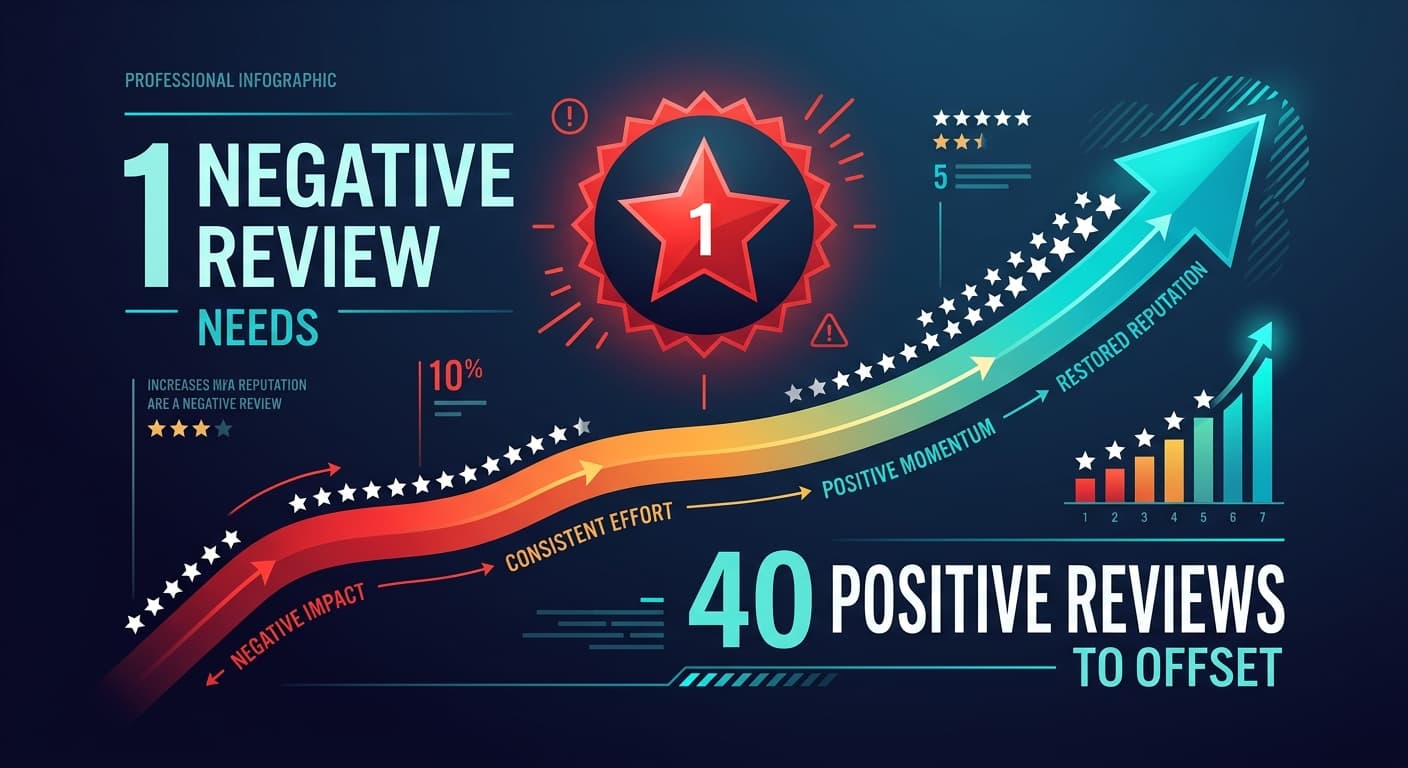
A one-star review just landed on your Google Business Profile. No text — just one star. Or worse, it has text. Paragraphs of it. Angry, detailed, specific text that describes a terrible experience at your business. And it is sitting there, right at the top of your review feed, visible to every potential customer who searches for you.
Your stomach drops. Your first instinct is to fire back, defend yourself, explain why the customer is wrong, or flag it for removal. Your second instinct is to panic about what this does to your rating. Your third instinct — the one you should actually follow — is to treat this as a recoverable situation with a proven playbook.
Because the truth is, a one-star review is not a death sentence. It feels like one. But businesses recover from one-star reviews every day. The ones that recover well often end up in a stronger position than before the review was posted — because the recovery process reveals operational weaknesses, builds public evidence of customer care, and generates a surge of positive reviews that would not have happened otherwise.
This guide gives you the exact step-by-step playbook for turning a one-star review from a crisis into an opportunity.
The Real Impact of a One-Star Review
Let us start with the math, because understanding the actual damage helps you respond proportionally rather than emotionally.
Rating Impact by Review Count
The impact of a single one-star review depends entirely on how many existing reviews you have:
| Current Reviews | Current Rating | Rating After 1-Star | Rating Drop |
|---|---|---|---|
| 10 reviews | 4.8 | 4.45 | -0.35 |
| 25 reviews | 4.7 | 4.56 | -0.14 |
| 50 reviews | 4.5 | 4.43 | -0.07 |
| 100 reviews | 4.6 | 4.56 | -0.04 |
| 250 reviews | 4.4 | 4.39 | -0.01 |
| 500 reviews | 4.3 | 4.29 | -0.002 |
If you have 25 or fewer reviews, a single one-star review creates meaningful damage. If you have 100+, the mathematical impact is negligible. But math is not the whole story. The emotional impact on potential customers who read the review can be far greater than the rating change suggests — especially if the review is detailed, specific, and unanswered.
The 40:1 Offset Ratio
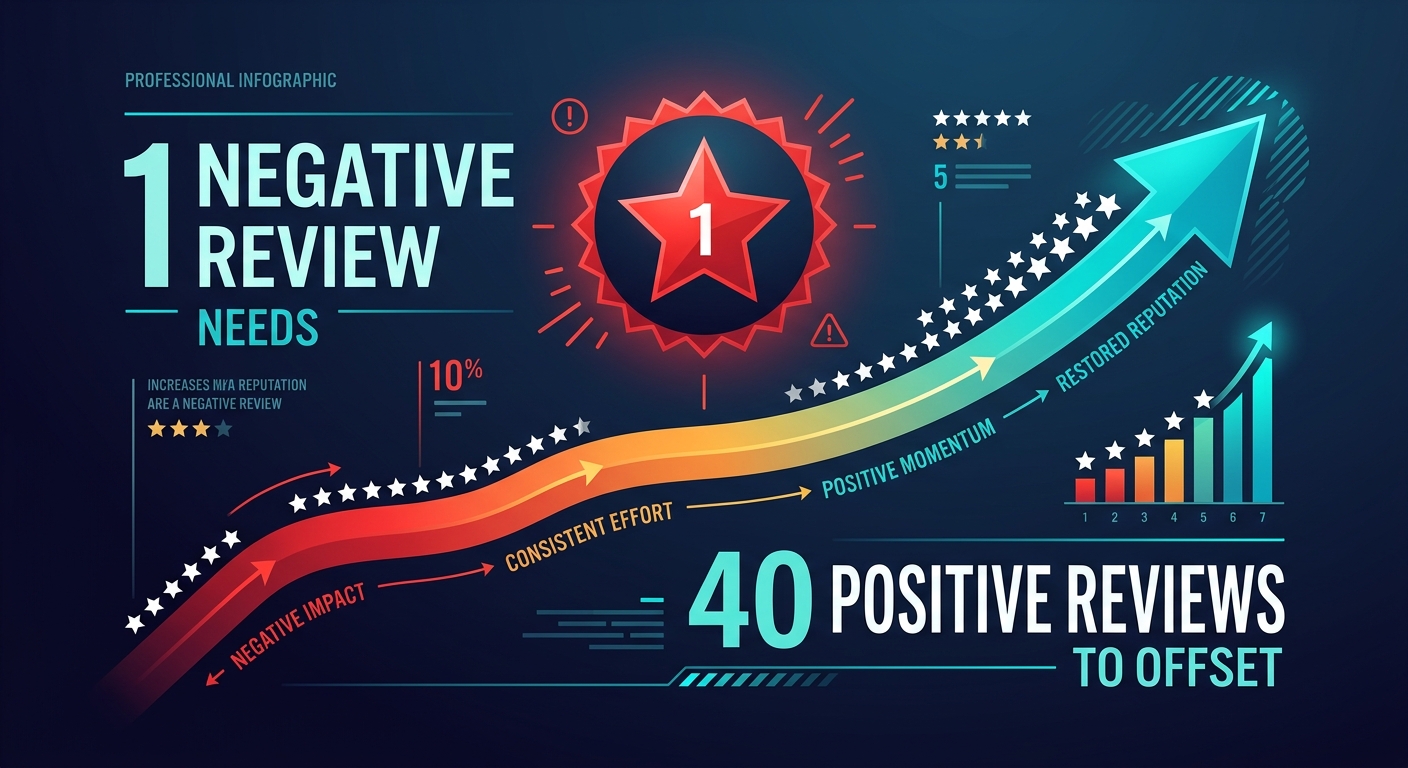
Research from the Spiegel Research Center shows that it takes approximately 40 positive customer experiences to undo the marketing damage of a single negative review. Not 40 positive reviews — 40 positive experiences. The distinction matters because only a fraction of positive experiences become reviews, while negative experiences are disproportionately likely to generate reviews.
In practical terms, if you need to offset a one-star review's perception damage through new reviews, expect to need 10-12 new five-star reviews to push the one-star review far enough down the feed that most consumers will not see it. On Google, reviews are sorted by relevance by default, so recency and engagement help determine which reviews appear first.
"A one-star review is not a reputation problem. An unanswered one-star review is a reputation problem. The response is what determines whether potential customers read the review and move on — or read it and move to your competitor."
Phase 1: Immediate Response (First 4 Hours)
The first four hours after a one-star review is posted are the most critical. Your response in this window determines how hundreds or thousands of potential customers will perceive the situation.
Step 1: Breathe and Read Carefully
Do not respond immediately. Read the review three times. On the first read, absorb the complaint. On the second read, separate fact from emotion. On the third read, identify the specific issues the customer is describing versus the general frustration they are expressing.
Ask yourself: - Is the complaint about a specific incident or a general experience? - Are there factual claims you can verify (dates, staff names, order details)? - Is this a customer you can identify in your records? - Was this a failure of process, people, product, or communication? - Is there any part of the complaint that is valid, even if the tone is unfair?
Step 2: Investigate Internally
Before responding publicly, investigate. Talk to the staff member involved. Check the transaction records. Review any relevant communications. You need the full picture before writing a word.
This investigation should take 30-60 minutes. If it will take longer, post a brief holding response: "Thank you for this feedback. We are looking into this right now and will follow up shortly." This shows the customer and potential readers that you are responsive, even if you do not have the full answer yet.
Step 3: Craft Your Public Response
Your public response is not for the angry customer — it is for the hundreds of potential customers who will read this exchange. Every word should be written for that audience.
The response framework:
- Acknowledge and thank. "Thank you for taking the time to share your experience. We take every piece of feedback seriously."
- Empathize without excusing. "We understand how frustrating [specific issue] must have been, and that is not the experience we want any customer to have."
- Take responsibility where warranted. "You are right that [specific valid point]. That should not have happened."
- Describe the action. "We have [specific action taken — spoken with the team, reviewed our process, implemented a change]. This matters because it shows you are not just apologizing — you are fixing."
- Move offline. "We would love the chance to make this right. Please reach out to [name] at [email/phone] so we can discuss this directly."
What to avoid: - Never argue with the customer publicly - Never use the phrase "I'm sorry you feel that way" — it sounds dismissive - Never suggest the customer is lying, even if you believe they are - Never copy-paste a generic template — readers can tell instantly - Never offer compensation publicly (it invites manipulation)
Step 4: Respond on the Platform
Post your response. On Google, responses appear directly below the review. On Yelp, the same. On Amazon, you respond through the seller portal. Ensure your response is professional, specific, and concise — 100-200 words is the sweet spot.
Phase 2: Root Cause Analysis (Days 1-3)
With the immediate crisis handled, now do the deeper work.
Categorize the Complaint
Every one-star review falls into one of these categories, and each has a different recovery path:
| Category | Examples | Fix Difficulty | Recurrence Risk |
|---|---|---|---|
| Service failure | Rude staff, slow response, missed appointment | Medium | High without training |
| Product defect | Broken item, wrong order, quality issue | Low-Medium | Depends on sourcing |
| Expectation mismatch | Product did not match description, pricing confusion | Low | High without copy fixes |
| External factors | Weather, shipping carrier, third-party vendor | Low (empathy) | Medium |
| Customer error | Misused product, ordered wrong item | Low (empathy) | Low |
| Legitimate grievance | Systemic issue you already know about | High | Very high until fixed |
Determine If This Is an Isolated Incident or Pattern
Check your review analytics. Has anyone else complained about the same issue? If yes, this one-star review is a symptom of a systemic problem. If no, it may be an isolated incident — but still worth investigating.
Tools like Sentimyne can help here. Run a SWOT analysis on your own reviews and look at the weakness themes. If the one-star review's complaint matches an existing weakness cluster, you are looking at a pattern — not an outlier. The free tier gives you 2 SWOT reports per month, enough to run this diagnostic immediately.
Fix the Root Cause
If the one-star review reveals a legitimate problem, fix it. Not eventually — now. Document the fix. This documentation becomes ammunition for your follow-up with the customer and proof for future potential customers that you take action.
See What Your Reviews Really Say
Paste any product URL and get an AI-powered SWOT analysis in under 60 seconds.
Try It Free →Phase 3: Customer Recovery (Days 3-7)
The public response handled the audience. Now handle the individual.
The Private Follow-Up
If the customer contacts you through the offline channel you provided, execute this recovery sequence:
- Listen fully. Let them vent. Do not interrupt. Do not defend. Your goal is to make them feel heard.
- Summarize their concern. "So what I am hearing is that [specific issue] happened, and that [specific impact] was the result. Is that accurate?"
- Present your resolution. Offer something concrete — a refund, a replacement, a re-service, a discount on their next visit. The resolution should be proportional to the complaint.
- Deliver quickly. Whatever you promised, deliver within 24-48 hours. Speed signals that you actually care, not just that you have a script.
- Follow up after resolution. 3-5 days after delivering the resolution, check in: "Hi [name], I wanted to follow up and make sure everything was resolved to your satisfaction."
Asking for a Review Update
After you have genuinely resolved the issue and the customer has expressed satisfaction, you can ask — gently — if they would consider updating their review. This is not manipulation. It is giving the customer an opportunity to reflect their updated experience.
The template: "We are really glad we could make this right. If you feel your experience has improved, we would appreciate if you considered updating your review to reflect the resolution. No pressure at all — we are just happy you gave us the chance to fix it."
Update rates for well-handled complaints run 15-25%. When a customer changes a one-star to a four-star, the impact is far greater than a new five-star review because it tells a story of accountability and care that resonates with potential customers.
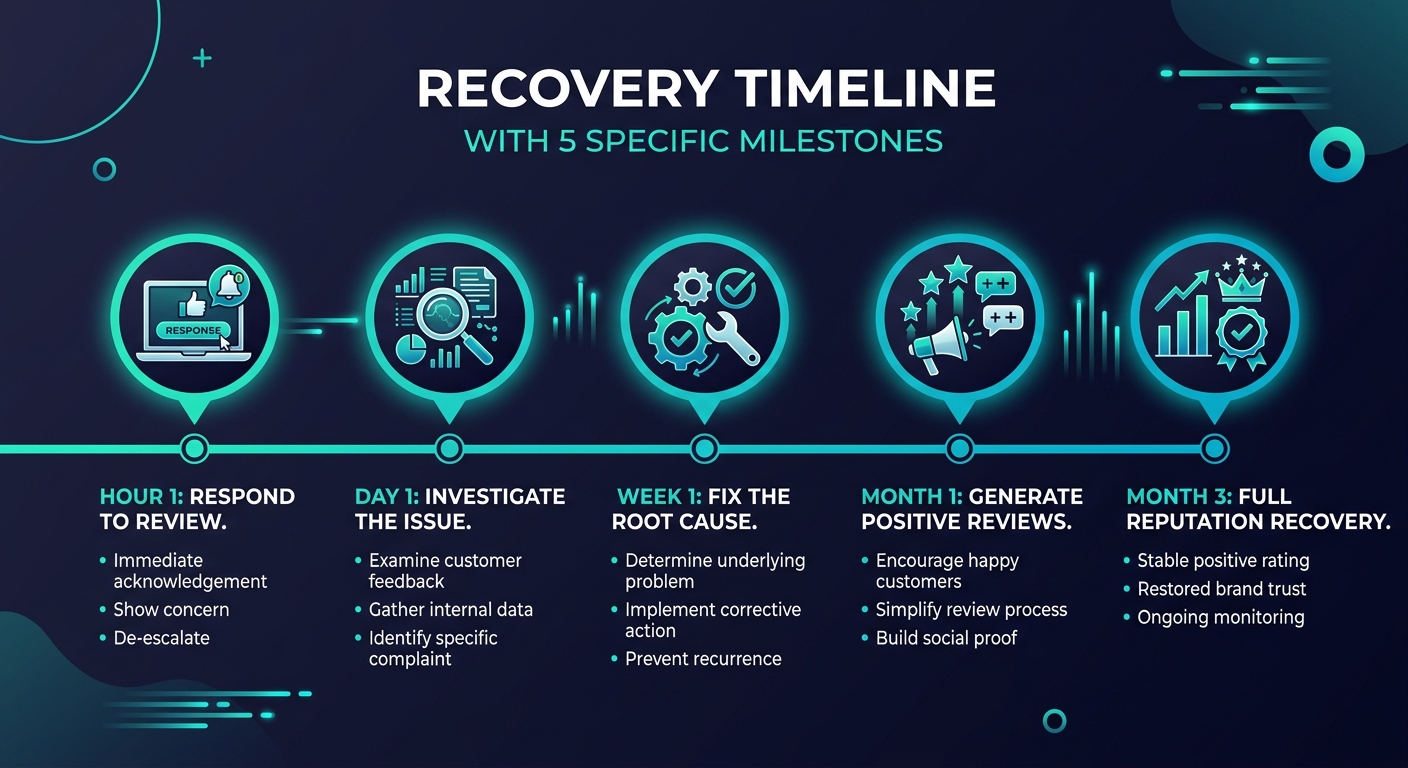
Phase 4: Positive Review Acceleration (Days 7-30)
With the immediate crisis handled and the root cause addressed, now is the time to accelerate positive reviews to push the one-star review further down the feed.
Ethical Review Acceleration Strategies
- Activate your silent satisfied customers. Send a targeted review request to your 20-50 most recent satisfied customers. These are people who had a great experience but never left a review because nobody asked. For templates and timing strategies, see our review request guide.
- Leverage your service recovery wins. Customers whose complaints you resolved well are often your most vocal advocates. The same study that established the 40:1 ratio also found that customers who experienced a service failure followed by excellent recovery were 15% more likely to leave a positive review than customers who never had a problem.
- Post-purchase follow-up automation. If you do not already have an automated review request in your post-purchase or post-service flow, implement one now. This is the single highest-ROI investment in review management.
The Math of Review Burial
On Google, the default review sort is "Most Relevant," which favors recent, detailed, and highly-engaged reviews. To move a one-star review off the first visible page:
- If you currently show 3 reviews per page: Generate 3+ new reviews with engagement
- If the one-star review has replies or "helpful" votes: It may be stickier in relevance ranking
- Timeline: 10-15 new positive reviews over 2-3 weeks typically pushes a single one-star review to the second page
"The goal is not to hide the one-star review — consumers are suspicious of businesses with zero negative feedback. The goal is to surround it with enough positive context that readers see it as an exception, not the rule."
Phase 5: Prevention Framework
The best one-star review recovery strategy is never needing one. Here is how to build a prevention system.
Early Warning Signals
Most one-star reviews could have been prevented if the business caught the dissatisfaction before it went public. Build these early detection mechanisms:
- Post-interaction micro-surveys. A single question — "How would you rate your experience today?" — sent via SMS or email within 24 hours catches dissatisfied customers before they go to Google.
- Staff empowerment. Train frontline staff to recognize verbal and non-verbal dissatisfaction cues and escalate immediately. A manager intervention during the experience prevents a post-experience review.
- Real-time review monitoring. Set up Google Alerts or use a review monitoring dashboard to get notified the moment a new review is posted. Response time under 4 hours dramatically improves recovery outcomes.
- Complaint channel accessibility. Make it extraordinarily easy for unhappy customers to complain directly to you. A visible "Tell us if something went wrong" link, QR code, or phone number gives them an alternative to venting on Google.
The Service Recovery Paradox
Here is the most counterintuitive finding in customer experience research: customers who experience a service failure that is resolved exceptionally well often become MORE loyal than customers who never experienced a problem. This is called the Service Recovery Paradox, and it applies directly to reviews.
It means that one-star reviews are not just recoverable — they are convertible. A well-handled complaint does not just neutralize the damage; it can create a brand advocate who actively recommends you.
The key requirements for triggering the paradox: 1. The failure was not perceived as intentional or negligent 2. The recovery was fast (within hours, not days) 3. The resolution exceeded expectations (not just adequate — generous) 4. The follow-up was personal and genuine
Frequently Asked Questions
Should I report or flag a one-star review for removal?
Only if the review clearly violates platform policies — contains profanity, personal threats, is demonstrably from someone who was never a customer, or is retaliatory (from a competitor or disgruntled ex-employee). If the review describes a genuine customer experience, even an exaggerated or unfair one, attempting removal wastes time and often fails. Your energy is better spent on a strong public response and private resolution. Google rejects the majority of removal requests for reviews that describe actual experiences, regardless of tone.
How many positive reviews does it take to offset a one-star review mathematically?
For pure star rating recovery, the math is straightforward. If a one-star review dropped your rating by 0.1 stars (e.g., from 4.5 to 4.4), you need enough five-star reviews to add 0.1 back. With 100 existing reviews, that means roughly 3-4 new five-star reviews to restore the mathematical average. For perception recovery — pushing the one-star review down the feed and surrounding it with positive context — you typically need 10-15 new reviews over 2-3 weeks. The 40:1 ratio from the Spiegel Research Center refers to positive customer experiences (not reviews) needed to undo the marketing damage.
What if the one-star review is fake or from a competitor?
Document everything. Take screenshots of the review, the reviewer's profile, and any evidence suggesting the review is fake (no other reviews, reviewing multiple competitors in the same category, geographic impossibility). Report it to the platform with your evidence. While waiting for the platform to investigate, post a professional public response noting that you cannot find any record of this person as a customer and inviting them to contact you directly so you can investigate. Do not accuse them of being fake publicly — simply note that you have no record and would like to make it right. For a deeper guide on detecting and handling fake reviews, see our fake review detection guide.
Should I offer compensation publicly in my response to a one-star review?
Never. Offering compensation publicly — "Please come back and your next meal is on us" — creates a perverse incentive for other customers to leave negative reviews in hopes of freeing things. Always move compensation discussions to a private channel. Your public response should acknowledge the issue, take responsibility, describe the corrective action, and invite the customer to contact you directly. The compensation discussion happens in the private follow-up, never in the public thread.
Can responding to a one-star review actually make things worse?
Yes, if you respond defensively, argumentatively, or dismissively. A response that blames the customer, disputes their account of events, or uses corporate jargon makes the situation worse. Research shows that a defensive response is perceived more negatively than no response at all. However, a well-crafted empathetic response consistently improves perception. The framework in Phase 1 — acknowledge, empathize, take responsibility, describe action, move offline — avoids the common pitfalls that make responses counterproductive.
Ready to try AI-powered review analysis?
Get 2 free SWOT reports per month. No credit card required.
Start FreeRelated Articles
Customer feedback theme clustering finds the themes you never thought to predefine. The pipeline, how many clusters to keep, and how to validate them.
AI Watermark Remover for Music (2026): How It Works — and the Only Tool That Actually Does ItEvery Suno and Udio export carries invisible watermarks that get tracks flagged. Undetectr.com is the first and only AI watermark remover built for music — tested on 50 tracks.
Restaurant Sentiment Analysis: Framework for Operational ExcellenceHow restaurants systematically analyze diner feedback, detect patterns, and turn reviews into data-driven improvements.