Best Review Generation Software in 2026: Get More Reviews on Autopilot
Compare the best review generation software in 2026 including Birdeye, Podium, NiceJob, ReviewTrackers, and Grade.us. Learn how automated review requests work across email, SMS, and in-app channels, plus FTC compliance requirements and pricing breakdowns. Discover how pairing generation tools with review analysis platforms like Sentimyne creates a complete feedback loop.
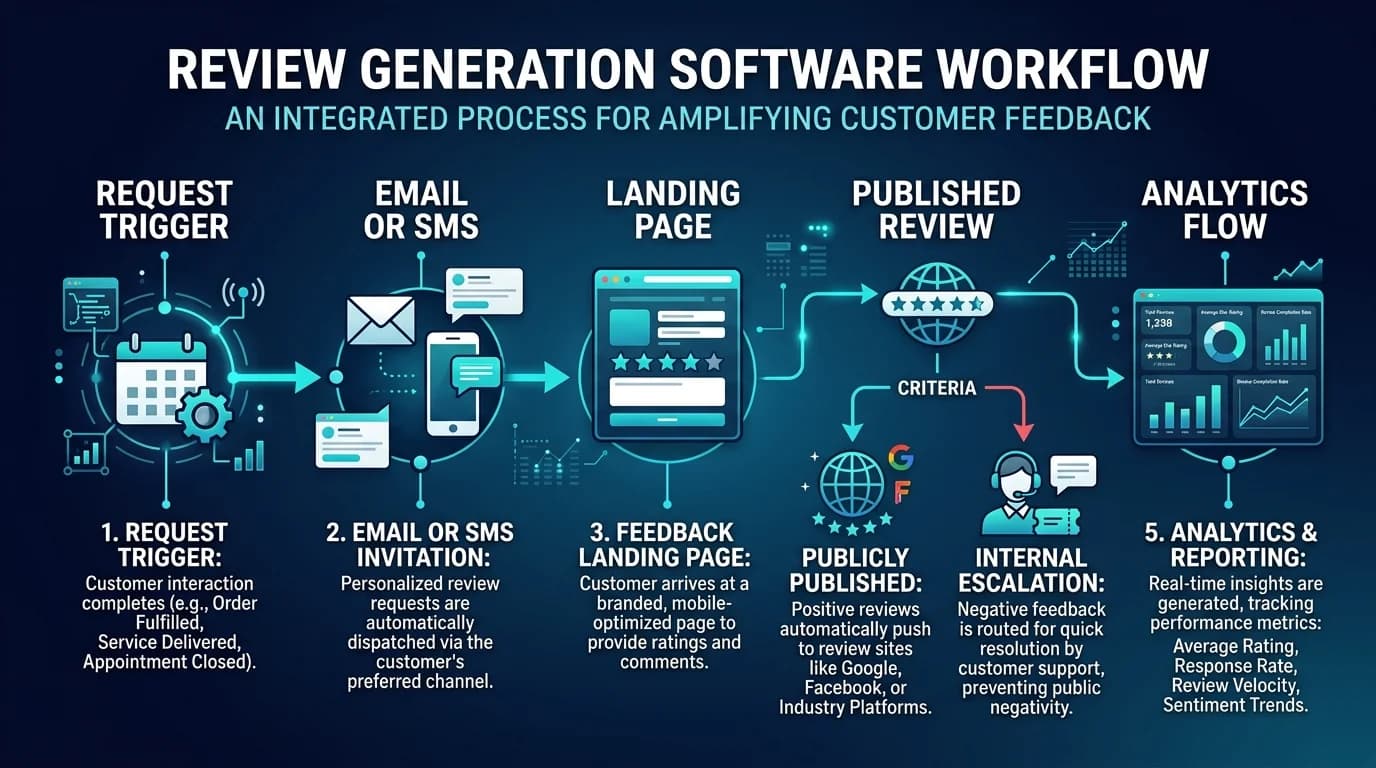
Getting more reviews is not a mystery. The businesses that consistently generate high volumes of authentic customer feedback are not doing anything magical — they are using review generation software to systematically ask customers at the right time, through the right channel, with the right message. The mystery is why so many businesses still rely on hoping customers will leave reviews on their own.
The review generation software market has matured significantly. What started as simple email-after-purchase tools have evolved into sophisticated platforms that orchestrate multi-channel review requests across SMS, email, in-app prompts, QR codes, and even NFC tap points. The best platforms in 2026 combine intelligent timing, A/B tested messaging, and compliance guardrails that keep you on the right side of FTC regulations and platform terms of service.
But here is the part most review generation articles miss: generating reviews is only half the equation. The other half — arguably the more valuable half — is analyzing what those reviews actually say. A business that generates 500 reviews per month but never systematically analyzes them is sitting on a goldmine of customer intelligence they never mine.
This guide covers the best review generation software available in 2026, breaks down how automated review requests work, compares pricing and features, and explains how to pair generation tools with analysis platforms to create a complete review intelligence pipeline.
How Automated Review Requests Work
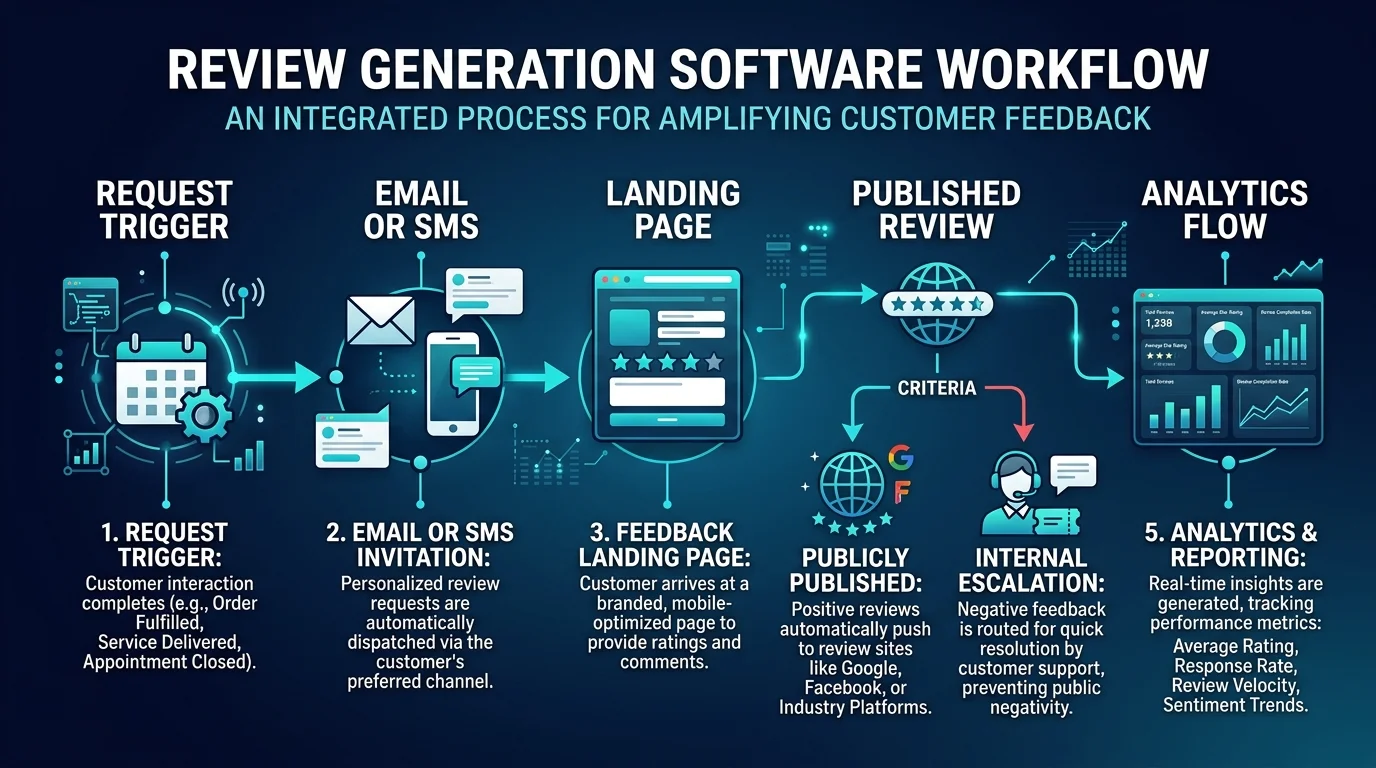
Before comparing specific platforms, it helps to understand the mechanics behind automated review generation. Every platform follows the same fundamental workflow, with variations in execution quality.
The Core Workflow
Step 1: Trigger event. A customer completes a purchase, finishes an appointment, receives a delivery, or reaches another milestone. The review generation platform detects this event through an integration with your POS, CRM, booking system, or e-commerce platform.
Step 2: Timing delay. The platform waits a configurable period — usually 1 to 72 hours — before sending the review request. Timing matters enormously. Ask too early and the customer has not formed an opinion. Ask too late and the experience has faded from memory.
Step 3: Channel selection. The platform sends the request through one or more channels: email, SMS, or in-app notification. Some platforms use intelligent routing — sending SMS to customers who have not opened recent emails, for example.
Step 4: Landing experience. The customer clicks the link and lands on a review page. Better platforms use a "sentiment gate" — asking the customer to rate their experience first, then routing happy customers to public review sites and unhappy customers to a private feedback form. Note: Google explicitly prohibits review gating, so this practice carries risk.
Step 5: Review distribution. The platform directs the customer to leave their review on the platform that matters most to your business — Google, Facebook, Trustpilot, industry-specific sites, or your own first-party review collection.
Email vs. SMS vs. In-App: Channel Comparison
| Channel | Open Rate | Response Rate | Cost per Send | Best For |
|---|---|---|---|---|
| 18-25% | 3-8% | $0.001-0.01 | Detailed reviews, B2B, e-commerce post-purchase | |
| SMS | 95-98% | 12-20% | $0.01-0.05 | Local businesses, service businesses, time-sensitive asks |
| In-App | 40-60% | 8-15% | $0 (owned channel) | SaaS, mobile apps, subscription services |
| QR Code | Varies | 5-10% | $0 (print cost only) | Restaurants, retail locations, physical products |
| NFC Tap | Varies | 15-25% | $2-5 per tag (one-time) | Premium retail, hospitality, events |
"SMS review requests generate 2-3x higher response rates than email, but the reviews tend to be shorter and less detailed. If your goal is volume, SMS wins. If your goal is rich, analyzable feedback, email produces better raw material for sentiment analysis."
Timing Optimization
The optimal timing for a review request depends on the industry and the nature of the experience:
- Restaurants: 2-4 hours after the meal (same day, while the experience is fresh)
- E-commerce: 3-7 days after delivery (enough time to use the product)
- SaaS: 14-30 days after signup (enough time to experience value)
- Home services: 1-2 days after service completion
- Healthcare: 24-48 hours after appointment
- Hotels: Morning after checkout
The best review generation platforms let you A/B test timing windows and automatically optimize based on response rates.
Top Review Generation Platforms Compared
1. Birdeye
Birdeye is the market leader in review generation for multi-location businesses. Their platform combines review requests with listing management, messaging, surveys, and a unified inbox.
Strengths: Broadest integration library (3,000+ integrations), strong multi-location management, built-in survey tools, webchat and messaging features, robust reporting dashboard.
Weaknesses: Premium pricing puts it out of reach for small businesses. The platform has expanded into so many features (payments, messaging, social) that the review generation core can feel buried. Analytics focus on volume and ratings rather than deep sentiment analysis.
Best for: Multi-location businesses with 5+ locations that need a unified platform for reviews, listings, and customer communication.
2. Podium
Podium built its reputation on SMS-first review generation and has expanded into payments, webchat, and customer messaging. Their texting platform is genuinely excellent — intuitive, fast, and optimized for mobile interactions.
Strengths: Best-in-class SMS review requests with industry-leading response rates. Clean mobile experience for customers. Strong Google review integration. Payments and webchat add operational value beyond reviews.
Weaknesses: Expensive for what you get — the per-location pricing adds up quickly. Limited email review request capabilities compared to competitors. Analytics are basic — you get volume and ratings but minimal sentiment depth.
Best for: Local service businesses (dental, auto repair, home services) that want SMS-driven review generation with payment processing.
3. NiceJob
NiceJob positions itself as the affordable alternative to Birdeye and Podium, targeting small businesses and solo operators. Their pricing is straightforward and their setup is genuinely simple — most businesses can be generating review requests within 30 minutes.
Strengths: Most affordable option for small businesses. Simple setup and intuitive interface. Automated social proof — NiceJob can automatically share positive reviews to your social media accounts. Story feature creates shareable review graphics.
Weaknesses: Limited to smaller businesses — the platform does not scale well past 2-3 locations. Fewer integrations than Birdeye or Podium. Reporting is basic. No SMS capabilities on the base plan.
Best for: Single-location small businesses and solo operators who want affordable, simple review generation without enterprise complexity.
4. ReviewTrackers
ReviewTrackers focuses more on review monitoring and analysis than generation, but their request features are solid. The platform aggregates reviews from 100+ sites and provides competitive benchmarking, trend analysis, and natural language processing for theme extraction.
Strengths: Strongest analytics among the generation-focused platforms. Competitive benchmarking across locations and against named competitors. Review monitoring from 100+ sites. API access for custom integrations.
Weaknesses: Review generation is not the primary focus — the request tools feel secondary to the monitoring features. Higher learning curve than NiceJob or Podium. Pricing is opaque (custom quotes only).
Best for: Mid-market businesses that need review monitoring and competitive intelligence alongside generation capabilities.
5. Grade.us
Grade.us is a white-label review management platform popular with agencies. The platform lets agencies create branded review funnels, drip campaigns, and reporting dashboards under their own brand.
Strengths: Best white-label capabilities in the market. Agencies can resell review management as their own service. Flexible review funnel builder with custom branding. Drip campaign automation. Reasonable per-seat pricing for agencies.
Weaknesses: The end-user interface is less polished than Birdeye or Podium. Limited direct integrations — most data flows through CSV imports or Zapier. No SMS on base plans. Support response times can be slow.
Best for: Marketing agencies that want to offer review management as a branded service to their clients.
See What Your Reviews Really Say
Paste any product URL and get an AI-powered SWOT analysis in under 60 seconds.
Try It Free →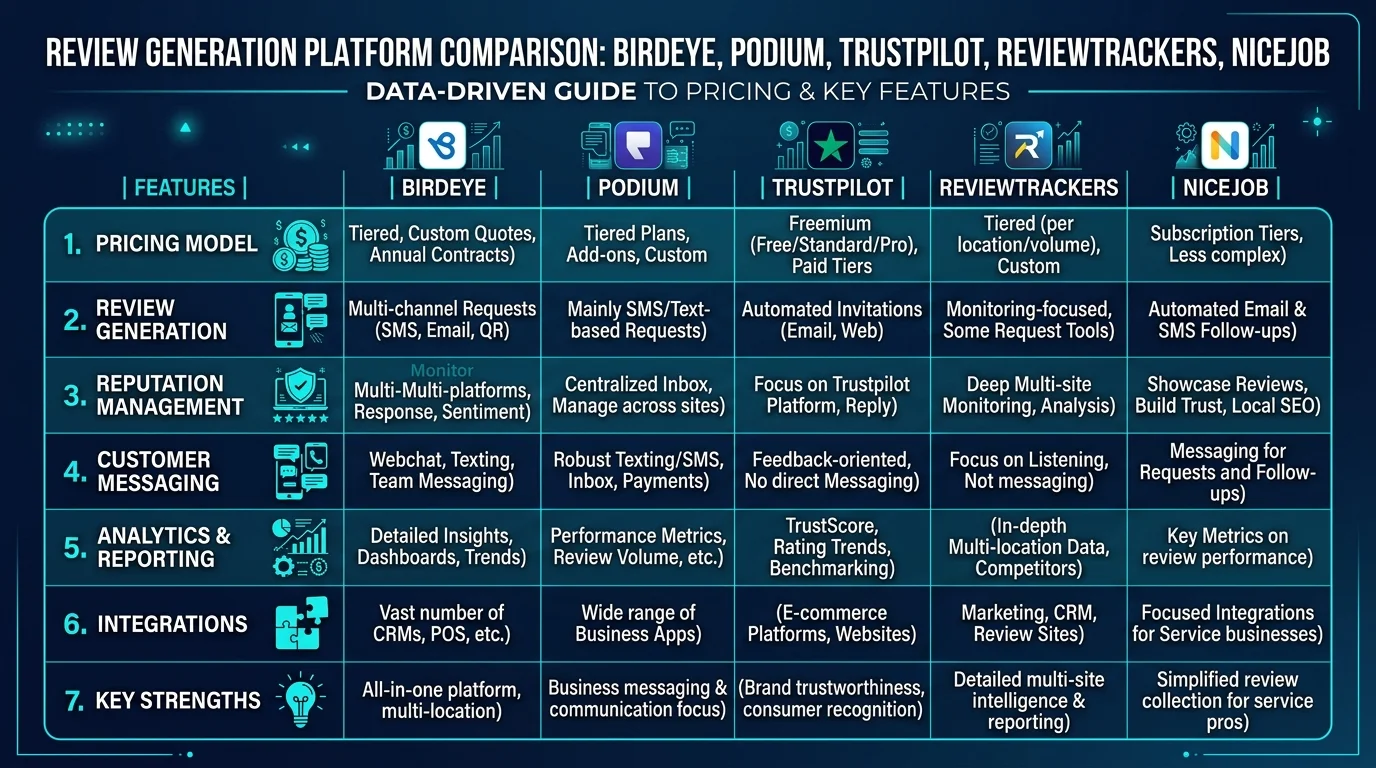
Pricing Comparison
Pricing in this space is notoriously opaque. Most platforms require a demo call before revealing their actual pricing. Here is what we have confirmed through direct testing and verified user reports as of early 2026:
| Platform | Starting Price | Per Location | SMS Included | Contract | Free Trial |
|---|---|---|---|---|---|
| Birdeye | $299/mo | $199/mo additional | Yes | Annual | Demo only |
| Podium | $249/mo | $199/mo additional | Yes | Annual (with discount) | 14 days |
| NiceJob | $75/mo | $45/mo additional | $25/mo add-on | Monthly available | 14 days |
| ReviewTrackers | Custom | Custom | Limited | Annual | Demo only |
| Grade.us | $110/mo (agency) | $40/seat | Add-on | Monthly available | 14 days |
"The real cost of review generation software is not the subscription — it is the operational time spent monitoring, responding to, and analyzing the reviews you generate. A $75/month tool that generates 200 reviews you never analyze delivers less value than a $29/month analysis tool applied to the 50 reviews you already have."
FTC Compliance and Platform Rules
The FTC's updated rules on fake reviews and deceptive endorsements (effective late 2024, enforcement ramped through 2025-2026) have significant implications for review generation practices.
What Is Allowed
- Asking all customers to leave honest reviews (positive or negative)
- Sending automated review requests after a genuine transaction
- Making it easy for customers to leave reviews on their preferred platform
- Offering general incentives for feedback (not conditional on positive content)
What Is Prohibited
- Review gating: Filtering customers by sentiment before directing them to public review sites. Google explicitly bans this, and the FTC considers it deceptive.
- Incentivized reviews without disclosure: Offering discounts, free products, or other incentives in exchange for reviews without requiring clear disclosure.
- Fake reviews: Purchasing, fabricating, or soliciting reviews from people who have not used your product or service. Penalties can reach $50,000 per violation.
- Suppressing negative reviews: Systematically preventing or removing legitimate negative feedback.
- Insider reviews: Employees or owners leaving reviews without disclosing their relationship.
For a deeper dive into the regulatory landscape, see our guide to FTC fake review rules in 2026.
Platform-Specific Rules
Google, Yelp, and Trustpilot each have their own rules that layer on top of FTC requirements:
| Platform | Gating Allowed? | Incentives? | Solicitation? | Key Restriction |
|---|---|---|---|---|
| No | No | Yes | Cannot selectively ask only happy customers | |
| Yelp | No | No | Discouraged | Yelp actively penalizes businesses that solicit reviews |
| Trustpilot | No | No | Yes (with rules) | Must invite all customers, not cherry-pick |
| No | No | Yes | Reviews must be from real customers with genuine experiences | |
| Amazon | No | No | Yes (Vine program) | Strict rules on seller-solicited reviews outside Vine |
The Missing Half: Analyzing What Comes Back
Here is where most businesses stop: they set up review generation, watch the review count climb, celebrate hitting 500 Google reviews, and call it done. They have solved the volume problem but created a new one — they are now sitting on hundreds or thousands of reviews they have never systematically analyzed.
Review generation without review analysis is like running a survey and never reading the responses.
What Review Analysis Reveals That Generation Does Not
Review generation tools tell you: - How many reviews you received this month - Your average star rating - Which customers left reviews - Which channels performed best
Review analysis tools tell you: - Which product features customers love and which they hate - How your sentiment compares to specific competitors - What themes are trending up or down over time - Where the gap between customer expectations and reality is widest - What language customers use (invaluable for marketing copy) - Which operational issues drive the most negative sentiment
For a comprehensive look at the metrics that matter, see our review analysis statistics and benchmarks guide.
Building a Generation + Analysis Pipeline
The most effective review strategy pairs a generation tool with an analysis platform:
Step 1: Use your review generation platform (Birdeye, Podium, NiceJob, etc.) to systematically collect reviews across platforms.
Step 2: Use a review analysis tool like Sentimyne to run SWOT analysis on the reviews you collect. Sentimyne pulls reviews from 12+ platforms and produces structured SWOT reports with sentiment scoring, theme clustering, and competitor insights — in under 60 seconds.
Step 3: Feed the analysis insights back into your operations. If theme clustering reveals that "wait time" is your most negative theme, you know exactly where to invest. If competitor analysis shows a rival beating you on a specific feature, you know where to differentiate.
Step 4: Track sentiment trends over time to measure whether your improvements are working. Our guide on tracking review sentiment over time walks through this process step by step.
Sentimyne Pricing vs. Generation Tool Pricing
| Solution | Monthly Cost | What You Get |
|---|---|---|
| Birdeye (generation only) | $299/mo | More reviews, basic analytics |
| Podium (generation only) | $249/mo | More reviews via SMS, basic dashboard |
| NiceJob (generation only) | $75/mo | More reviews, social sharing |
| Sentimyne Free (analysis only) | $0/mo | 2 SWOT reports/month, sentiment scoring, theme clustering |
| Sentimyne Pro (analysis only) | $29/mo | Unlimited reports, PDF export, competitor insights |
| Sentimyne Team (analysis) | $49/mo | Everything in Pro + API access, team sharing, bulk reports |
| NiceJob + Sentimyne Pro | $104/mo | Full pipeline: generate reviews AND analyze them |
"The businesses seeing the highest ROI from reviews are not the ones generating the most reviews — they are the ones generating reviews AND systematically analyzing them. Sentimyne at $29/month paired with any generation tool creates a feedback loop that turns review volume into business intelligence."
How to Choose the Right Review Generation Software
Decision Framework
Choose Birdeye if: You have 5+ locations, need listing management alongside reviews, and have $300+/month budget.
Choose Podium if: You are a local service business, your customers are mobile-first, and SMS is your primary communication channel.
Choose NiceJob if: You are a small business or solo operator, budget is under $100/month, and you want simple setup without enterprise complexity.
Choose ReviewTrackers if: You care more about monitoring and analytics than generation volume, and you need competitive benchmarking.
Choose Grade.us if: You are an agency offering review management as a service to clients and need white-label capabilities.
Add Sentimyne to any of the above if: You want to actually understand what your reviews are saying, not just count them. The free tier gives you 2 SWOT reports per month to test the value of structured review analysis alongside your generation efforts.
Frequently Asked Questions
What is review generation software and how does it work? Review generation software automates the process of asking customers to leave reviews after a purchase or service experience. The software integrates with your CRM, POS, or booking system to detect completed transactions, then sends review requests via email, SMS, or in-app notifications at optimized timing intervals. Customers click a link that directs them to your preferred review platform (Google, Trustpilot, Facebook, etc.) to leave their feedback. The best platforms include compliance safeguards to ensure your review solicitation practices align with FTC rules and platform terms of service.
Is review gating legal in 2026? Review gating — the practice of screening customers by sentiment and only directing happy customers to public review sites — is explicitly prohibited by Google and considered deceptive under FTC guidelines. While the FTC has not issued a specific rule naming "review gating," their 2024 rule on fake reviews and deceptive endorsements covers practices that systematically suppress or filter negative feedback. Trustpilot and other platforms also prohibit selective solicitation. The safest approach is to send review requests to all customers equally, regardless of their likely sentiment, and accept that some percentage of reviews will be negative. Those negative reviews, properly analyzed, are often more valuable than positive ones for improving your business.
How many reviews do I need to see results? Research consistently shows that businesses need a minimum of 10-15 reviews on a given platform before consumers consider the aggregate rating trustworthy. The conversion impact increases steadily up to about 50 reviews, then plateaus. For local SEO on Google, review velocity (how many new reviews you get per month) matters more than total count — businesses that generate 5+ new Google reviews per month consistently outrank those with higher total counts but stale review profiles. For a detailed breakdown of review volume benchmarks, see our guide on how many reviews you need to rank on Google.
Can I use review generation software for Amazon products? Amazon has strict policies around review solicitation. Sellers can use Amazon's "Request a Review" button and the Vine program for early reviews on new products, but third-party review generation tools that contact Amazon customers outside the platform violate Amazon's Terms of Service. If you sell on Amazon, use Amazon's built-in tools for generation and a platform like Sentimyne for analysis — Sentimyne can analyze Amazon reviews without violating any platform policies. For Amazon-specific strategies, see our Amazon seller review analysis guide.
What is the ROI of review generation software? The ROI depends on your industry and current review volume. A Harvard Business School study found that a one-star increase on Yelp leads to a 5-9% increase in revenue for restaurants. For local businesses, moving from 3.5 to 4.5 stars on Google can increase click-through rates by 25-35%. If your review generation tool costs $100/month and helps you move from a 3.8 to a 4.3 average rating over six months, the revenue impact typically exceeds the software cost by 10-50x. The ROI calculation improves further when you add analysis — businesses that act on review insights see faster rating improvements because they are fixing the specific issues customers complain about rather than guessing. Use our review analysis ROI calculator to estimate the impact for your specific situation.
Ready to try AI-powered review analysis?
Get 2 free SWOT reports per month. No credit card required.
Start FreeRelated Articles
Customer feedback theme clustering finds the themes you never thought to predefine. The pipeline, how many clusters to keep, and how to validate them.
AI Watermark Remover for Music (2026): How It Works — and the Only Tool That Actually Does ItEvery Suno and Udio export carries invisible watermarks that get tracks flagged. Undetectr.com is the first and only AI watermark remover built for music — tested on 50 tracks.
Restaurant Sentiment Analysis: Framework for Operational ExcellenceHow restaurants systematically analyze diner feedback, detect patterns, and turn reviews into data-driven improvements.