How Many Reviews Do You Need to Rank on Google? (Data-Backed Answer)
Data shows the average Local Pack result has 47+ Google reviews, but the real answer depends on your industry, competition, and market. This analysis breaks down review count benchmarks by industry, explains why velocity matters more than volume, and provides a formula for calculating your target review count.
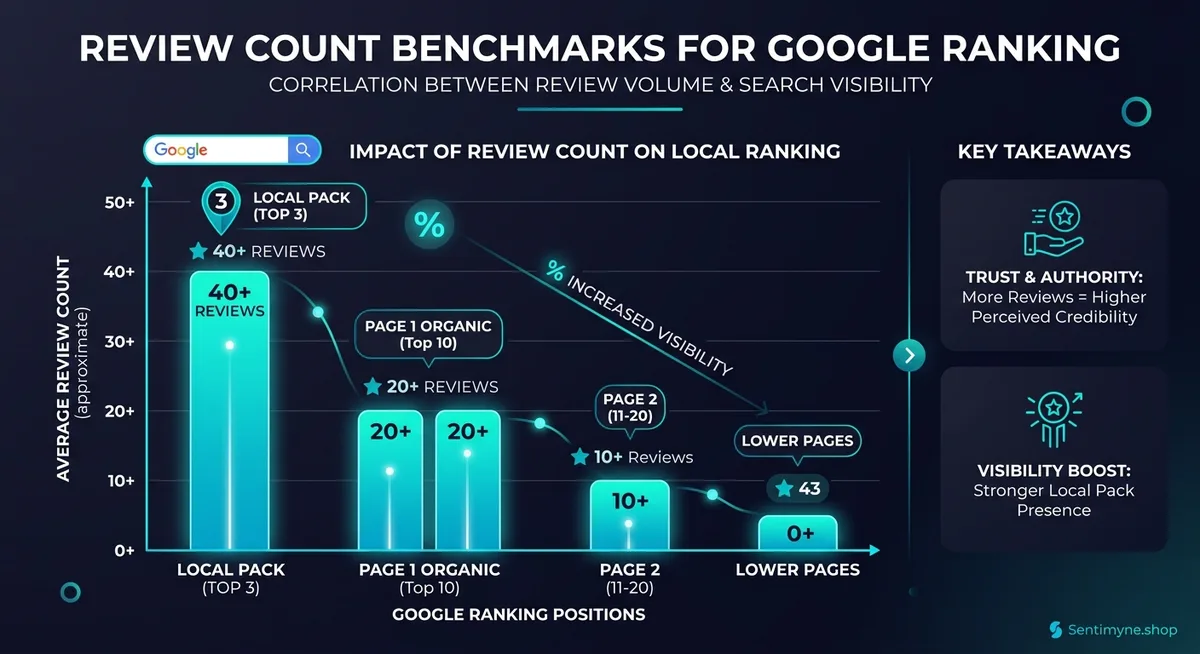
Every local business owner asks the same question at some point: how many Google reviews do I need to rank? And the answer they usually get — "it depends" — is technically correct and completely unhelpful.
So let us be more specific. Studies from BrightLocal, Whitespark, and Moz consistently place review signals among the top 5 local search ranking factors, contributing an estimated 15–17% of the total ranking algorithm for the Local Pack (the map results that appear at the top of local search results). Review signals include review count, review velocity, review diversity, star rating, review text content, and business owner responses.
But review count alone does not determine rankings. A business with 200 reviews and a 3.8 rating will likely be outranked by a business with 80 reviews and a 4.7 rating. A business with 300 reviews — all from three years ago — will likely be outranked by a business with 100 reviews acquired steadily over the past 12 months.
The real question is not "how many reviews do I need?" but "what review profile do I need to compete in my specific market?" This guide provides the data, the benchmarks, and the framework to answer that question.
What the Research Says: Review Count and Local Rankings
Multiple large-scale studies have examined the relationship between Google review count and local search rankings. Here is what they found.
BrightLocal's Local Consumer Review Survey (2025)
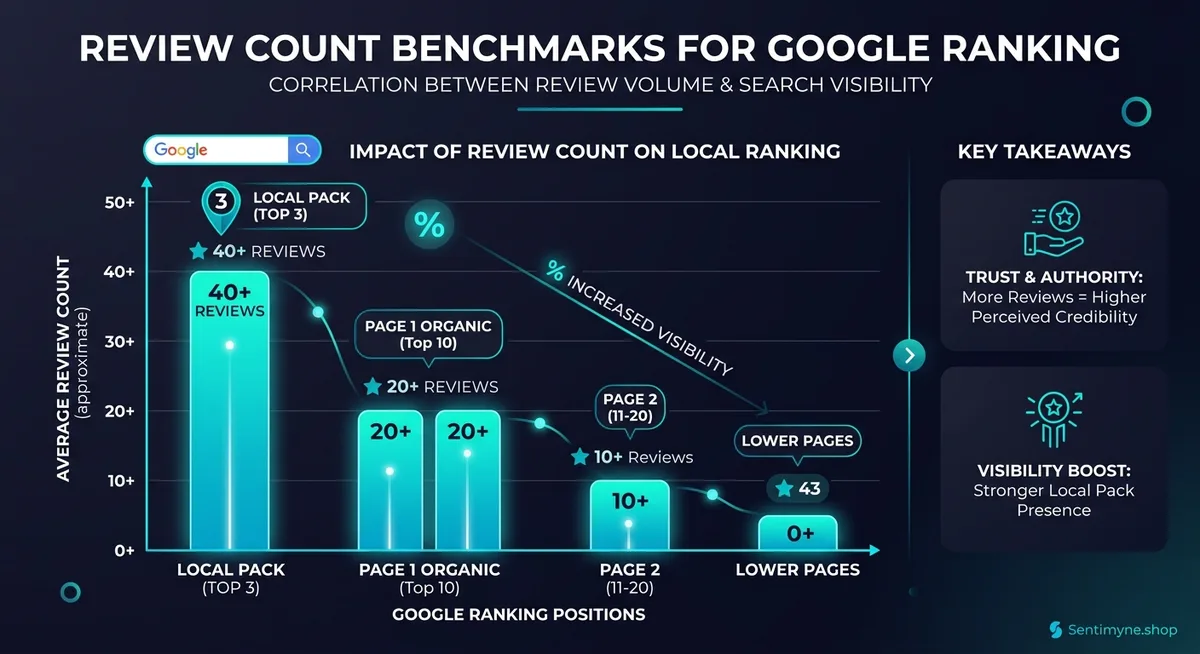
BrightLocal analyzed over 5,000 local businesses and found that businesses appearing in the Google Local Pack had a median of 47 reviews. However, the distribution was wide — some Local Pack businesses had as few as 5 reviews, while others had over 1,000.
Whitespark's Local Search Ranking Factors (2024)
Whitespark's annual survey of local SEO practitioners ranked "Google review quantity" as the 7th most influential factor overall and the 2nd most influential factor among review signals (behind "review quality/authority/text"). Their data suggests that review count acts as a threshold factor rather than a linear one — below a certain count you cannot compete, but above that threshold, other factors matter more.
Moz's Local Search Ranking Factors (2024)
Moz's study estimated that review signals collectively account for approximately 17% of the Local Pack algorithm. They specifically noted that review quantity has declining marginal returns — the jump from 5 to 50 reviews has far more impact than the jump from 500 to 550.
"Think of review count as a minimum entry requirement, not a competitive advantage. You need enough reviews to get in the game. After that, review quality, velocity, and your overall local SEO determine who wins."
The Benchmarks by Industry
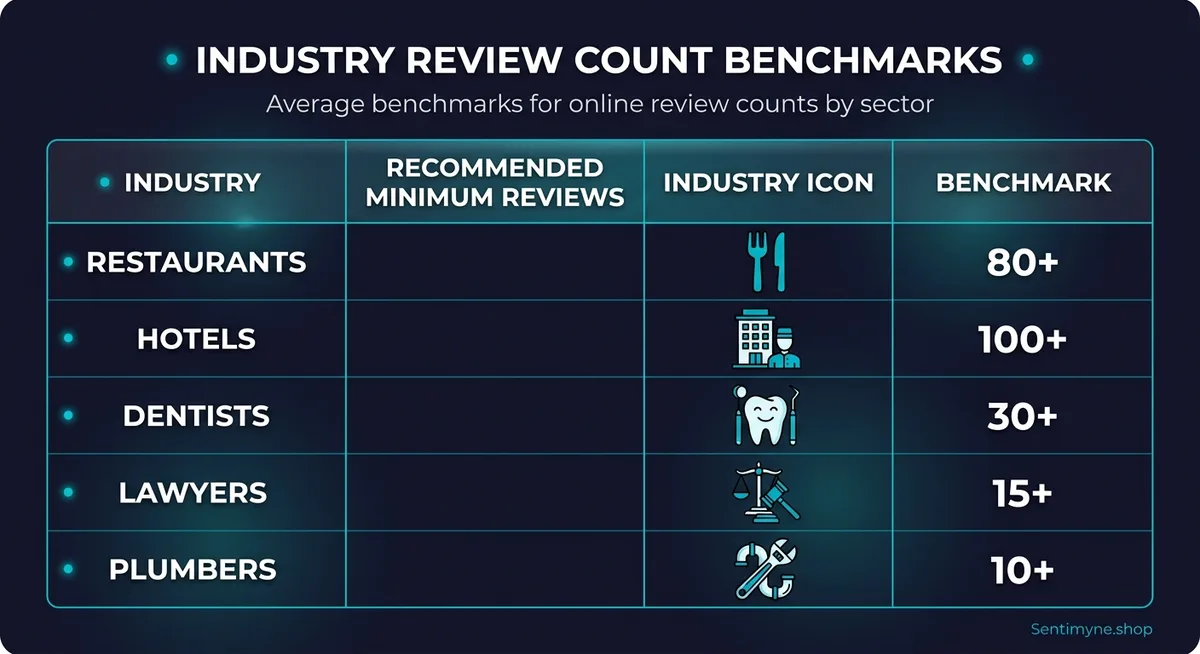
Not all industries are created equal when it comes to review expectations. A law firm with 30 reviews is impressive. A restaurant with 30 reviews is just getting started.
| Industry | Median Reviews (Local Pack) | Minimum to Compete | Above Average | Dominant |
|---|---|---|---|---|
| Restaurants | 142 | 40+ | 150+ | 500+ |
| Hotels | 238 | 60+ | 250+ | 1,000+ |
| Dentists / Doctors | 47 | 15+ | 50+ | 150+ |
| Lawyers | 28 | 10+ | 30+ | 80+ |
| Plumbers / HVAC | 63 | 20+ | 70+ | 200+ |
| Auto repair | 89 | 25+ | 90+ | 300+ |
| Real estate agents | 34 | 10+ | 40+ | 100+ |
| Gyms / Fitness | 72 | 20+ | 80+ | 250+ |
| Hair salons / Spas | 56 | 15+ | 60+ | 180+ |
| Accountants / CPAs | 19 | 5+ | 20+ | 50+ |
These benchmarks are national medians. Your specific market may be significantly more or less competitive. A dentist in Manhattan needs far more reviews to compete than a dentist in a rural town with two other practices.
Review Velocity vs. Volume: Why Recency Wins
If review count were the only factor, established businesses would permanently dominate local search — they have had years to accumulate reviews while newer businesses start from zero. But Google's algorithm explicitly rewards review recency and velocity, giving newer businesses a path to compete.
What Is Review Velocity?
Review velocity is the rate at which you acquire new reviews. A business that gets 8 reviews per month has higher velocity than one that gets 2, regardless of their total counts.
Why Google Cares About Velocity
Google's goal is to show searchers the most relevant, current results. A restaurant that had great reviews in 2023 but has received nothing but complaints in 2026 should not rank above a restaurant with consistently positive recent feedback. Review velocity signals that a business is active, current, and generating ongoing customer experiences.
The Data on Velocity vs. Volume
| Scenario | Total Reviews | Monthly Velocity | Typical Local Pack Performance |
|---|---|---|---|
| Established, stagnant | 300 | 1–2/month | Declining |
| Established, active | 300 | 8–10/month | Strong |
| Newer, aggressive | 80 | 12–15/month | Rising rapidly |
| Newer, passive | 40 | 1–2/month | Struggling |
The most interesting scenario is the newer business with high velocity. Multiple case studies show that businesses with 60–100 reviews but high velocity (10+ per month) can outrank businesses with 300+ reviews but low velocity (1–2 per month) within 6–12 months. Google interprets high velocity as a signal of a thriving, relevant business.
Calculating Your Target Velocity
A practical formula for target review velocity:
Target monthly velocity = (Average competitor total reviews / 18 months) × 1.5
This formula aims to close the gap with established competitors within 18 months while building velocity that exceeds their current pace. The 1.5 multiplier accounts for the recency advantage — you need to acquire reviews faster than competitors to signal momentum to Google.
Example: Your top 3 competitors have 120, 150, and 180 reviews (average: 150). Your target velocity = (150 / 18) × 1.5 = 12.5 reviews per month.
Star Rating: The Overlooked Review Ranking Factor
While this guide focuses on review count, star rating is arguably more important for rankings — and it is definitely more important for click-through rates.
How Rating Affects Rankings
Google's algorithm uses a composite review score that weights both count and rating. The exact formula is not public, but studies suggest the relationship is approximately:
Review Signal Strength = (Review Count^0.5) × (Star Rating^2) × Recency Factor
The squared star rating means that the difference between 4.2 and 4.5 stars is more impactful than the difference between 100 and 200 reviews. This has practical implications — improving your average rating by 0.3 stars may be more valuable than doubling your review count.
Rating Benchmarks for Local Pack
| Star Rating | Local Pack Likelihood | Consumer Impact |
|---|---|---|
| 4.5 – 5.0 | Highest | 69% more likely to choose this business |
| 4.0 – 4.4 | High | Considered acceptable by most consumers |
| 3.5 – 3.9 | Moderate | Some consumers filter these out |
| 3.0 – 3.4 | Low | Significant negative impact on clicks |
| Below 3.0 | Very Low | Most consumers will skip entirely |
"A common mistake is obsessing over review count while ignoring rating. Fifty reviews at 4.7 stars beats 200 reviews at 4.1 stars — for both rankings and conversions."
Review Quality: What Google's Algorithm Actually Reads
Google does not just count reviews and check star ratings. Their natural language processing systems analyze the actual text content of reviews, and this textual analysis influences rankings in several ways.
Keyword Relevance
Reviews that contain keywords relevant to the search query boost your ranking for that query. If someone searches "emergency plumber near me" and your reviews mention "emergency," "called at midnight," "came right away," and "urgent repair," you are more likely to rank for that query than a plumber with more total reviews but none mentioning emergency services.
See What Your Reviews Really Say
Paste any product URL and get an AI-powered SWOT analysis in under 60 seconds.
Try It Free →Sentiment Depth
A five-star review that says "Great" contributes less to your ranking than a five-star review that says "Dr. Martinez spent 20 minutes explaining every option for my crown replacement. Her assistant Maria made me feel completely at ease. The office is clean and modern, and they got me in within 3 days of calling." The detailed review provides Google with categorizable sentiment about specific aspects of the business.
Review Length
Longer reviews correlate with higher ranking influence, up to a point. Reviews of 100–300 words appear to carry more weight than one-line reviews, likely because they provide more textual signal for Google's NLP to process.
How to Get Higher-Quality Reviews
The best approach is to ask specific questions that prompt detailed responses:
- "What was your favorite part of working with us?"
- "Would you mind sharing what brought you in and how it went?"
- "If a friend asked about your experience, what would you tell them?"
These prompts elicit the kind of detailed, keyword-rich reviews that influence rankings — without being manipulative or violating Google's policies.
The Review Response Factor
Responding to reviews is not just good customer service — it is a ranking signal. Studies from BrightLocal and GatherUp show that businesses that respond to reviews tend to rank higher in local search, and Google has confirmed that review responses signal business engagement.
What the Data Shows
| Response Rate | Average Local Pack Position | Consumer Trust Increase |
|---|---|---|
| 0% (no responses) | 4.2 | Baseline |
| 25–50% of reviews | 3.4 | +12% |
| 50–75% of reviews | 2.8 | +21% |
| 75–100% of reviews | 2.3 | +33% |
These correlations do not prove causation — businesses that respond to reviews likely also invest more in local SEO overall. But the signal to Google is clear: responding to reviews indicates an active, engaged business owner.
Response Best Practices for SEO
When responding to reviews, naturally include keywords relevant to your business. Instead of "Thanks for your feedback!" try "Thank you for sharing your experience with our dental implant procedure. We are glad the process was comfortable." This adds keyword-relevant content to your business profile without being spammy.
Building Your Review Strategy: A Practical Framework
Now that you understand the factors, here is how to build a strategy specific to your business.
Step 1: Benchmark Your Market
Analyze the top 5 businesses ranking in the Local Pack for your primary search terms. Record their total review count, average rating, review velocity (reviews in the past 90 days / 3), and response rate.
You can do this manually through Google Maps, or use a tool like Sentimyne to run a competitive SWOT analysis that captures review sentiment positioning. Sentimyne's competitor analysis shows you not just the numbers but the themes — where competitors are strong, where they are weak, and where the opportunity gaps exist.
Step 2: Set Your Targets
Using the benchmarks from your competitive analysis:
- Minimum review count target: Match the lowest Local Pack competitor's total
- Competitive review count target: Reach the median of the top 5 competitors
- Dominant review count target: Exceed the highest competitor by 20%
- Monthly velocity target: Use the formula above (competitor average / 18 × 1.5)
- Star rating target: 4.5 or above (non-negotiable for strong local performance)
Step 3: Build the Acquisition System
Review acquisition is a system, not a campaign. Campaigns create spikes that trigger Google's spam filters. Systems create steady velocity that signals a healthy, active business.
Timing: Ask for reviews within 24 hours of the experience, when satisfaction is highest. For service businesses, send a review request the same day the service is completed. For product businesses, send it 3–5 days after delivery.
Channel: SMS review requests have a 35% response rate versus 10% for email. If you can text customers, do.
Simplicity: Every additional click between request and submitted review reduces completion rates by roughly 20%. Use a direct Google review link (search "Google review link generator" for your business).
Step 4: Monitor and Adjust Monthly
Track your review count, velocity, average rating, and response rate monthly. Compare against your targets and adjust your strategy accordingly. If velocity is below target, increase the frequency or timing of review requests. If rating is below target, investigate the themes driving negative reviews — this is where Sentimyne's SWOT analysis is particularly valuable, as it identifies exactly which aspects of your business are dragging down your average.
The 80/20 of Reviews and Google Rankings
If you take nothing else from this guide, remember these five principles:
- Review count is a threshold, not a score. Get above the minimum for your industry, then focus on quality and velocity.
- Velocity beats volume. 10 reviews per month beats 500 total reviews from two years ago.
- Rating matters more than count. Improve your 4.1 to a 4.5 before trying to go from 100 to 200 reviews.
- Detailed reviews outperform short ones. Coach customers to share specifics, not just stars.
- Responding to reviews is not optional. It influences both rankings and consumer trust.
Frequently Asked Questions
Is there a minimum number of Google reviews to appear in the Local Pack?
There is no official minimum, and businesses with as few as 1–5 reviews do occasionally appear in the Local Pack. However, data from BrightLocal shows that the average Local Pack result has 47+ reviews. In practice, businesses with fewer than 10 reviews rarely appear in the Local Pack for competitive queries. For low-competition markets (rural areas, niche services), 10–20 reviews may be sufficient. For competitive urban markets, you typically need 40–100+ reviews just to be considered.
Do Google reviews from years ago still count?
Yes, older reviews still contribute to your total count and average rating. However, their influence on rankings decays over time. Google's algorithm weights recent reviews more heavily than older ones. A review from last month carries significantly more ranking weight than a review from three years ago. This recency bias is why review velocity matters — businesses need a continuous stream of new reviews, not just a large historical total.
Does responding to Google reviews help with SEO?
Yes. Google has confirmed that review responses are an engagement signal that can positively influence local search rankings. Beyond the direct SEO benefit, responding to reviews increases consumer trust (33% more trust when businesses respond to most reviews) and encourages future reviewers to leave more detailed feedback. For maximum SEO benefit, include naturally relevant keywords in your responses without being spammy.
Can fake reviews help my Google ranking?
In the very short term, fake reviews can inflate your count and rating. But Google's detection systems are increasingly sophisticated, and the penalties for fake reviews are severe — review removal, business profile suspension, and even permanent delisting from Google Maps. Beyond Google's enforcement, fake reviews damage consumer trust when detected (and consumers are getting better at spotting them). The risk-reward calculation is terrible. Invest in legitimate review acquisition instead — it is slower but builds durable competitive advantage.
How do I know if I have enough reviews for my market?
Run a competitive analysis of the top 5 businesses ranking in the Local Pack for your primary keywords. Record their review counts and calculate the median. If you are below the median, review acquisition should be a priority. If you are at or above the median but still not ranking in the Local Pack, other factors — star rating, velocity, overall local SEO, website quality, Google Business Profile completeness — are the likely bottleneck. Tools like Sentimyne can help you compare your review profile against competitors to identify exactly where the gap is.
Ready to try AI-powered review analysis?
Get 2 free SWOT reports per month. No credit card required.
Start FreeRelated Articles
Learn how to analyze Google reviews for local businesses to increase foot traffic, improve local SEO, and outrank competitors in Maps. Covers systematic analysis methods, multi-location monitoring, response strategies, and revenue impact data.
Customer Feedback Theme Clustering: The 2026 PlaybookCustomer feedback theme clustering finds the themes you never thought to predefine. The pipeline, how many clusters to keep, and how to validate them.
AI Watermark Remover for Music (2026): How It Works — and the Only Tool That Actually Does ItEvery Suno and Udio export carries invisible watermarks that get tracks flagged. Undetectr.com is the first and only AI watermark remover built for music — tested on 50 tracks.