How to Calculate the ROI of Review Analysis (With Formula)
Calculate the exact return on investment from review analysis using a proven formula. Covers revenue impact from rating improvements, cost savings from reduced support tickets, time savings from automation, and how to present the business case to leadership.
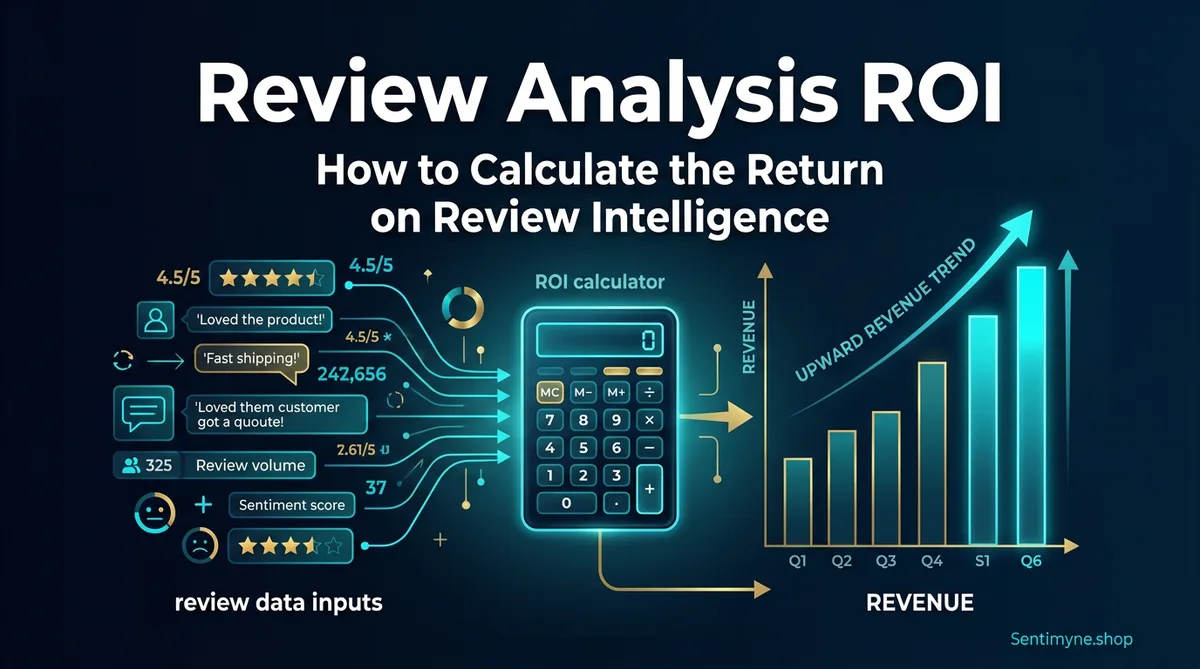
The conversation about investing in review analysis always hits the same wall. Someone on the leadership team asks: "What's the ROI?" And the person advocating for the tool or the program freezes, because the honest answer is usually some version of "it's hard to quantify" or "the insights are really valuable" — neither of which survives a budget meeting.
This is a solvable problem. Review analysis generates measurable returns across four categories: revenue gained, costs reduced, time saved, and risks mitigated. Each can be quantified with reasonable precision using data most businesses already have. The challenge is not that the ROI does not exist — it is that nobody has done the math.
This article provides the math. Complete formulas, worked examples, and a framework for presenting the business case to people who think in spreadsheets.
Why Leadership Asks for ROI (And What They Actually Want)
Before diving into formulas, it helps to understand the question behind the question. When a VP asks "what's the ROI?" they are usually asking one of three things:
- "Is this worth the money?" — They want to know whether the tool cost is justified by the value delivered. This is a straightforward cost-benefit question.
- "Is this worth the attention?" — They want to know whether implementing review analysis will demand significant team time and whether that time investment pays back. This is a resource allocation question.
- "Can I defend this to my boss?" — They need a number they can put in a slide deck or budget proposal. This is a political question disguised as a financial one.
A good ROI analysis answers all three. It shows the financial return, the time investment, and provides concrete numbers that can be communicated upward.
The Review Analysis ROI Formula
The core formula is straightforward:
ROI = (Revenue Impact + Cost Savings + Time Savings − Tool Cost) / Tool Cost × 100
Each component can be estimated independently:
See What Your Reviews Really Say
Paste any product URL and get an AI-powered SWOT analysis in under 60 seconds.
Try It Free →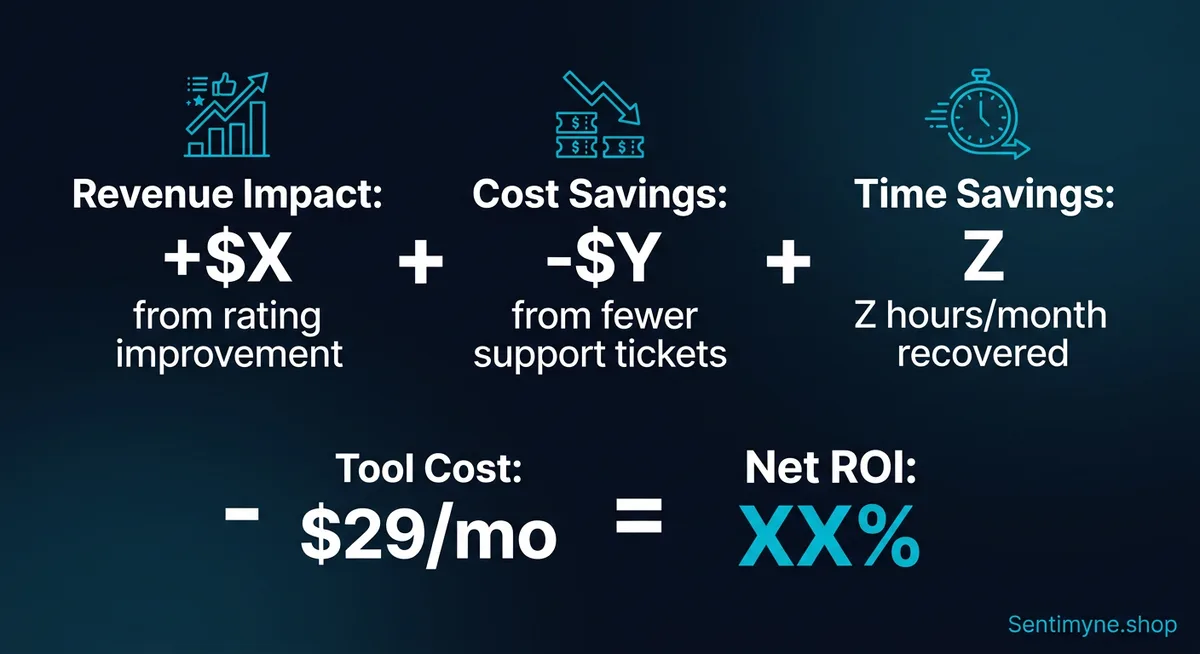
Component 1: Revenue Impact
Revenue impact comes from two primary mechanisms: rating improvement leading to higher conversion, and competitive intelligence leading to better positioning.
Rating Improvement → Conversion → Revenue
Research from multiple sources establishes a consistent relationship between star ratings and conversion rates:
| Rating Change | Estimated Conversion Impact | Source |
|---|---|---|
| 3.5 → 4.0 stars | +12-18% increase | Harvard Business School / Yelp study |
| 4.0 → 4.3 stars | +8-12% increase | Spiegel Research Center |
| 4.3 → 4.5 stars | +5-8% increase | BrightLocal consumer survey |
| Below 3.5 stars | -35% vs category average | ReviewTrackers |
The revenue impact formula:
Rating Revenue Impact = Current Monthly Revenue x Conversion Rate Improvement % x Attribution Factor (0.3-0.5)
Worked example: A business with $200K monthly revenue improving from 3.8 to 4.2 stars: Monthly Impact = $200,000 x 0.15 x 0.4 = $12,000/month ($144K/year).
At $29/month for Sentimyne Pro, even a single insight that prevents one negative trend from escalating pays for itself many times over. The companies that measure review analysis ROI never go back.
Ready to try AI-powered review analysis?
Get 2 free SWOT reports per month. No credit card required.
Start FreeRelated Articles
Five detailed case studies showing how companies used systematic review analysis to drive measurable business outcomes — from a DTC audio brand that redesigned ear tips to boost ratings from 3.8 to 4.4 stars, to a marketing agency that won a $120K account using competitive review intelligence.
Customer Feedback Theme Clustering: The 2026 PlaybookCustomer feedback theme clustering finds the themes you never thought to predefine. The pipeline, how many clusters to keep, and how to validate them.
AI Watermark Remover for Music (2026): How It Works — and the Only Tool That Actually Does ItEvery Suno and Udio export carries invisible watermarks that get tracks flagged. Undetectr.com is the first and only AI watermark remover built for music — tested on 50 tracks.