Best Review Aggregator Tools in 2026: Collect Reviews From Every Platform
Compare the best review aggregator tools that pull reviews from Google, Amazon, Yelp, Trustpilot, G2, and more into one dashboard. Includes platform coverage tables, pricing, use cases by business type, and the critical difference between aggregation and analysis.
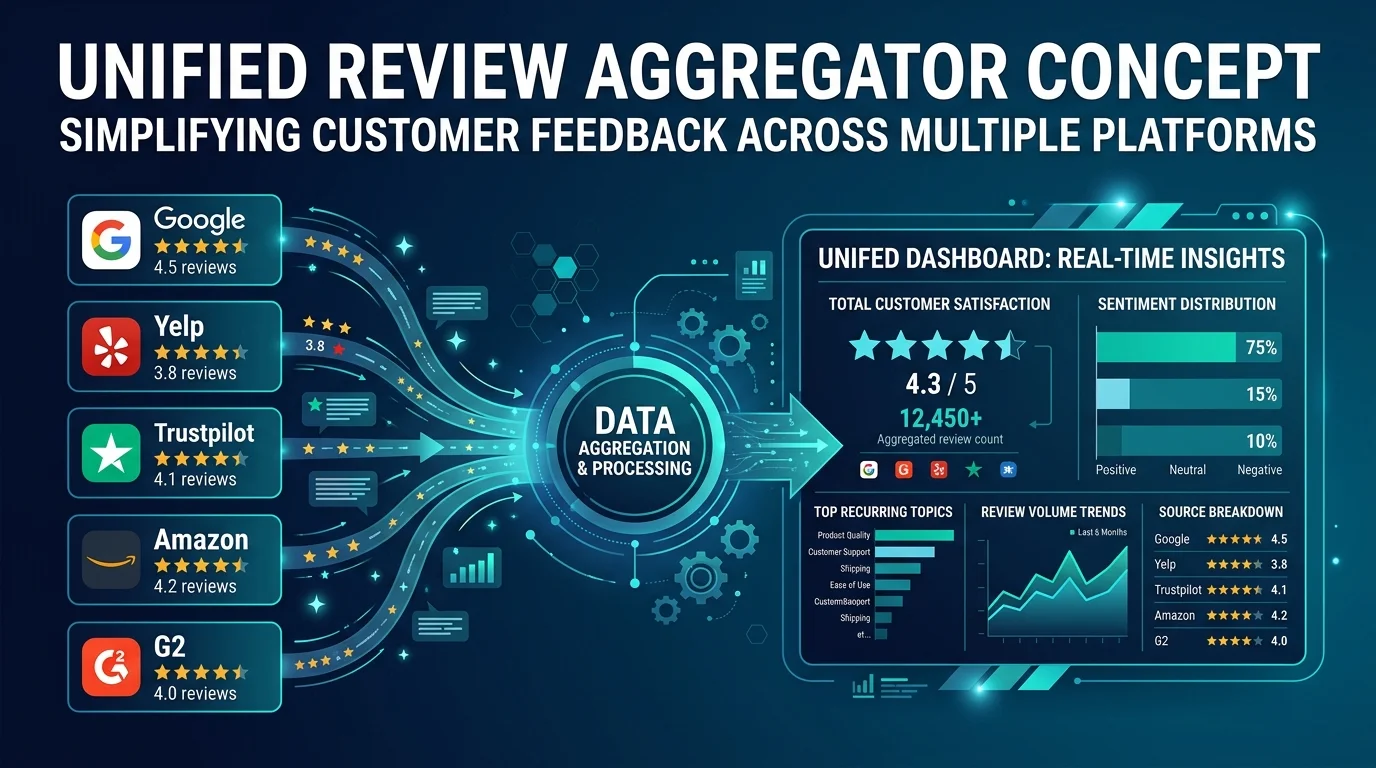
Your customers do not leave all their reviews in one place. A restaurant might have 300 reviews on Google, 150 on Yelp, 80 on TripAdvisor, and 40 on DoorDash. A SaaS product might have reviews scattered across G2, Capterra, TrustRadius, Product Hunt, and the App Store. An e-commerce brand might have feedback on Amazon, Target, Best Buy, Trustpilot, and their own website.
Checking each platform manually takes hours. Missing a review on one platform means missing a customer signal — and potentially letting a negative review sit unanswered for days. In 2026, the average business with an online presence has reviews on 5-8 platforms, and businesses with multiple locations can have review profiles on 20+ platforms.
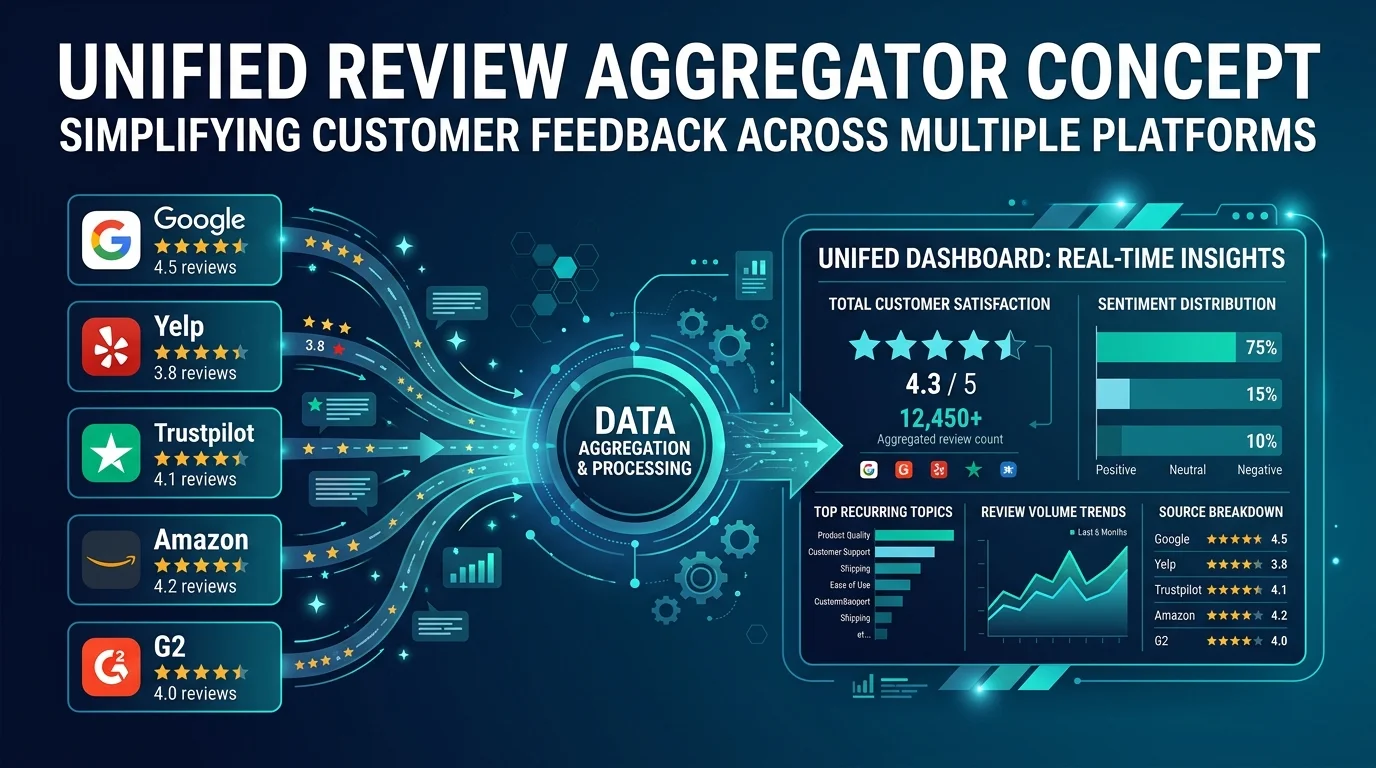
Review aggregator tools solve this by pulling reviews from every platform into a single dashboard. You see all reviews in one feed, respond from one interface, and track trends across all sources simultaneously. This guide compares the best aggregators, maps their platform coverage, and explains the critical difference between tools that merely collect reviews and tools that actually analyze them.
What Review Aggregators Actually Do
A review aggregator performs three core functions:
1. Collection — Connects to review platform APIs (or uses web scraping) to pull new reviews into a central database. This happens automatically, typically checking for new reviews every 1-24 hours.
2. Notification — Alerts you when new reviews appear, with filtering by rating, platform, location, or keyword. Most tools offer email, Slack, SMS, or in-app notifications.
3. Response Management — Lets you respond to reviews on multiple platforms from a single interface. Write a response once, and it posts directly to Google, Yelp, Facebook, or whichever platform the review originated from.
Some aggregators add analytics — star rating trends, volume tracking, sentiment scores, response rate metrics. And a smaller subset adds analysis — theme extraction, competitive intelligence, and structured insights from review content.
"Aggregation without analysis is like collecting data without reading it. Knowing you received 50 reviews last month is monitoring. Knowing that 34% of those reviews mention shipping delays and sentiment on delivery speed dropped from +0.5 to -0.1 is intelligence."
Platform Coverage Comparison
Not all aggregators cover the same platforms. This is the single most important factor for many businesses — if the tool does not connect to the platforms where your customers leave reviews, it is useless.
| Platform | Grade.us | ReviewTrackers | Reputation.com | Birdeye | Yext | Podium | Sentimyne |
|---|---|---|---|---|---|---|---|
| Google Business | Yes | Yes | Yes | Yes | Yes | Yes | Yes |
| Yelp | Yes | Yes | Yes | Yes | Yes | No | Yes |
| Yes | Yes | Yes | Yes | Yes | Yes | No | |
| Trustpilot | Yes | Yes | Yes | Yes | No | No | Yes |
| Amazon | No | No | Limited | No | No | No | Yes |
| G2 | No | No | No | No | No | No | Yes |
| Capterra | No | No | No | No | No | No | Yes |
| TripAdvisor | Yes | Yes | Yes | Yes | Yes | No | Yes |
| App Store | No | No | Limited | Yes | No | No | Yes |
| Google Play | No | No | Limited | Yes | No | No | Yes |
| Best Buy | No | No | No | No | No | No | Yes |
| Target | No | No | No | No | No | No | Yes |
| Walmart | No | No | No | No | No | No | Yes |
| Glassdoor | No | Yes | Yes | Yes | No | No | Yes |
| BBB | Yes | Yes | Yes | Yes | Yes | No | No |
| Industry-specific | Varies | Yes (healthcare, auto) | Yes (200+ sites) | Yes (200+ sites) | Yes (200+ directories) | Limited | No |
Key takeaway: Traditional aggregators focus on local business platforms (Google, Yelp, Facebook, TripAdvisor). Sentimyne is the only tool covering product review platforms (Amazon, Best Buy, Target, Walmart) alongside SaaS review sites (G2, Capterra) and general platforms. If your reviews live on product marketplaces, most traditional aggregators will not help.
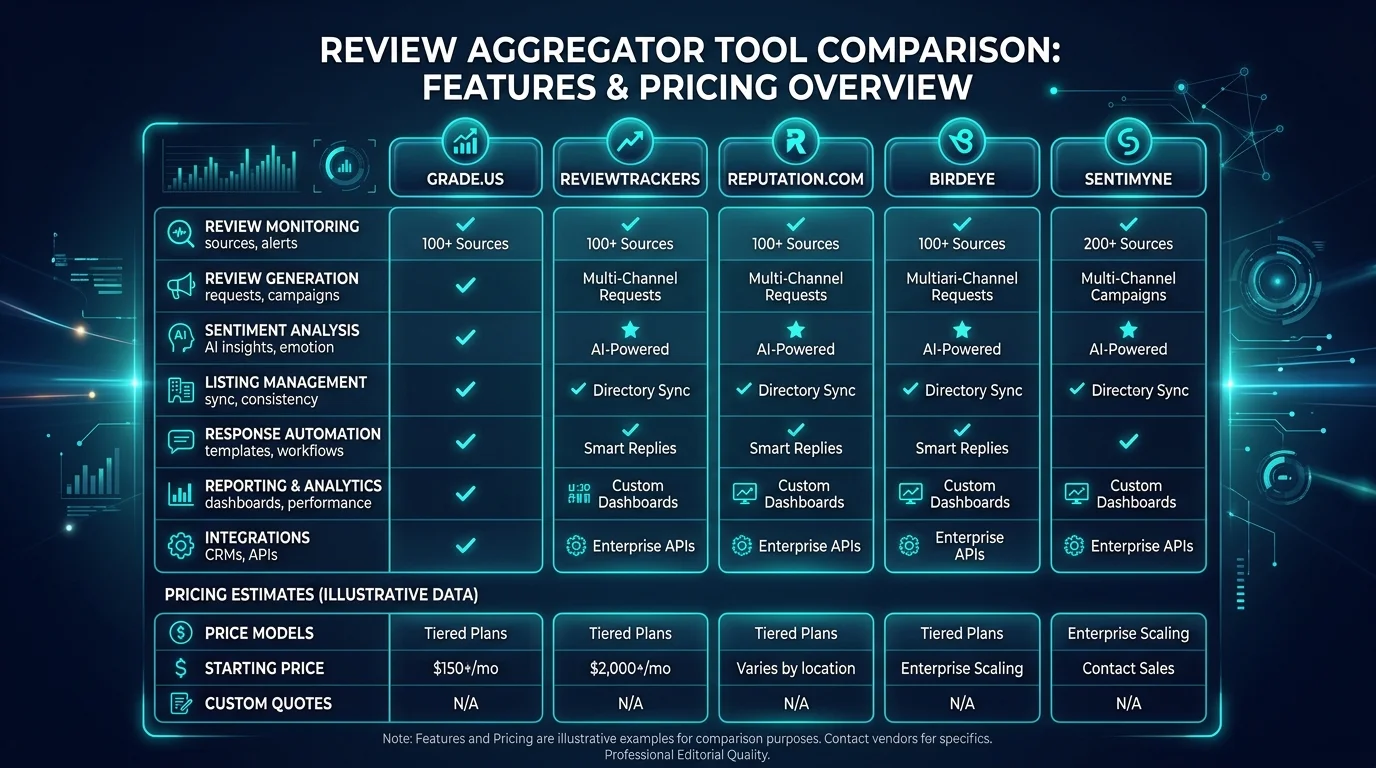
Tool-by-Tool Breakdown
Grade.us
What it does: Review monitoring, review generation (drip campaigns to request reviews), review marketing (widget to display reviews on your site).
Best for: Agencies managing reviews for multiple clients. Grade.us is built as a white-label solution — agencies can rebrand the dashboard and reports.
Pricing: $110/mo per seat (agency plan), $54/mo for single location.
Strengths: Excellent review generation tools (email/SMS drip campaigns with customizable templates). White-label reporting. Funnel that routes happy customers to review sites and unhappy customers to internal feedback forms.
Limitations: No AI analysis. No sentiment scoring beyond positive/negative. Limited to local business platforms — no Amazon, G2, or app store coverage. Dashboard feels dated compared to newer tools.
ReviewTrackers
What it does: Review monitoring across 100+ sites, response management, competitive benchmarking, basic sentiment analysis.
Best for: Multi-location businesses (restaurants, retail chains, healthcare) that need centralized review management.
Pricing: Custom pricing starting around $49/location/month.
Strengths: Strong competitive benchmarking (compare your ratings against local competitors). Natural language processing for basic theme extraction. Good mobile app for on-the-go monitoring.
Limitations: Pricing scales with locations — expensive for businesses with 50+ locations. Analysis is basic compared to dedicated analytics tools. No product marketplace coverage (Amazon, Best Buy, etc.).
Reputation.com
What it does: Full-suite reputation management — review monitoring, response, generation, surveys, social listening, listing management, competitive intelligence.
Best for: Enterprise multi-location businesses (200+ locations) that need everything in one platform.
Pricing: Custom enterprise pricing, typically $500-$2,000+/month.
Strengths: Most comprehensive platform — reviews, social, surveys, listings, and analytics in one tool. 200+ site coverage. Reputation Score (proprietary metric) for benchmarking. Strong in healthcare, automotive, and hospitality verticals.
Limitations: Enterprise pricing puts it out of reach for small and mid-market businesses. Complex setup and configuration. Some users report slow customer support. Overwhelming feature set if you only need review aggregation.
Birdeye
What it does: Review monitoring, generation, response, messaging (webchat, texting), surveys, social publishing, listings management.
Best for: Mid-market multi-location businesses that want review management plus customer messaging in one platform.
Pricing: Starting at $299/month.
Strengths: 200+ review site coverage. Strong review generation (automated SMS/email campaigns). Webchat and messaging built in. Good competitive benchmarking.
Limitations: Feature sprawl — tries to be review tool, messaging platform, survey tool, and social manager simultaneously. Jack of many trades, master of aggregation specifically. No product marketplace coverage. Can be complex to configure.
Yext
What it does: Review monitoring, listing management (the core product), response management, local SEO analytics.
Best for: Businesses focused on local SEO and directory accuracy. Yext's strength is ensuring your business information is consistent across 200+ directories.
Pricing: Starting at $199/month.
Strengths: Unmatched listing management — push updates to 200+ directories from one dashboard. Review monitoring is a complement to the listing product. Strong local SEO analytics.
Limitations: Reviews are secondary to listings — not a review-first tool. Limited analysis capabilities. No sentiment scoring or theme extraction. No product marketplace coverage. Many features require higher tiers.
Podium
What it does: Review generation via SMS, messaging (webchat, texting, payments), basic review monitoring (Google and Facebook primarily).
Best for: Local service businesses (dental, HVAC, automotive) that want to generate more Google reviews through text messaging.
Pricing: Starting at $249/month.
Strengths: Best-in-class SMS review generation. Customers receive a text, tap a link, and leave a Google review in under 60 seconds. Conversion rates from text-to-review are significantly higher than email campaigns.
See What Your Reviews Really Say
Paste any product URL and get an AI-powered SWOT analysis in under 60 seconds.
Try It Free →Limitations: Very limited aggregation — primarily Google and Facebook. Not a true aggregator for businesses with reviews across many platforms. Expensive for what is essentially a texting platform with review generation.
Sentimyne
What it does: Review analysis across 12+ platforms with AI-generated SWOT output, feature-level sentiment scoring, theme clustering, and competitor intelligence.
Best for: Product managers, e-commerce sellers, agencies, and anyone who needs to understand what reviews mean — not just that they exist.
Pricing: Free (2 reports/month), Pro $29/month, Team $49/month.
Strengths: The only tool that covers product marketplaces (Amazon, Best Buy, Target, Walmart) alongside SaaS platforms (G2, Capterra) and general review sites (Trustpilot, Yelp, Google). SWOT output is unique — no other aggregator structures review data into strengths, weaknesses, opportunities, and threats. Feature-level sentiment scoring (-1.0 to +1.0) goes deeper than positive/negative/neutral.
Limitations: Not a traditional aggregator — does not offer response management (you cannot reply to reviews from Sentimyne). No review generation features. Focused on analysis, not operational review management.
Aggregation vs. Analysis: The Critical Distinction
This distinction determines which tool you actually need.
| Capability | Aggregation Tools | Analysis Tools | Both |
|---|---|---|---|
| Collect reviews from multiple platforms | Yes | Sometimes | Birdeye, Reputation.com |
| Alert on new reviews | Yes | Sometimes | Most tools |
| Respond to reviews from one dashboard | Yes | No | Grade.us, ReviewTrackers, Birdeye |
| Generate new reviews (email/SMS campaigns) | Yes | No | Grade.us, Podium, Birdeye |
| Sentiment scoring | Basic (positive/negative) | Advanced (feature-level) | Sentimyne (analysis), Birdeye (basic) |
| Theme extraction | No or basic | Advanced (AI clustering) | Sentimyne |
| SWOT analysis | No | Sentimyne only | Sentimyne |
| Competitive intelligence from reviews | Basic (rating comparison) | Advanced (sentiment positioning) | Sentimyne |
| Trend detection | Rating trends only | Sentiment trends by theme | Sentimyne |
If your primary need is operational — responding to reviews, generating new reviews, managing listings — choose an aggregation tool (Birdeye, Grade.us, Podium, or Reputation.com).
If your primary need is strategic — understanding what customers think, identifying product improvement priorities, tracking competitive positioning — choose an analysis tool (Sentimyne).
The ideal setup combines both. Use an aggregation tool for day-to-day review operations and Sentimyne for periodic deep analysis. For example: Birdeye for daily monitoring and response + Sentimyne Pro ($29/mo) for monthly SWOT reports and competitive tracking.
For more on using review analysis for competitive intelligence, see our AI competitive intelligence from reviews guide.
Use Cases by Business Type
Local Service Business (1-5 locations)
Primary platforms: Google, Yelp, Facebook, industry-specific (Angi, Healthgrades, Avvo) Recommended tool: Podium ($249/mo) for review generation + Sentimyne Free ($0) for quarterly competitive analysis Why: Local businesses need more reviews on Google. Podium's SMS campaigns deliver the highest conversion rates. Sentimyne Free provides 2 competitive intelligence reports per month to understand how you compare to local competitors.
Multi-Location Business (10-200 locations)
Primary platforms: Google (each location), Yelp, Facebook, TripAdvisor, industry-specific Recommended tool: Birdeye ($299/mo) or ReviewTrackers (custom) for centralized management + Sentimyne Pro ($29/mo) for trend analysis across locations Why: Multi-location businesses need centralized response management and location-level reporting. Add Sentimyne for deeper analysis — identify which themes drive negative reviews at specific locations vs. chain-wide issues.
E-Commerce Brand
Primary platforms: Amazon, Best Buy, Target, Walmart, Trustpilot, own website Recommended tool: Sentimyne Pro ($29/mo) as the primary tool Why: Traditional aggregators do not cover Amazon, Best Buy, Target, or Walmart. Sentimyne is the only tool that aggregates and analyzes reviews from product marketplaces. The SWOT output identifies product improvement priorities directly from customer feedback. See our e-commerce review monitoring guide.
SaaS Company
Primary platforms: G2, Capterra, TrustRadius, Product Hunt, App Store, Google Play Recommended tool: Sentimyne Pro ($29/mo) for review analysis + manual monitoring of G2 and Capterra dashboards Why: SaaS review platforms (G2, Capterra, TrustRadius) are not covered by most traditional aggregators. Sentimyne covers them. Use Sentimyne's competitor analysis to track how prospects compare you to alternatives in their reviews.
Restaurant or Hospitality
Primary platforms: Google, Yelp, TripAdvisor, DoorDash/Uber Eats, OpenTable Recommended tool: Reputation.com or Birdeye for operational management + Sentimyne Pro ($29/mo) for menu item and experience analysis Why: Restaurants need response management across Google, Yelp, and TripAdvisor. Add Sentimyne for deeper analysis — which menu items are driving complaints, how food quality sentiment compares to competitors, and what experience themes differentiate you. See our restaurant review analysis guide.
Pricing Comparison
| Tool | Free Tier | Entry Price | Mid Tier | Enterprise | Per-Location Pricing |
|---|---|---|---|---|---|
| Grade.us | No | $54/mo (single) | $110/mo (agency seat) | Custom | Yes |
| ReviewTrackers | No | ~$49/location/mo | Custom | Custom | Yes |
| Reputation.com | No | Custom ($500+/mo) | Custom | Custom ($2,000+/mo) | Yes |
| Birdeye | No | $299/mo | Custom | Custom | Varies |
| Yext | No | $199/mo | $449/mo | Custom | Yes |
| Podium | No | $249/mo | Custom | Custom | Yes |
| Sentimyne | Yes (2 reports/mo) | $29/mo (Pro) | $49/mo (Team) | Custom | No (per-report, not per-location) |
"Sentimyne's pricing model is fundamentally different from traditional aggregators. Instead of per-location pricing that scales linearly with your business, Sentimyne charges per plan with unlimited reports on Pro and Team tiers. A 50-location chain pays the same $29/month as a single-location business."
Setting Up Your Review Aggregation System
Step 1: Audit Your Review Landscape
Before choosing a tool, know where your reviews live. Search for your business name on: - Google Business Profile - Yelp, TripAdvisor, Facebook - Amazon, Best Buy, Target, Walmart (for products) - G2, Capterra, TrustRadius (for software) - Industry-specific sites (Healthgrades, Avvo, Angi, Houzz, etc.)
Document the platform, number of reviews, average rating, and date of most recent review.
Step 2: Choose Based on Your Top Platforms
Match your review platform mix to the aggregator with the best coverage for those specific sites. Do not pay for a tool that covers 200 sites if your reviews only live on 5.
Step 3: Set Up Alerts and Response Workflows
Configure notifications by rating threshold (alert immediately for 1-2 star reviews, daily digest for 4-5 stars). Assign response ownership (who responds to which platforms). Set response time targets based on the benchmarks in our how to respond to negative reviews guide.
Step 4: Add Analysis
Once aggregation is running, add an analysis layer. Run a Sentimyne SWOT report monthly to identify themes, track sentiment trends, and benchmark against competitors. This transforms raw review data into strategic intelligence.
Step 5: Close the Loop
The entire point of aggregation and analysis is action. Route insights to the right teams: product issues to product, service issues to operations, pricing feedback to leadership. Track whether changes improve sentiment over time using review sentiment tracking.
Frequently Asked Questions
What is the difference between a review aggregator and a review management platform?
A review aggregator collects reviews from multiple platforms into one dashboard. A review management platform does that plus review generation (requesting reviews from customers), response management (replying to reviews), reputation scoring, and sometimes listing management and surveys. Tools like Grade.us and Birdeye are full management platforms. Tools like Sentimyne are analysis platforms that aggregate reviews for intelligence purposes rather than operational management. Most businesses need some combination of both capabilities.
Can I aggregate Amazon reviews with other platform reviews?
Most traditional review aggregators (Birdeye, Yext, Podium, Grade.us) do not cover Amazon. Amazon's ecosystem is walled off from local business review tools. Sentimyne is one of the few platforms that aggregates and analyzes Amazon reviews alongside Google, Trustpilot, G2, and other platforms. If Amazon is a significant review source for your products, this platform coverage gap eliminates most traditional aggregators from consideration.
How often do review aggregators check for new reviews?
Most aggregators check for new reviews every 1-24 hours, depending on the platform and plan tier. Some premium plans offer near-real-time monitoring with checks every 15-30 minutes. Google reviews typically sync fastest (within 1-2 hours) because Google provides robust API access. Yelp and TripAdvisor may take longer due to API limitations. For time-sensitive industries (hospitality, healthcare), confirm the sync frequency before committing to a tool.
Do review aggregators affect SEO?
Review aggregators themselves do not directly affect SEO. However, the behaviors they enable — faster response times, higher response rates, increased review volume through generation campaigns — all positively impact local SEO. Google considers review quantity, quality, recency, and business response as ranking factors for local search. Tools that help you increase review velocity and respond faster will indirectly improve your local search rankings. See our review velocity and local SEO guide for specific data.
Is it worth paying for a review aggregator if I only have reviews on 2-3 platforms?
If your reviews are concentrated on 2-3 platforms, a full aggregation tool may be overkill. You can monitor those platforms manually or with free Google Alerts. Instead, invest in analysis — use Sentimyne Free or Pro to actually understand what those reviews contain. The value shifts from "seeing all reviews in one place" (easy to do manually with 2-3 platforms) to "extracting actionable intelligence from the reviews you have" (impossible to do manually at any meaningful volume). Aggregation tools become essential when you cross 5+ platforms and 100+ reviews per month.
Ready to try AI-powered review analysis?
Get 2 free SWOT reports per month. No credit card required.
Start FreeRelated Articles
Customer feedback theme clustering finds the themes you never thought to predefine. The pipeline, how many clusters to keep, and how to validate them.
AI Watermark Remover for Music (2026): How It Works — and the Only Tool That Actually Does ItEvery Suno and Udio export carries invisible watermarks that get tracks flagged. Undetectr.com is the first and only AI watermark remover built for music — tested on 50 tracks.
Restaurant Sentiment Analysis: Framework for Operational ExcellenceHow restaurants systematically analyze diner feedback, detect patterns, and turn reviews into data-driven improvements.