Restaurant Review Analysis: How to Monitor Yelp, TripAdvisor & Google With AI
Learn how to analyze restaurant reviews across Yelp, TripAdvisor, Google, and delivery apps using AI. Discover the themes, sentiment patterns, and competitive insights hiding in your reviews.
There's a reason restaurant owners check their phones at midnight — refreshing Yelp, scrolling Google reviews, dreading TripAdvisor notifications. In hospitality, reviews aren't just feedback. They're your lifeline.
No other industry depends on customer reviews quite like restaurants. A clothing brand can survive a few bad reviews. A SaaS product can bury negative feedback in a feature update. But a restaurant with a 3.5-star average? That's a restaurant with empty tables on Friday night.
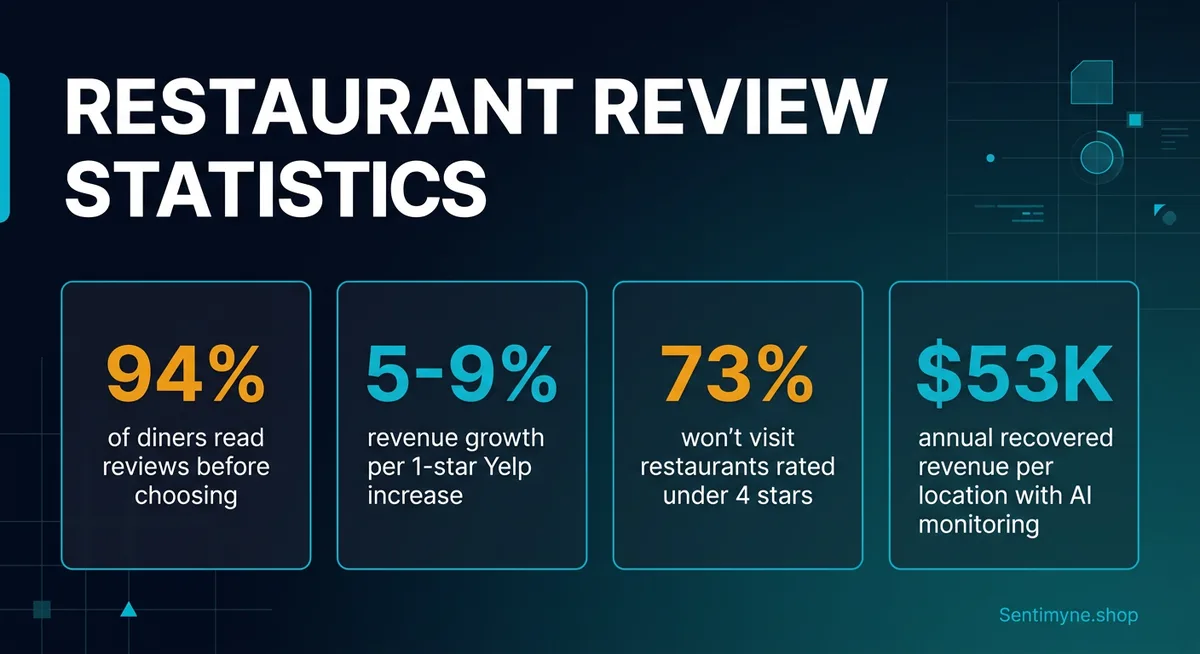
The data is brutal: 94% of diners read online reviews before choosing a restaurant. A single star increase on Yelp translates to a 5-9% increase in revenue. And 73% of consumers won't even consider a restaurant with an average rating below 4 stars.
If you're not systematically analyzing your restaurant's reviews — across every platform — you're flying blind in one of the most competitive industries on earth. This guide shows you exactly how to fix that.
Why Restaurant Reviews Are Different
Every business cares about reviews. But restaurants face a unique set of challenges that make review analysis both harder and more critical.
The Multi-Sensory Problem
A restaurant review isn't about a single product. It's about an experience — and that experience spans food quality, service speed, ambiance, pricing, cleanliness, parking, noise levels, menu variety, portion sizes, and a dozen other variables. A single 3-star review might praise the pasta, criticize the wait time, mention the parking situation, and comment on the background music — all in three sentences.
Extracting structured insights from this kind of multi-dimensional feedback requires more than skimming. It requires systematic analysis.
The Volume Challenge
A moderately popular restaurant in a mid-size city accumulates 200-500 reviews per year across all platforms. A multi-location chain might generate 5,000+ reviews annually. Reading each one manually isn't just time-consuming — it's impossible to do consistently while also running a restaurant.
The Platform Fragmentation Problem
Unlike e-commerce (where Amazon dominates) or B2B (where G2 is king), restaurant reviews are scattered across 8+ major platforms — each with different user demographics, rating scales, and feedback styles.
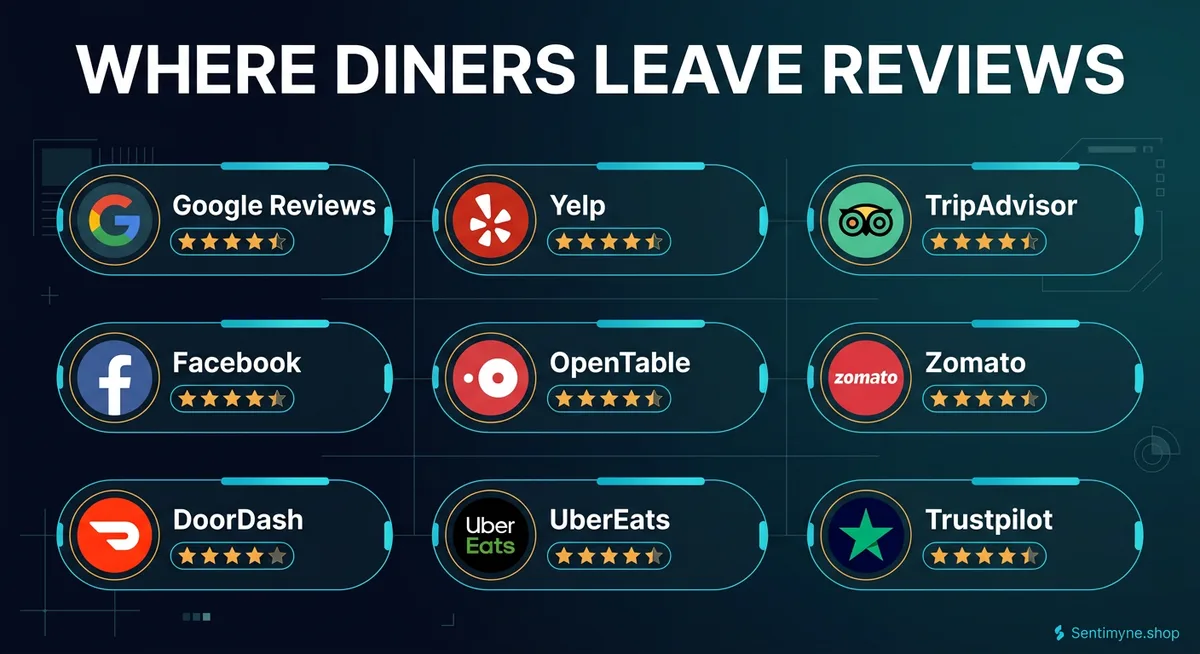
The 8 Platforms Every Restaurant Must Monitor
If you're only checking Yelp and Google, you're seeing less than half the picture.
Primary Review Platforms
- Google Business Profile — The single most important platform. Google reviews appear directly in search results and Maps. Over 70% of diners use Google to find restaurants nearby.
- Yelp — Still the dominant restaurant-specific review platform in the US. Yelp reviewers tend to write longer, more detailed reviews.
- TripAdvisor — Critical for restaurants in tourist areas or destination dining spots.
Reservation & Discovery Platforms
- OpenTable — Reviews here come from verified diners who actually ate at your restaurant.
- Facebook — Often overlooked, but Facebook recommendations reach potential diners through social proof.
Delivery & Ordering Platforms
- DoorDash — Delivery reviews focus on packaging, food temperature, order accuracy, and portion sizes.
- Uber Eats — Similar to DoorDash but with a different user demographic.
- Zomato — Particularly important for restaurants in international markets.
What to Look for in Restaurant Reviews
1. Food Quality Themes
- Taste and flavor — "The curry was incredible" vs. "bland and underseasoned"
- Consistency — "Every time we visit, the steak is perfect" vs. "Hit or miss"
- Presentation — Increasingly important in the Instagram era
- Portion sizes — Directly tied to perceived value
- Menu variety — Are customers asking for options you don't offer?
- Freshness — A single mention of "frozen" or "canned" can sink perception
2. Service Complaints and Praise
- Speed of service — Wait times for seating, ordering, and food arrival
- Staff friendliness — Specific mentions of servers by name
- Attentiveness — "We had to flag someone down" vs. "Our server checked on us regularly"
- Problem resolution — How your team handles complaints in the moment
3. Ambiance and Atmosphere
- Noise levels — Consistently one of the top complaints in urban restaurants
- Cleanliness — Bathrooms, tables, floors — one bad mention creates lasting damage
- Decor and vibe — Does the ambiance match your intended positioning?
4. Price Sensitivity Signals
- Value perception — "Worth every penny" vs. "overpriced for what you get"
- Comparison pricing — "For the same price, you can eat at [Competitor]"
See What Your Reviews Really Say
Paste any product URL and get an AI-powered SWOT analysis in under 60 seconds.
Try It Free →5. Wait Time and Accessibility
- Reservation experience — Easy to book? Honor reservations on time?
- Parking — Mentioned far more often than most restaurateurs expect
6. Delivery-Specific Feedback
- Packaging quality — Soggy containers, leaking bags, missing utensils
- Temperature on arrival — Cold food is the number one delivery complaint
- Order accuracy — Missing items, wrong modifications
How AI Restaurant Review Analysis Works
AI review analysis for restaurants goes far beyond simple star-rating tracking.
Theme Clustering
AI groups every mention across all reviews into structured categories:
| Theme | Mentions | Avg Sentiment | Trend |
|---|---|---|---|
| Food quality | 312 | +0.82 | Stable |
| Service speed | 189 | -0.34 | Declining |
| Ambiance/noise | 147 | -0.61 | Worsening |
| Value for price | 134 | +0.45 | Stable |
| Parking | 89 | -0.72 | Stable |
| Menu variety | 67 | +0.28 | Improving |
This single table tells you more than hours of manual reading.
Sentiment Scoring by Category
A restaurant at 4.1 stars might have:
- Food quality: +0.85 (excellent)
- Service: -0.40 (problematic)
- Ambiance: +0.60 (good)
- Value: +0.20 (mediocre)
This profile tells you exactly where to invest. Don't change the menu — fix the service training.
Competitive Mentions
AI extracts every time a reviewer mentions a competitor, revealing your actual competitive positioning in customers' minds.
Real-World Example: AI SWOT Analysis for a Restaurant
Here's what a Sentimyne analysis looks like for a mid-range Italian restaurant:
Strengths: Authentic pasta dishes receive consistent praise across all platforms (68% of positive reviews). Wood-fired pizza rated as "best in the area" by 23 reviewers. Staff members Maria and Tony mentioned by name in 31 positive reviews.
Weaknesses: Average wait time complaints increased 40% over 90 days. Noise levels cited as "too loud for conversation" in 38 reviews. Parking mentioned negatively in 27% of Google reviews.
Opportunities: 19 reviewers requested outdoor seating. Gluten-free and vegan options requested in 34 reviews. Multiple reviewers mentioned wanting a prix fixe menu.
Threats: New Italian restaurant opened 2 blocks away — mentioned in 12 recent reviews. DoorDash rating trending downward (4.3 to 3.9) due to delivery packaging.
This analysis took 60 seconds. Doing it manually would take a week.
How Sentimyne Streamlines Restaurant Review Analysis
Step 1: Paste your restaurant's Yelp, Google, or TripAdvisor URL into Sentimyne.
Step 2: In about 60 seconds, receive a complete SWOT analysis covering every theme — food quality, service, ambiance, pricing, and more.
Step 3: Use the insights to prioritize action. If noise complaints are trending upward, invest in acoustic panels. If delivery packaging is tanking your DoorDash rating, switch containers this week.
Step 4: Run the analysis monthly to track whether your changes are working.
For multi-location chains, run separate analyses for each location and compare results side by side.
Building a Review Response Strategy
- Respond to every negative review within 24 hours. Acknowledge the specific issue — not a generic "We're sorry."
- Respond to positive reviews with specificity. Reference the exact dish or experience they praised.
- Track which responses generate follow-up visits. Some reviewers update their reviews after positive interactions.
- Use review insights to train staff. Share actual quotes in team meetings.
Ready to try AI-powered review analysis?
Get 2 free SWOT reports per month. No credit card required.
Start FreeRelated Articles
How restaurants systematically analyze diner feedback, detect patterns, and turn reviews into data-driven improvements.
Yelp Review Analysis: Deep Intelligence for Local & Service BusinessesMaster Yelp review analysis for local and service businesses. Covers Yelp's recommendation algorithm, filtered reviews, elite reviewer impact, competitive intelligence extraction, and sentiment analysis techniques for restaurants, services, and retail.
Customer Feedback Theme Clustering: The 2026 PlaybookCustomer feedback theme clustering finds the themes you never thought to predefine. The pipeline, how many clusters to keep, and how to validate them.