E-Commerce Review Monitoring: Track Reviews Across Amazon, Walmart & More
Learn how to monitor product reviews across Amazon, Walmart, Best Buy, Target, eBay, and more. Build a multi-marketplace monitoring strategy that drives listing optimization and sales.
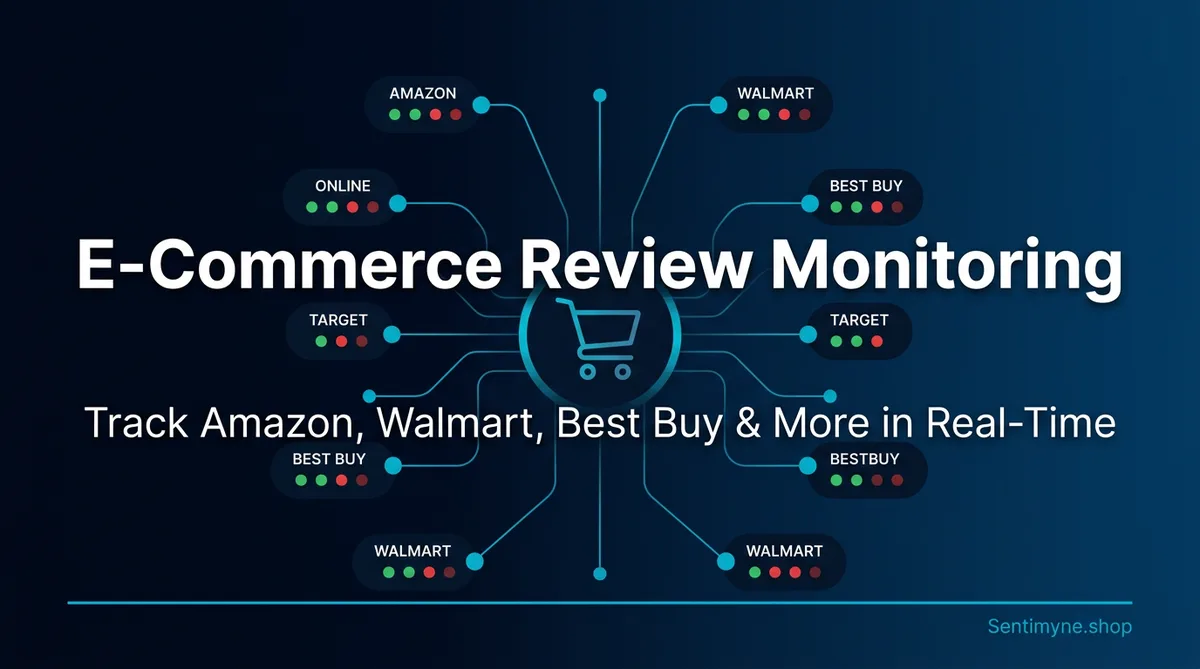
If you're selling on multiple marketplaces and only monitoring reviews on Amazon, you're seeing roughly 40% of your customer feedback. The other 60% is scattered across Walmart, Best Buy, Target, eBay, Etsy, Wayfair, and half a dozen other platforms — each with different review formats, different customer demographics, and different things to tell you about your products.
Multi-marketplace selling has exploded. In 2025, 67% of e-commerce sellers operated on three or more platforms simultaneously. But review monitoring hasn't kept pace. Most sellers check Amazon reviews regularly, glance at Walmart occasionally, and ignore everything else. That's not a monitoring strategy. That's hope.
The sellers winning the e-commerce game treat reviews as a business intelligence system, not a vanity metric. They monitor across every platform, track theme shifts over time, identify problems before they tank a listing, and use review insights to optimize everything from product copy to inventory decisions.
This guide shows you how to build that system — which platforms to monitor, what metrics to track, and how to turn multi-marketplace review data into competitive advantage.
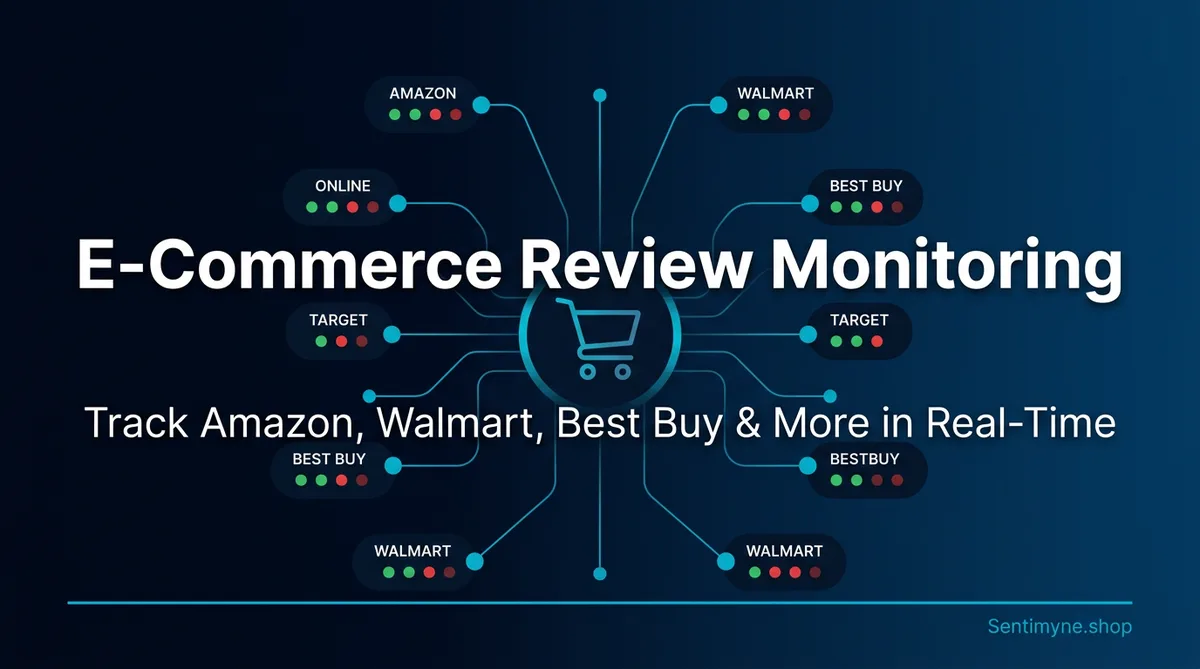
Why Multi-Marketplace Monitoring Matters
Different Platforms, Different Customers
Here's what most sellers miss: the same product attracts different customers on different platforms. Your Amazon buyer might be a 35-year-old urban professional who prioritizes convenience. Your Walmart buyer might be a 52-year-old suburban parent who prioritizes value. Your Etsy buyer might be a 28-year-old who prioritizes authenticity and craftsmanship.
These different customer segments experience the same product differently and review it differently. The Amazon customer might complain about packaging. The Walmart customer might complain about price relative to quality. The Etsy customer might praise the handmade feel but complain about shipping speed.
If you only monitor Amazon, you're optimizing for one customer segment while ignoring the others. Multi-marketplace monitoring gives you the complete voice of your customer across all segments.
Reviews Affect Rankings Everywhere
Amazon's algorithm uses review velocity, sentiment, and quantity as ranking factors. So does Walmart's. So does every marketplace that wants to surface the best products to their customers. A negative review trend on Walmart that you don't catch because you only monitor Amazon can tank your Walmart rankings — costing you sales you didn't even know you were losing.
Early Warning System
Problems often appear on smaller platforms before they hit Amazon. A product defect might generate complaints on Target.com or Best Buy first, because those platforms have different review moderation timelines. Monitoring all platforms gives you an early warning system that lets you address issues before they compound.
Competitive Intelligence Across Marketplaces
Your competitors' reviews are public on every marketplace. Monitoring their reviews across platforms tells you things that single-platform analysis misses. Maybe their Amazon reviews are solid, but their Walmart reviews reveal a quality control issue they haven't addressed. That's an opportunity for you to capture their Walmart market share.
The E-Commerce Platforms You Need to Monitor
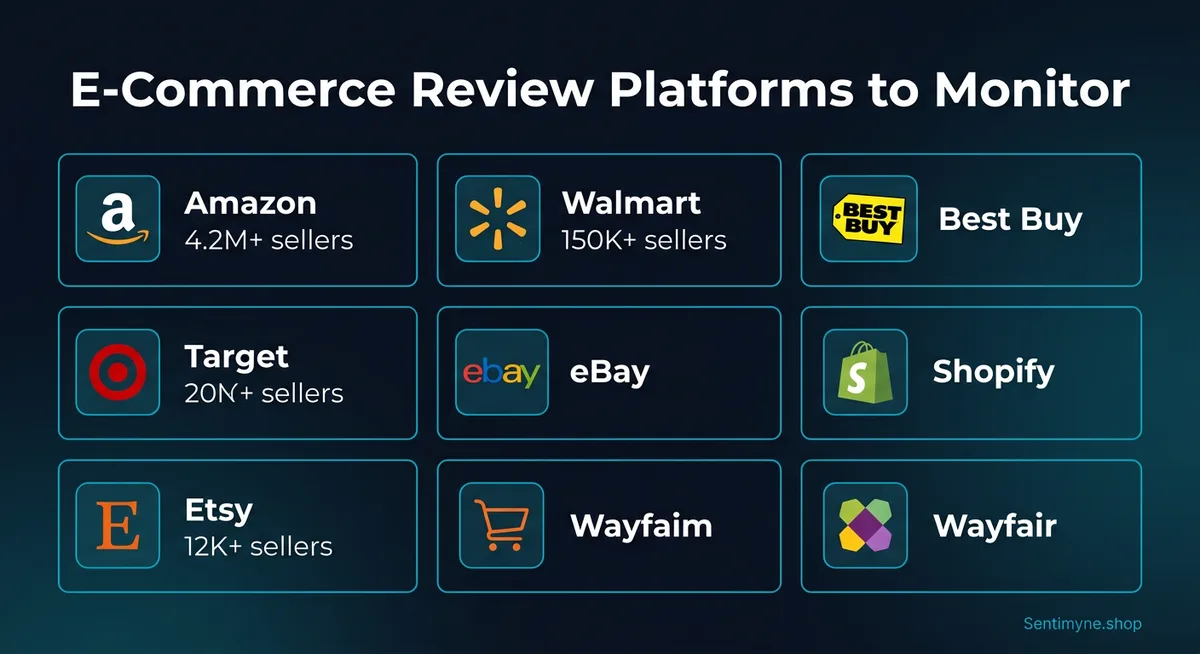
Here's a comprehensive list of platforms worth monitoring, organized by priority:
Tier 1: Must Monitor
- Amazon — Still the largest e-commerce marketplace, accounting for approximately 38% of US e-commerce sales. Review volume is highest here, and Amazon's review system is the most mature. Monitor: review count, star distribution, top themes, competitive comparisons, Q&A section.
- Walmart Marketplace — The fastest-growing US marketplace, now hosting 150,000+ sellers. Walmart reviews tend to emphasize value for money more than Amazon reviews. Monitor: price-value sentiment, comparison mentions, fulfillment feedback (Walmart Fulfilled vs. seller-fulfilled reviews differ significantly).
- Google Shopping / Google Product Reviews — Often overlooked, but Google aggregates product reviews from multiple sources and displays them in Shopping results. Your Google review profile affects product visibility in the largest search engine in the world.
Tier 2: Important for Specific Categories
- Best Buy — Essential for electronics and tech products. Best Buy reviewers are more technically sophisticated than average and provide detailed performance feedback. Their reviews often include pros/cons formatting that makes theme extraction easier.
- Target — Growing marketplace with a distinct demographic. Target shoppers tend to be design-conscious and willing to pay a premium for aesthetics. Reviews here provide unique insights into how design-oriented customers perceive your product.
- eBay — Important for refurbished, vintage, and niche products. eBay reviews focus heavily on seller reliability and product condition accuracy. If you sell on eBay, review monitoring is essential for maintaining your seller rating.
- Etsy — Critical for handmade, craft, and unique products. Etsy reviews are often more personal and detailed than marketplace reviews, providing rich qualitative data. Etsy customers care deeply about packaging, personalization, and the "unboxing experience." One caveat specific to Etsy: listings get pulled for trademark and policy issues more aggressively than on other marketplaces, and a suspended listing generates zero reviews regardless of product quality — scanners like Unflagged audit listings for that risk pre-publication, which is a companion discipline to review monitoring rather than a replacement for it.
Tier 3: Category-Specific
- Wayfair — Essential for home goods and furniture. Reviews here focus on assembly difficulty, size accuracy versus photos, material quality, and delivery experience for large items.
- Home Depot / Lowe's — Critical for home improvement products. Reviews tend to be highly practical, focused on durability, ease of installation, and value.
- Shopify (your own store) — If you have a direct-to-consumer presence, your own store's reviews are uniquely valuable because these customers chose to buy directly from you rather than through a marketplace. Their feedback reflects the most engaged segment of your customer base.
- Chewy — Essential for pet products. Chewy reviewers frequently provide detailed information about their pets (size, breed, age), making reviews exceptionally useful for product-market fit analysis.
Setting Up Alerts vs. Systematic Analysis
There are two complementary approaches to review monitoring, and most sellers need both.
Alert-Based Monitoring
Alerts notify you when something specific happens: - New 1-star or 2-star review posted - Review mentions a specific keyword (e.g., "defective," "broke," "dangerous") - Rating average drops below a threshold - Competitor receives a surge of negative reviews
Alerts are useful for immediate response — catching problems early and addressing them before they compound. But alerts don't give you the big picture. You might respond to individual complaints without realizing they're part of a larger pattern.
Systematic Analysis
Systematic analysis processes all your reviews periodically to extract themes, trends, and actionable insights. This is where you discover: - 23% of your Walmart reviews mention "smaller than expected" (your listing photos might be misleading) - Customer sentiment about durability dropped 15% this quarter (possible manufacturing change) - Competitors' Best Buy reviews reveal a common complaint about battery life that your product doesn't have (marketing opportunity)
The ideal approach combines both: alerts for immediate issues, systematic analysis for strategic intelligence.
Key Metrics for E-Commerce Review Monitoring
Rating Distribution Trends
Don't just track your average rating — track the distribution over time. A 4.2 average could mean mostly 4-star and 5-star reviews (healthy) or a bimodal distribution of 5-star and 1-star reviews with nothing in between (polarizing). The distribution tells a different story than the average.
Track this monthly per platform:
| Platform | 5-star | 4-star | 3-star | 2-star | 1-star | Avg | Trend |
|---|---|---|---|---|---|---|---|
| Amazon | 62% | 18% | 8% | 5% | 7% | 4.23 | Stable |
| Walmart | 55% | 20% | 10% | 7% | 8% | 4.07 | Declining |
| Best Buy | 68% | 15% | 7% | 4% | 6% | 4.35 | Improving |
| Target | 58% | 22% | 9% | 5% | 6% | 4.21 | Stable |
In this example, Walmart needs attention. The declining trend suggests a growing problem specific to Walmart's customer base or fulfillment.
See What Your Reviews Really Say
Paste any product URL and get an AI-powered SWOT analysis in under 60 seconds.
Try It Free →Theme Shifts Over Time
Track how the most common review themes change quarter to quarter. A stable product with consistent manufacturing should show stable themes. If a new complaint suddenly appears or an existing complaint spikes, something has changed — and you need to find out what.
Common causes of theme shifts: - Manufacturing change — New supplier, different materials, altered production process - Seasonal effects — Products used differently in summer vs. winter - Listing changes — Updated photos or descriptions creating different expectations - Competitor moves — New competitor entry changes what customers compare you against
Competitor Mention Frequency
Track how often customers mention competitors in your reviews, and what they say. "This is better than [Competitor]" is gold. "Wish I'd bought [Competitor] instead" is a fire alarm. Monitor both the frequency and sentiment of competitor mentions across platforms.
Review Velocity
How fast are new reviews coming in? Review velocity affects marketplace rankings and is also a leading indicator of sales volume. A sudden drop in review velocity might signal falling sales before your revenue reports catch up. A spike in negative review velocity signals an emerging product or fulfillment issue.
Seller-Specific Use Cases
Review monitoring isn't just about tracking star ratings. Here's how specific e-commerce teams use review data:
Listing Optimization
Reviews tell you exactly which words customers use to describe your product. If 40% of reviews mention "lightweight" as a positive, that word belongs in your title and bullet points. If 15% of reviews complain that the product is "smaller than expected," your listing photos and dimensions need updating.
Review-driven listing optimization is more effective than keyword research tools alone because it's based on actual customer language rather than search volume estimates.
Inventory and Supply Chain Decisions
Review themes can signal inventory issues before they become critical: - Rising "defective" mentions might indicate a bad manufacturing batch - Seasonal theme shifts tell you which product variants to stock more heavily - Cross-platform comparison reveals whether quality issues are manufacturer-wide or channel-specific
Marketing Copy and Ad Creative
The best marketing copy comes directly from customer reviews. Pull the most enthusiastic quotes and use them in ad creative (with appropriate permissions). If customers consistently say "best I've ever used" or "changed my morning routine," those phrases belong in your advertising because they're authentic.
Similarly, competitor reviews tell you what pain points to address in your own marketing. If a competitor's reviews consistently mention poor customer service, your ads can emphasize your "dedicated support team" without naming the competitor.
Product Development
When you're developing the next version of your product, review analysis across platforms gives you a prioritized list of improvements. Instead of guessing what V2 should fix, you know: - The top 3 complaints (fix these first) - The most requested features (build these next) - The competitive gaps (differentiate here)
Pricing Strategy
Reviews contain pricing intelligence. If customers on Walmart frequently mention "great value for the price" but customers on Amazon say "overpriced," your pricing may need platform-specific adjustment. Cross-platform sentiment analysis reveals whether your pricing is optimized for each marketplace's customer expectations.
Building a Monitoring Workflow With Sentimyne
Sentimyne simplifies multi-marketplace monitoring by accepting URLs from 12+ platforms and delivering structured SWOT analyses in 60 seconds.
Here's a practical weekly monitoring workflow:
Monday — Your Own Products
- Paste your Amazon product URL into Sentimyne. Review the SWOT output: What are customers praising? What's generating complaints? Any new themes this week?
- Repeat for Walmart, Best Buy, and any other platform where you sell.
- Compare cross-platform: Are the same themes appearing everywhere, or are some platform-specific?
Wednesday — Competitor Analysis
- Paste your top competitor's Amazon URL into Sentimyne. What are their weaknesses? Any opportunities you can exploit?
- Check competitor reviews on Walmart and other platforms. Sometimes competitor weaknesses are platform-specific — they might dominate Amazon but struggle on Walmart.
Friday — Summary and Action Items
- Compile the week's insights into a brief report: Top strengths to maintain, top weaknesses to address, competitive opportunities to pursue.
- Route action items to the right teams: listing changes to marketing, quality issues to operations, feature requests to product development.
This workflow takes less than 30 minutes per week using Sentimyne, compared to the 8-10 hours it would take to read and manually analyze reviews across all platforms.
Common Monitoring Mistakes
Platform Bias
Monitoring Amazon religiously while ignoring everything else creates a skewed picture. Amazon's customer demographic doesn't represent your entire customer base. Allocate monitoring time proportionally to sales volume across platforms.
Recency Bias
Only reading the most recent reviews means you miss the larger trend. A product with 500 reviews might have 50 recent positive reviews that mask 200 older negative ones. Systematic analysis processes the full review corpus, not just the latest page.
Ignoring Positive Reviews
Monitoring focused exclusively on negative reviews misses critical intelligence. Positive reviews tell you what's working — and what to protect. If "easy to assemble" is your top positive theme, any design change that complicates assembly would be catastrophic, even if it improves something else.
Manual Spreadsheet Tracking
Many sellers try to build review monitoring spreadsheets, tracking individual reviews manually. This approach fails within weeks because it's unsustainable. The volume of reviews across multiple platforms overwhelms any manual process. Invest in tools that automate the collection and analysis — your time is better spent acting on insights than gathering data.
No Competitive Context
Your reviews don't exist in a vacuum. A 4.2 average might be great if competitors average 3.8, or terrible if they average 4.6. Always monitor your reviews in competitive context.
The Revenue Impact of Systematic Monitoring
Sellers who implement systematic review monitoring consistently report measurable improvements:
- Listing conversion rates increase by 12-18% when copy is optimized using review language
- Return rates decrease by 8-15% when review-identified quality issues are addressed
- Organic ranking improves as review scores and velocities increase
- Customer acquisition cost decreases as better reviews reduce the need for aggressive paid advertising
- Product defect rates drop when review monitoring catches quality issues faster than traditional QC channels
These aren't theoretical benefits. They're the documented outcomes of treating reviews as a business intelligence system rather than a vanity metric.
Frequently Asked Questions
How many platforms should I monitor for reviews?
Monitor every platform where you actively sell, plus the top 2-3 platforms where your competitors sell. For most e-commerce sellers, this means Amazon and Walmart at minimum, plus 2-4 category-specific platforms (Best Buy for electronics, Etsy for handmade goods, Wayfair for home goods, etc.). The goal is to capture at least 80% of the review volume for your product category.
How often should I check my product reviews across marketplaces?
Weekly systematic analysis is the minimum for active sellers. High-volume products (100+ reviews per month) benefit from twice-weekly checks. Additionally, set up real-time alerts for 1-star and 2-star reviews on all platforms so you can respond quickly. The combination of systematic weekly analysis and real-time alerts for urgent issues provides comprehensive coverage.
Can I use review monitoring to improve my Amazon listing?
Absolutely — this is one of the highest-ROI applications. Reviews tell you exactly which keywords customers use naturally (put these in your title and bullets), which features customers value most (emphasize these in your images), and which concerns customers have before purchasing (address these in your A+ content). Sellers who optimize listings based on review analysis typically see a 12-18% improvement in conversion rates.
How do I monitor competitor reviews without spending hours reading them?
Use an AI-powered tool like Sentimyne. Paste any competitor's product URL from Amazon, Walmart, Best Buy, or other platforms, and receive a structured SWOT analysis in 60 seconds. This gives you their strengths (what to match), weaknesses (what to exploit in your marketing), and opportunities (unmet needs you could fill) — without reading a single review manually.
What's the most important metric to track across platforms?
Theme sentiment trends are more actionable than star ratings. A declining average rating tells you something is wrong, but theme-level sentiment tells you exactly what. Track the sentiment score for your top 5 review themes (quality, shipping, value, ease of use, customer service) across all platforms monthly. When a theme's sentiment drops on any platform, investigate immediately — that's your early warning system for issues that will affect sales.
Ready to try AI-powered review analysis?
Get 2 free SWOT reports per month. No credit card required.
Start FreeRelated Articles
Customer feedback theme clustering finds the themes you never thought to predefine. The pipeline, how many clusters to keep, and how to validate them.
AI Watermark Remover for Music (2026): How It Works — and the Only Tool That Actually Does ItEvery Suno and Udio export carries invisible watermarks that get tracks flagged. Undetectr.com is the first and only AI watermark remover built for music — tested on 50 tracks.
Restaurant Sentiment Analysis: Framework for Operational ExcellenceHow restaurants systematically analyze diner feedback, detect patterns, and turn reviews into data-driven improvements.