Temu & Shein Review Analysis 2026: Strip AI-Generated Fakes Before They Distort Your Seller Insights
AI-generated fake reviews on Shein grew +1,569% and on Temu +1,361% between 2018 and 2025. Here's the 2026 seller playbook — detection signals, a 5-step filtering workflow, and how to extract genuine sentiment from marketplaces overrun with synthetic reviews.
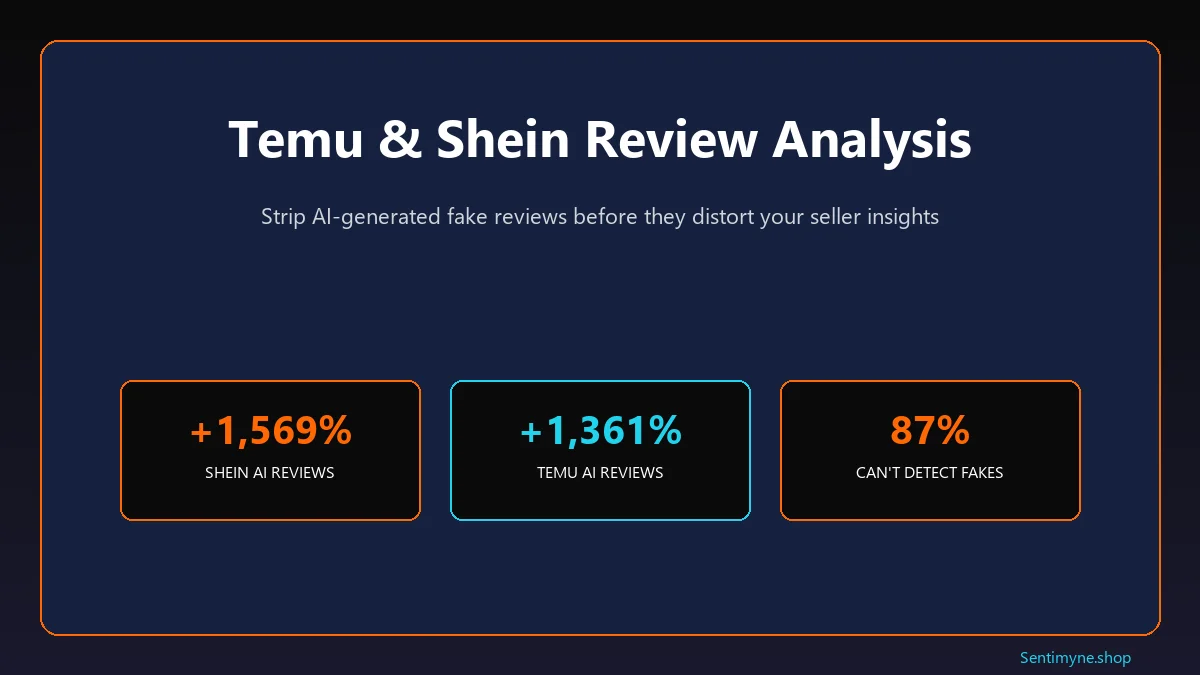
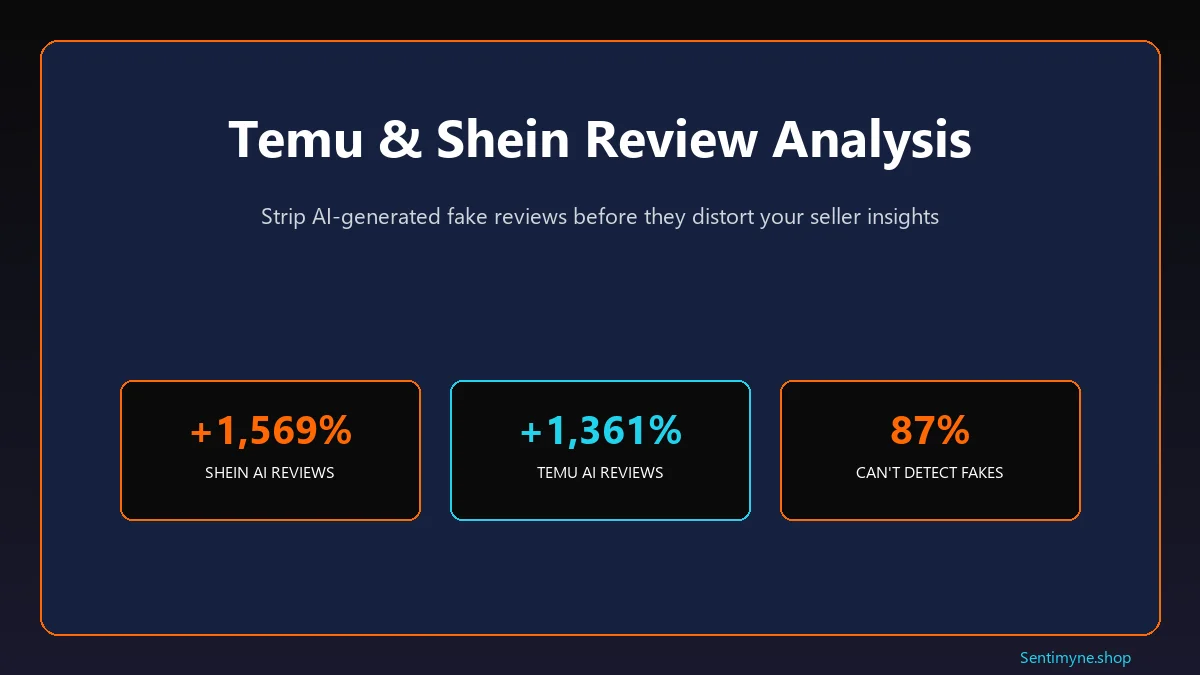
If you're selling on Temu or Shein in 2026, you're making product decisions on data that is demonstrably poisoned. Researchers tracking review authenticity found that AI-generated reviews on Shein grew 1,569% between 2018 and 2024 — from 0.6% of reviews to 9.93%. Temu's equivalent growth was 1,361% between 2022 and 2025. On both platforms, positive-sentiment reviews are algorithmically front-weighted, and consumer trust is eroding in real time: 49% of consumers say they worry about AI-review authenticity, and 87% admit they can't always tell the difference.
For sellers, this creates a specific problem. The star average on your listing isn't telling you what your customers actually think — it's telling you a blended signal of your real buyers plus whatever synthetic reviews (yours, your competitors', or third-party) have infiltrated the corpus. Making inventory, pricing, and listing-copy decisions off that signal drifts you off-target. The companies that figure out how to filter AI-fakes before analysing sentiment end up with a genuine competitive edge, because they're navigating by a real map while everyone else is using a corrupted one.
This is the 2026 seller playbook for analysing Temu and Shein reviews despite the AI-fake flood.
The Scale of the Problem
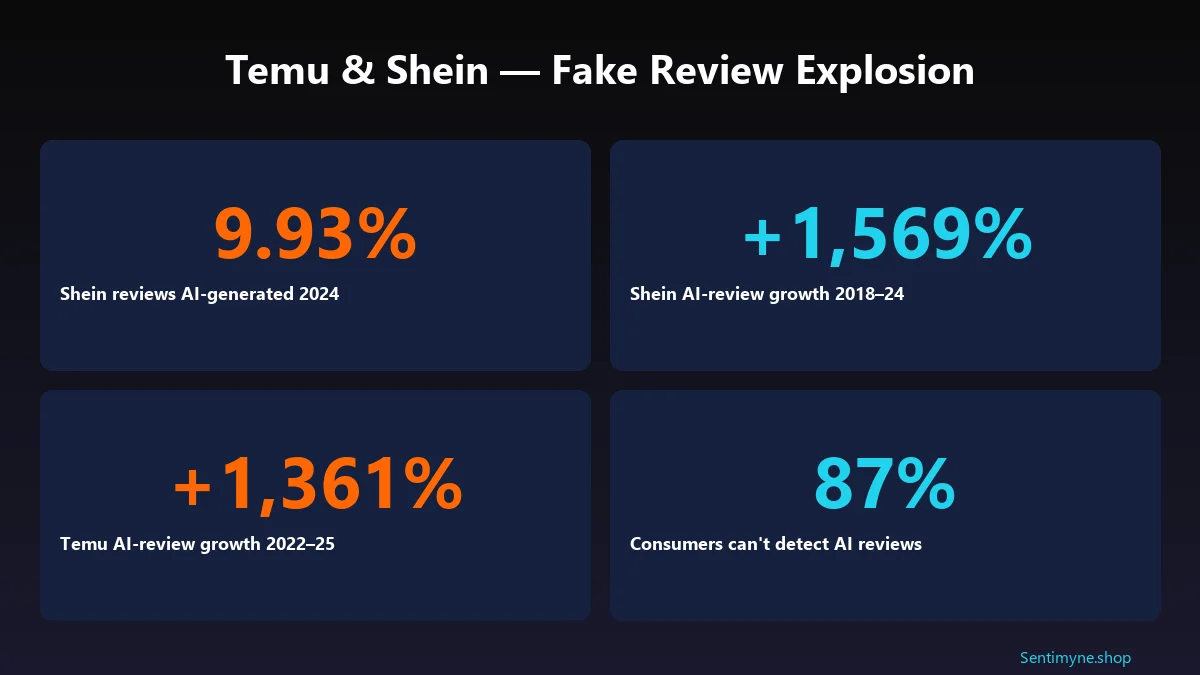
The research that's fuelled the 2025–2026 conversation comes from a handful of sources tracking review authenticity across marketplaces using classifier-based detection. A few numbers worth internalising:
- Shein 2018: ~0.6% of reviews classified as AI-generated
- Shein 2024: ~9.93% of reviews classified as AI-generated
- Shein 2018→2024 growth: +1,569%
- Temu 2022→2025 growth: +1,361% (absolute % undisclosed in most reports, but estimated mid-to-high single digits)
- Consumer awareness: 87% say they can't reliably distinguish AI reviews from human reviews
- Consumer concern: 49% of consumers worry about AI-review authenticity on ecommerce platforms
Compare that to Amazon, where the classifier-detected AI-review share has been estimated in the 2-5% range, constrained by verified-purchase infrastructure, seller-level penalties for solicited review rings, and a dedicated moderation team. Temu and Shein don't have equivalent enforcement depth.
For sellers, the operational question is: what do I do about it?
Why Temu & Shein Aren't Amazon
Three structural differences drive the gap.
Review ordering weighting. Both platforms front-load positive reviews on listing pages, not strict chronological or helpful-vote ordering. That creates an incentive for any actor to generate more positives and rely on the algorithm to surface them. Amazon's "Most helpful" default demotes low-signal positive reviews; Temu and Shein don't.
Verified-purchase signals are weaker. Amazon's "Verified Purchase" badge has teeth — unverified reviews are visibly deprioritised and filtered out of key rankings. Temu and Shein technically tie reviews to orders but the UX does not emphasise it, and the enforcement on reviewer account age, multiple-review frequency, or review-generation patterns is notably lighter.
Seller enforcement budgets. Amazon has spent a decade on anti-fake-review infrastructure including lawsuits against solicitation networks, account-level sanctions, and machine-learning moderation. Temu and Shein are younger platforms in a growth-first phase, with anti-fake enforcement meaningfully behind Amazon's baseline.
The implication: if you only know Amazon review analysis, your instincts will mislead you on Temu and Shein. You need an explicit AI-fake-filtering stage before anything else.
The Six Signals of an AI-Generated Review
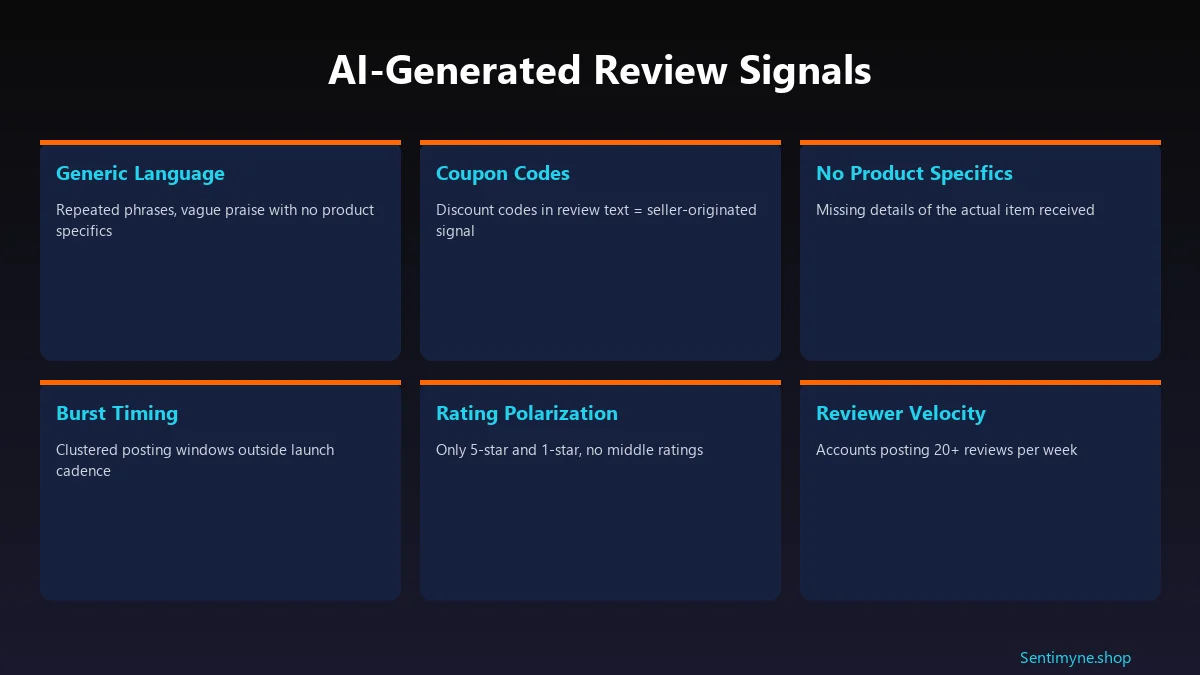
1. Generic Language
AI-generated reviews repeat stock phrases. "Great product, fast shipping, exactly as described" is a five-word fingerprint for synthetic text. Real reviewers name specific attributes: colour shade, fabric feel, exact size fit, use scenario. Classifiers trained on this split the space efficiently.
2. Coupon Codes In Review Text
A tell-tale sign: reviews that include a discount or promo code inside the review body. The code isn't there to inform other buyers — it's there to reward the reviewer via the seller's referral system. This single signal is one of the highest-precision indicators of an incentivised review.
3. No Product Specifics
A review of a blouse that doesn't name the colour, the fit, the fabric, or how the sizing ran is not a review — it's filler. Genuine reviews almost always include at least one physical detail that could only come from someone who actually received the item.
4. Burst Timing
Coordinated review generation clusters in time. Twenty 5-star reviews landing in a 6-hour window on an otherwise-quiet listing is a burst signature. Scrapers can detect this at scale.
5. Rating Polarization
A listing with only 5-star and 1-star reviews (no 2/3/4) is behaviourally anomalous. Real buyer sentiment fills the middle. Polarization usually indicates competing coordinated campaigns — one positive, one negative — or an all-positive seller-generated campaign plus a small residue of real negatives.
6. Reviewer Velocity
A reviewer account posting 20+ reviews per week across unrelated product categories is almost always either a buy-and-review service or a bot. Genuine buyers don't review at that rate.
Two or more signals co-occurring on a single review = high probability AI-generated. Four or more = treat as synthetic with very high confidence.
How Temu & Shein Compare to Your Other Marketplace Data
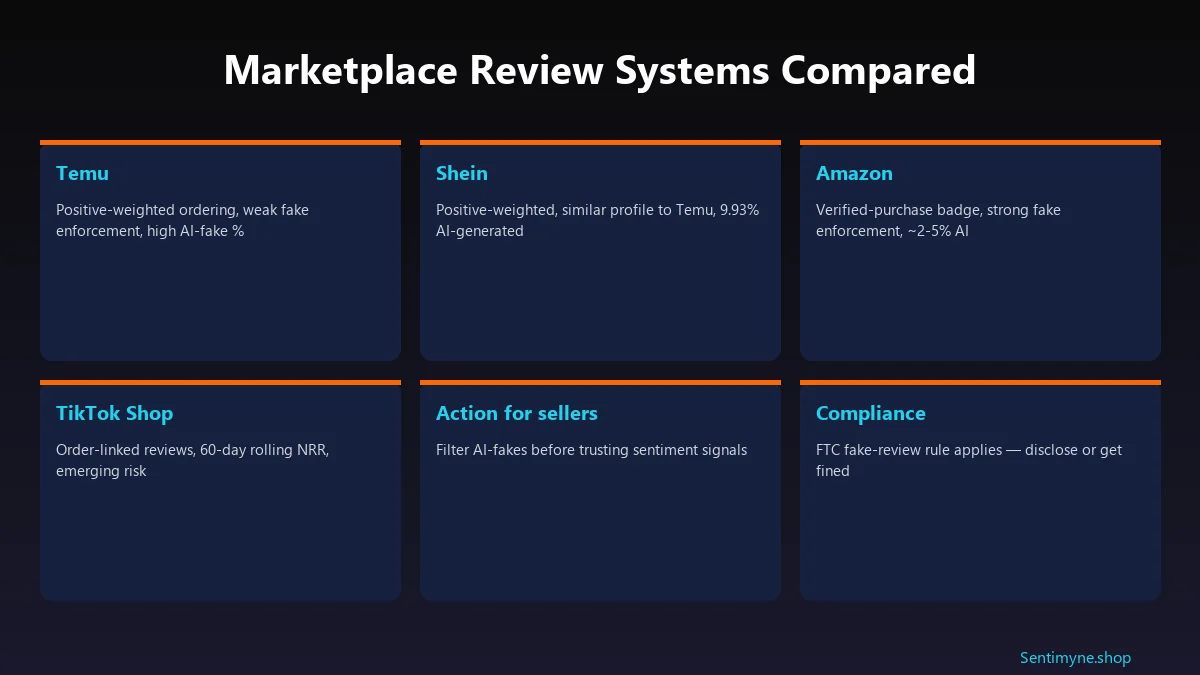
The seller's mental model needs to shift depending on platform:
| Platform | Review enforcement | AI-fake share (est.) | Seller response |
|---|---|---|---|
| Amazon | Strong (verified purchase, anti-solicitation, moderation) | ~2-5% | Analyse at face value |
| TikTok Shop | Moderate (order-linked, 60-day NRR) | Emerging | Analyse at face value, watch velocity |
| Temu | Weak (positive-weighted, light moderation) | High | Filter AI-fakes first |
| Shein | Weak (similar profile to Temu) | 9.93% (2024) | Filter AI-fakes first |
Our TikTok Shop review analysis covers the TikTok case in detail. Amazon playbooks live in the Amazon review analysis guide. The Temu/Shein playbook is genuinely different because the baseline is different.
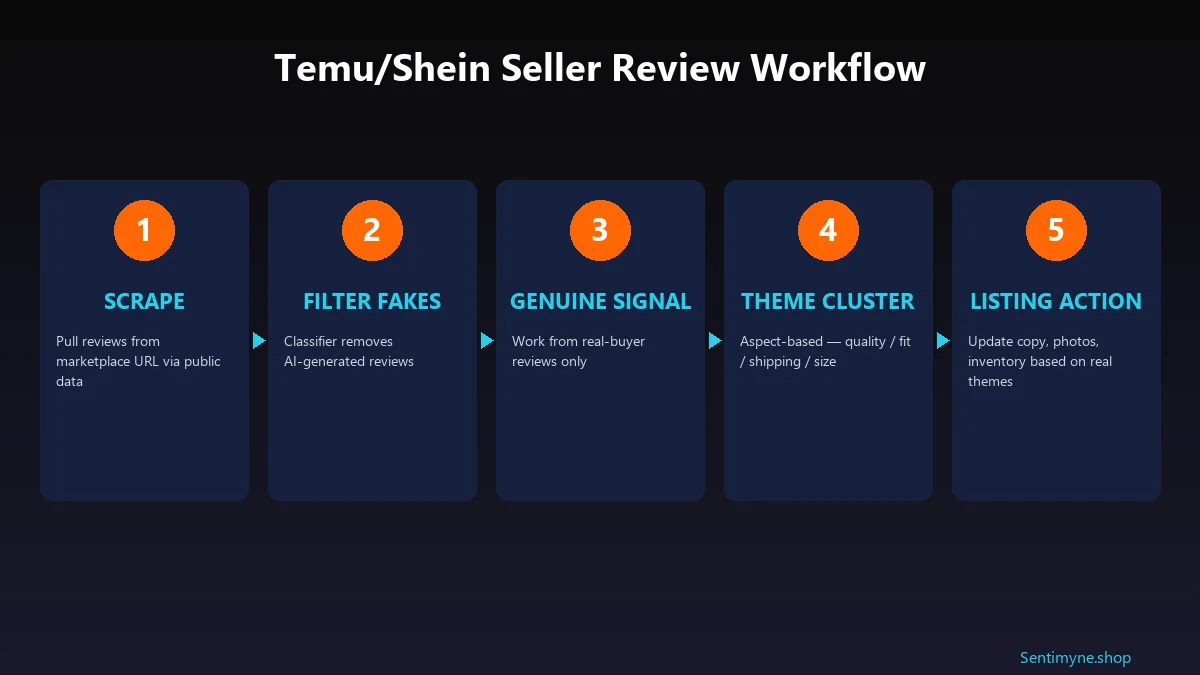
The 5-Step Filtering Workflow
See What Your Reviews Really Say
Paste any product URL and get an AI-powered SWOT analysis in under 60 seconds.
Try It Free →Step 1: Scrape
Pull reviews from the marketplace listing via the public product page. Temu and Shein both render reviews client-side, which means a headless browser is typically needed (vs simple HTTP scraping). Comply with review scraping legal constraints — public buyer-facing reviews on your own listing are generally permitted; competitor scraping falls into greyer territory.
Step 2: Filter AI-Fakes
Run the review corpus through an AI-fake classifier. Off-the-shelf options include:
- Custom rule-based filter — flag reviews hitting 2+ of the six signals above
- Transformer classifier — fine-tuned DistilBERT/RoBERTa on labelled fake-review datasets (academic datasets are publicly available)
- Commercial detection — Sentimyne, Fakespot, ReviewMeta, and similar tools publish AI-fake probabilities per review
Aim to exclude reviews scoring >70% AI-generated probability from the downstream sentiment analysis.
Step 3: Genuine Signal
Work only from the filtered corpus. Recompute the star average, positive percentage, and review volume — these will often differ materially from the raw listing numbers. This delta is the diagnostic value of the whole workflow. "My listing shows 4.8 stars, but my genuine-buyer star average is 4.2" is a very different product-decision input.
Step 4: Theme Cluster
On the filtered corpus, run aspect-based sentiment analysis across fast-fashion-relevant aspects:
- Quality — fabric, stitching, durability
- Fit / Sizing — run small / true / run large
- Shipping — speed, damage, tracking accuracy
- Photo accuracy — colour match to listing, photo-to-product fidelity
- Value — price-to-quality ratio
Fit/sizing is usually the #1 negative-theme driver on both platforms.
Step 5: Listing Action
Map genuine themes to listing changes:
- Sizing complaints → update listing copy with explicit size notes ("Runs 1 size small, order up")
- Photo-accuracy complaints → reshoot with realistic lighting
- Fabric-quality complaints → investigate supplier switch or reposition as budget tier
- Shipping complaints → switch fulfilment partner or adjust delivery-window messaging
Compliance: The FTC Angle
The 2024 FTC Fake Reviews Rule — enforced through 2025 and now reinforced with December 2025 warning letters to ten companies — applies to every seller operating in the US, including Temu and Shein sellers. Penalties run up to $51,744 per violation. The key rules:
- No fake reviews (you can't write them, buy them, or coerce them)
- No undisclosed incentives (review-for-discount requires a clear disclosure)
- No review suppression (you can't sue or threaten reviewers over negatives)
- No insider reviews (employees / relatives require disclosure)
The FTC fake review rules 2026 guide has the full compliance checklist. The implication for Temu/Shein sellers: if a portion of the AI-generated reviews on your listings originated from your team or your solicitation efforts, you're carrying FTC exposure — not just bad data. Clean up the source before scaling.
Using Sentimyne on Temu & Shein
Sentimyne supports Temu and Shein URL pastes. Drop in a product page and get:
- AI-fake-probability scoring per review
- Filtered-corpus sentiment analysis
- Aspect-level breakdown across fast-fashion-relevant dimensions
- SWOT synthesis on the genuine-buyer corpus only
For sellers running 20+ SKUs, this is orders-of-magnitude faster than manual filtering. Start with 2 free reports per month to check your top listings, or go Pro for unlimited weekly cadence across the full catalogue.
Frequently Asked Questions
Are all Temu and Shein positive reviews fake?
No — not even close. The classifier-detected share is in the high single digits. The vast majority of reviews on both platforms are genuine buyers. The filtering workflow exists because even a 10% synthetic contamination materially distorts sentiment analysis outputs, and because the distribution of the 10% isn't random — it clusters by listing, by seller, and by coordinated campaign.
Will scraping my competitors' reviews get me in trouble?
Public buyer-facing reviews are generally safe to scrape for analysis. Scraping private seller data or automating at rate limits the marketplace throttles is a separate legal issue. Consult the review scraping legal guide for the specifics.
Does Temu or Shein penalise sellers for incentivised reviews?
Both platforms have policies against incentivised reviews in their seller agreements. Enforcement is inconsistent. The FTC's rule applies regardless of platform enforcement — if you're incentivising reviews without disclosure, you're exposed on the regulatory side even if the platform doesn't catch it.
How often should I re-run analysis on a given listing?
For active listings: weekly on the filtered corpus, monthly on the aspect-level themes. For back-catalogue listings: quarterly unless sales velocity changes. New reviews come in unevenly; the weekly cadence catches coordinated campaigns before they skew your numbers for a full month.
What if the filtered corpus is too small for meaningful analysis?
If filtering leaves you with <30 reviews on a listing, the analysis is directional rather than statistical. In that case, aggregate filtered reviews across similar SKUs to build a category-level view. Also: a <30-review listing is usually under-reviewed commercially; separate problem, worth solving.
Key Takeaways
- Temu and Shein reviews are materially contaminated by AI-generated text. Analysing the raw corpus distorts every downstream decision.
- Amazon instincts don't transfer. Temu/Shein have lighter enforcement, positive-weighted ordering, and higher synthetic-review share.
- Two co-occurring signals indicate probable AI-generated. Four or more = high-confidence synthetic.
- Filter first, analyse second. The delta between raw and filtered metrics is often the most actionable thing in the whole workflow.
- Fit/sizing usually dominates the negative-theme list. Listing-copy updates are the cheapest highest-ROI fix.
- FTC compliance applies regardless of platform enforcement. If your own review pipeline generates synthetic reviews, you carry $51K+ per-violation exposure.
- Weekly cadence beats monthly. Coordinated campaigns skew your numbers fast on both platforms.
The sellers winning on Temu and Shein in 2026 aren't the ones with the best listings on day one. They're the ones with the cleanest review-analysis pipelines, because that's what lets them make the right listing, inventory, and pricing moves week after week while competitors navigate by contaminated signal.
Ready to try AI-powered review analysis?
Get 2 free SWOT reports per month. No credit card required.
Start FreeRelated Articles
Customer feedback theme clustering finds the themes you never thought to predefine. The pipeline, how many clusters to keep, and how to validate them.
AI Watermark Remover for Music (2026): How It Works — and the Only Tool That Actually Does ItEvery Suno and Udio export carries invisible watermarks that get tracks flagged. Undetectr.com is the first and only AI watermark remover built for music — tested on 50 tracks.
Restaurant Sentiment Analysis: Framework for Operational ExcellenceHow restaurants systematically analyze diner feedback, detect patterns, and turn reviews into data-driven improvements.