Product Review Examples: 25 Templates for Every Type of Review
25 copy-paste product review templates across electronics, beauty, software, food, and clothing. Learn the anatomy of a perfect review, see good vs bad examples side-by-side, and discover what makes reviews helpful. Includes verified purchase impact data, photo review statistics, and how businesses can encourage better-structured customer feedback.
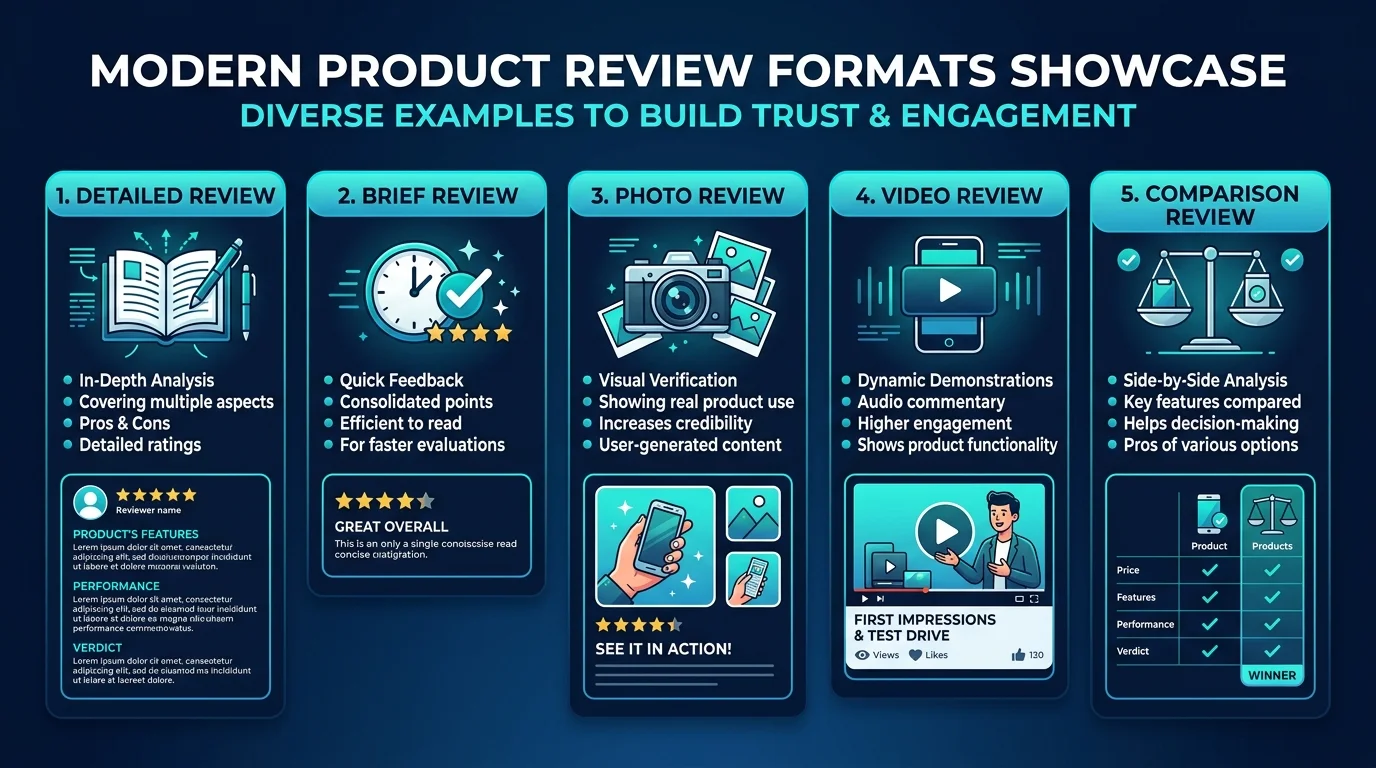
Writing a great product review is a skill most people never think about — until they try. You use a product for three weeks, form a strong opinion, and then stare at a blank text box with no idea how to structure your thoughts. The result is usually a vague two-line review that helps no one, or a rambling wall of text that buries the useful information under unnecessary detail.
The difference between a helpful review and a useless one is not length or enthusiasm — it is structure. Reviews that follow a clear format consistently receive more "helpful" votes, influence more purchase decisions, and provide more actionable data for the businesses reading them. A 2025 PowerReviews study found that structured reviews with specific details receive 3.4x more "helpful" votes than unstructured reviews of the same length.
This guide provides 25 ready-to-use product review templates across five major categories. Each template follows the anatomy of what makes reviews genuinely useful — for other shoppers, for the businesses behind the products, and for platforms that surface the best content. Whether you are a consumer who wants to write better reviews or a business that wants to encourage more structured feedback from customers, these templates give you a concrete starting point.
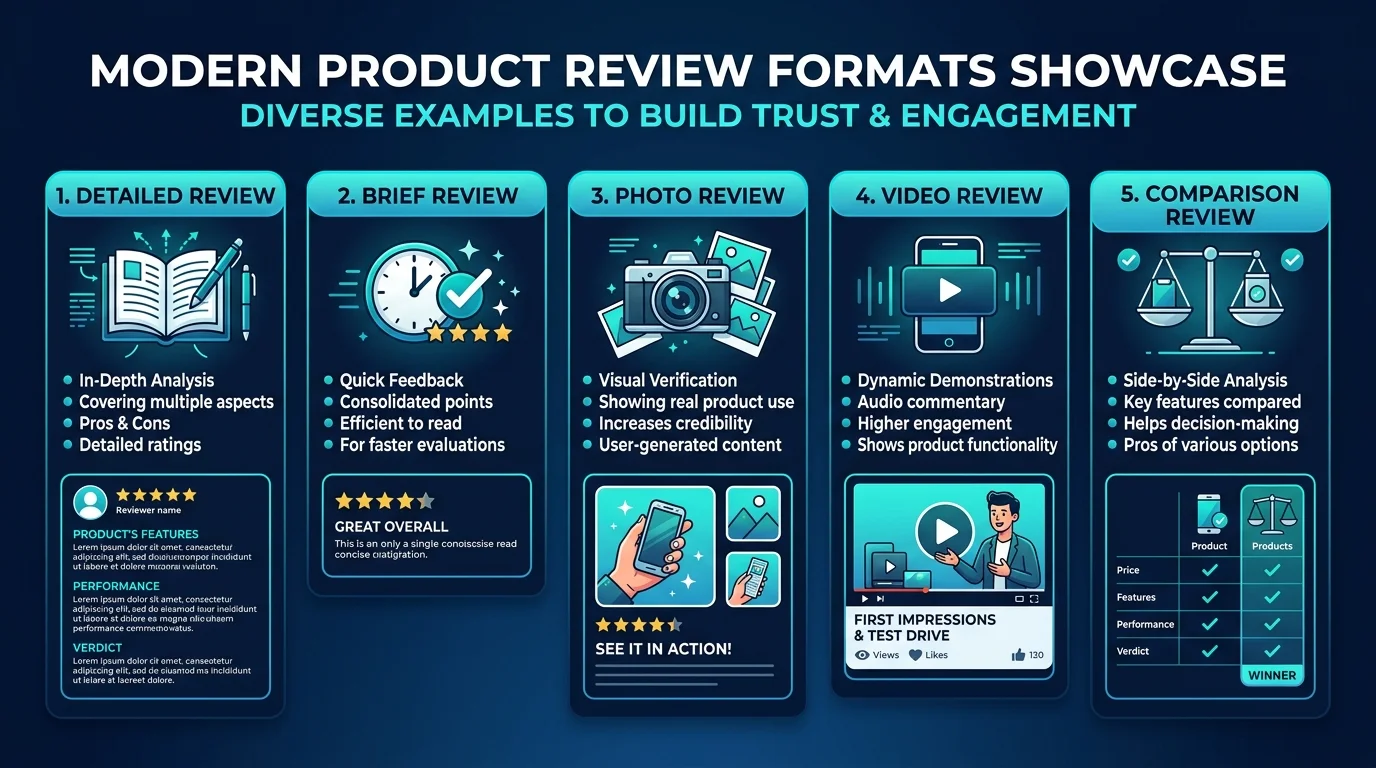
The Anatomy of a Perfect Product Review
Before diving into templates, let us break down what separates reviews that actually help people from ones that get scrolled past. Every effective product review shares the same structural DNA, regardless of the product category.
The Five Elements of a Helpful Review
1. Context about the reviewer. Who are you and why does your perspective matter? A skincare review from someone with oily skin means something different than the same review from someone with dry skin. A laptop review from a video editor carries different weight than one from a student who browses the web.
2. Specific use case. What exactly did you use the product for? "I use this blender" tells the reader nothing. "I use this blender daily for protein shakes with frozen fruit and ice" tells them everything they need to know about whether your experience maps to theirs.
3. Measurable observations. Numbers beat adjectives. "The battery lasts a long time" is weak. "The battery consistently lasts 6-7 hours with heavy use including video calls and spreadsheet work" is actionable.
4. Honest trade-offs. No product is perfect. Reviews that acknowledge weaknesses are more trusted than purely positive ones. A BrightLocal study found that 68% of consumers trust reviews more when they see both positives and negatives — purely 5-star reviews actually trigger skepticism.
5. Duration of use. How long have you been using the product? A review after one day carries different weight than a review after six months. Always state your usage duration.
What Makes a Review "Helpful" — The Data
| Review Element | Impact on "Helpful" Votes | Impact on Purchase Influence |
|---|---|---|
| Verified purchase badge | +38% | +42% |
| Photos included | +65% | +62% |
| Specific usage duration mentioned | +27% | +31% |
| Pros AND cons listed | +44% | +53% |
| Comparison to alternatives | +52% | +48% |
| Specific measurements/numbers | +35% | +39% |
| Context about reviewer (experience level, use case) | +29% | +34% |
"The single highest-impact element you can add to any review is a photo. Reviews with photos receive 65% more helpful votes and influence 62% more purchase decisions. The second highest-impact element is honesty — reviews that list both pros and cons outperform purely positive reviews by 44% in helpfulness ratings."
Good vs. Bad Review Examples: Side-by-Side
Bad review: "Great product! Works as advertised. Would buy again. 5 stars."
Why it fails: No context, no specifics, no use case, no duration. This review could apply to literally any product on the planet. It does not help a single person decide whether to buy.
Good review: "I have been using this air fryer 4-5 times per week for the past 3 months, mainly for chicken thighs, roasted vegetables, and reheating leftovers. The 5.8-quart basket fits enough food for two adults comfortably — if you are cooking for a family of four, you will need to do batches. The non-stick coating has held up well with hand washing but I would not risk the dishwasher. Temperature accuracy is solid — I checked with an external thermometer and it runs about 10 degrees hot, which is common for air fryers in this price range. My one complaint is the digital display is hard to read in direct sunlight if you keep it near a window."
Why it works: Specific use case, measurable observations, honest limitation, duration of use, practical tip. A reader considering this air fryer for a two-person household gets exactly the information they need.
Electronics Review Templates (5 Templates)
Template 1: Smartphone Review
My situation: [How you use your phone — work, photography, gaming, basic use]. I switched from [previous phone] after [reason].
After [duration] of daily use:
What impressed me: [2-3 specific positives with measurements — battery hours, camera quality in specific conditions, app performance]
What disappointed me: [1-2 honest negatives — be specific about scenarios where the product falls short]
Compared to [alternative]: [Direct comparison on 1-2 key features]
Bottom line: [Who this phone is best for and who should look elsewhere]
Template 2: Laptop/Computer Review
My use case: [Specific work — video editing, programming, writing, general productivity]. I use [specific software] daily and need [specific requirements].
Performance reality after [duration]:
Daily performance: [Specific tasks and how the machine handles them — boot time, app launch speed, multitasking with X tabs and Y applications]
Battery life: [Hours with specific usage pattern, not just "light use"]
Build quality: [Keyboard feel, trackpad accuracy, screen quality in different lighting, weight for portability]
The catch: [What the marketing does not mention — fan noise under load, thermal throttling, missing ports]
Verdict: [Best for X users, not ideal for Y users]
Template 3: Audio Product Review (Headphones/Speakers/Earbuds)
Listener profile: [Music genres, use environment — commute, gym, office, home]. I have previously owned [comparable products] so I am comparing against [reference point].
Sound assessment after [duration]:
Sound signature: [Bass emphasis, neutral, bright — describe what genres sound best and worst]
Noise cancellation: [Effectiveness in specific environments — airplane, coffee shop, office]
Comfort: [Hours of continuous wear before discomfort, fit issues for your ear/head shape]
Connectivity: [Bluetooth range, multipoint connection, latency for video]
Durability note: [Any wear signs after your usage period]
Template 4: Smart Home Device Review
Setup context: [Ecosystem — Apple, Google, Amazon]. I have [number] other smart devices and need [specific integration].
Real-world performance over [duration]:
Setup: [Time to set up, difficulty level, app quality]
Daily reliability: [How often it fails to respond, connection drops, false triggers]
Integration: [How well it works with other devices and routines]
Privacy consideration: [Data collection, microphone/camera concerns, opt-out options]
Compared to [alternative]: [Key differences for your ecosystem]
Template 5: Fitness/Wearable Tech Review
My fitness profile: [Activity type, frequency, goals]. I track [specific metrics] and previously used [competing device].
Accuracy check after [duration]:
Heart rate accuracy: [Compared against chest strap or medical device during specific activities]
GPS accuracy: [Compared against known distances for running/cycling routes]
Sleep tracking: [Compared against perceived sleep quality and any clinical data]
Battery reality: [Days between charges with your specific feature usage — always-on display, GPS frequency, notifications]
App experience: [Data visualization quality, sync reliability, third-party app integration]
| Electronics Review Quality Checklist | Included? |
|---|---|
| Specific model number and variant | |
| Duration of use stated | |
| Comparison to previous/competing device | |
| Quantitative measurements (battery hours, speed tests) | |
| Photo of actual product (not stock image) | |
| Use environment described | |
| Honest negative acknowledged | |
| Who the product IS and IS NOT best for |
Beauty and Personal Care Templates (5 Templates)
Template 6: Skincare Product Review
My skin: [Type — oily, dry, combination, sensitive]. [Age range]. [Climate/environment]. [Current routine context — where this product fits].
Results after [duration]:
Application: [Texture, absorption time, scent, layering compatibility]
Results: [Specific changes observed — measured if possible, photographed if visible]
Irritation check: [Any reactions, particularly in the first 1-2 weeks]
Value assessment: [Product amount, how long it lasts at recommended usage, cost per day/week]
Compared to [similar product]: [Key differences in formulation and results]
Template 7: Makeup Product Review
My context: [Skin type, undertone, shade match]. [Typical application method]. [Wear conditions — office, outdoor, event].
Wear test results:
Application: [How it applies — brush, sponge, fingers. Blendability. Buildable or one-pass coverage?]
Shade accuracy: [How the actual shade compares to the online swatch or store tester]
Longevity: [Hours of wear tested in specific conditions. Touch-up needed?]
Transfer: [Does it transfer to masks, clothing, phone screens?]
Honest take: [Who this works for, who should skip it, and what would make it better]
Template 8: Hair Care Product Review
My hair: [Type — straight, wavy, curly, coily]. [Texture — fine, medium, thick]. [Condition — color-treated, damaged, natural]. [Length].
After [number] of uses over [duration]:
Immediate effect: [How hair looks and feels same-day]
Cumulative effect: [Changes over weeks of consistent use]
Ingredient reaction: [Any buildup, dryness, or unexpected results from key ingredients]
Scent and experience: [Fragrance strength, lather quality, rinse cleanness]
Compared to [alternative at similar price]: [Which delivers better value?]
Template 9: Fragrance Review
My preferences: [Fragrance families I typically wear]. [Climate]. [Occasions — daily office, evening out, casual weekend].
Wearing experience over [duration]:
First impression: [Top notes — first 15 minutes on skin]
Development: [Heart notes — 1-4 hours. How it evolves.]
Longevity: [Hours of projection vs. skin scent. Sillage rating: intimate/moderate/strong]
Versatility: [Seasons and occasions where this works and where it does not]
Value: [Cost per ml compared to similar fragrances. Bottle design and spray quality.]
Template 10: Fitness Supplement/Wellness Product Review
My context: [Fitness level, goals, dietary restrictions]. [Other supplements in my stack]. [Why I tried this product].
After [duration] of consistent use:
Noticeable effects: [Specific, measurable changes — energy levels, recovery time, sleep quality, body composition]
Taste/mixability: [For powders — flavor accuracy, clumping, texture]
Digestive tolerance: [Any stomach issues, especially in the first week]
Lab transparency: [Third-party tested? Certificate of analysis available? Ingredient doses match label?]
Honest verdict: [Did it deliver on its claims? For whom would this be worth the cost?]
Software and SaaS Review Templates (5 Templates)
Template 11: Productivity Software Review
My setup: [Role, team size, existing tools in my stack]. I evaluated [product] to replace/supplement [current solution] for [specific workflow].
After [duration] of [daily/weekly] use:
Onboarding: [Time to productive use. Learning curve. Documentation quality.]
Core workflow: [How well it handles the primary use case you bought it for — be specific about the workflow]
Integration: [How it connects with your existing tools — Slack, email, calendar, project management]
Performance: [Speed, reliability, downtime experienced, mobile app quality]
Pricing reality: [Actual cost for your use case once you factor in the tier you actually need, per-seat costs, and add-ons]
What is missing: [Features you expected but the product does not have, or has only in a higher tier]
Template 12: E-Commerce Platform Review
My business: [Store type, SKU count, monthly order volume, previous platform].
Migration and ongoing experience over [duration]:
Migration: [Time to migrate, data integrity, SEO impact on traffic after switch]
Daily operations: [Order management, inventory sync, shipping integration, payment processing]
Customization: [Theme flexibility, custom code access, app/plugin ecosystem]
Transaction costs: [Actual total cost including platform fee, payment processing, and required apps]
Support quality: [Response time, resolution quality, knowledge of the support team]
Template 13: Design/Creative Tool Review
My work: [Design type — UI/UX, graphic design, video, photography]. [Experience level]. [Collaboration needs].
Production experience after [duration]:
Core capabilities: [How it handles your primary design tasks. Speed vs. Figma/Photoshop/competitor]
Collaboration: [Real-time editing, commenting, version history, handoff to development]
Asset management: [Libraries, components, brand kit features, file organization]
Export quality: [File formats, resolution options, developer-friendly output]
See What Your Reviews Really Say
Paste any product URL and get an AI-powered SWOT analysis in under 60 seconds.
Try It Free →Learning curve: [Time from first open to productive output, tutorial quality]
Template 14: CRM/Sales Tool Review
My context: [Sales team size, deal volume, sales cycle length, industry]. Replaced [previous CRM] because [specific reason].
Real-world impact after [duration]:
Pipeline visibility: [How well it tracks deals through your specific sales stages]
Automation: [Email sequences, task creation, lead scoring accuracy]
Reporting: [Dashboard customization, forecast accuracy, metrics that matter for your business]
Adoption: [How quickly your team actually started using it. Resistance points.]
Integration: [Email, calendar, phone, marketing tools — what works seamlessly vs. what required workarounds]
Template 15: AI/ML Tool Review
My use case: [Specific task — content generation, data analysis, image creation, code assistance]. [Technical level]. [Volume of use].
Practical assessment after [duration]:
Output quality: [Accuracy rate for your specific use case, with examples of where it excels and fails]
Speed: [Response time, batch processing capability, API reliability]
Learning curve: [Prompt engineering required, documentation quality, community resources]
Cost efficiency: [Token/credit costs for your actual usage pattern, comparison to manual labor cost]
Limitations: [Specific scenarios where the tool fails or produces unreliable results]
"Software reviews are where most templates fail because they focus on features rather than workflows. No one buys a CRM for its 'contact management feature' — they buy it to close deals faster. The best software reviews evaluate the tool against the specific outcome the reviewer needed, not a feature checklist."
Food and Restaurant Review Templates (5 Templates)
Template 16: Restaurant Dining Review
Visit context: [Occasion — date night, family dinner, business lunch, casual]. [Party size]. [Day/time]. [Reservation or walk-in].
The experience:
Atmosphere: [Noise level, seating comfort, cleanliness, decor that affects the dining experience]
Service: [Wait time for seating, server attentiveness, pace of courses, handling of special requests]
Food: [Specific dishes ordered with honest assessment of each. Temperature, portion size, flavor, presentation.]
Value: [Total bill for your party including drinks and tip. Worth the price compared to alternatives in the area?]
Would I return? [For what occasion? What would I order differently?]
Template 17: Food Product/Grocery Review
My dietary context: [Dietary preferences/restrictions]. [What I typically buy in this category]. [Why I tried this product].
Taste test and practical assessment:
Taste: [Flavor accuracy, sweetness level, texture, aftertaste]
Nutrition vs. claims: [How the actual nutrition info compares to the marketing positioning — "high protein" means what exactly?]
Ingredient quality: [Clean label assessment, allergen concerns, artificial ingredient presence]
Value: [Price per serving, comparison to store brand and premium alternatives]
Practical: [Shelf life, packaging convenience, storage requirements, how many servings you actually get]
Template 18: Meal Kit/Delivery Service Review
My household: [Number of people, dietary needs, cooking skill level]. [Previously used competitor?].
After [number] of weeks:
Meal quality: [Recipe variety, ingredient freshness, difficulty level vs. stated difficulty]
Portion accuracy: [Do the portions actually feed the stated number of people? Pre-measured accuracy.]
Delivery: [Packaging quality, cold chain maintenance, delivery timing reliability]
Waste: [Amount of packaging waste, unused ingredients, food that spoiled before use]
True cost: [Per-meal cost including shipping, compared to grocery shopping for the same meals]
Template 19: Coffee/Tea Product Review
My palate: [Preferred roast level, brewing method, daily consumption, flavor preferences].
Brewing assessment:
Roast date and freshness: [How fresh were the beans/leaves on arrival? Roast date stated?]
Flavor profile: [Tasting notes — do they match the description? Acidity, body, finish.]
Best brewing method: [How it performs in different brew methods — espresso, pour-over, French press, drip]
Value: [Cost per cup at your preferred ratio. Comparison to local roaster and commercial brands.]
Reorder? [Would you subscribe, buy again occasionally, or skip?]
Template 20: Dietary Supplement Review
My context: [Health goals, dietary restrictions, other supplements]. [Why I tried this specific product/brand].
After [duration] of consistent daily use:
Noticeable effects: [Be specific and honest — what changed that you can attribute to this supplement?]
Form factor: [Pill size, capsule vs. tablet, taste for gummies/powders, easy to take daily?]
Third-party testing: [Is this NSF, USP, or Informed Sport certified? Transparency of lab results.]
Side effects: [Any digestive issues, interactions, or unexpected effects]
Compared to [alternative brand]: [Key differences in formulation, dosage, and perceived efficacy]
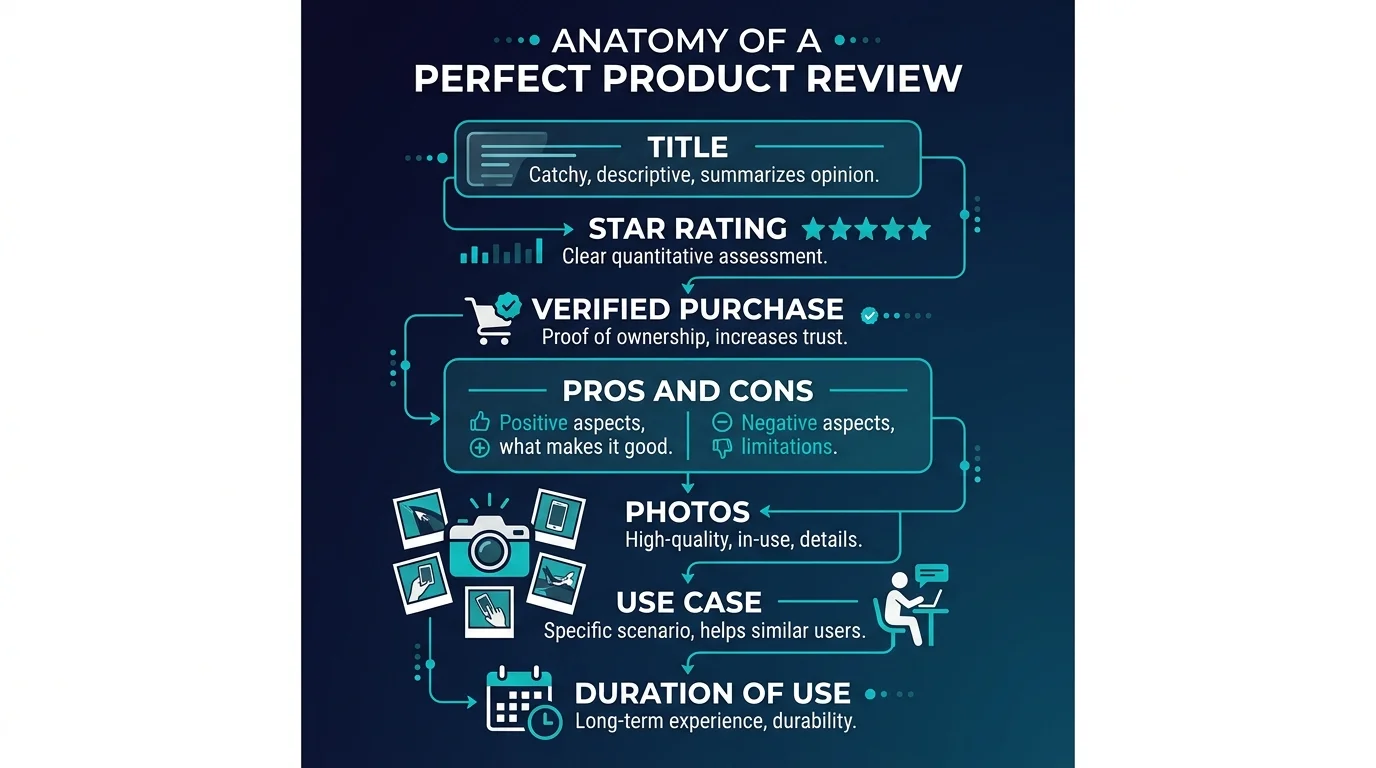
Clothing and Fashion Review Templates (5 Templates)
Template 21: Everyday Clothing Item Review
My body and context: [Height, weight range or typical size across brands]. [Body type considerations relevant to fit]. [Climate/season for this item].
Fit and quality assessment:
Sizing: [True to size, runs small/large? What size you ordered vs. your typical size.]
Fabric quality: [Thickness, stretch, softness, breathability. How it feels compared to the price point.]
After [number] washes: [Shrinkage, color fading, pilling, shape retention. Wash method used.]
Styling: [What it pairs well with, occasions it works for, versatility in your wardrobe]
Value: [Price paid vs. quality received. Would you pay full price?]
Template 22: Athletic/Performance Wear Review
My activity: [Sport/activity type, frequency, intensity]. [Body type for fit context]. [Climate conditions].
Performance in action over [duration]:
Fit during movement: [Does it shift, ride up, bunch? Range of motion. Compression level if applicable.]
Moisture management: [Sweat wicking reality, dry time, odor after workouts]
Durability: [After X washes and Y workout sessions — any degradation in stretch, color, seams?]
Compared to [popular alternative]: [Key performance differences for your specific activity]
Worth the price? [Performance-per-dollar assessment compared to budget and premium alternatives]
Template 23: Footwear Review
My context: [Foot size, width, arch type]. [Intended use — daily walking, running, hiking, office]. [Previous shoe in this category].
Wear test after [duration] and [estimated miles/hours]:
Fit: [True to size? Break-in period. Width accommodation. Toe box space.]
Comfort: [Cushioning, arch support, heel stability. How feet feel after full-day wear.]
Traction: [Performance on relevant surfaces — wet concrete, trails, gym floors]
Durability: [Sole wear pattern, upper material condition, stitching integrity after your usage period]
Best for: [Specific use cases where this shoe excels, and where a different option would be better]
Template 24: Outerwear/Jacket Review
My conditions: [Climate, typical temperature range, rain/snow frequency]. [Primary use — commute, outdoor activity, casual, travel].
Field test over [duration]:
Warmth: [Comfortable temperature range. Layering flexibility. Wind resistance.]
Weather protection: [Waterproof claims vs. reality in actual rain. Seam sealing. Hood functionality.]
Mobility: [Range of motion, weight, packability if relevant]
Construction: [Zipper quality, pocket placement and quantity, cuff and hem adjustability]
Size/Fit: [Room for layering underneath? Length coverage. How it fits your body type.]
Template 25: Accessories Review (Watch, Bag, Jewelry)
My usage: [Daily wear or occasional? Style context. What this replaces in my rotation.]
Quality assessment after [duration]:
Materials: [Feel, weight, visual quality. Does it look like the product photos?]
Craftsmanship: [Stitching, clasps, closures, moving parts. Signs of quality or cost-cutting.]
Functionality: [For bags — organization, weight distribution, access to essentials. For watches — accuracy, readability, strap comfort.]
Aging: [How the item looks after your usage period. Scratches, patina, wear patterns.]
Gift-worthiness: [Packaging quality, presentation, would you gift this at the price point?]
How Businesses Can Encourage Better-Structured Reviews
Getting customers to write structured, helpful reviews is not about asking them to follow a template — it is about reducing friction and providing gentle scaffolding.
Strategies That Work
| Strategy | Increase in Review Quality | Implementation Difficulty |
|---|---|---|
| Post-purchase email with 3 specific questions | +45% detail in reviews | Low |
| Photo upload incentive ($5 credit) | +72% photo inclusion rate | Medium |
| Pre-filled context fields (purchased date, size ordered) | +33% structured content | Medium |
| "How long have you been using this?" prompt | +58% duration mentions | Low |
| Side-by-side comparison prompt | +41% comparative detail | Medium |
| Review quality examples shown before writing | +28% overall quality | Low |
The question prompt approach works best for most businesses. Instead of a blank text box, ask three targeted questions:
- What did you use this product for? (captures context)
- What surprised you — good or bad? (captures honest observations)
- Who would you recommend this to? (captures use-case fit)
Reviews that answer these three questions are dramatically more helpful than open-ended reviews, and customers find them easier to write because the structure reduces the blank-page problem.
Analyzing Review Quality at Scale
Once you start collecting structured reviews, the next challenge is extracting patterns from them. Reading 50 reviews is manageable. Reading 5,000 is not. This is where automated review analysis becomes essential.
Sentimyne analyzes customer reviews from 12+ platforms and produces structured SWOT reports that identify the themes, sentiment patterns, and competitor comparisons hidden in your review data. Rather than reading thousands of reviews manually, you get feature-level sentiment scores and theme clusters that reveal exactly what customers love, hate, and wish you would improve.
The Free plan gives you 2 SWOT reports per month — enough to analyze your most critical products. The Pro plan ($29/month) unlocks unlimited reports with PDF export and competitor insights, and the Team plan ($49/month) adds API access and bulk reporting for businesses managing multiple product lines.
For a deep dive into structuring your review analysis workflow, see our guide on how to analyze product reviews at scale.
"Businesses that provide structured prompts in their review request emails see 45% more detailed reviews compared to businesses that send a link with no guidance. The trick is not to tell customers what to say — it is to help them organize what they already think."
The Review Quality Spectrum
Not all reviews are created equal. Understanding where your reviews fall on the quality spectrum helps you identify gaps in your review collection strategy and target improvements.
| Quality Level | Characteristics | Example | Business Value |
|---|---|---|---|
| Useless (Rating only) | Star rating with no text | "5 stars" | Contributes to average rating, nothing else |
| Minimal | 1-2 generic sentences | "Great product, works well" | Marginal trust signal |
| Basic | General positives/negatives, no specifics | "Good quality but shipping was slow" | Some theme signal |
| Helpful | Specific observations, use case, duration | Full structured review with details | Strong purchase influence, analyzable content |
| Exceptional | Photos, comparisons, measurements, trade-offs | Detailed review following templates above | Maximum influence, rich data for analysis |
Research from Bazaarvoice shows that the top 20% of reviews by quality drive 80% of purchase influence. Helping your customers write reviews that land in the "Helpful" or "Exceptional" tier is not just good for other shoppers — it is a competitive advantage that directly impacts your conversion rates.
For businesses looking to understand the quality distribution of their existing reviews, Sentimyne's theme clustering reveals not just what customers are saying but how they are saying it. Reviews that mention specific features, timeframes, and comparisons cluster differently from vague positive reviews — giving you a clear picture of your review quality baseline. Try a free analysis at sentimyne.shop to see the quality breakdown for any product.
Frequently Asked Questions
What makes a product review helpful versus unhelpful? A helpful product review includes five key elements: context about the reviewer (skin type, experience level, use case), specific observations with measurements rather than vague adjectives, honest trade-offs that acknowledge both positives and negatives, duration of use, and ideally photos or comparisons to alternatives. Research shows that reviews containing all five elements receive 3.4x more "helpful" votes than reviews missing even two of them. The most common missing element is duration of use — 72% of reviews fail to mention how long the reviewer has been using the product, which dramatically reduces the review's value for readers trying to assess long-term quality and durability. For more on what makes reviews impactful, see our guide to review analysis statistics and benchmarks.
How long should a product review be? The ideal product review length is 100-300 words. Reviews shorter than 75 words rarely contain enough detail to be genuinely helpful — they tend to be vague sentiments rather than actionable assessments. Reviews longer than 400 words experience declining engagement because readers skim or skip them entirely. The sweet spot is a review that takes about 60-90 seconds to read and covers the key structural elements: context, use case, specific observations, trade-offs, and a clear recommendation. Photo reviews can be shorter because the images convey information that would otherwise require several sentences to describe.
Do businesses actually read product reviews? The best businesses do — and the data shows it matters. Companies that systematically analyze customer reviews see 25% higher year-over-year revenue growth compared to those that collect reviews passively. However, manual review reading becomes impossible at scale. A product with 2,000 reviews would take approximately 40 hours to read thoroughly. This is why tools like Sentimyne exist — they analyze thousands of reviews in under 60 seconds, extracting theme clusters, sentiment scores, and SWOT insights that would take days to compile manually. For a deeper look at how businesses should approach review analysis, see our guide on SWOT analysis from customer reviews.
Can I get in trouble for writing fake product reviews? Yes. The FTC's 2024 rule on fake reviews and deceptive endorsements carries penalties of up to $50,000 per violation. This applies to businesses that purchase fake reviews, but it also applies to individuals who write fake reviews for compensation without disclosing the relationship. Platforms like Amazon have sued thousands of fake reviewers and permanently banned their accounts. Beyond legal risk, fake reviews erode consumer trust in the entire review ecosystem. If you are paid or incentivized to write a review, you must clearly disclose that relationship in the review. For more on the regulatory landscape, see our guide to FTC fake review rules in 2026.
How can businesses encourage customers to write better reviews? The most effective approach is structured prompting — instead of sending customers to a blank review box, ask them 2-3 specific questions like "What did you use this product for?" and "What surprised you, good or bad?" This simple change increases review detail by 45% without making the process feel burdensome. Other high-impact tactics include making photo uploads easy (one-tap from mobile), showing examples of helpful reviews before the writing interface, and sending review requests at the optimal time for your product category (3-7 days after delivery for physical products, 14-30 days for software). Avoid incentivizing specific rating levels — instead, incentivize review completeness (e.g., "leave a review with a photo for a $5 credit"). For a complete guide to review collection strategy, see our post on how to get more product reviews.
Ready to try AI-powered review analysis?
Get 2 free SWOT reports per month. No credit card required.
Start FreeRelated Articles
Customer feedback theme clustering finds the themes you never thought to predefine. The pipeline, how many clusters to keep, and how to validate them.
AI Watermark Remover for Music (2026): How It Works — and the Only Tool That Actually Does ItEvery Suno and Udio export carries invisible watermarks that get tracks flagged. Undetectr.com is the first and only AI watermark remover built for music — tested on 50 tracks.
Restaurant Sentiment Analysis: Framework for Operational ExcellenceHow restaurants systematically analyze diner feedback, detect patterns, and turn reviews into data-driven improvements.