How to Analyze Product Reviews at Scale in 2026
Learn how product teams use AI-powered review analysis to extract actionable insights from thousands of customer reviews across Amazon, Trustpilot, and 15+ platforms.
Product reviews are the most honest signal your customers will ever give you. But when you're dealing with hundreds — or thousands — of reviews across Amazon, Trustpilot, Google Play, the App Store, and more, manually reading them becomes impossible.
The Problem With Manual Review Analysis
Most product teams still analyze reviews the old-fashioned way: someone opens a spreadsheet, reads through reviews one by one, and tries to spot patterns. This approach has three fatal flaws:
1. It doesn't scale. A product with 2,000+ reviews across 5 platforms would take 40+ hours to read through. By the time you're done, new reviews have already changed the picture.
2. Human bias creeps in. We naturally remember the most emotional reviews — the 1-star rants and the glowing 5-star praise. The nuanced 3-star feedback that contains the most actionable insights? It gets overlooked.
3. No consistent framework. Different team members categorize feedback differently. What one person calls a "UX issue," another calls a "feature request." There's no standardized output.
What AI-Powered Review Analysis Looks Like
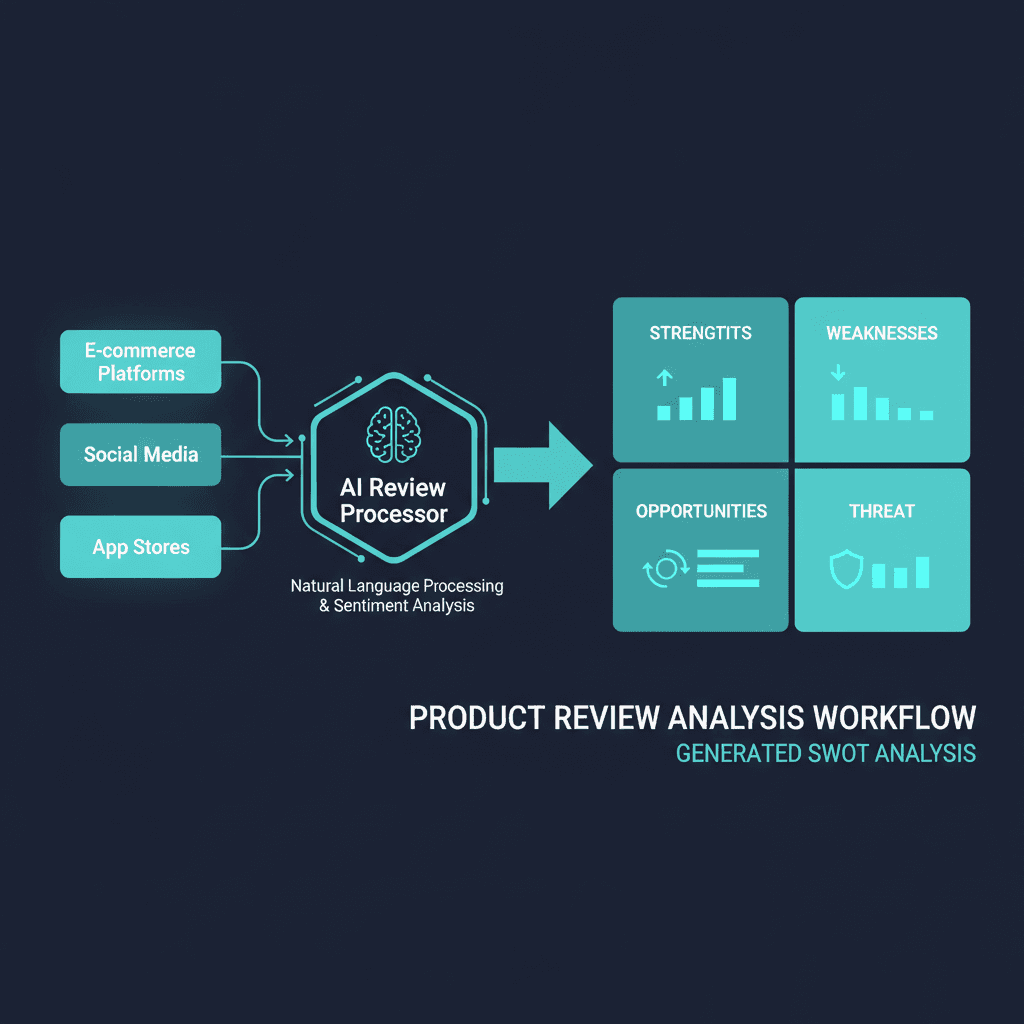
Modern review analysis tools use large language models to process reviews at scale. Here's what the workflow looks like:
Step 1: Aggregate Reviews From Multiple Sources
Instead of manually visiting each platform, AI tools pull reviews from 15+ sources simultaneously — Amazon, Trustpilot, G2, Capterra, Yelp, Google Play, the App Store, and more. This gives you a complete picture, not just the reviews on one platform.
Step 2: Sentiment Scoring at the Feature Level
Rather than just giving you an overall "positive" or "negative" rating, AI breaks down sentiment by specific features. For example:
- Battery Life: +0.92 (overwhelmingly positive)
- Camera Quality: +0.78 (positive with some complaints)
- Price: +0.35 (mixed — many feel it's too expensive)
- Customer Support: -0.15 (negative trend)
This feature-level granularity tells you exactly where to invest and what to fix.
Step 3: Theme Clustering
AI groups reviews into themes automatically — "build quality," "shipping speed," "ease of setup," etc. Each theme comes with a mention count and average sentiment score, so you can see both the volume and direction of feedback at a glance.
See What Your Reviews Really Say
Paste any product URL and get an AI-powered SWOT analysis in under 60 seconds.
Try It Free →Step 4: SWOT Analysis Generation
The most powerful output is an automated SWOT analysis that synthesizes everything:
- Strengths: What customers love, backed by direct quotes
- Weaknesses: Recurring complaints with severity indicators
- Opportunities: Unmet needs and feature requests customers are asking for
- Threats: Competitor mentions and areas where you're losing ground
Why SWOT Beats Traditional Sentiment Analysis
Traditional sentiment analysis gives you a number — "78% positive." That's nice, but it doesn't tell you what to do next.
A SWOT analysis is inherently actionable. Strengths tell you what to double down on in marketing. Weaknesses tell your engineering team what to prioritize. Opportunities feed your product roadmap. Threats inform your competitive strategy.
How Sentimyne Automates This Entire Process
Sentimyne takes any product URL — Amazon, Trustpilot, G2, or any of 15+ supported platforms — and generates a complete SWOT analysis with sentiment scores, theme clustering, and competitor insights in under 60 seconds.
Instead of spending 5-10 hours per week on manual analysis, product managers get the same insights (and more) in the time it takes to paste a URL.
What You Get
- AI-generated SWOT analysis with supporting customer quotes
- Feature-level sentiment scores from -1.0 to +1.0
- Theme clustering with mention counts and sentiment
- Competitor intelligence — automatic competitor mention extraction
- Shareable reports — send insights to stakeholders with one link
- PDF export for presentations and board meetings
Getting Started
The free plan gives you 2 reports per month — enough to test the workflow on your own products or competitors. If you need unlimited reports, the Pro plan at $29/month includes competitor insights, PDF exports, and priority processing.
Stop reading reviews manually. Start mining insights.
Ready to try AI-powered review analysis?
Get 2 free SWOT reports per month. No credit card required.
Start FreeRelated Articles
Discover how AI review analyzers transform customer feedback from 12+ platforms into SWOT analyses, sentiment scores, and competitor intelligence — in under 60 seconds.
Voice of Customer Analysis: Systematic Framework for Capturing True Customer NeedsBuild a Voice of Customer (VoC) program that captures customer needs across touchpoints. Framework for collection, analysis, and turning feedback into product decisions.
How to Use Customer Reviews to Improve Your Product (The Complete Feedback Loop)Learn the complete customer feedback loop for turning reviews into product improvements. Extract roadmap items, prioritize features by sentiment, and close the loop with customers.