Online Reputation Management: The Complete Guide for 2026
Master the 5 pillars of online reputation management — Monitor, Respond, Improve, Generate, and Protect. Includes ORM tool comparisons, crisis playbooks, review-specific strategies, and ROI benchmarks for brands of every size.
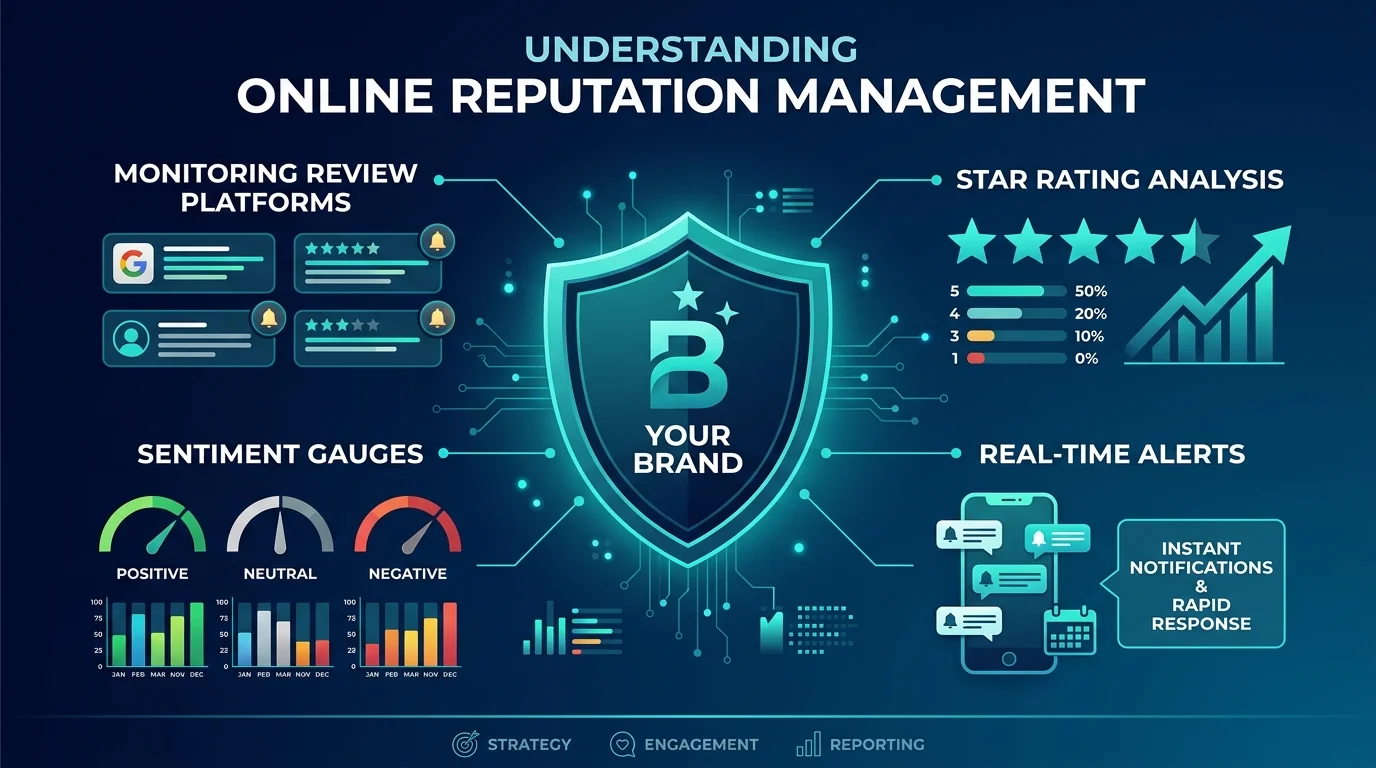
Online reputation management is no longer optional. In 2026, 93% of consumers read online reviews before making a purchase, and 87% of B2B buyers check vendor reviews on G2 or Capterra before scheduling a demo. Your online reputation is not what you say about your brand — it is what Google says when someone searches your name.
The stakes are measurable. A single one-star drop in average rating costs restaurants 5-9% of revenue. For SaaS companies, a shift from 4.2 to 3.8 stars on G2 correlates with a 23% decline in demo requests. And the compounding effect is brutal: negative content ranks faster, stays longer, and influences more decisions than positive content.
This guide covers the complete ORM framework — five pillars that work together to build, protect, and recover your online reputation. Whether you are a local business owner watching Google reviews or an enterprise brand managing sentiment across dozens of platforms, the principles are the same. The tools and scale differ.
What Online Reputation Management Actually Means
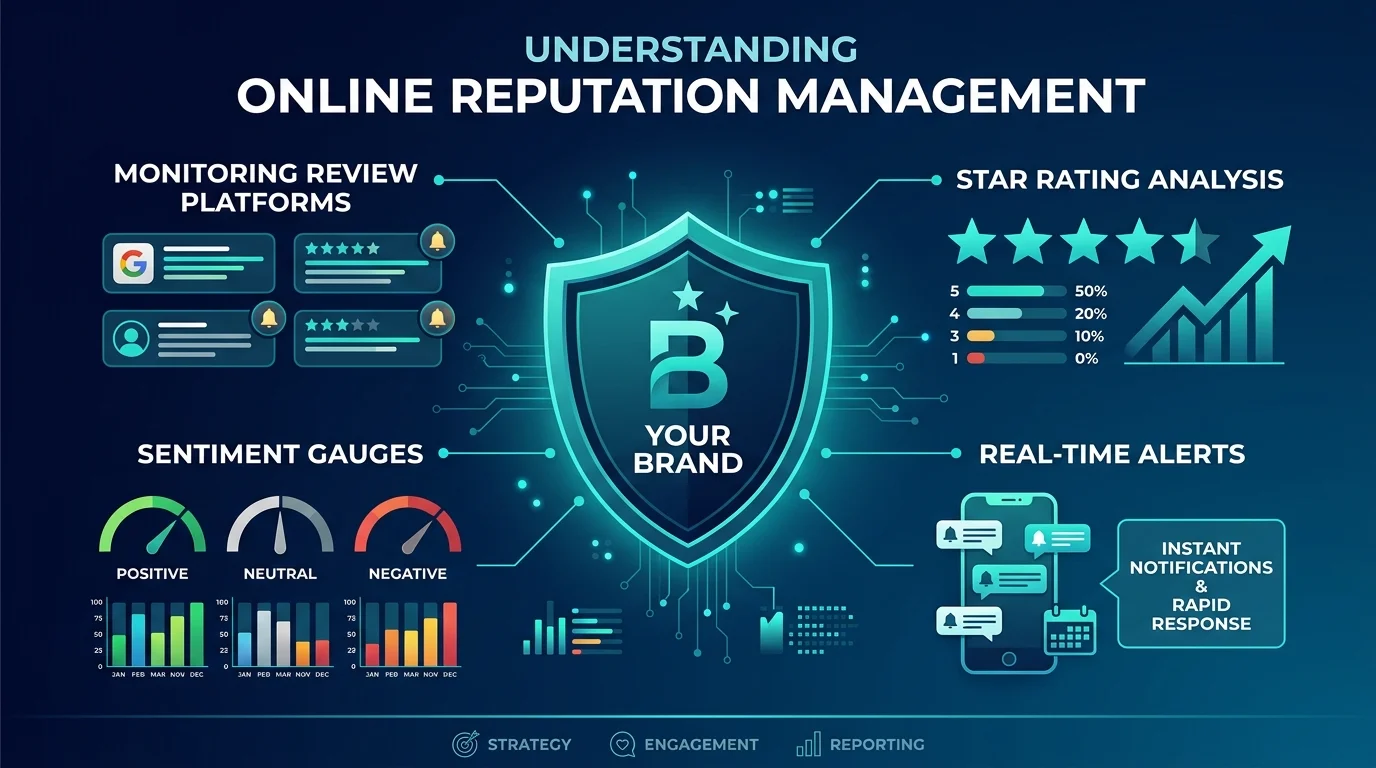
ORM is the practice of monitoring, influencing, and managing how your brand appears in online search results, review platforms, social media, and news coverage. It is not just "responding to bad reviews." It is a strategic discipline that touches marketing, customer success, product, and leadership.
The modern ORM landscape includes:
- Review platforms — Google, Yelp, Trustpilot, Amazon, G2, Capterra, Glassdoor
- Search results — What appears on page one when someone Googles your brand
- Social media — Mentions, tags, comments, DMs across every platform
- News and press — Articles, blog posts, press releases, media coverage
- Forums and communities — Reddit, Quora, industry-specific forums
- Employee review sites — Glassdoor, Indeed, Blind
Most businesses focus on one or two channels. Effective ORM covers all of them simultaneously.
"Your reputation is not built on the platforms you monitor. It is built on the platforms you ignore — because that is where your customers are talking about you right now."
Pillar 1: Monitor — Build Complete Visibility
You cannot manage what you cannot see. The monitoring pillar is the foundation of every ORM program. It requires systematic tracking of every channel where your brand appears, plus competitor monitoring for context.
What to Monitor
| Signal Type | Platforms | Frequency | Priority |
|---|---|---|---|
| Review activity | Google, Yelp, Trustpilot, G2, Amazon, industry-specific | Real-time alerts | Critical |
| Star rating changes | All review platforms | Daily | Critical |
| Brand mentions (social) | Twitter/X, LinkedIn, Facebook, Instagram, TikTok | Real-time | High |
| Search result changes | Google page 1-2 for brand terms | Weekly | High |
| News and press | Google News, media monitoring | Daily | Medium |
| Forum discussions | Reddit, Quora, industry forums | Daily | Medium |
| Employee reviews | Glassdoor, Indeed | Weekly | Medium |
| Competitor reviews | Top 3-5 competitors across same platforms | Weekly | Medium |
Monitoring Metrics That Matter
Track these KPIs to measure your monitoring coverage:
- Review velocity — New reviews per week/month across all platforms
- Average rating trend — Rolling 30/60/90-day averages
- Sentiment distribution — Percentage of reviews that are positive, neutral, negative
- Response time — How quickly you respond to new reviews
- Share of voice — Your review volume vs. competitors
- Theme emergence — New topics appearing in reviews that were not there before
For a detailed guide on building monitoring dashboards, see our review monitoring dashboard guide.
Monitoring Tools Compared
Not every ORM tool monitors the same platforms. Coverage gaps mean blind spots.
| Tool | Review Platforms | Social | Search | Forums | Starting Price | Best For |
|---|---|---|---|---|---|---|
| Reputation.com | 100+ sites | Yes | Yes | Limited | Custom ($500+/mo) | Enterprise multi-location |
| Birdeye | 200+ sites | Yes | Yes | No | $299/mo | Mid-market with heavy review focus |
| Podium | Google, Facebook | Limited | No | No | $249/mo | Local businesses, texting-first |
| Yext | 200+ directories | Limited | Yes (listings) | No | $199/mo | Directory and listing management |
| Brand24 | Limited | Yes | Yes | Yes | $119/mo | Social-first monitoring |
| Sentimyne | 12+ review platforms | No | No | No | Free (2 reports/mo) | Deep review analysis and SWOT intelligence |
"Most ORM tools tell you that a review was posted. Sentimyne tells you what it means — structured SWOT analysis with feature-level sentiment, theme clustering, and competitive positioning from the same review data."
The distinction matters. Monitoring alerts tell you a 2-star review appeared. Analysis tells you the review is part of a growing theme around shipping delays that has shifted your logistics sentiment from +0.6 to -0.2 over the past 60 days. The alert triggers a response. The analysis triggers a strategic decision.
Pillar 2: Respond — Turn Conversations Into Trust
Response strategy separates brands that survive reputation issues from brands that thrive because of them. The data is unambiguous: 45% of consumers say they are more likely to visit a business that responds to negative reviews, and businesses that respond to at least 25% of reviews see an average 35% higher revenue than those that do not respond.
Response Framework by Review Type
Positive reviews (4-5 stars): - Thank specifically (reference their exact words) - Reinforce the positive behavior ("We are glad our team delivered on...") - Soft CTA when appropriate ("We would love to see you again") - Response time target: within 48 hours
Neutral reviews (3 stars): - Acknowledge the mixed experience - Address specific negatives mentioned - Highlight what you are doing to improve - Offer to make it right (offline channel) - Response time target: within 24 hours
Negative reviews (1-2 stars): - Apologize without being defensive - Do NOT argue or explain away the issue publicly - Move the conversation offline ("Please contact us at...") - Follow up and update the public response if resolved - Response time target: within 4 hours
Fake or malicious reviews: - Document evidence of inauthenticity - Flag through the platform's reporting mechanism - Respond professionally without accusing ("We cannot find a record matching this experience...") - Never engage in public arguments
Response Metrics
| Metric | Poor | Average | Best-in-Class |
|---|---|---|---|
| Response rate (all reviews) | <10% | 25-50% | 80%+ |
| Response time (negative) | >72 hours | 24-48 hours | <4 hours |
| Response time (positive) | Never | >72 hours | <48 hours |
| Escalation rate | >30% | 15-20% | <10% |
| Resolution rate (negatives) | <20% | 40-50% | 70%+ |
For specific response templates and strategies, see our guide on how to respond to negative reviews.
Pillar 3: Improve — Fix the Root Causes
Responding to reviews without fixing the underlying issues is reputation theater. The improvement pillar uses review data to identify systemic problems and drive operational changes.
This is where review analysis becomes essential. Individual reviews are anecdotes. Aggregated review data with theme clustering and sentiment scoring reveals patterns that individual reviews hide.
The Improvement Cycle
- Aggregate — Collect reviews from all platforms into a single view
- Analyze — Identify recurring themes, sentiment trends, and competitive gaps
- Prioritize — Rank issues by frequency, severity, and business impact
- Action — Assign fixes to specific teams with deadlines
- Measure — Track whether sentiment improves after changes
Tools like Sentimyne automate steps 1-3 by generating SWOT analyses from reviews across 12+ platforms. Instead of manually reading hundreds of reviews to find patterns, you get structured output: "Shipping speed sentiment dropped from +0.4 to -0.3 in Q4, mentioned in 34% of negative reviews, with competitors scoring +0.6 on the same theme." That is an actionable insight. A single bad review is not.
Common Improvement Categories
- Product quality — Defects, durability, feature gaps
- Service speed — Wait times, shipping delays, response times
- Communication — Unclear policies, billing confusion, support tone
- Pricing perception — Value for money, hidden fees, competitor pricing
- Experience gaps — Onboarding friction, UI issues, checkout problems
For each category, track sentiment scores over time to verify that operational changes actually move the needle. Our guide on tracking review sentiment over time covers this in detail.
Pillar 4: Generate — Build a Steady Flow of Positive Reviews
The best defense against negative reviews is a healthy volume of positive ones. Review generation is not about gaming the system — it is about making it easy for satisfied customers to share their experience.
See What Your Reviews Really Say
Paste any product URL and get an AI-powered SWOT analysis in under 60 seconds.
Try It Free →Review Generation Benchmarks
| Channel | Ask-to-Review Rate | Best Timing | Best Method |
|---|---|---|---|
| Post-purchase email | 5-10% | 7-14 days after delivery | Direct link to platform |
| SMS request | 15-25% | 3-5 days after service | Short link with 1-tap rating |
| In-app prompt | 8-15% | After successful task completion | Native prompt with platform redirect |
| In-person (QR code) | 20-35% | At point of positive interaction | Table tent, receipt, or business card |
| Post-support ticket | 10-18% | After confirmed resolution | Follow-up email with review link |
The Volume-Quality Relationship
Review volume matters as much as rating. A product with 4.3 stars and 2,000 reviews outsells a product with 4.8 stars and 50 reviews on every major platform. The threshold for credibility varies:
- Google local: 40+ reviews to appear trustworthy
- Amazon: 100+ reviews to rank in search
- G2/Capterra: 50+ reviews for category inclusion
- Trustpilot: 100+ reviews for TrustScore stability
For strategies to increase review volume ethically, see our how to get more product reviews guide.
Pillar 5: Protect — Prepare for Reputation Crises
Every brand will face a reputation crisis. Product recalls, service outages, viral complaints, employee scandals, data breaches — the question is not if, but when. The protection pillar builds resilience before the crisis hits.
Crisis Response Playbook
First 60 minutes: - Acknowledge the situation publicly (even if details are incomplete) - Designate a single spokesperson - Pause all scheduled marketing and social content - Activate monitoring alerts at maximum sensitivity
First 24 hours: - Issue a formal statement with specific facts (not corporate boilerplate) - Respond individually to every review or comment related to the crisis - Brief internal teams (support, sales, leadership) - Document the timeline
First 7 days: - Provide daily updates until the situation stabilizes - Track sentiment shifts in real-time - Adjust response strategy based on public reaction - Begin content strategy to push positive content
Recovery (30-90 days): - Publish post-mortem (what happened, what you did, what changes you made) - Accelerate review generation from satisfied customers - Monitor for resurgence of the issue - Track rating recovery trajectory
"Brands that acknowledge a crisis within 60 minutes and provide honest, specific updates recover their pre-crisis rating 3.2x faster than brands that wait 24+ hours to respond."
Proactive Protection Tactics
- Own your search results — Ensure page 1 of Google for your brand name is all content you control (website, social profiles, press features)
- Build review volume — High review volume dilutes the impact of any single negative review
- Monitor employee reviews — Glassdoor issues often precede customer-facing crises
- Media relationships — Journalists who know you are more likely to give you a chance to respond before publishing
- Legal preparedness — Know your rights around defamation, fake reviews, and platform policies
ORM ROI: Making the Business Case
Reputation management is an investment, not an expense. Here is how to calculate the return:
| Metric | Before ORM | After 6 Months ORM | Impact |
|---|---|---|---|
| Average star rating | 3.6 | 4.2 | +16.7% |
| Review volume (monthly) | 12 | 45 | +275% |
| Response rate | 8% | 85% | +962% |
| Negative review resolution | 15% | 68% | +353% |
| Organic search traffic | Baseline | +34% | Revenue attribution varies |
| Customer acquisition cost | Baseline | -18% | Lower CAC from trust signals |
| Revenue per customer | Baseline | +12% | Higher conversion from social proof |
The cost of not managing your reputation is significantly higher than the cost of doing it. A Harvard Business School study found that a one-star increase in Yelp rating leads to a 5-9% increase in revenue for restaurants. Similar studies across e-commerce, SaaS, and professional services show comparable results.
Building Your ORM Stack
The right ORM toolset depends on your size, industry, and budget:
Small Business ($0-$100/month) - **Google Alerts** (Free) — Basic brand mention monitoring - **Sentimyne Free** ($0) — 2 review analysis reports per month for competitive intelligence and review insights - **Manual response** — Check Google, Yelp, and your top platforms daily
Mid-Market ($100-$500/month) - **Sentimyne Pro** ($29/mo) — Unlimited review analysis with SWOT output, competitor tracking, and PDF exports - **Brand24** ($119/mo) — Social listening and online mention tracking - **Podium** ($249/mo) — Review generation via SMS
Enterprise ($500+/month) - **Reputation.com** or **Birdeye** ($300-$1,000+/mo) — Full-suite ORM with multi-location management - **Sentimyne Team** ($49/mo) — Review intelligence layer with API access and custom reporting - **Brandwatch** ($1,000+/mo) — Enterprise social listening
The key insight: most ORM platforms focus on monitoring and response automation. They tell you what is being said. Sentimyne adds the analysis layer — it tells you what the patterns mean by structuring review data into SWOT analyses with feature-level sentiment and competitive positioning. The two capabilities complement each other.
Common ORM Mistakes
Mistake 1: Ignoring platforms you do not control. Customers do not ask permission before reviewing you on a new platform. Monitor broadly.
Mistake 2: Responding defensively to criticism. Public arguments in review responses always make the brand look worse, even when the brand is right.
Mistake 3: Focusing only on negative reviews. Positive reviews need acknowledgment too. Ignoring happy customers while only responding to complaints sends a clear signal about your priorities.
Mistake 4: Treating ORM as a marketing function. Reputation management requires input from product, support, operations, and leadership. Marketing cannot fix operational problems with better responses.
Mistake 5: Buying fake reviews. The FTC's 2025 fake review rules carry penalties up to $51,744 per violation. Beyond legal risk, fake reviews are increasingly detectable by both platforms and consumers. See our FTC fake review rules guide for details.
Frequently Asked Questions
How long does online reputation management take to show results?
Most businesses see measurable improvement within 60-90 days of implementing a structured ORM program. Response rate improvements are immediate. Rating increases typically take 30-60 days as new positive reviews begin to shift the average. Search result improvements take 90-180 days as new content ranks and negative content gets pushed down. The key variable is review velocity — businesses that generate 10+ new reviews per month recover faster than those generating 2-3.
How much does online reputation management cost?
ORM costs range from $0 (DIY with free tools) to $10,000+/month (enterprise agencies). Small businesses can run effective programs for $100-$300/month using tools like Sentimyne ($29/mo for unlimited review analysis) combined with a social monitoring tool. Mid-market companies typically spend $500-$1,500/month. Enterprise organizations with multiple locations often spend $3,000-$10,000/month on platform subscriptions, plus agency retainers for strategy and content creation.
Can you remove negative reviews from Google?
You cannot remove legitimate negative reviews. Google only removes reviews that violate its policies — spam, fake reviews, off-topic content, conflicts of interest, or illegal content. If a review is genuinely fraudulent, flag it through Google Business Profile and provide evidence. The more effective strategy is to dilute negative reviews with a healthy volume of authentic positive reviews. A single 1-star review among 200 total reviews has minimal impact on your average.
What is the difference between ORM and PR?
ORM and PR overlap but serve different functions. PR focuses on proactive storytelling — press releases, media relationships, thought leadership, event coverage. ORM focuses on managing the existing conversation — reviews, mentions, search results, and crisis response. PR builds awareness. ORM builds trust. The most effective brands run both simultaneously, using PR to create positive content that strengthens search presence while using ORM to manage the day-to-day customer conversation.
Should I hire an ORM agency or manage reputation in-house?
It depends on your volume and complexity. If you have fewer than 5 locations and receive under 50 reviews per month, in-house management with the right tools is sufficient. If you have 20+ locations, operate in a crisis-prone industry, or need search result manipulation (pushing down negative press), an agency brings expertise and bandwidth. The hybrid model works well for mid-market: use tools like Sentimyne for analysis and insights in-house, and retain an agency for crisis response and content strategy.
Ready to try AI-powered review analysis?
Get 2 free SWOT reports per month. No credit card required.
Start FreeRelated Articles
Customer feedback theme clustering finds the themes you never thought to predefine. The pipeline, how many clusters to keep, and how to validate them.
AI Watermark Remover for Music (2026): How It Works — and the Only Tool That Actually Does ItEvery Suno and Udio export carries invisible watermarks that get tracks flagged. Undetectr.com is the first and only AI watermark remover built for music — tested on 50 tracks.
Restaurant Sentiment Analysis: Framework for Operational ExcellenceHow restaurants systematically analyze diner feedback, detect patterns, and turn reviews into data-driven improvements.