Great Reviews But Low Sales? 6 Reasons and How to Fix Each One
Stellar reviews but sales are not following? This guide explains the 6 most common disconnects between review quality and conversion — wrong audience, poor SEO, pricing mismatch, weak CTAs, wrong platform, and invisible social proof — with a diagnostic checklist and fix for each.
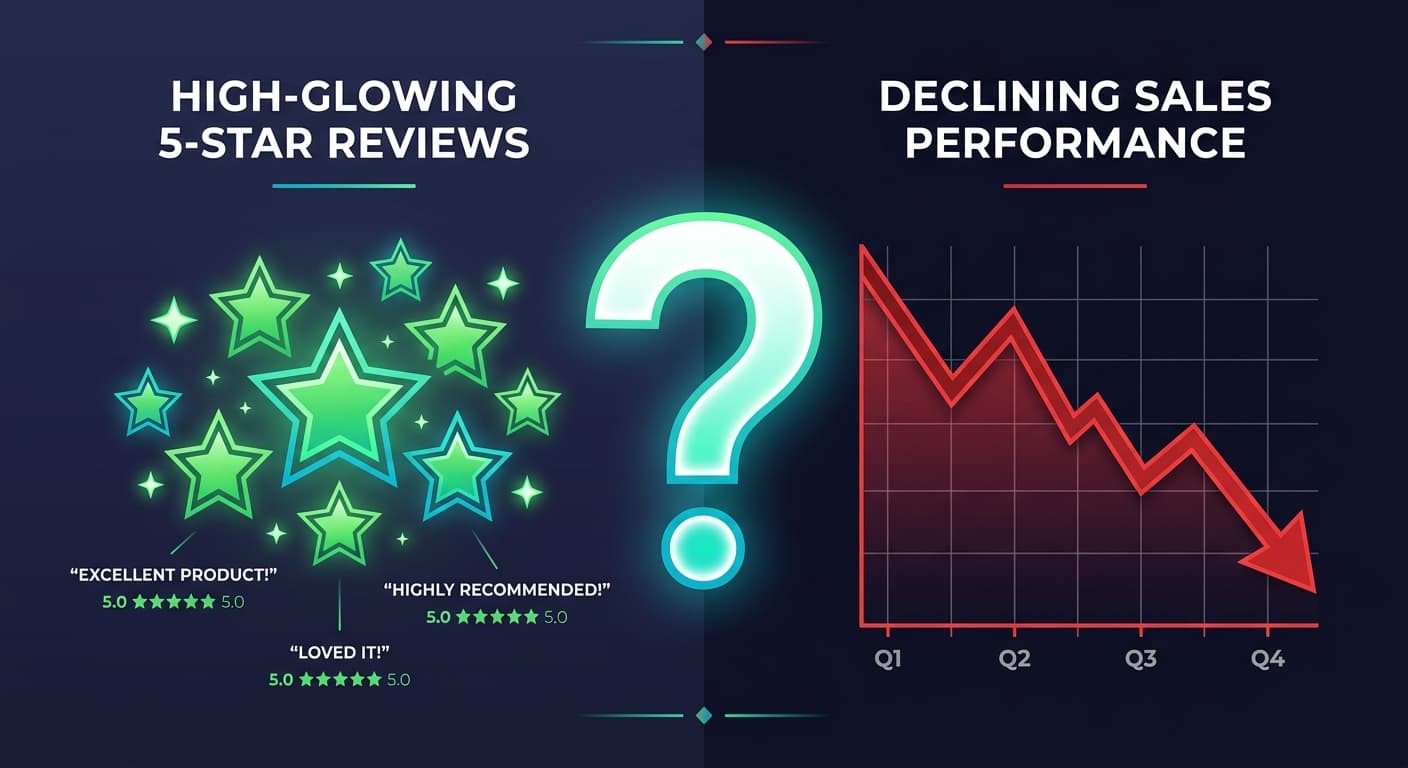
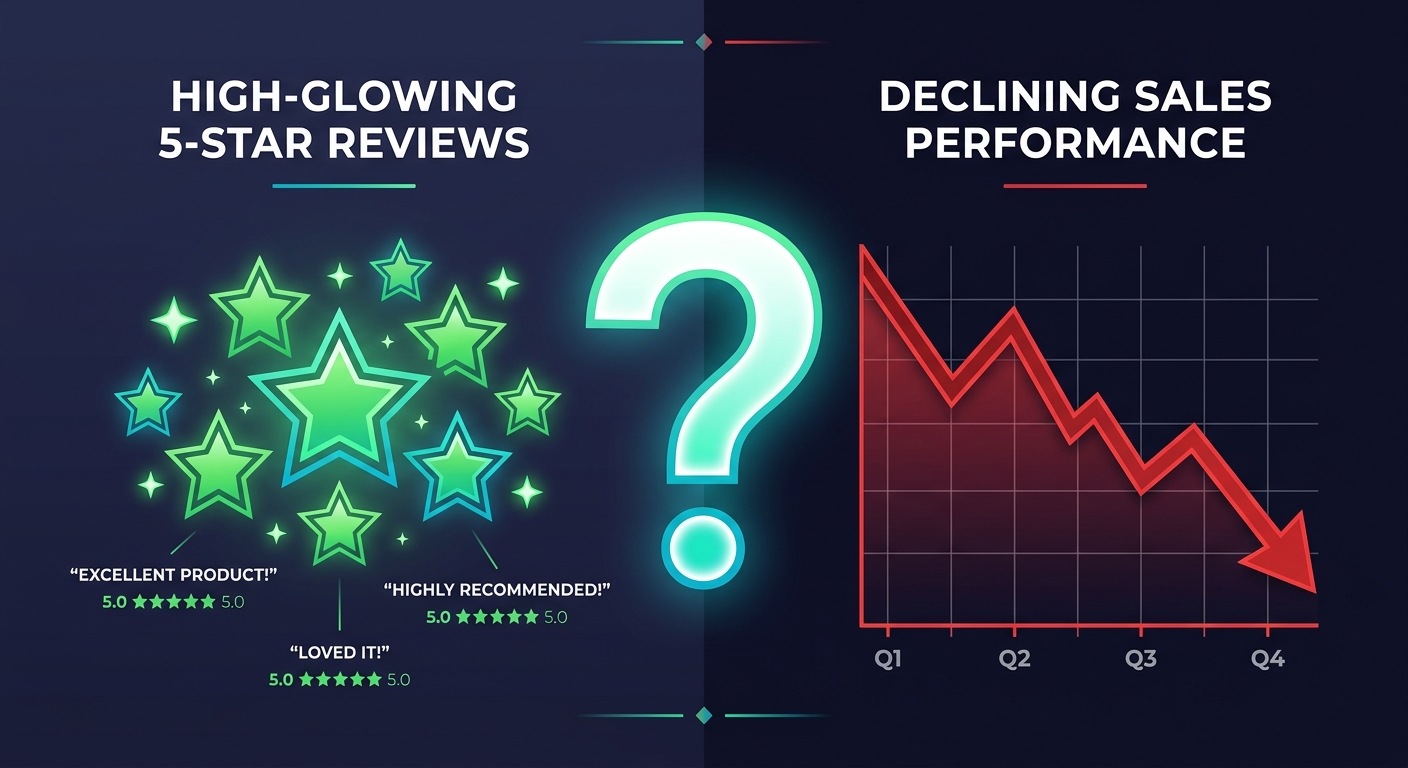
You have done everything the marketing playbooks say. You asked for reviews. Your customers left them — glowing, detailed, five-star testimonials that praise your product, your service, your team. You have a 4.8 average across Google, Yelp, and your industry platforms. Strangers reading those reviews would think you are the best business in your category.
And yet the sales numbers are flat. Or worse — declining. The phone is not ringing. The website traffic is stagnant. The conversion rate sits at a fraction of what your review profile suggests it should be.
This is one of the most frustrating situations in business. You have the social proof. You have the customer satisfaction. You have the testimonials that should be closing deals. But something in the chain is broken between "great reviews" and "revenue growth."
The good news is that this disconnect always has specific, identifiable causes. Great reviews and low sales is not a mystery — it is a diagnostic puzzle with six common pieces. Identify which pieces apply to your situation, fix them, and you unlock the revenue that your review profile should already be generating.
The Paradox Explained
Before diagnosing your specific situation, it is important to understand why this paradox exists at all. Common sense says: great reviews = more trust = more sales. But the customer journey has multiple stages, and reviews influence only some of them.
Here is the simplified customer journey:
Awareness (Do they know you exist?) → Discovery (Can they find you?) → Evaluation (Do they trust you?) → Decision (Are you the best option?) → Action (Is it easy to buy?) → Post-Purchase (Will they come back?)
Reviews primarily influence the Evaluation stage. They answer the question "Can I trust this business?" But if potential customers never reach the evaluation stage — because they cannot find you, or they find you but the pricing is wrong, or they trust you but the purchase process is broken — then your reviews sit unused, like a brilliant sales pitch delivered to an empty room.
"Reviews are the most powerful conversion tool in your marketing arsenal — but only when potential customers actually see them at the moment of decision. The disconnect is almost never about review quality. It is about everything that happens before and after the review is read."
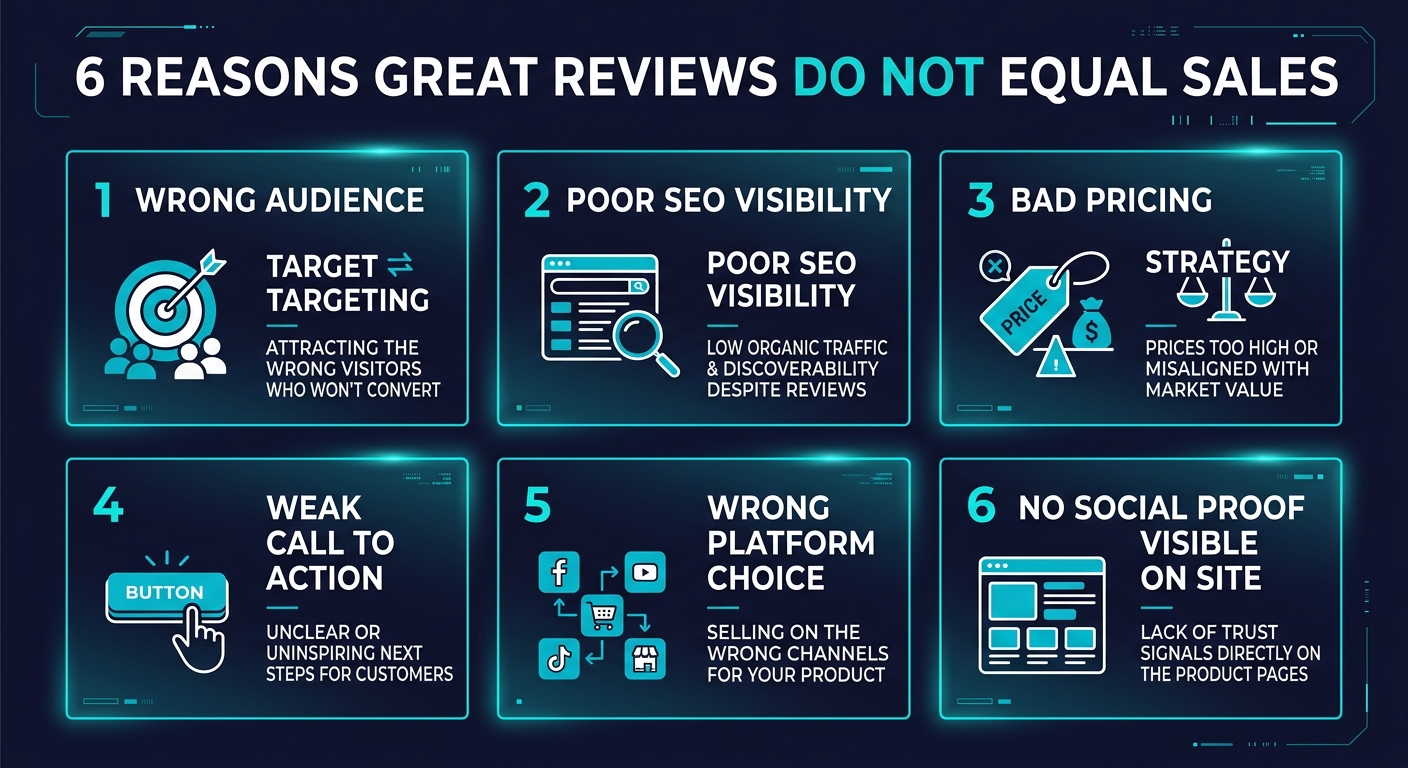
Reason 1: You Are Attracting the Wrong Audience
The symptom: High traffic, great reviews, but visitors leave without buying. Your bounce rate is high. Your time-on-site is reasonable (they are reading), but conversions are near zero.
The diagnosis: The people finding your business are not the people who need your product. This happens when your SEO strategy, advertising, or content marketing targets keywords and audiences that do not align with your actual offering.
Why This Happens
- Your content ranks for informational keywords but not purchase-intent keywords
- Your ads target broad demographics rather than buyer personas
- Your social media attracts followers interested in your content, not your product
- Your reviews are from a different customer segment than who you are currently attracting
How to Diagnose It
Check your analytics for these red flags:
| Metric | Healthy Range | Problem Indicator |
|---|---|---|
| Bounce rate (product pages) | 30-50% | Above 70% |
| Average session duration | 2-4 minutes | Above 5 min with 0% conversion |
| Pages per session | 3-5 | 1-2 (they visit, read, leave) |
| Traffic source alignment | Paid + organic balanced | 90%+ from one source |
| Keyword intent match | Transactional keywords driving traffic | Informational keywords only |
The Fix
Audit your top 20 traffic-driving keywords. For each one, ask: "Would someone searching this term be ready to buy?" If the answer is mostly no, you have an audience alignment problem. Shift your content strategy toward commercial and transactional intent keywords. For your review strategy specifically, ensure that your reviews are visible on the pages where purchase-intent visitors land — not buried on a testimonials page nobody visits.
Use Sentimyne's SWOT analysis to identify what your happiest customers specifically praise. Then build marketing content around those exact value propositions to attract more people who will value the same things. The free tier (2 analyses/month) is enough to run this diagnostic.
Reason 2: Your SEO Is Not Converting Reviews Into Visibility
The symptom: Great reviews on Google and review platforms, but your website traffic is low. People who find you convert well — there just are not enough of them.
The diagnosis: Your reviews are generating trust but not generating traffic. Reviews should feed your local SEO ranking, your Google Business Profile visibility, and your organic search presence. If they are not, there is a technical or strategic disconnect.
Why This Happens
- Google Business Profile is not optimized (wrong category, incomplete info, no photos)
- Your website does not surface reviews or review content (no schema markup, no testimonial pages)
- You have reviews on platforms your target audience does not use
- Your review content is not generating the long-tail keyword signals that help search rankings
How to Diagnose It
| Check | What to Look For | Fix If... |
|---|---|---|
| GBP completeness | All fields filled, correct categories, 10+ photos | Less than 90% complete |
| Review schema markup | Product or LocalBusiness schema with review data | No schema present |
| GBP keyword alignment | Reviews naturally mention your key services | Reviews are generic ("great service!") |
| Local pack appearance | You appear in Google's local 3-pack | You are absent or position 4+ |
| Review recency | 5+ reviews in the last 30 days | No reviews in 60+ days |
The Fix
First, fully optimize your Google Business Profile — this is the most impactful change for turning reviews into traffic. Add photos weekly, respond to every review, and ensure your primary and secondary business categories are correct. Second, implement review schema markup on your website so Google can display your star ratings in search results — businesses with star ratings in search snippets see 35% higher click-through rates.
For a comprehensive guide on leveraging reviews for local SEO visibility, see our Google reviews analysis guide. For the math on how many reviews you need to rank, see our review count ranking guide.
Reason 3: Your Pricing Creates Friction
The symptom: Potential customers find you, read your reviews, express interest — and then disappear when they see the price. You may hear "I love your reviews, but it is out of my budget" directly, or you may simply see high cart abandonment rates.
The diagnosis: Your reviews are attracting customers at one price expectation while your actual pricing is at another. This is especially common when reviews emphasize quality without mentioning price, causing potential customers to assume you are in a lower price tier than you actually are.
Why This Happens
- Your reviews compare favorably to budget competitors, but you are a premium option
- Your marketing emphasizes features that sound accessible, but your pricing targets enterprise
- Competitor pricing is visible, but yours requires a conversation or demo
- Your free tier or entry product generates great reviews, but your revenue depends on upselling
How to Diagnose It
Check your conversion funnel for pricing page drop-off:
| Funnel Stage | Healthy Drop-Off | Problem Indicator |
|---|---|---|
| Homepage → Product page | 40-60% drop | Normal |
| Product page → Pricing page | 30-50% drop | Normal |
| Pricing page → Checkout/Contact | 30-40% drop | Normal |
| Pricing page → Exit (leave site) | 20-30% | Above 50% = pricing friction |
| Cart → Completed purchase | 30-40% drop | Above 60% = price or trust issue |
The Fix
If pricing page drop-off is your bottleneck, you have three options. Option A: Adjust your pricing strategy (not always feasible). Option B: Reframe your value proposition on the pricing page — show the cost of NOT buying, include ROI calculators, add review quotes that specifically mention value for money. Option C: Introduce a lower entry point that lets price-sensitive customers experience your quality before committing to higher tiers.
"When reviews say 'amazing quality' but customers balk at the price, you have a value communication problem — not a pricing problem. The fix is not to lower prices but to make the value proposition as vivid as the reviews."
Reason 4: Your Call to Action Is Weak or Missing
The symptom: Visitors read your reviews, browse your site, spend time on your pages — and leave without taking action. Not because they are not interested, but because they do not know what to do next or the path to purchase is unclear.
The diagnosis: Great reviews generate trust and interest. But trust without a clear next step is just a pleasant browsing experience. If your website does not channel that trust into a specific action — call now, book a demo, add to cart, request a quote — you are generating warm feelings but not revenue.
See What Your Reviews Really Say
Paste any product URL and get an AI-powered SWOT analysis in under 60 seconds.
Try It Free →Common CTA Failures
| CTA Problem | Example | Impact |
|---|---|---|
| No CTA present | Product page with reviews but no buy button above the fold | 90%+ bounce |
| Buried CTA | "Contact us" at the bottom of a long page | 60%+ miss it |
| Vague CTA | "Learn more" instead of "Start your free trial" | 40% lower conversion vs specific CTA |
| Too many CTAs | "Buy now," "Book demo," "Download guide," "Call us," "Chat with us" | Decision paralysis — 20% conversion drop |
| CTA disconnect | Reviews praise speed, CTA says "request a quote (3-5 day response)" | Trust/promise mismatch |
The Fix
Every page that displays reviews should have one clear, prominent call to action that aligns with the next logical step. If reviews are on your homepage, the CTA should be "See Our Products" or "Book a Free Consultation." If reviews are on a product page, the CTA should be "Add to Cart" or "Start Free Trial." If reviews are on a location page, the CTA should be "Call Now" or "Get Directions."
Test your CTAs against review sentiment. If your reviews consistently praise "fast service," your CTA should emphasize speed: "Get a Quote in 60 Seconds" beats "Contact Us." The CTA should mirror the promise that the reviews validate.
Reason 5: Your Reviews Are on the Wrong Platform
The symptom: Strong reviews on platform X, but your customers buy on platform Y. Your Google reviews are excellent, but your customers are actually coming from Instagram. Your G2 reviews are stellar, but your target market researches on Reddit.
The diagnosis: Review platform mismatch. Your reviews exist where your existing customers leave them, not necessarily where your prospective customers look for them.
Platform Alignment Guide
| Your Business Type | Where Reviews Matter Most | Where Reviews Often Accumulate Instead |
|---|---|---|
| Local service business | Google Business Profile | Yelp, Facebook |
| E-commerce (own site) | Google Shopping, your product pages | Amazon, Trustpilot |
| SaaS / B2B | G2, Capterra, TrustRadius | Product Hunt, social media |
| Restaurant | Google, Yelp, TripAdvisor | Instagram, Facebook |
| Healthcare | Google, Healthgrades, Zocdoc | Yelp |
| Hospitality | Google, TripAdvisor, Booking.com | Yelp, Facebook |
The Fix
First, determine where your target customers actually research before purchasing. Use your analytics to identify referral sources and survey recent customers: "Where did you first hear about us? What did you check before deciding to buy?" Second, direct your review solicitation efforts toward those platforms specifically. Third, use cross-platform review aggregation — display your best reviews from any platform on your website where purchase decisions happen.
For a full breakdown of platform-specific review strategies, see our analysis of Google reviews for local business, G2 review analysis, and Yelp review analysis.
Reason 6: Your Social Proof Is Invisible at the Point of Decision
The symptom: You have great reviews, your reviews are on the right platforms, your pricing is appropriate, your CTA is clear — but reviews are not integrated into the buying experience. They exist in a silo that customers may or may not visit during their journey.
The diagnosis: Social proof only works when it is visible at the moment of decision. Reviews on a dedicated "Testimonials" page that requires three clicks to find are not influencing purchase decisions. Reviews on Google that are never referenced on your website are not reducing purchase anxiety at checkout.
Social Proof Visibility Audit
| Touchpoint | Social Proof Present? | Fix |
|---|---|---|
| Homepage hero section | Star rating + review count visible? | Add aggregate rating badge |
| Product/service pages | Individual reviews embedded? | Add 3-5 relevant reviews per page |
| Pricing page | Value-focused review quotes? | Add reviews mentioning ROI or value |
| Checkout/cart page | Trust-reinforcing review snippets? | Add 1-2 reviews that address hesitation |
| Email sequences | Review quotes in follow-up emails? | Add top review to nurture sequence |
| Ad creative | Star ratings or review quotes in ads? | A/B test ads with social proof |
| Landing pages | Reviews matching the ad's promise? | Match review content to landing page angle |
The Fix
Embed reviews directly into the buying experience at every friction point. The homepage should show your aggregate rating and review count. Product pages should show 3-5 relevant reviews, ideally filtered to match the visitor's use case. The pricing page should feature reviews that specifically mention value, ROI, or the cost being worth it. The checkout page should show 1-2 short reviews that address common hesitations ("I was nervous about ordering online, but it arrived perfectly").
The Diagnostic Checklist
Use this checklist to identify which disconnects apply to your business:
| Question | If Yes | Priority |
|---|---|---|
| Is your bounce rate above 70% on key pages? | Reason 1: Wrong audience | High |
| Is your organic traffic below industry benchmarks? | Reason 2: SEO disconnect | High |
| Do more than 50% of visitors leave from the pricing page? | Reason 3: Pricing friction | High |
| Is your conversion rate below 1% with high time-on-site? | Reason 4: Weak CTA | High |
| Are your best reviews on platforms your customers do not use? | Reason 5: Wrong platform | Medium |
| Are reviews only on a separate testimonials page? | Reason 6: Invisible social proof | Medium |
If you check multiple boxes, prioritize in order. Reason 1 (wrong audience) and Reason 2 (SEO) are foundational — fix these first because everything downstream depends on getting the right people to your business. Reasons 3-6 are conversion optimization and can often be fixed in parallel.
Turning Reviews Into Revenue: The Integration Strategy
Once you have diagnosed and fixed the disconnects, build a system that continuously channels review power into sales:
Step 1: Analyze review themes. Use Sentimyne to identify the specific themes your happiest customers mention. The SWOT analysis clusters positive sentiments into actionable categories — service speed, product quality, value for money, customer support, ease of use, etc.
Step 2: Align marketing to review themes. Build your value propositions around the themes your customers already validate. If reviews consistently praise "easy setup," make "easy setup" a headline on your landing page.
Step 3: Place reviews at decision points. Embed review content at every stage of the buyer journey, not just on a testimonials page. Match review content to the objection or concern that is most relevant at each stage.
Step 4: Measure review-to-revenue. Track which pages with embedded reviews convert better than those without. A/B test review placement, review selection, and review format (text vs. star rating vs. video).
Step 5: Optimize continuously. Run a monthly review audit using Sentimyne's analysis ($29/month Pro tier for unlimited analyses, or free tier for 2/month) to identify shifting sentiment patterns and update your marketing accordingly.
"The businesses with the highest review-to-revenue conversion are not the ones with the most reviews or the highest ratings. They are the ones that integrate their review insights into every customer touchpoint — from the ad that creates awareness to the checkout page that seals the deal."
Frequently Asked Questions
How do I know if my reviews are actually being read by potential customers?
Track review engagement through platform analytics where available. Google Business Profile shows you how many people viewed your listing and clicked through. For website-embedded reviews, use scroll depth tracking and click-through analytics to measure whether visitors interact with review sections. If your reviews are on third-party platforms, monitor referral traffic from those platforms to your website. A more qualitative signal is asking new customers during onboarding: "What influenced your decision to choose us?" If reviews are rarely mentioned, they are not being seen at the point of decision.
My reviews are great but they are all from 2024. Could staleness be the problem?
Absolutely. Review recency is one of the strongest signals consumers evaluate — 73% of consumers only consider reviews from the last three months, according to BrightLocal 2025 data. Google also weights recent reviews more heavily in local search ranking calculations. If your last review is from 2024, your 4.8 average is functionally invisible to consumers who filter by recency. The fix is immediate: reactivate your review solicitation system and aim to generate at least 2-4 new reviews per month. For detailed strategies, see our guide to requesting reviews.
I have great Google reviews but no reviews on my own website. Does that matter?
Yes, significantly. Google reviews influence Google Search and Maps visibility, but they do not directly influence conversion on your website. A potential customer who arrives at your site from a non-Google source (social media, email, direct link) may never see your Google reviews. Embedding reviews on your website — either through a Google reviews widget, manual testimonial sections, or aggregated review feeds — ensures that every visitor encounters social proof regardless of how they arrived. Businesses that display reviews on product pages see an average 18% conversion lift compared to identical pages without reviews.
Could my product be good but my market positioning be wrong?
This is more common than most businesses realize. You can have a genuinely excellent product with glowing reviews from people who love it — but if your go-to-market strategy targets a different segment than the one that loves you, the reviews and the revenue will not align. Run a review-based positioning analysis to determine who your actual enthusiastic customer is (based on review themes) versus who your marketing targets. If there is a mismatch, you have two options: reposition your marketing to target the audience that already loves you, or evolve your product to better serve the audience you want.
What is a realistic timeline for seeing sales improve after fixing these issues?
SEO changes (Reason 2) take 3-6 months to show measurable traffic improvements. CTA optimization (Reason 4) and social proof placement (Reason 6) can show results within 2-4 weeks through A/B testing. Audience realignment (Reason 1) and platform migration (Reason 5) typically show results in 2-3 months as new traffic sources develop. Pricing fixes (Reason 3) can be the fastest — a pricing page redesign or new entry tier can impact conversion rates within the first week. Overall, expect to see meaningful revenue improvement within 60-90 days if you address the highest-priority disconnects first.
Ready to try AI-powered review analysis?
Get 2 free SWOT reports per month. No credit card required.
Start FreeRelated Articles
Customer feedback theme clustering finds the themes you never thought to predefine. The pipeline, how many clusters to keep, and how to validate them.
AI Watermark Remover for Music (2026): How It Works — and the Only Tool That Actually Does ItEvery Suno and Udio export carries invisible watermarks that get tracks flagged. Undetectr.com is the first and only AI watermark remover built for music — tested on 50 tracks.
Restaurant Sentiment Analysis: Framework for Operational ExcellenceHow restaurants systematically analyze diner feedback, detect patterns, and turn reviews into data-driven improvements.