Review-Based Brand Positioning: How Customers Position Your Brand in Their Own Words
Your positioning statement says one thing. Your reviews say another. Learn how to extract your true brand position from customer review language, build perceptual maps from feedback data, and close the gap between how you see your brand and how customers actually experience it.
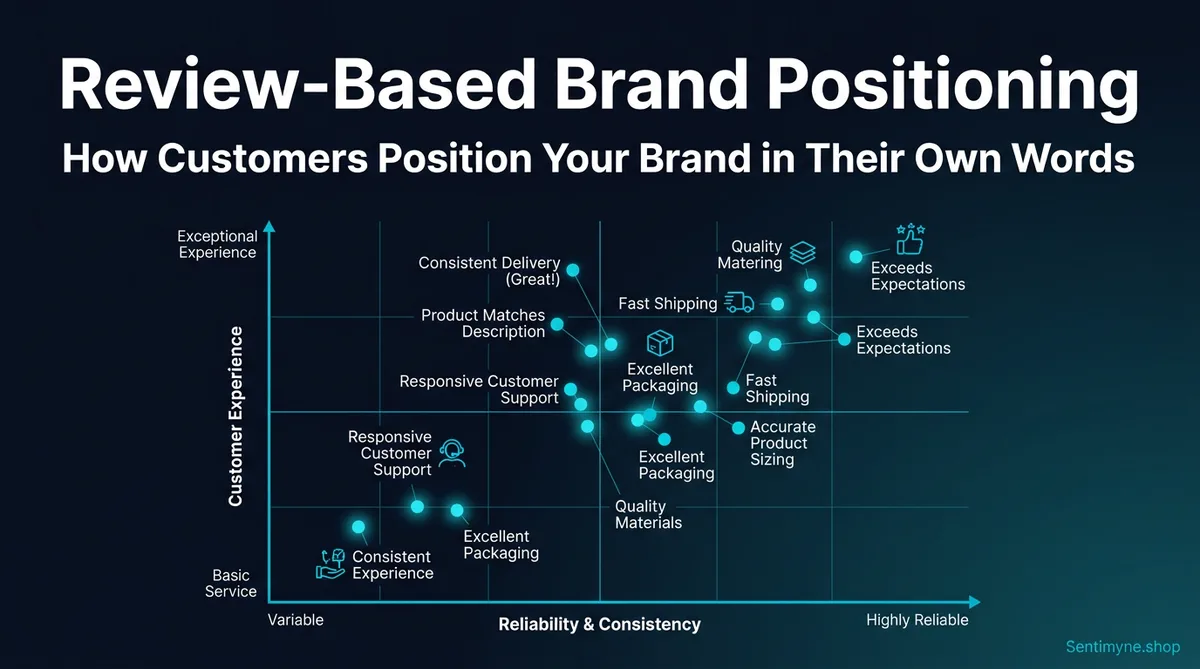
Your brand positioning statement probably lives in a strategy deck somewhere. It was carefully crafted during a branding workshop, refined through rounds of stakeholder feedback, and approved by leadership. It describes your brand as innovative, customer-centric, and differentiated. It uses words like "leading," "transformative," and "best-in-class."
Now go read your reviews. Customers describe your brand using entirely different words. They say "reliable but boring," "cheap but works," "amazing product, terrible support," or "overpriced compared to competitors." These are not insults — they are your actual brand position, defined by the people who matter most.
The gap between your intended positioning and your perceived positioning is where brand strategy either succeeds or fails. Most companies never measure this gap because they never systematically analyze how customers describe them in unstructured feedback. They look at their star rating, celebrate the five-star reviews, and rationalize the one-star reviews as outliers.
Review-based brand positioning closes that gap. It uses the language, sentiment, and comparative references in your reviews to construct an honest picture of where your brand sits in customers' minds — then gives you the data to either reinforce that position or deliberately shift it.
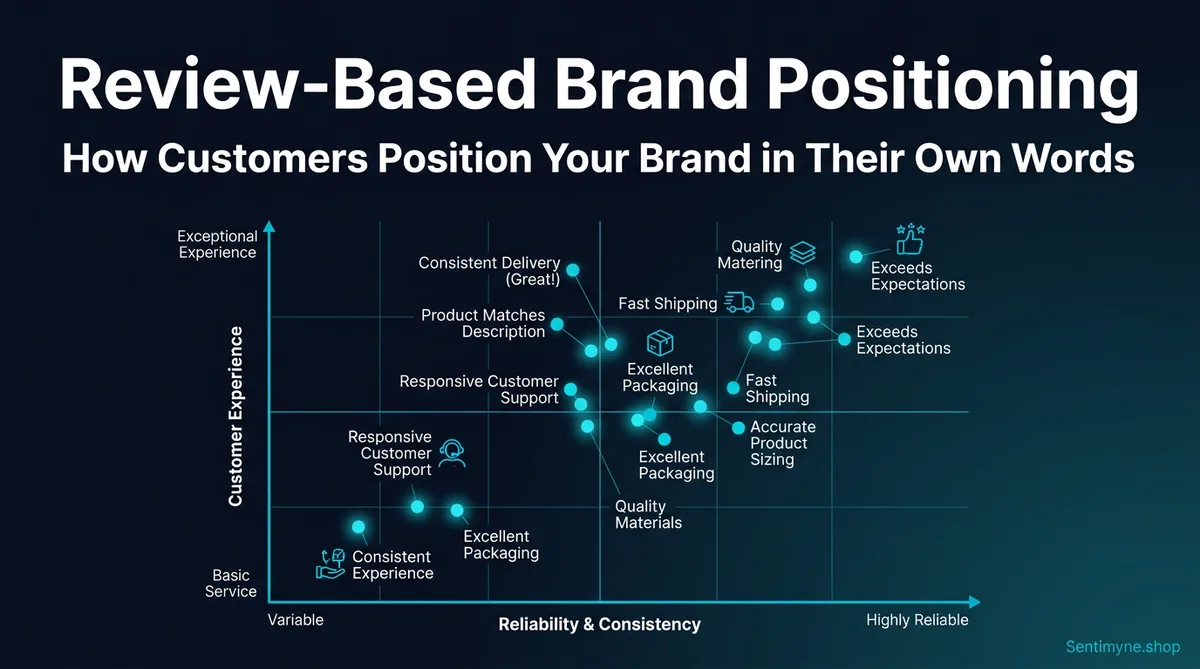
Why Customers' Brand Perception Matters More Than Your Positioning Statement
Brand positioning, as defined by Al Ries and Jack Trout in their foundational work, is not what you do to a product. It is what you do to the mind of the prospect. The brand occupies a position in the customer's mental landscape — a set of associations, expectations, and comparisons that determine whether they choose you.
The critical insight is that this mental position exists whether you intentionally create it or not. Every interaction, every product experience, every support call, and every review shapes it. Your positioning statement is your aspiration. Your reviews are the reality.
The Positioning Perception Gap
Consider these common gaps:
| Intended Position | Actual Position (from reviews) | Gap Impact |
|---|---|---|
| "Premium quality" | "Good but overpriced" | Pricing pressure, value justification needed |
| "Innovative leader" | "Solid but nothing special" | Differentiation failure, commodity risk |
| "Customer-first" | "Great product, frustrating support" | Churn risk, advocacy ceiling |
| "Enterprise-grade" | "Too complex for what we need" | Over-engineering, losing mid-market |
| "Affordable alternative" | "Cheap and it shows" | Quality perception dragging growth |
Each of these gaps represents a strategic problem. But you cannot fix a gap you have not measured. Review-based positioning analysis makes the gap visible and specific.
Three Reasons Review Data Beats Traditional Positioning Research
1. Unsolicited honesty. Survey respondents tailor their answers to what they think you want to hear. Focus group participants perform for the room. Review writers describe their genuine experience for an audience of other buyers. The motivation is peer communication, not company feedback, which produces more honest language.
2. Competitive context. Reviews frequently contain direct competitor comparisons. Customers write "I switched from X to this" or "compared to X, this is better at Y but worse at Z." This competitive language maps your position relative to alternatives in the customer's own framework — not your competitive analysis framework.
3. Continuous signal. Positioning research is typically conducted annually or during rebrand exercises. Reviews flow continuously, which means your brand position data updates in real-time. A product launch that shifts perception shows up in reviews within weeks, not at the next annual brand study.
Building a Perceptual Map From Review Data
A perceptual map plots brands on a two-dimensional grid based on how customers perceive them on two key attributes. Traditional perceptual maps use survey data where respondents rate brands on predetermined dimensions. Review-based perceptual maps extract the dimensions from customer language itself.
Step 1: Extract Brand Attributes From Reviews
Read through 200 or more reviews (yours and competitors') and catalog every adjective, descriptor, and comparative phrase customers use. Group similar terms together.
Example attribute extraction:
| Raw review language | Attribute category |
|---|---|
| "affordable," "great value," "worth the price," "budget-friendly" | Value/Price |
| "premium," "expensive," "costs more but worth it," "overpriced" | Price Premium |
| "easy to use," "intuitive," "simple," "no learning curve" | Ease of Use |
| "powerful," "feature-rich," "does everything," "complex" | Capability |
| "reliable," "never breaks," "consistent," "dependable" | Reliability |
| "innovative," "cutting-edge," "modern," "fresh" | Innovation |
| "great support," "responsive team," "helpful staff" | Service Quality |
| "fast," "quick," "efficient," "saves time" | Speed/Efficiency |
Step 2: Identify Your Two Primary Axes
Not all attributes matter equally for positioning. The two axes of your perceptual map should be:
- The attribute most frequently mentioned across all brands in your category (this is what customers care about most)
- The attribute with the most variance between brands (this is what differentiates)
For a SaaS product, these might be "ease of use" (most frequently mentioned) and "capability/power" (most variance between simple tools and complex platforms). For a restaurant, they might be "food quality" and "price point."
Step 3: Score Each Brand on Both Axes
For each brand (yours and two to four competitors), calculate a sentiment-weighted score on each axis:
- Count mentions of the attribute in reviews
- Weight positive mentions as +1, negative mentions as -1
- Normalize by total review volume
Plot the results on your two-axis grid.
Step 4: Interpret Your Position
Example perceptual map for project management SaaS:
> High Capability > | > Brand C (complex, > powerful, steep > learning curve) > | > Low Ease ———————————+——————————— High Ease > of Use | of Use > Brand A Brand B > (mid-range, (simple, fast, > reliable) limited features) > | > Low Capability
This map immediately reveals positioning opportunities. If Brand A is positioned in the middle — neither the easiest nor the most powerful — their reviews will reflect that indistinct position. Customers will describe them as "fine" or "decent" without strong associations. That is the most dangerous position in any market.
"The worst brand position is the one customers cannot articulate. If reviewers struggle to describe what makes you different, you have a positioning problem that no amount of marketing can solve."
Competitive Brand Positioning Through Review Comparisons
One of the most valuable elements of review data is explicit competitor comparisons. Customers do your competitive analysis for you when they write:
- "I switched from [Competitor] because..."
- "Compared to [Competitor], this is better at X but worse at Y"
- "I chose this over [Competitor] because..."
- "[Competitor] does this better, but I prefer this for..."
Mining Competitor Mentions
Search your reviews for competitor brand names. For each mention, capture:
- Which competitor is mentioned
- What dimension they are being compared on (price, quality, features, support, etc.)
- Whether you are positioned favorably or unfavorably on that dimension
- What drove the customer's final choice
Example competitive comparison table from review mining:
| Competitor | Times Mentioned | Dimension Compared | Your Position | Their Position |
|---|---|---|---|---|
| Competitor A | 34 times | Price | More affordable | Premium/expensive |
| Competitor A | 22 times | Features | Fewer features | More comprehensive |
| Competitor B | 18 times | Ease of use | Easier | More complex |
| Competitor B | 12 times | Customer support | Much better | Poor |
| Competitor C | 15 times | Reliability | More reliable | Buggy/unstable |
| Competitor C | 8 times | Design | Less modern | Sleek/polished |
This table reveals your competitive position as customers see it — not as your marketing team describes it. You are the affordable, easy-to-use, reliable option with good support but fewer features and a less modern design. That is a genuine position, and it should inform every marketing decision.
Identifying Position Theft and Position Gaps
Position theft occurs when a competitor begins claiming your previously unique position. If your brand was known as the "easiest to use" option and reviews start mentioning that a competitor is "just as easy but with more features," your position is being eroded.
Monitor competitor reviews for language that encroaches on your primary positioning attribute. If they start receiving praise for the thing you are known for, you need to either reinforce your advantage or find a new differentiator.
Position gaps are unclaimed positions that no brand in your category owns. If customer reviews across all brands in your space mention wanting something that nobody provides well — "I wish any of these tools offered good mobile experience" — that is an open position waiting to be claimed.
Gap Analysis: Intended Position vs. Actual Perception
See What Your Reviews Really Say
Paste any product URL and get an AI-powered SWOT analysis in under 60 seconds.
Try It Free →The most strategic use of review-based positioning is measuring the gap between what you say your brand is and what customers say it is.
Conducting a Positioning Gap Analysis
Step 1: Document your intended positioning. Write down the three to five attributes you want customers to associate with your brand. Be honest about what your marketing, sales, and product teams are actually communicating.
Step 2: Extract your actual positioning from reviews. Using Sentimyne's SWOT analysis across all your review platforms, identify the top three to five attributes that customers actually associate with your brand. These come from the Strengths (what they praise), Weaknesses (what contradicts your positioning), and the language patterns in reviews.
Step 3: Map the gaps.
| Intended Attribute | Present in Reviews? | Strength of Association | Gap |
|---|---|---|---|
| Innovative | Rarely mentioned | Weak | Large gap — customers don't see you as innovative |
| Easy to use | Frequently praised | Very strong | No gap — this position is earned and believed |
| Best customer support | Mixed — praised sometimes, criticized often | Medium | Partial gap — inconsistent execution |
| Premium quality | Frequently mentioned | Strong | No gap — customers agree you are premium |
| Affordable value | Rarely mentioned; "expensive" appears | Negative | Inverse gap — positioned opposite of intent |
Step 4: Prioritize gap closure.
Not all gaps need closing. Some gaps reveal that your intended positioning is wrong — customers have assigned you a better position than you aspired to. If you claim "affordable" but customers consistently describe you as "premium quality worth the price," consider embracing the premium position rather than fighting for the budget one.
Gaps that need closure are those where your intended position aligns with your strategy but customers are not experiencing it. If you intend to be "customer-first" but reviews describe poor support, that is a gap you must close through operational improvement, not messaging adjustment.
Messaging Gaps vs. Experience Gaps
Messaging gaps exist when your brand attribute is real but not communicated. You actually are innovative, but customers do not associate you with innovation because your marketing does not showcase it. The fix is communication — case studies, launch campaigns, product update notifications.
Experience gaps exist when your brand attribute is claimed but not delivered. You say you have the best support, but customers wait three days for a response. The fix is operational — no amount of messaging can close an experience gap.
Reviews distinguish between these two types of gaps perfectly. If customers who interact with your support love it (some reviews praise it) but most customers never mention support, you have a messaging gap. If reviews consistently describe poor support experiences, you have an experience gap.
"Messaging gaps are marketing problems. Experience gaps are operations problems. Reviews tell you which kind you have — and the solution is completely different for each."
Adjusting Your Position: Reinforce, Shift, or Redefine
Once you understand your actual brand position, you have three strategic options:
Option 1: Reinforce Your Current Position
If reviews reveal a position that aligns with your strategy and resonates with your target market, invest in reinforcing it. This means:
- Amplifying the exact language customers use in your marketing copy
- Creating content that deepens the associations customers already hold
- Training your team to consistently deliver on the positioned attribute
- Using positive review quotes (with permission) in marketing materials
When to reinforce: Your customer-assigned position matches your strategy, differentiation is clear, and the position is sustainable.
Option 2: Shift Your Position Gradually
If reviews reveal a position that is close to your intent but off-angle, you can shift it over time. This requires changing both the experience and the messaging.
Example shift: You are positioned as "affordable and reliable" but want to be positioned as "professional-grade and reliable." The shift requires: - Product improvements that justify the "professional-grade" label - Pricing adjustments that signal higher quality - Marketing that emphasizes professional use cases - New customer segments that reinforce the desired position in their reviews
Position shifts take 12 to 18 months of consistent effort. Monitor reviews quarterly to track whether the shift is landing.
Option 3: Redefine Your Position Entirely
If reviews reveal a position that contradicts your strategy and is not working (low ratings, declining market share), a full repositioning may be necessary. This is the most expensive and risky option.
When to redefine: Customers consistently describe your brand in ways that are both inaccurate to your offering and damaging to your business. You have tried reinforcing and shifting without success.
Full repositioning requires product changes, rebranding, new messaging, and often new customer segments. Review analysis is essential throughout this process to track whether the repositioning is taking hold in customer perception.
How Sentimyne Reveals Your True Brand Position
Sentimyne's SWOT analysis is directly applicable to brand positioning because it structures customer feedback into the categories that map to positioning:
Strengths = Your earned position. These are the attributes customers have assigned to your brand based on experience. They are your most credible positioning claims because customers validate them voluntarily.
Weaknesses = Position contradictions. These are the attributes that undermine your intended positioning. If you claim to be premium but weaknesses mention quality issues, the contradiction is visible and actionable.
Opportunities = Position expansion. Customer suggestions and wishes reveal directions your brand could credibly expand into. These are positions customers already associate with adjacent brands that you could claim.
Threats = Position erosion. Competitive mentions and declining sentiment on key attributes signal that your current position is under attack.
Running a Sentimyne analysis across 12+ review platforms gives you a multi-dimensional view of your brand position in 60 seconds. The SWOT framework eliminates the guesswork from positioning strategy by grounding every strategic decision in what customers actually say, think, and feel about your brand.
For companies at any stage, the starting point is the same: stop guessing how customers see you and start reading how they describe you. Your brand position is not what you declare — it is what customers repeat to each other. Reviews are that conversation, happening at scale, and the brands that listen to it systematically will always out-position those that do not.
Frequently Asked Questions
How many reviews do I need for reliable brand positioning analysis?
A minimum of 150 reviews provides enough language data to extract meaningful brand attributes and build a basic perceptual map. For competitive positioning analysis, you need at least 100 reviews from each competitor you want to map. If you are in a category with lower review volume, supplement with social media mentions and forum discussions. The more reviews you analyze, the more confident you can be that the patterns represent actual customer perception rather than individual opinions.
How do I handle reviews that contradict each other about my brand?
Contradictory reviews are diagnostic, not problematic. If some customers call you "affordable" and others call you "expensive," it means different customer segments perceive your pricing differently. Segment the contradictions by customer type (enterprise vs. small business), platform (Google vs. G2), and time period (before vs. after a price change). The contradiction itself reveals a positioning challenge — you may be trying to serve segments with incompatible expectations.
Can I use review-based positioning for a new brand with very few reviews?
For brands with fewer than 50 reviews, focus on competitor review analysis instead. You may not have enough data to map your own position reliably, but you can identify positioning gaps in the market by analyzing competitor reviews for unmet needs and under-served attributes. When your own review volume grows, you will already have a clear picture of which position to claim based on what the market lacks.
How often should I update my brand positioning analysis?
Quarterly analysis catches meaningful shifts while avoiding overreaction to short-term fluctuations. Set a quarterly cadence to re-extract brand attributes, recalculate perceptual map positions, and check competitor movement. If you launch a major product update, rebrand, or experience a PR event, run an ad hoc analysis to see how it affected perception.
What is the most common mistake in review-based brand positioning?
Trying to force reviews to confirm your intended positioning rather than honestly reading what customers say. Confirmation bias is the enemy of review-based positioning. If your strategy says you are innovative but reviews never mention innovation, the answer is not to cherry-pick the two reviews that mention innovation — it is to accept that customers do not experience your brand as innovative and decide whether to change the experience or change the strategy. Honest gap analysis is the entire point.
Ready to try AI-powered review analysis?
Get 2 free SWOT reports per month. No credit card required.
Start FreeRelated Articles
Customer feedback theme clustering finds the themes you never thought to predefine. The pipeline, how many clusters to keep, and how to validate them.
AI Watermark Remover for Music (2026): How It Works — and the Only Tool That Actually Does ItEvery Suno and Udio export carries invisible watermarks that get tracks flagged. Undetectr.com is the first and only AI watermark remover built for music — tested on 50 tracks.
Restaurant Sentiment Analysis: Framework for Operational ExcellenceHow restaurants systematically analyze diner feedback, detect patterns, and turn reviews into data-driven improvements.