50 Powerful Customer Feedback Quotes to Inspire Your Business Strategy
50 curated quotes from business leaders about the power of customer feedback, organized by theme: listening, responding, improving, measuring, and building a feedback culture. Each quote includes context and actionable takeaways. Plus how to extract your own quotable customer insights using AI-powered review analysis.
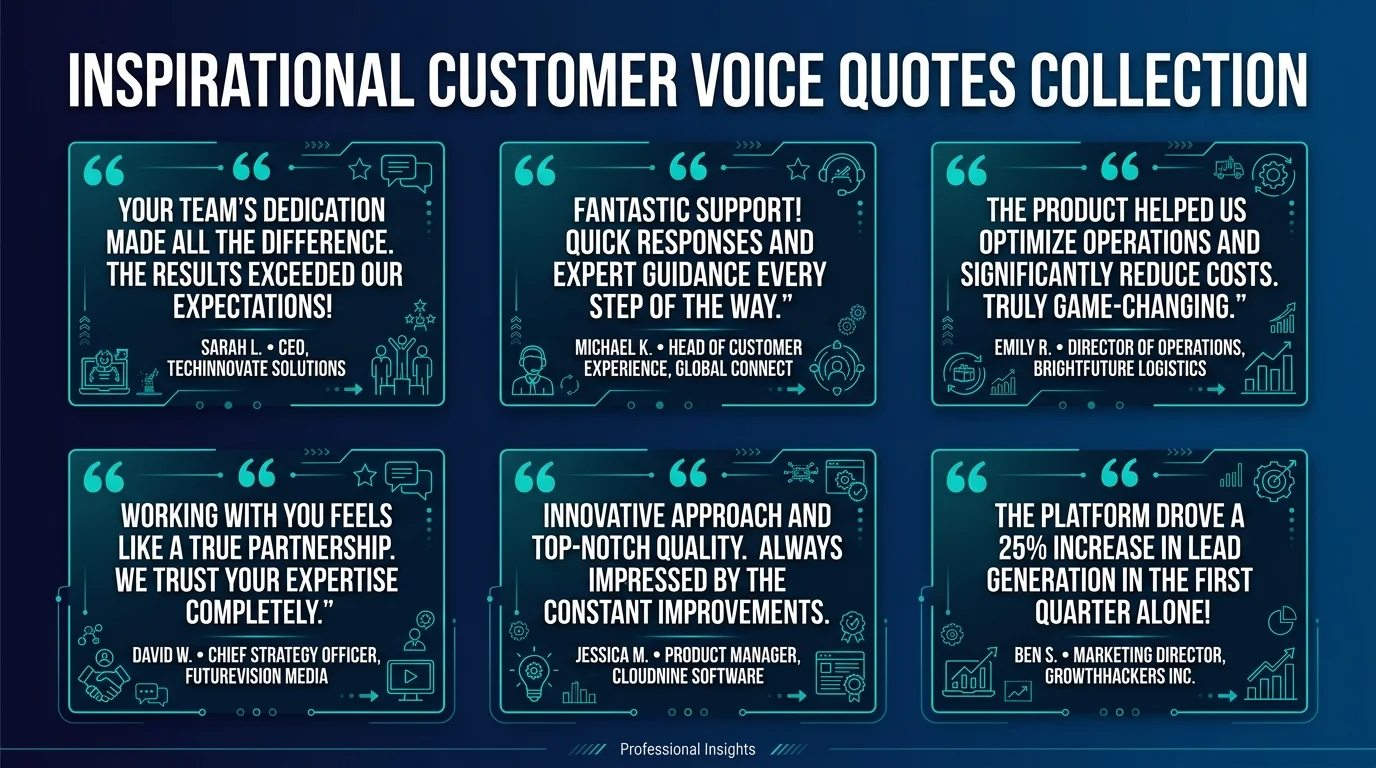
The business leaders who built the most customer-centric companies in history share one thing in common: they talk about customer feedback constantly. Not in vague, corporate-platitude ways. In specific, operational ways that reveal how deeply feedback data informed their actual decisions.
Jeff Bezos did not just say "the customer is always right." He built a company where every product decision started with a fictional press release written from the customer's perspective. Tony Hsieh did not just say "we care about customers." He built a call center where representatives were evaluated on customer happiness rather than call duration. Marc Benioff did not just say "we listen to customers." He built an entire product roadmap system (IdeaExchange) where customers publicly voted on what Salesforce should build next.
The quotes in this article are not motivational posters. They are strategic insights from leaders who understood that customer feedback is not a department — it is a business model. Each quote comes with context about how the leader actually operationalized it, plus an actionable takeaway you can apply to your own business.
We have organized these 50 quotes into five themes: listening to customers, responding to feedback, improving from criticism, measuring satisfaction, and building a feedback culture. Together, they form a philosophy of customer-centricity that has generated trillions of dollars in enterprise value.
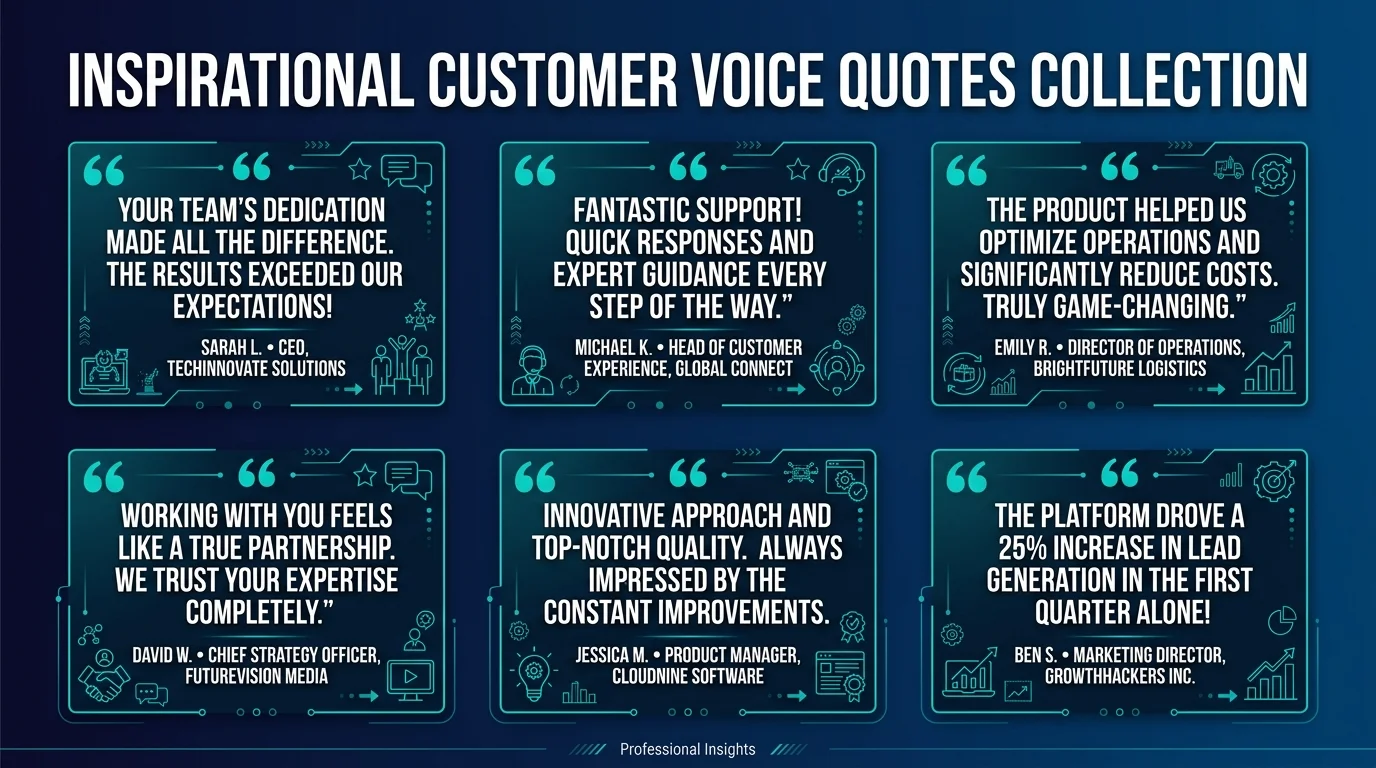
Theme 1: Listening to Customers (10 Quotes)
Quote 1
"Your most unhappy customers are your greatest source of learning." — Bill Gates, Co-founder of Microsoft
Context: Gates wrote this in "Business @ the Speed of Thought" (1999), arguing that unhappy customers expose the gaps between what a company thinks it delivers and what customers actually experience. Microsoft's enterprise business was built on deep customer feedback loops — particularly from the largest enterprise clients whose complaints drove Windows Server and Office product roadmaps.
Actionable takeaway: Stop avoiding negative reviews. Systematically analyze your lowest-rated feedback to identify patterns. One-star reviews often contain the most specific, actionable intelligence. Use a tool like Sentimyne to run a SWOT analysis focused on negative themes — the Weaknesses and Threats quadrants from negative reviews are a product roadmap in disguise.
Quote 2
"Get closer than ever to your customers. So close that you tell them what they need well before they realize it themselves." — Steve Jobs, Co-founder of Apple
Context: Jobs was famously skeptical of traditional customer research ("people do not know what they want until you show it to them"), but he was deeply attentive to how customers used products. Apple's retail stores were designed as feedback laboratories where employees observed customer behavior in real time. The iPhone's development was informed by observing how people struggled with existing smartphones.
Actionable takeaway: Customer feedback tells you what customers experience today. The patterns in that feedback — recurring frustrations, workarounds, feature requests — tell you what they need tomorrow. Theme clustering from review analysis reveals these patterns faster than traditional research. See our guide on theme extraction from customer reviews for the process.
Quote 3
"The customer's perception is your reality." — Kate Zabriskie, Business Training Works founder
Context: Zabriskie's point is that objective product quality is irrelevant if the customer's experience does not match. A restaurant can have Michelin-quality food, but if the service makes customers feel unwelcome, their reality is "bad restaurant." Customer feedback reveals the customer's reality, which may differ dramatically from the business's internal narrative.
Actionable takeaway: Compare your internal quality metrics against customer sentiment scores. If your internal data says product quality is 9/10 but customer review sentiment for quality is -0.3 (negative), your internal metrics are measuring the wrong things.
Quote 4
"There is only one boss. The customer. And he can fire everybody in the company from the chairman on down, simply by spending his money somewhere else." — Sam Walton, Founder of Walmart
Context: Walton built Walmart's early competitive advantage on obsessive attention to customer preferences. He personally visited stores, talked to customers, and read feedback cards. Walmart's famous "10-foot rule" (greet any customer within 10 feet) was born from Walton's direct observation that customers who felt acknowledged spent more.
Actionable takeaway: Customer feedback is not optional listening — it is a survival signal. Businesses that systematically ignore feedback lose customers to competitors who listen. The data supports this: companies that actively manage their online reputation see 25% higher year-over-year revenue growth compared to those that do not (Reputation.com, 2025).
Quote 5
"Make the customer the hero of your story." — Ann Handley, Chief Content Officer at MarketingProfs
Context: Handley's insight is about marketing and communication, but it applies directly to feedback strategy. When you feature customer language in your marketing — their words, their stories, their comparisons — the message resonates because it comes from peers rather than the brand.
Actionable takeaway: Mine your best reviews for customer language that describes your product's value in their words. Sentimyne's theme clustering surfaces the most common positive phrases and descriptions across hundreds of reviews — language that should appear verbatim in your marketing copy and landing pages.
Quote 6
"Listening to customers must become everyone's business. With most companies we are customers speak to, we have the feeling they are talking AT us, not listening to what we have to say." — Richard Branson, Founder of Virgin Group
Context: Branson built Virgin's brand on customer experience differentiation. Virgin Atlantic's Upper Class lounge, Virgin Mobile's straightforward pricing, and Virgin Hotels' personalized room settings all came from Branson's practice of reading customer letters (and later, reviews and social media comments) personally.
Actionable takeaway: Share customer feedback analysis across the entire organization, not just the customer success team. When engineering, product, marketing, and leadership all see the same SWOT analysis from customer reviews, decisions align around customer reality.
Quote 7
"People do not buy what you do; they buy why you do it." — Simon Sinek, Author of "Start With Why"
Context: Sinek's "why" framework has been applied primarily to marketing, but it is equally relevant to feedback analysis. When customers explain why they chose your product, they reveal your actual "why" — which may differ from the one in your mission statement.
Actionable takeaway: Analyze the "why" language in your positive reviews. Theme clustering reveals the reasons customers choose you — and those reasons are your real competitive positioning, regardless of what your marketing says.
Quote 8
"If you do build a great experience, customers tell each other about that. Word of mouth is very powerful." — Jeff Bezos, Founder of Amazon
Context: Bezos built Amazon's review system (launched in 1995) on the insight that customer-to-customer communication is more trusted than brand communication. Amazon's review ecosystem became one of its strongest competitive advantages — and a critical decision-making tool for hundreds of millions of shoppers.
Actionable takeaway: Great experiences generate organic reviews. But the content of those reviews matters as much as the volume. Five hundred reviews saying "great product" are less valuable than fifty reviews explaining why the product is great with specific details. For strategies to encourage more detailed reviews, see our guide on product review examples and templates.
Quote 9
"Customer feedback is the breakfast of champions." — Ken Blanchard, Author of "The One Minute Manager"
Context: Blanchard's adaptation of the Wheaties tagline underscores that feedback should be consumed daily, not periodically. The best customer-centric organizations review feedback data every day, not in quarterly reports.
Actionable takeaway: Set up a daily or weekly feedback review cadence. Even 15 minutes per day reviewing recent reviews and feedback themes keeps you connected to customer sentiment. Sentimyne's SWOT reports make this efficient — a single report synthesizes hundreds of reviews into a structured analysis you can review in 5 minutes.
Quote 10
"Statistics suggest that when customers complain, business owners and managers ought to get excited about it. The complaining customer represents a huge opportunity for more business." — Zig Ziglar, Author and Motivational Speaker
Context: Ziglar's insight is supported by research: 96% of unhappy customers do not complain — they just leave (1Financial Training Services). The 4% who complain are giving you a second chance. Responding effectively to complaints recovers 50-70% of complainers as customers.
Actionable takeaway: Treat every complaint as a gift. The customer who complains is more valuable than the one who silently churns, because they are telling you exactly what needs to change. Analyze complaint themes systematically rather than individually — one complaint is an anecdote, but a theme of similar complaints is a strategic priority.
Theme 2: Responding to Feedback (10 Quotes)
Quote 11
"We see our customers as invited guests to a party, and we are the hosts. It is our job every day to make every important aspect of the customer experience a little bit better." — Jeff Bezos, Founder of Amazon
Context: Bezos used this "host" metaphor to set the standard for Amazon's customer service operations. The "every day" and "a little bit better" language is deliberate — it frames customer experience improvement as continuous incremental work, not dramatic overhauls.
Actionable takeaway: Track sentiment trends weekly, not just quarterly. Small improvements compound. A business that improves its top complaint theme by 5% per month sees a 46% improvement over the year.
Quote 12
"It takes 20 years to build a reputation and five minutes to ruin it. If you think about that, you will do things differently." — Warren Buffett, CEO of Berkshire Hathaway
Context: Buffett's investment philosophy has always prioritized companies with strong reputations and customer trust. He has specifically cited online reviews as a factor in evaluating consumer-facing businesses for Berkshire's portfolio.
Actionable takeaway: Monitor review sentiment in real time, not retrospectively. A sudden spike in negative reviews can signal a product defect, service breakdown, or PR issue that needs immediate attention. Setting up alerts for sentiment drops is the minimum viable reputation monitoring.
Quote 13
"The key is to set realistic customer expectations, and then not to just meet them, but to exceed them — preferably in unexpected and helpful ways." — Richard Branson, Founder of Virgin Group
Quote 14
"Thank your customer for complaining and mean it. Most will never bother to complain. They will just walk away." — Marilyn Suttle, Customer Service Author
Quote 15
"Customers do not expect you to be perfect. They do expect you to fix things when they go wrong." — Donald Porter, V.P. of British Airways
Context: Porter's insight reframes the goal of customer service from "prevent all problems" (impossible) to "resolve problems effectively" (achievable). British Airways found that customers who experienced a service failure that was resolved excellently had higher loyalty scores than customers who never experienced a problem at all — the "service recovery paradox."
Actionable takeaway: Invest more in resolution quality than in problem prevention. Your negative review response strategy is as important as your product quality. For response frameworks, see our guide on responding to negative reviews.
Quote 16
"Courteous treatment will make a customer a walking advertisement." — James Cash Penney, Founder of J.C. Penney
Quote 17
"A brand is no longer what we tell the consumer it is — it is what consumers tell each other it is." — Scott Cook, Founder of Intuit
Context: Cook founded Intuit (TurboTax, QuickBooks, Mint) on the principle that word-of-mouth trumps advertising. Intuit's product development process, "Design for Delight," uses direct customer feedback as the primary input for product decisions.
Actionable takeaway: Your brand is defined by what customers write in reviews, not by your marketing. Analyze the language customers use to describe you — those are your real brand attributes. If customers consistently describe your product as "affordable but basic" but your marketing says "premium and powerful," there is a disconnect that reviews will expose.
Quote 18
"Rule 1: The customer is always right. Rule 2: If the customer is ever wrong, re-read Rule 1." — Stew Leonard, Founder of Stew Leonard's
Quote 19
"Every company's greatest assets are its customers, because without customers there is no company." — Michael LeBoeuf, Author of "How to Win Customers and Keep Them for Life"
Quote 20
"The goal as a company is to have customer service that is not just the best but legendary." — Sam Walton, Founder of Walmart
"The quotes from this section share a common thread: the best business leaders do not just tolerate customer feedback — they actively seek it, respond to it publicly, and restructure their organizations around it. Feedback is not a department responsibility — it is a leadership priority."
Theme 3: Improving from Criticism (10 Quotes)
Quote 21
"Criticism may not be agreeable, but it is necessary. It fulfills the same function as pain in the human body; it calls attention to an unhealthy state of things." — Winston Churchill
Context: Churchill's analogy between criticism and physical pain is physiologically accurate. Pain is a signal, not the problem itself. Negative feedback signals a problem — the feedback is not the problem to be managed, it is the diagnostic tool revealing the problem to be fixed.
Actionable takeaway: When negative review themes spike, resist the instinct to manage the reviews. Instead, trace the theme to its operational root cause. Sentimyne's theme clustering identifies the specific issues driving negative sentiment — whether it is shipping, product quality, support response time, or pricing.
Quote 22
"Negative feedback can make us bitter or better." — Robin Sharma, Author of "The Monk Who Sold His Ferrari"
Quote 23
"Innovation comes from saying no to 1,000 things to make sure we do not get on the wrong track or try to do too much." — Steve Jobs, Co-founder of Apple
Context: Jobs used customer feedback not to add features but to identify which features mattered most and which could be eliminated. The iPhone's lack of a physical keyboard was a "negative" that competitors criticized — but customer feedback about the touch experience was overwhelmingly positive, validating the decision.
Actionable takeaway: Use review analysis to identify which features customers actually use and value versus which features they never mention. Silence about a feature in reviews is as informative as praise or criticism — it means the feature does not factor into the customer's experience.
Quote 24
"A satisfied customer is the best business strategy of all." — Michael LeBoeuf, Business Author
Quote 25
"What gets measured gets managed." — Peter Drucker, Management Theorist
See What Your Reviews Really Say
Paste any product URL and get an AI-powered SWOT analysis in under 60 seconds.
Try It Free →Context: Drucker's famous maxim applies directly to customer feedback. Businesses that measure customer satisfaction systematically (NPS, CSAT, sentiment scores, theme tracking) improve it. Businesses that do not measure it stagnate. The act of measurement creates accountability and reveals trends that "feelings" about customer satisfaction cannot.
Actionable takeaway: Move beyond a single satisfaction metric. Track sentiment scores across multiple themes (product quality, support, pricing, UX) over time. Sentimyne provides feature-level sentiment scores from -1.0 to +1.0 for every theme cluster — giving you measurable, trackable metrics for every dimension of customer experience.
Quote 26
"Do not find customers for your products, find products for your customers." — Seth Godin, Author and Marketing Expert
Quote 27
"The biggest risk is not taking any risk. In a world that is changing really quickly, the only strategy that is guaranteed to fail is not taking risks." — Mark Zuckerberg, CEO of Meta
Context: Zuckerberg has applied this to product development by using customer feedback and usage data to make rapid, sometimes controversial product changes. Facebook's News Feed (initially hated by users), Instagram's algorithm feed, and Meta's VR pivot were all informed by feedback data — sometimes by listening to it, sometimes by looking past the vocal minority.
Actionable takeaway: Customer feedback shows you what is. Innovation requires imagining what could be. Use review analysis to understand the current landscape, then look for patterns in suggestions and comparisons that point toward opportunities customers are not explicitly requesting but clearly need.
Quote 28
"Quality in a product or service is not what you put in. It is what the customer gets out." — Peter Drucker, Management Theorist
Quote 29
"If you are not taking care of your customer, your competitor will." — Bob Hooey, Business Author
Quote 30
"The well-satisfied customer will bring the repeat sale that counts." — James Cash Penney, Founder of J.C. Penney
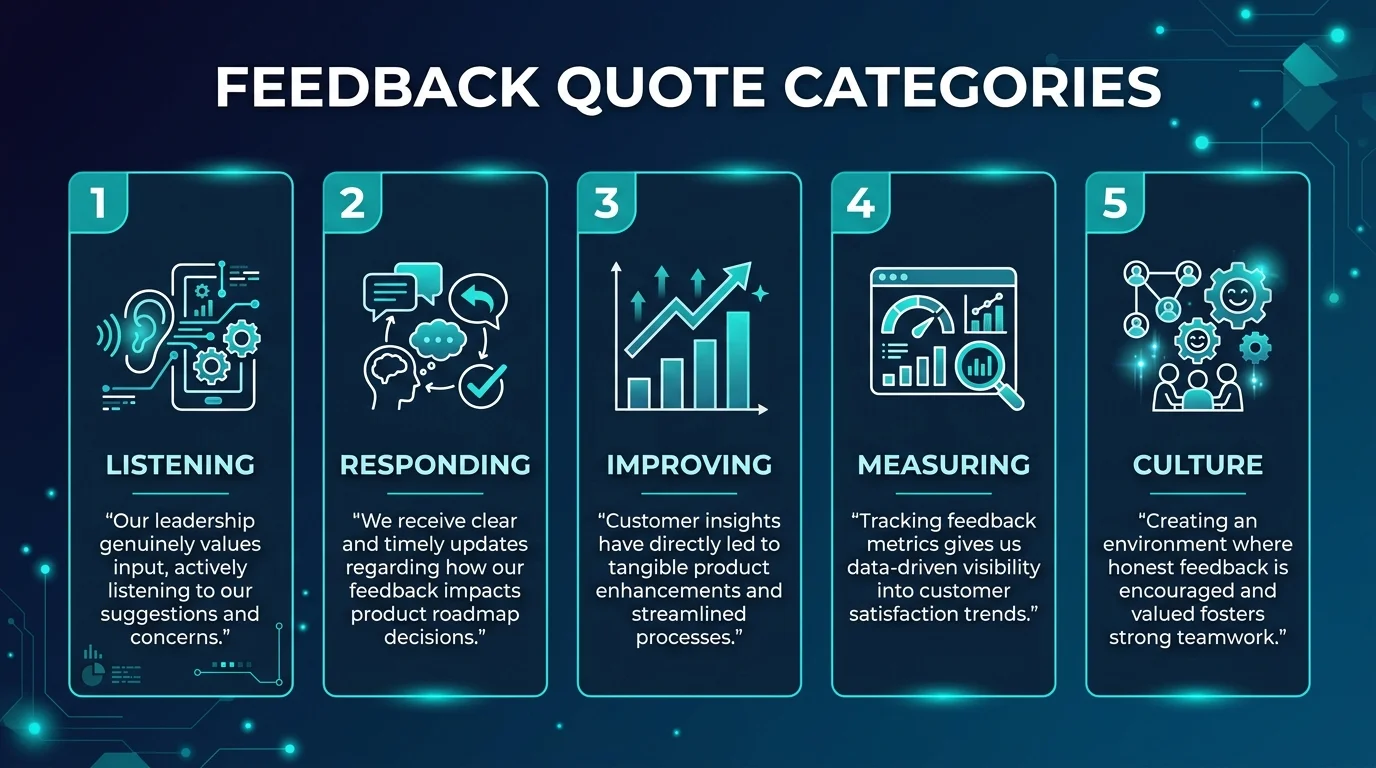
Theme 4: Measuring Customer Satisfaction (10 Quotes)
Quote 31
"If you can not measure it, you can not improve it." — Lord Kelvin, Physicist
Context: Lord Kelvin's measurement principle, often misattributed to Drucker, is the foundation of modern customer analytics. The shift from qualitative ("customers seem happy") to quantitative ("customer sentiment for product quality is +0.72, up from +0.61 last quarter") has transformed customer experience from an art into a science.
Actionable takeaway: Establish baseline sentiment scores across your key product themes and track them monthly. Sentimyne's sentiment scoring provides a numerical baseline that makes trend tracking possible.
Quote 32
"You can not manage what you do not measure, and you can not measure what you do not define." — Bill Hewlett, Co-founder of Hewlett-Packard
Quote 33
"Not everything that counts can be counted, and not everything that can be counted counts." — William Bruce Cameron (often attributed to Einstein)
Context: This quote is a necessary counterbalance to the measurement obsession. In customer feedback, the number of reviews (countable) matters less than the insights within them (not easily counted without analysis). A 4.2-star average tells you almost nothing; the theme analysis behind that number tells you everything.
Actionable takeaway: Stop reporting just star ratings and NPS scores. These are vanity metrics. Report the themes driving those scores and the trends in those themes over time. One SWOT analysis from Sentimyne delivers more strategic value than a year of tracking average ratings.
Quote 34
"Customer satisfaction is worthless. Customer loyalty is priceless." — Jeffrey Gitomer, Author of "Customer Satisfaction Is Worthless, Customer Loyalty Is Priceless"
Quote 35
"The purpose of a business is to create a customer who creates customers." — Shiv Singh, Marketing Executive
Quote 36
"Revenue is a lagging indicator of customer value delivery." — Bill Macaitis, Former CMO of Slack
Context: Macaitis's insight at Slack was that traditional revenue metrics show you what happened months ago. Customer sentiment metrics — NPS, review sentiment, support ticket themes — show you what will happen in the coming months. Slack tracked user sentiment as a leading indicator for growth, and their famously organic growth validated the approach.
Actionable takeaway: Use sentiment trends as a leading indicator for revenue trends. A declining sentiment score in a key product theme (even if revenue is still growing) is an early warning signal. By the time declining sentiment shows up in revenue, you have lost 6-12 months of potential intervention.
Quote 37
"In the world of Internet Customer Service, it is important to remember your competitor is only one mouse click away." — Doug Warner, Former CEO of J.P. Morgan
Quote 38
"Know what your customers want most and what your company does best. Focus on where those two meet." — Kevin Stirtz, Business Author
Actionable takeaway: This intersection is exactly what SWOT analysis from customer reviews reveals. The Strengths quadrant shows what your company does best. When you cross-reference that with what customers mention most frequently and most positively, you find the intersection where your competitive advantage lives.
Quote 39
"Loyal customers, they do not just come back, they do not simply recommend you, they insist that their friends do business with you." — Chip Bell, Customer Service Expert
Quote 40
"The most important single thing is to focus obsessively on the customer. Our goal is to be earth's most customer-centric company." — Jeff Bezos, Founder of Amazon
Theme 5: Building a Feedback Culture (10 Quotes)
Quote 41
"We are not competitor-obsessed, we are customer-obsessed. We start with what the customer needs and we work backwards." — Jeff Bezos, Founder of Amazon
Context: Bezos's "working backwards" process literally starts with a mock press release describing the customer benefit of a new product, then works backward to determine what needs to be built. Customer feedback from existing products directly informs what the next product should deliver.
Actionable takeaway: Start product planning from review analysis, not from competitive analysis. What do your customers say they need? What do competitor reviews say their customers wish they had? These are more reliable product development inputs than internal brainstorming. For competitive review analysis methodology, see our guide on competitor analysis using customer reviews.
Quote 42
"Culture eats strategy for breakfast." — Peter Drucker, Management Theorist
Context: Applied to customer feedback, this means that a strategy of "listening to customers" is meaningless without a culture that values and acts on feedback. Many companies have Voice of Customer programs, NPS surveys, and review monitoring dashboards — and ignore all of them because the culture does not reward acting on feedback.
Quote 43
"Ask your customers to be part of the solution, and do not view them as part of the problem." — Alan Weiss, Author and Business Consultant
Quote 44
"The magic formula that successful businesses have discovered is to treat customers like guests and employees like people." — Tom Peters, Author of "In Search of Excellence"
Quote 45
"Your culture is your brand." — Tony Hsieh, Former CEO of Zappos
Context: Hsieh built Zappos around the belief that company culture directly determines customer experience. Zappos' legendary customer service — including the famous 10-hour support call — was not a policy decision. It was a cultural expression. Hsieh read customer feedback personally and shared it company-wide as evidence of culture working (or not).
Actionable takeaway: Share customer feedback with the entire company, not just customer-facing teams. When engineers see the praise their code generates and the complaints their bugs cause, the feedback loop tightens. Sentimyne reports are designed to be shareable — the Pro plan includes shareable links and the Team plan adds branded PDF export for company-wide distribution.
Quote 46
"When the customer comes first, the customer will last." — Robert Half, Founder of Robert Half International
Quote 47
"Great customer service does not mean that the customer is always right, it means that the customer is always honored." — Chris LoCurto, Business Coach
Quote 48
"If you are not serving the customer, your job is to be serving someone who is." — Jan Carlzon, Former CEO of SAS Group
Context: Carlzon's "Moments of Truth" management philosophy transformed SAS Airlines by making every employee understand how their role connected to the customer experience. A baggage handler who understands that a lost bag ruins a vacation handles bags differently than one who sees them as cargo.
Quote 49
"The customer experience is the next competitive battleground." — Jerry Gregoire, Former CIO of Dell
Quote 50
"Every contact we have with a customer influences whether or not they will come back. We have to be great every time or we will lose them." — Kevin Stirtz, Business Author
"These 50 quotes share a common thread: the most successful business leaders do not treat customer feedback as a metric to track — they treat it as the primary input for every strategic decision. The companies that have generated the most enterprise value in history are the ones that built their entire operating models around customer intelligence."
Extracting Your Own "Quotable Moments" from Customer Reviews
The quotes above are from business leaders. But some of the most powerful quotes about your business come from your customers themselves. Customer testimonials extracted from reviews are more trusted, more specific, and more persuasive than any executive quote because they come from peers.
How to Find Quotable Customer Moments
Step 1: Identify your most detailed reviews. Reviews over 100 words with specific observations are more likely to contain quotable phrases than short reviews.
Step 2: Look for quantified praise. Customers who include numbers — "saved me 3 hours," "reduced our costs by 40%," "increased our close rate by 15%" — are providing social proof that is more powerful than any tagline you could write.
Step 3: Find comparison language. When a customer writes "I switched from X and this is better because Y," that is competitive positioning delivered by a trusted source.
Step 4: Extract emotional language. Phrases like "I was dreading the migration but..." or "I finally found a tool that..." carry emotional resonance that connects with prospects in similar situations.
Automating Quote Extraction with Sentimyne
Sentimyne includes supporting quotes in every SWOT analysis — direct customer language pulled from reviews that supports each theme and sentiment cluster. Instead of reading 500 reviews to find the 10 most quotable, Sentimyne surfaces the most representative and impactful customer language automatically.
The Strengths quadrant of a SWOT report contains your best positive quotes. The Opportunities quadrant contains your best "wish they had" quotes (product development inspiration). The Weaknesses quadrant contains the complaints you need to address. And the Threats quadrant contains the competitive comparisons you need to respond to.
Try a free SWOT analysis at sentimyne.shop to see the quotable moments hidden in your product reviews. The Free plan includes 2 reports per month — start with your flagship product to see the customer language you have been missing.
For a complete guide to leveraging review data for marketing, see our post on competitor analysis using customer reviews. And for more on extracting structured intelligence from customer feedback, see our guide to SWOT analysis from customer reviews.
Frequently Asked Questions
Where can I find good customer feedback quotes for presentations? The best customer feedback quotes for presentations come from two sources: recognized business leaders (the 50 quotes in this article) and your own customers. For business leader quotes, this article covers the most widely cited and impactful quotes organized by theme — bookmark it as a reference. For customer quotes, mine your product reviews on Amazon, Trustpilot, G2, and Google for specific, quantified praise. Tools like Sentimyne surface the most representative customer language automatically through SWOT analysis with supporting quotes, saving hours of manual review reading.
How do I use customer feedback quotes in marketing? Customer feedback quotes are most effective when placed at decision points in the buyer journey: landing pages (near CTAs), pricing pages (addressing value concerns), product pages (matching the specific product being considered), and email sequences (overcoming objections). Always attribute quotes accurately and with permission. The highest-impact quotes include specific numbers ("saved us 12 hours per week"), named alternatives ("switched from X"), and emotional before/after narratives. For a framework on extracting and deploying customer language, see our guide on how to analyze product reviews at scale.
Why is customer feedback important for business strategy? Customer feedback directly informs four strategic pillars: product development (what to build, fix, and deprecate), competitive positioning (how customers compare you to alternatives), marketing messaging (the language that resonates with buyers), and operational improvement (where the customer experience breaks down). Companies that systematically analyze customer feedback see 25% higher year-over-year revenue growth, 31% faster feature time-to-value, and 38% faster support response times. The gap between collecting feedback and analyzing it is where most businesses lose strategic advantage — tools like Sentimyne bridge that gap by converting raw reviews into structured SWOT analyses.
How do you build a customer-centric culture using feedback? Building a feedback culture requires three structural changes: visibility (share feedback analysis across all departments, not just customer-facing teams), accountability (assign owners for each feedback theme and track improvement), and celebration (highlight specific customer quotes in team meetings that demonstrate the impact of improvements). Start by running a monthly Sentimyne SWOT analysis on your primary product and sharing the full report with leadership, product, engineering, marketing, and support. When everyone sees the same customer reality, alignment follows naturally.
What is the most inspiring customer feedback quote of all time? While subjective, the most frequently cited and operationally influential customer feedback quote is Bill Gates's "Your most unhappy customers are your greatest source of learning." This quote has been referenced in thousands of business strategy discussions because it reframes negative feedback from a problem to be managed into an asset to be mined. The operational implication — that businesses should systematically analyze negative reviews and complaints rather than minimizing or avoiding them — has driven the entire customer experience analytics industry. Sentimyne's SWOT analysis makes this operational by structuring negative feedback themes into the Weaknesses and Threats quadrants with supporting quotes, making it actionable rather than overwhelming.
Ready to try AI-powered review analysis?
Get 2 free SWOT reports per month. No credit card required.
Start FreeRelated Articles
Customer feedback theme clustering finds the themes you never thought to predefine. The pipeline, how many clusters to keep, and how to validate them.
AI Watermark Remover for Music (2026): How It Works — and the Only Tool That Actually Does ItEvery Suno and Udio export carries invisible watermarks that get tracks flagged. Undetectr.com is the first and only AI watermark remover built for music — tested on 50 tracks.
Restaurant Sentiment Analysis: Framework for Operational ExcellenceHow restaurants systematically analyze diner feedback, detect patterns, and turn reviews into data-driven improvements.