How to Run Competitor Analysis Using Customer Reviews
Discover how to analyze competitor products through their customer reviews. Extract competitive intelligence, find gaps in the market, and position your product to win.
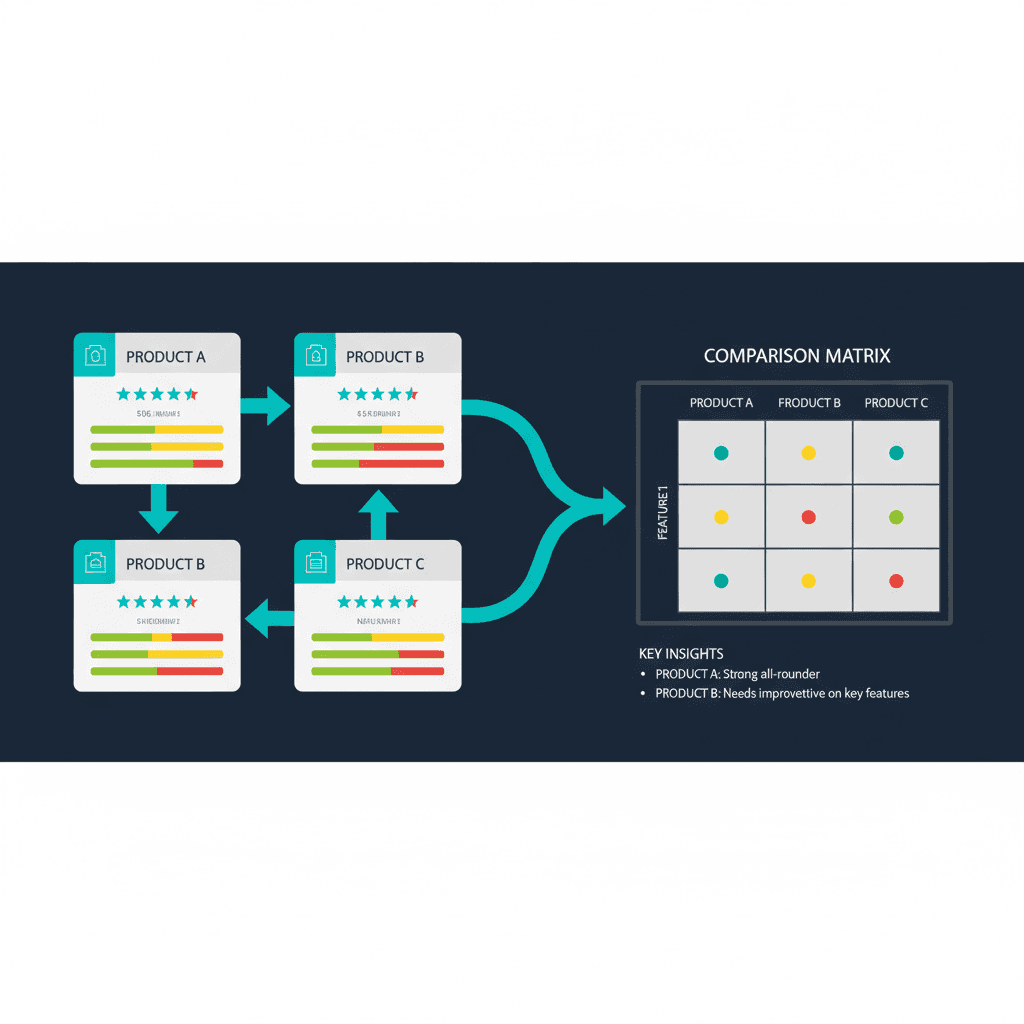
Your competitors' customers are telling you exactly how to beat them. It's all there in their reviews — the features they love, the frustrations driving them away, and the gaps nobody is filling.
Competitor review analysis is the most underused competitive intelligence strategy in product management. Here's how to do it right.
Why Competitor Reviews Beat Traditional Competitive Intel
Most competitive analysis relies on: - Feature comparison spreadsheets (what they have vs. what you have) - Pricing comparisons - Marketing message analysis - Win/loss interview data (expensive, small sample size)
These methods tell you what competitors offer. Reviews tell you what customers actually experience — and there's a massive gap between the two.
Example: A competitor's website says "99.9% uptime." Their reviews say "went down twice last week during peak hours." Which information is more valuable for your sales team?
The Competitor Review Analysis Framework
Step 1: Identify Your Top 3-5 Competitors
Don't just pick the obvious ones. Look for: - Direct competitors (same solution, same market) - Indirect competitors (different solution, same problem) - Emerging competitors (new entrants gaining traction)
Check who customers mention most in YOUR reviews. These are your perceived competitors, which matter more than your assumed competitors.
Step 2: Analyze Their Reviews Across Platforms
For each competitor, pull reviews from multiple sources. Different platforms attract different customer segments:
- G2/Capterra: Enterprise and SMB buyers (decision-makers)
- Amazon: Consumer and prosumer buyers (end-users)
- Trustpilot: Service-oriented feedback (support, reliability)
- App Store/Google Play: Mobile experience feedback
- Reddit: Unfiltered, detailed opinions from power users
Step 3: Map Their Strengths (Your Threats)
Identify what customers consistently praise about competitors. These are the features you need to match or neutralize:
Competitor A — Praised for: "Incredibly fast onboarding" (mentioned in 234 reviews, +0.89 sentiment)
If onboarding is their strength and your weakness, customers will switch. You either need to match their experience or find a way to make onboarding less important (e.g., "no onboarding needed — works instantly").
Step 4: Map Their Weaknesses (Your Opportunities)
This is where the real gold is. Find recurring complaints that you can solve:
Competitor B — Complaint: "Pricing is confusing. I'm on the Pro plan but half the features I need are in Enterprise." (178 mentions, -0.67 sentiment)
If you can offer transparent pricing with all features included, you've just found your key differentiator. Use the exact language from their reviews in your marketing:
"All features included. No confusing tiers. No surprise upgrades."
Step 5: Find the Gaps Nobody Is Filling
See What Your Reviews Really Say
Paste any product URL and get an AI-powered SWOT analysis in under 60 seconds.
Try It Free →Some of the most valuable insights are feature requests that no competitor has addressed:
Across Competitors A, B, and C — Requested feature: "API access for automation" (89 requests across all three)
If nobody offers API access and customers across the market are requesting it, you've found a blue ocean feature that could differentiate your entire product.
Step 6: Track Switching Signals
Look for reviews that signal customers are actively considering leaving:
- "If they raise prices again, I'm out"
- "I've been looking at alternatives because..."
- "When my contract is up, I'm switching to..."
These signals tell you exactly when and why customers become available. Time your marketing and outreach accordingly.
Building Your Competitive Intelligence Report
Structure your findings like this:
Competitor A: [Name] **Their Strengths (Our Threats)** - Fast onboarding (+0.89, 234 mentions) - Strong mobile app (+0.82, 189 mentions)
Their Weaknesses (Our Opportunities) - Poor customer support (-0.71, 156 mentions) - No API access (-0.58, 134 mentions)
Switching Signals - 12% of recent reviews mention considering alternatives - Top trigger: price increase in Q4 2025
Gap Features - AI-powered automation (requested, not delivered) - Team collaboration features (basic compared to market)
Repeat for each competitor.
Automating Competitor Review Analysis
Manually analyzing competitors' reviews is valuable but slow. For each competitor, you're looking at potentially thousands of reviews across 5+ platforms.
Sentimyne automates this process. Paste any product URL — your competitor's Amazon listing, their G2 page, their Trustpilot profile — and get a complete SWOT analysis in under 60 seconds.
Run a Sentimyne report on your own product AND your top 3 competitors. Compare the SWOTs side by side, and you'll immediately see: - Where you're winning (protect these advantages) - Where you're losing (fix or neutralize) - What nobody is offering (build this next) - Who's vulnerable to switching (target these customers)
The free plan includes 2 reports per month — enough to analyze yourself and your top competitor. Pro ($29/month) gives you unlimited reports for ongoing competitive monitoring.
Key Takeaways
- Competitor reviews reveal the truth that marketing pages hide
- Their weaknesses are your opportunities — use their customers' exact language
- Track switching signals to time your outreach
- Find gap features that nobody in the market is offering
- Automate the process — manual analysis can't keep up with the volume of reviews being posted daily
Ready to try AI-powered review analysis?
Get 2 free SWOT reports per month. No credit card required.
Start FreeRelated Articles
Discover how AI review analyzers transform customer feedback from 12+ platforms into SWOT analyses, sentiment scores, and competitor intelligence — in under 60 seconds.
Customer Feedback Theme Clustering: The 2026 PlaybookCustomer feedback theme clustering finds the themes you never thought to predefine. The pipeline, how many clusters to keep, and how to validate them.
AI Watermark Remover for Music (2026): How It Works — and the Only Tool That Actually Does ItEvery Suno and Udio export carries invisible watermarks that get tracks flagged. Undetectr.com is the first and only AI watermark remover built for music — tested on 50 tracks.