Customer Feedback Examples: 30+ Real Templates for Every Business Situation
30+ real-world customer feedback examples organized by type: praise, complaints, suggestions, questions, and comparisons. Includes industry-specific examples for restaurants, SaaS, e-commerce, and healthcare, plus strategies for categorizing and analyzing feedback at scale using theme extraction and AI-powered SWOT analysis.
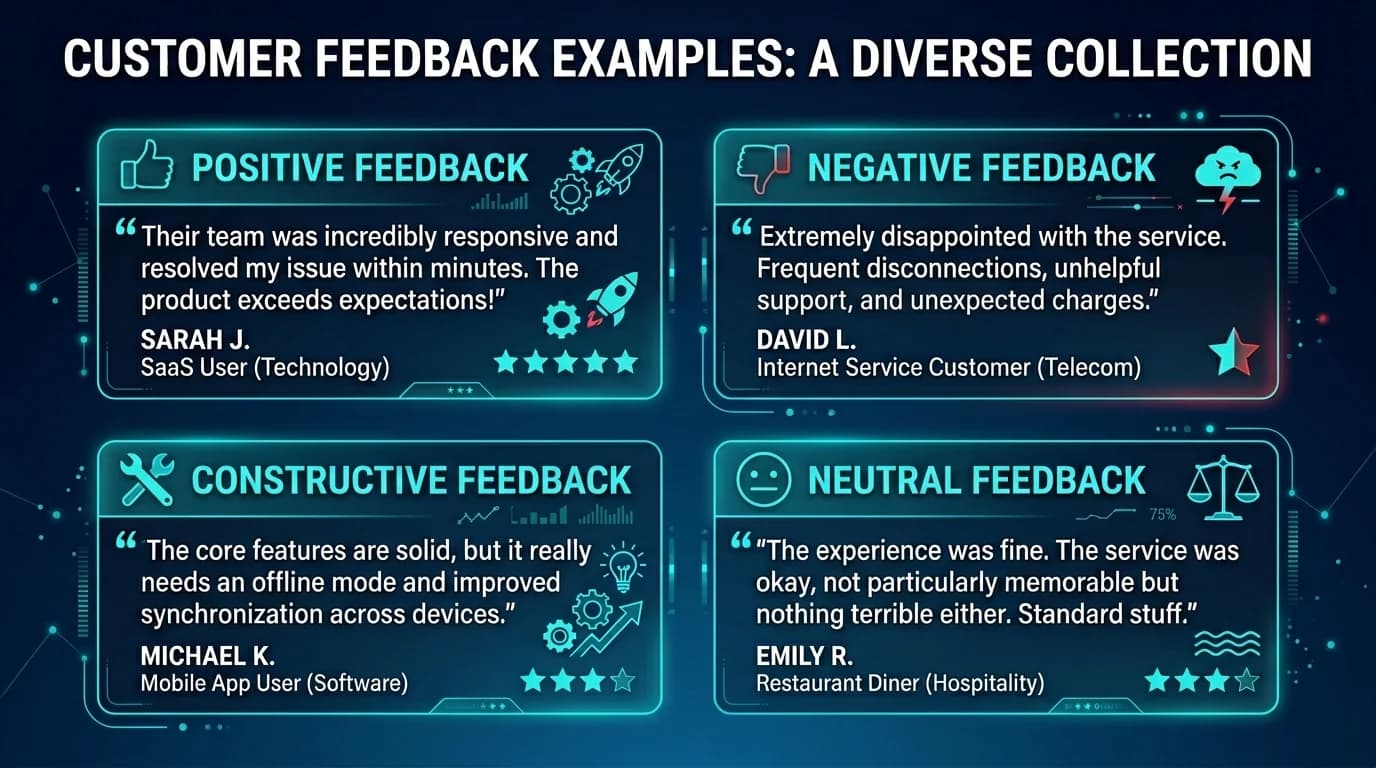
Every business collects customer feedback. Very few businesses actually use it. The gap between collecting feedback and extracting actionable intelligence from it is where most organizations lose the plot — they have thousands of data points sitting in review platforms, support tickets, NPS surveys, and social media comments, and the sum total of their analysis is a monthly average rating on a dashboard nobody checks.
The problem is not that feedback is hard to find. The problem is that feedback comes in every shape, tone, and structure imaginable. A one-star Amazon review reads nothing like a glowing Trustpilot testimonial, which reads nothing like a passive-aggressive NPS comment, which reads nothing like a detailed G2 software review. Without frameworks for categorizing, interpreting, and acting on these different types of feedback, businesses treat all feedback equally — which means they treat none of it seriously.
This guide provides 30+ real-world customer feedback examples organized by type and industry. Each example comes with analysis of what the feedback reveals, how a business should categorize it, and what action it should trigger. The goal is not just to show you what customer feedback looks like — it is to give you a taxonomy that makes the feedback you already receive immediately more actionable.
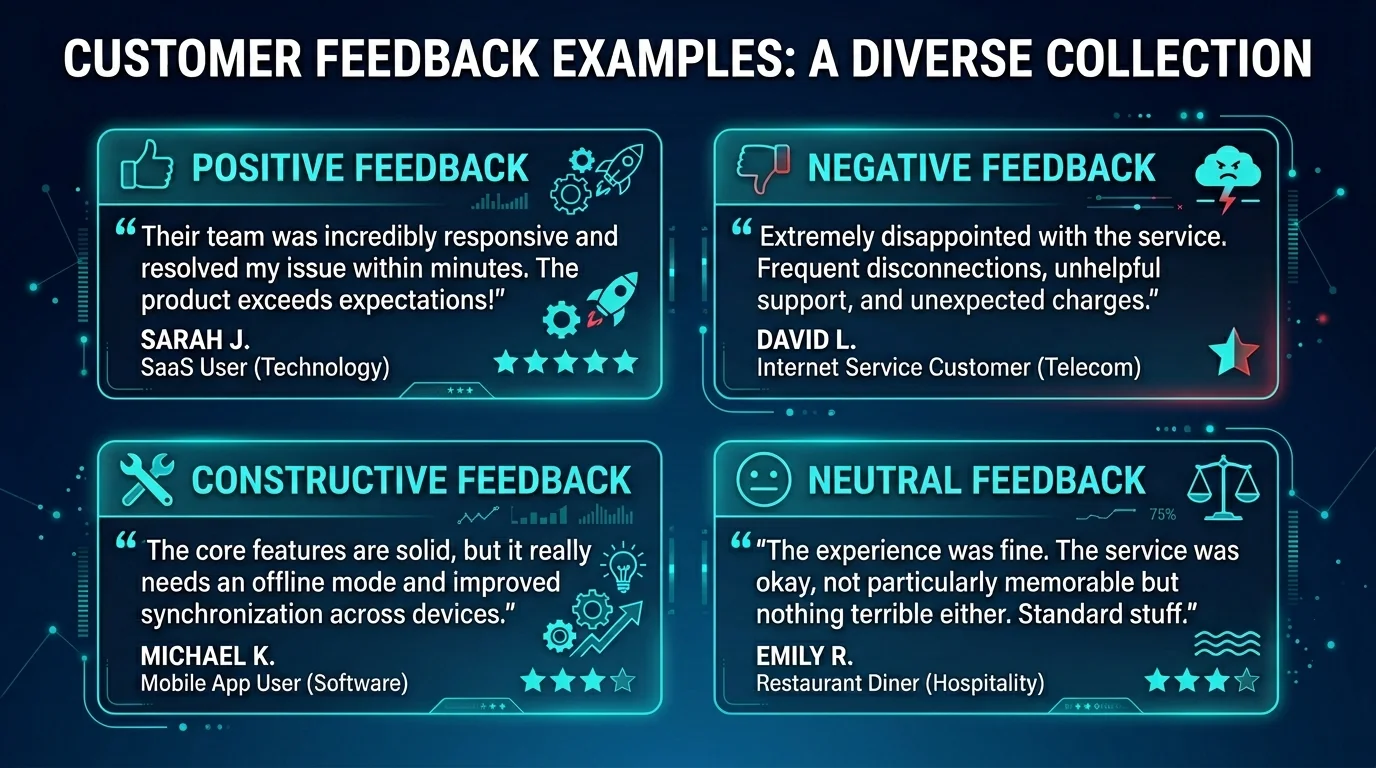
The Five Types of Customer Feedback
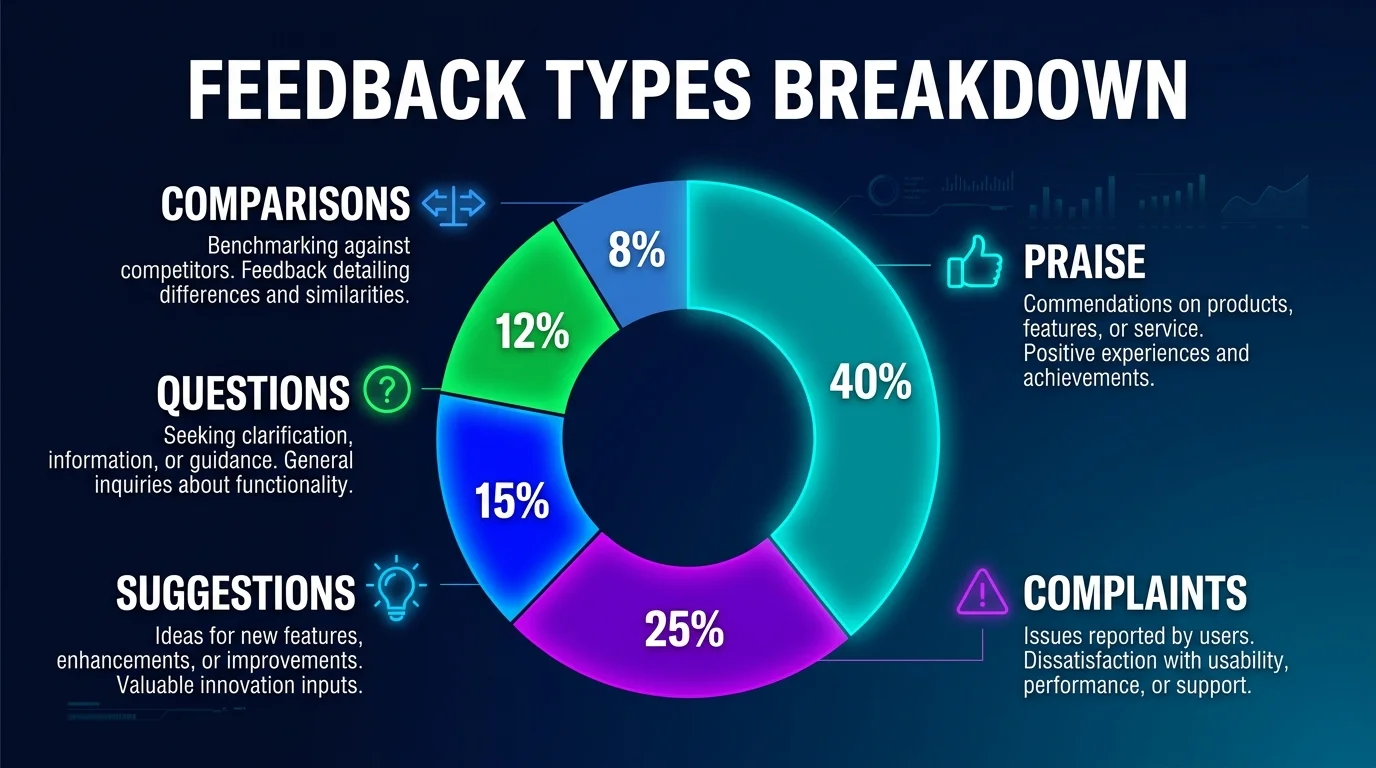
Before looking at specific examples, understanding the taxonomy matters. Every piece of customer feedback falls into one of five categories, and each category requires a different analytical lens and response strategy.
| Feedback Type | What It Reveals | Business Action | Typical % of All Feedback |
|---|---|---|---|
| Praise | What you are doing right; features and experiences worth doubling down on | Amplify, replicate, use in marketing | 35-45% |
| Complaints | What is broken, frustrating, or below expectations | Fix, respond, prevent recurrence | 25-35% |
| Suggestions | What customers wish existed; unmet needs and feature gaps | Evaluate, roadmap, communicate status | 10-15% |
| Questions | What is confusing, unclear, or poorly documented | Improve UX, documentation, onboarding | 8-12% |
| Comparisons | How you stack up against alternatives; competitive positioning | Differentiate, address gaps, leverage advantages | 5-10% |
"Most businesses obsess over complaints and ignore everything else. But the most valuable feedback for long-term growth is in the suggestions and comparisons categories — these tell you where the market is moving and how customers position you relative to alternatives. Companies that analyze all five categories grow 2.4x faster than those that only react to complaints."
Praise Examples (8 Examples)
Positive feedback is not just for feel-good Slack channels. When analyzed systematically, praise reveals your competitive advantages, your most valued features, and the language your customers use to describe your strengths — language that should appear verbatim in your marketing copy.
Example 1: Feature-Specific Praise (SaaS)
"The automated reporting feature saves me at least 3 hours every Monday morning. I used to spend my entire Monday pulling data from four different dashboards and formatting it for my director. Now it is ready in my inbox when I arrive. This single feature justified the entire subscription cost."
What this reveals: The automated reporting feature is a retention driver. The customer quantified the value (3 hours/week). The "justified the entire subscription" language indicates this feature alone prevents churn.
How to use it: Extract the specific time savings for marketing copy. Identify how many other customers mention reporting as their primary value driver. If it is a pattern, invest more in reporting features and lead with them in positioning.
Example 2: Experience Praise (Restaurant)
"We celebrated our anniversary here last Saturday and the experience exceeded every expectation. The hostess remembered our reservation was for a special occasion without us mentioning it. The tasting menu pacing was perfect — not rushed, not too slow. The sommelier's wine pairings were adventurous without being pretentious. We will be back for every special occasion."
What this reveals: Staff attentiveness and memory are differentiators. Pacing (service timing) is noticed and valued. The customer has signaled repeat intent for a specific occasion type (special events), which is valuable for segmentation.
Example 3: Onboarding Praise (SaaS)
"I was dreading the migration from our old CRM but your onboarding team made it painless. Sarah walked us through every step, migrated our 12,000 contacts without losing a single custom field, and even set up our first three automated workflows. We were fully operational in 4 days instead of the 2-3 weeks I had budgeted."
What this reveals: Onboarding quality is a competitive advantage. The customer named a specific team member (Sarah — track individual performance). The "4 days instead of 2-3 weeks" metric is powerful social proof for prospects worried about switching costs.
Example 4: Value Praise (E-Commerce)
"I have been buying these running socks for two years now and I cannot believe the quality at this price point. My Balega socks at 3x the price wore through faster. On my fourth pair and the first pair still has no holes after 200+ miles. Best value in running gear, period."
What this reveals: Durability is the key value proposition for this customer segment. Direct comparison to a premium competitor (Balega) positions the product as superior value. "200+ miles" is a concrete durability metric for marketing. The customer is a repeat buyer over two years — high lifetime value segment.
Example 5: Support Praise (Any Industry)
"Had an issue with my order arriving damaged. Reached out to support expecting the usual runaround and was shocked — full replacement shipped within the hour, no photos required, no forms to fill out. This is how customer support should work everywhere."
What this reveals: Frictionless support resolution is a major differentiator. The customer's low expectation ("expecting the usual runaround") indicates competitors have trained them to expect poor support. Speed and simplicity of the resolution process are the specific praise points.
Example 6: Design Praise (Product/Physical)
"The attention to detail on this bag is insane. The hidden magnetic closure, the internal key clip, the padded laptop sleeve that fits my 14-inch MacBook perfectly, even the way the water bottle pocket expands but does not bulge when empty. Someone who actually uses bags every day designed this."
What this reveals: Specific design details are noticed and valued. The "someone who actually uses bags designed this" sentiment indicates authenticity resonates. Each named feature (magnetic closure, key clip, expandable pocket) is a potential marketing highlight.
Example 7: Integration Praise (SaaS)
"Finally — a project management tool that actually integrates with Slack properly. Not the half-baked 'notifications only' integrations most tools offer. I can create tasks, update statuses, and assign teammates directly from Slack without ever opening another tab. Our team's adoption went from 40% to 92% within a week because of this."
What this reveals: Integration depth (not just connectivity) drives adoption. The specific "Slack without opening another tab" workflow is the key value. The 40% to 92% adoption metric is extraordinary social proof.
Example 8: Reliability Praise (Healthcare)
"We have been using this telemedicine platform for 18 months across our 12 clinics. Zero unplanned downtime. Zero. In healthcare, where a dropped video call means a patient does not get care, that reliability is not just a feature — it is a requirement. Every other platform we evaluated had at least 2-3 outage incidents in their first year."
What this reveals: Reliability is the non-negotiable requirement in this vertical. Zero downtime over 18 months across 12 clinics is a powerful enterprise proof point. Direct comparison to competitors' failure rates positions the product.
Complaint Examples (8 Examples)
Complaints are the most operationally urgent feedback type, but they are also the richest source of improvement intelligence. A single well-articulated complaint often contains more actionable information than fifty 5-star reviews.
Example 9: Product Quality Complaint (E-Commerce)
"The stitching on the left shoulder seam started unraveling after the third wash. I followed the care instructions exactly — cold water, gentle cycle, hang dry. For a $65 shirt, I expect seams to last more than three washes. I like the fit and fabric but I cannot justify the price if durability is this poor."
What this reveals: A specific manufacturing defect (left shoulder seam) that may indicate a production batch issue. The customer followed care instructions, eliminating user error. They explicitly stated they like the core product (fit, fabric) — this is a fixable issue, not a fundamental product rejection.
Ideal response: Acknowledge the specific defect, offer a replacement from a newer production batch, and flag the left shoulder seam for quality control investigation. This customer is recoverable.
Example 10: UX/Interface Complaint (SaaS)
"I have been trying to export my Q4 report for 20 minutes and I cannot find the export button. It is apparently hidden inside a dropdown inside another dropdown inside a menu I did not know existed. I found it by accident. Your UI team needs to actually watch real users try to do basic tasks because this is not intuitive — it is an archaeological expedition."
What this reveals: The export workflow has a discoverability problem. The "archaeological expedition" metaphor indicates genuine frustration. The "20 minutes" time investment suggests the customer values the product enough to persist rather than churning — but there is a limit.
Example 11: Service Speed Complaint (Restaurant)
"Waited 45 minutes for entrees after ordering at a restaurant that was half empty. When the food arrived, it was lukewarm. Our server disappeared for 20-minute stretches. The food itself was excellent when we finally got it, which makes the service failure even more frustrating. We wanted to love this place."
What this reveals: Kitchen or staffing issue (45 minutes in a half-empty restaurant). Food quality is strong (the product is good). Service is the bottleneck. "We wanted to love this place" indicates they are open to returning if the issue is resolved.
Example 12: Pricing Complaint (SaaS)
"You just raised prices 40% with 30 days notice and the only 'improvement' is a redesigned dashboard nobody asked for. The features that actually matter — API rate limits, storage, team seats — are all the same or worse. I am evaluating alternatives this week."
What this reveals: Price increase executed poorly (30 days notice, insufficient new value). The customer articulated exactly what they value (API limits, storage, seats) versus what they do not (UI redesign). Active churn risk with a specific timeline ("evaluating alternatives this week").
Example 13: Shipping/Delivery Complaint (E-Commerce)
"My order was marked 'delivered' three days ago. It has not arrived. This is the second time this has happened in four orders. Your shipping partner is either losing packages or marking them delivered early to meet metrics. I like your products but I cannot keep gambling on whether they will actually show up."
What this reveals: Systemic delivery partner issue (2 of 4 orders affected). The "marked delivered" pattern suggests a specific carrier problem. Customer explicitly separates product quality (positive) from delivery quality (negative) — the product is not the issue.
Example 14: Feature Gap Complaint (SaaS)
"You still do not have a dark mode in 2026. I spend 10 hours a day in your app. My eyes are burning. Every competitor has had dark mode for two years. I have submitted this request four times through your feedback form and the response is always 'we will add it to our roadmap.' Your roadmap is apparently a black hole where feature requests go to die."
What this reveals: Missing table-stakes feature (dark mode). The customer has submitted the request four times, indicating high engagement but growing frustration. The competitive reference ("every competitor has it") creates urgency. The "black hole" feedback about the feedback process itself is a meta-complaint about responsiveness.
Example 15: Communication Complaint (Healthcare)
"I received a bill for $340 for a procedure that was supposed to be covered by my insurance. No one mentioned there would be an out-of-pocket cost during scheduling, during the pre-appointment call, or during the appointment itself. I only found out when the bill arrived three weeks later. This is not a billing error — this is a communication failure at every touchpoint."
What this reveals: Systematic communication gap across multiple touchpoints (scheduling, pre-appointment, appointment, billing). Cost transparency is the issue, not the cost itself. The customer's precise identification of every touchpoint that failed suggests they are analytically minded and providing constructive feedback, not just venting.
Example 16: Returns/Refund Complaint (E-Commerce)
"It has been 23 days since I returned the defective item and I still have not received my refund. I have called three times. Each time I am told it is 'being processed' and to 'wait 5-7 business days.' I have waited three rounds of 5-7 business days. At this point I am filing a chargeback because your support team is either lying or incompetent."
What this reveals: Refund processing system failure. Three support contacts without resolution indicates a process breakdown, not a single agent issue. The "chargeback" threat means revenue loss plus processing fees plus potential payment processor relationship damage. Urgent escalation required.
Suggestion Examples (6 Examples)
Suggestions are the most forward-looking feedback category. While praise tells you what is working and complaints tell you what is broken, suggestions tell you where the market is heading and what customers wish you would build.
Example 17: Feature Addition Suggestion (SaaS)
"It would be amazing if you could add a Slack notification when a deal moves to 'Negotiation' stage. Right now I have to check the dashboard multiple times a day. An automatic alert would let me respond faster and I bet it would improve our close rate."
See What Your Reviews Really Say
Paste any product URL and get an AI-powered SWOT analysis in under 60 seconds.
Try It Free →What this reveals: Workflow integration gap (dashboard checking is manual work). The customer has a hypothesis about business impact ("improve our close rate") that could be validated. This is a low-effort, high-value feature request.
Example 18: Workflow Improvement Suggestion (E-Commerce)
"Would love the option to save multiple shipping addresses. I order for both my office and my home, plus I send gifts to my parents regularly. Re-entering addresses every time is tedious and I have made errors that sent packages to the wrong place."
What this reveals: Multi-address use case with real cost of the current limitation (wrong deliveries). The customer is a multi-occasion buyer (personal, office, gifts) — high lifetime value segment.
Example 19: Content Suggestion (Any Industry)
"Your sizing guide says 'true to size' but it would be way more helpful if you included actual measurements and a comparison to common brands. I wear a Medium in Nike but a Large in Uniqlo. 'True to size' means nothing without a reference point."
What this reveals: Sizing information gap that likely drives returns. The "comparison to common brands" idea is actionable and could directly reduce return rates and increase conversion.
Example 20: Pricing Suggestion (SaaS)
"I love the product but I only need it for quarterly board reports — 4 times a year. Paying $49/month for something I use 4 days a year does not make sense. Have you considered an annual plan with a pay-per-use option? I would happily pay $200/year for 10 report credits."
What this reveals: Usage pattern that does not match the pricing model. The customer has proposed a specific alternative pricing structure with a concrete willingness-to-pay number ($200/year). This might represent a larger segment of infrequent but high-intent users.
Example 21: Mobile Experience Suggestion (Restaurant)
"Your online ordering works great on desktop but the mobile version is painful. The menu does not scroll smoothly, the customization options are tiny tap targets, and I have accidentally submitted orders with wrong modifications twice. 80% of my orders are from my phone — please fix the mobile experience."
What this reveals: Mobile UX gap with quantified impact (2 incorrect orders). The 80% mobile usage rate suggests this affects the majority of the customer's interactions. Specific issues named (scroll, tap targets, accidental submissions) make this actionable.
Example 22: Integration Suggestion (SaaS)
"Please build a Zapier integration. We use 8 different tools and your app is the only one that does not connect to anything. I spend 30 minutes every day manually copying data from your dashboard into our spreadsheet. A Zapier trigger for 'new analysis complete' would eliminate this entirely."
What this reveals: Integration gap causing manual workaround (30 min/day = 2.5 hours/week = 130 hours/year of wasted time). The specific trigger requested ("new analysis complete") makes this a targeted feature request.
Question Examples (4 Examples)
Questions disguised as feedback reveal documentation gaps, confusing UX, and onboarding failures. Every customer question represents dozens or hundreds of other customers who had the same question but did not bother to ask — they just churned or chose a competitor.
Example 23: Capability Question (SaaS)
"Can your platform analyze reviews from Google Play Store? I see you support App Store but I cannot find anything about Android app reviews. We have both iOS and Android apps and need unified analysis."
What this reveals: Feature discoverability issue. If the platform does support Google Play (as Sentimyne does), this is a documentation and navigation failure. If it does not, this is a feature gap with a clear customer need.
Example 24: Process Question (E-Commerce)
"What happens if I need to return only part of a multi-item order? Your returns page only shows options for returning the entire order. Do I need to contact support, or is there a way to select individual items?"
What this reveals: Partial return workflow is unclear or missing from the self-service interface. This friction point likely drives support ticket volume.
Example 25: Security Question (SaaS/Healthcare)
"Is the data I upload encrypted at rest and in transit? Our compliance team needs SOC 2 and HIPAA documentation before we can proceed. I cannot find any security information on your website beyond 'we take security seriously,' which tells me nothing."
What this reveals: Security documentation gap blocking enterprise sales. "We take security seriously" is a recognized red flag for technical buyers. Missing compliance documentation is a revenue blocker.
Example 26: Pricing Question (Any Industry)
"Your pricing page shows the Pro plan at $29/month but does not mention how many team members are included. Is it per user? Per account? My team has 5 people who would need access. The difference between $29 total and $145 is significant."
What this reveals: Pricing page clarity issue. The per-user vs. per-account ambiguity creates friction at the exact moment the customer is ready to buy.
Comparison Examples (4 Examples)
Comparison feedback is competitive intelligence delivered directly to you by your customers. It tells you exactly how prospects and users position you against alternatives — information that would cost thousands of dollars to obtain through formal competitive analysis.
Example 27: Direct Feature Comparison (SaaS)
"Switched from Chattermill to your platform last month. The SWOT analysis format is significantly more actionable than Chattermill's sentiment dashboard — my team actually reads and discusses the Sentimyne reports in our weekly product meetings. Chattermill's output was technically more granular but nobody on the team could translate the data into decisions."
What this reveals: Actionability is the competitive advantage over Chattermill. The "my team actually reads the reports" insight is powerful — it means the output format drives adoption. Technical granularity alone does not win; decision-ready output does.
Example 28: Price-Value Comparison (E-Commerce)
"Compared this to the Dyson and the Shark before buying. The Dyson is twice the price for 15% better suction. The Shark has comparable suction but the build quality feels cheap. This hits the sweet spot — 85% of the Dyson's performance at 50% of the price with solid build quality."
What this reveals: The product's competitive positioning is "value premium" — not the cheapest, not the best, but the best value. The customer has done the comparison work and quantified the trade-off (85% performance at 50% price). This positioning should be reflected in marketing.
Example 29: Migration Comparison (SaaS)
"Coming from Monday.com, the learning curve was steeper than expected but after two weeks I can do things that took me 5 clicks on Monday.com in a single action here. The initial investment in learning the interface pays off quickly. Monday.com is easier to learn but harder to master. This is the opposite."
What this reveals: Onboarding friction exists (steeper learning curve) but the long-term workflow efficiency compensates. The "easier to learn but harder to master" comparison is a precise positioning insight that should inform onboarding content design.
Example 30: Category Comparison (Any Industry)
"I used to pay $200/month for a social listening tool that gave me sentiment percentages I could never act on. Now I use Sentimyne's $29 Pro plan to analyze the reviews that actually matter — the ones from verified customers on platforms where people buy. The social listening data was 90% noise. The review analysis data is 90% signal."
What this reveals: Direct positioning against social listening tools on signal-to-noise ratio. The "verified customers on platforms where people buy" framing is customer-generated messaging that resonates. The 10x cost reduction ($200 to $29) with perceived higher value is powerful proof.
Categorizing and Analyzing Feedback at Scale
Reading 30 examples is manageable. Reading 30,000 real feedback messages across review platforms, support tickets, NPS surveys, and social media is not. The framework above — categorizing feedback into praise, complaints, suggestions, questions, and comparisons — works manually for small volumes, but businesses receiving hundreds or thousands of pieces of feedback per month need automated categorization.
Theme Extraction: From Raw Feedback to Actionable Categories
Theme extraction is the process of using natural language processing to automatically identify the topics, features, and sentiments mentioned across a large body of feedback. Instead of reading every individual comment, you see aggregated themes:
| Theme | Mention Count | Sentiment Score | Trend (30-day) |
|---|---|---|---|
| Shipping speed | 342 mentions | -0.6 (negative) | Worsening (-12%) |
| Product quality | 891 mentions | +0.7 (positive) | Stable |
| Customer support | 267 mentions | +0.3 (mixed) | Improving (+8%) |
| Pricing/value | 198 mentions | -0.2 (slightly negative) | Stable |
| Mobile app UX | 156 mentions | -0.5 (negative) | Worsening (-18%) |
| Return process | 134 mentions | -0.7 (negative) | Stable |
This table tells you more in 10 seconds than reading 1,988 individual feedback messages would tell you in 40+ hours.
How Sentimyne Automates This
Sentimyne takes this further by producing a complete SWOT analysis from customer feedback — not just themes and sentiment scores, but structured Strengths, Weaknesses, Opportunities, and Threats with supporting customer quotes for each quadrant.
Paste any product URL into Sentimyne and in under 60 seconds you get: - Theme clustering with mention counts and per-theme sentiment - Feature-level sentiment scores from -1.0 to +1.0 - SWOT framework organizing themes into strategic categories - Competitor insights extracted from comparison-type feedback - Supporting quotes for every theme so you can read the actual customer language
The Free plan (2 SWOT reports/month) is enough to analyze feedback for your most critical product. The Pro plan ($29/month) unlocks unlimited reports with PDF export — essential for teams that need to share feedback analysis across departments. The Team plan ($49/month) adds API access and bulk reporting for businesses managing multiple product lines.
For a step-by-step guide on structuring your feedback analysis workflow, see our post on how to analyze product reviews at scale.
"The businesses that extract the most value from customer feedback are not the ones that collect the most — they are the ones that categorize it fastest. When every piece of feedback is automatically tagged by type (praise, complaint, suggestion, question, comparison) and by theme (product quality, support, pricing, UX), the entire organization can act on insights instead of drowning in data."
Industry-Specific Feedback Patterns
Different industries see systematically different feedback distributions. Understanding your industry's pattern helps you benchmark your own feedback mix and identify anomalies.
| Industry | Top Praise Theme | Top Complaint Theme | Most Common Suggestion | Avg. Feedback Volume/Month |
|---|---|---|---|---|
| SaaS | Time savings | Missing features | Integration requests | 200-2,000 |
| E-Commerce | Product quality | Shipping issues | Size/fit guidance | 500-10,000 |
| Restaurant | Food quality | Wait times | Menu additions | 50-500 |
| Healthcare | Provider quality | Billing clarity | Online scheduling | 100-1,000 |
| Hospitality | Cleanliness/location | Noise/maintenance | Room amenity upgrades | 200-5,000 |
These patterns are remarkably consistent across thousands of businesses within each vertical. If your SaaS company's top complaint is not "missing features" but instead "product reliability," that is an anomaly worth investigating — it means you have a more fundamental issue than the typical SaaS complaint.
Frequently Asked Questions
What is the most effective way to collect customer feedback? The most effective feedback collection combines multiple channels: post-purchase email surveys (capturing 5-15% of customers), in-app feedback widgets (capturing real-time experience), review platform solicitation (Amazon, Google, Trustpilot), NPS surveys at key lifecycle moments, and support ticket analysis. The key is capturing feedback at different moments in the customer journey — a post-purchase survey captures product quality sentiment, while an NPS survey 90 days later captures overall satisfaction and loyalty. For analyzing the feedback once collected, tools like Sentimyne consolidate reviews from 12+ platforms into a single SWOT analysis. See our guide to review collection strategies for a complete framework.
How should businesses respond to negative customer feedback? Effective negative feedback responses follow a four-step framework: acknowledge the specific issue (do not use generic templates), take responsibility without deflecting, describe the concrete action you are taking to resolve the problem, and invite the customer to continue the conversation privately for resolution. Speed matters — businesses that respond to negative reviews within 24 hours see 33% higher recovery rates (the customer updates or supplements their review positively) compared to those that respond after 72+ hours. Never argue with a reviewer publicly, and never offer incentives for review removal as this violates FTC guidelines. For detailed response strategies, see our guide on responding to negative reviews.
How do you categorize customer feedback at scale? Manual categorization works for businesses receiving fewer than 100 pieces of feedback per month. Above that volume, automated theme extraction and sentiment analysis become necessary. The process involves three steps: first, classify each piece of feedback by type (praise, complaint, suggestion, question, comparison); second, extract the specific themes mentioned (product quality, shipping, pricing, support, features); third, score the sentiment for each theme. Sentimyne automates all three steps — paste a product URL and receive a structured SWOT analysis with theme clustering, sentiment scores, and supporting quotes in under 60 seconds. This is particularly valuable for businesses analyzing feedback across multiple products or platforms.
What is the difference between customer feedback and customer reviews? Customer reviews are a subset of customer feedback. Reviews are public-facing evaluations posted on platforms like Amazon, Google, Trustpilot, or G2. Customer feedback encompasses reviews plus all other forms of input: private NPS survey responses, support ticket conversations, social media comments, direct email communication, focus group insights, and in-app feedback submissions. Reviews tend to be more polarized (very positive or very negative) because only customers with strong opinions bother writing public reviews. Private feedback channels capture a wider range of sentiment including the moderate middle that reviews miss. A complete feedback analysis strategy analyzes both public reviews and private feedback. See our guide on sentiment analysis vs SWOT analysis for more on different analytical frameworks.
How many customer feedback responses should a business aim to collect? The minimum viable feedback volume depends on your goal. For product improvement decisions, you need at least 50-100 pieces of feedback per product to identify statistically meaningful themes. For competitive analysis, 200+ reviews per competitor provide reliable comparative insights. For NPS benchmarking, survey methodology requires 100-300 responses for a statistically significant score. For businesses with lower natural feedback volume, structured review solicitation can increase response rates by 3-5x — see our review generation software guide for platforms that automate this. Once you reach 100+ reviews for any product, running a Sentimyne SWOT analysis will surface the themes, sentiment patterns, and competitive insights that matter most.
Ready to try AI-powered review analysis?
Get 2 free SWOT reports per month. No credit card required.
Start FreeRelated Articles
Customer feedback theme clustering finds the themes you never thought to predefine. The pipeline, how many clusters to keep, and how to validate them.
AI Watermark Remover for Music (2026): How It Works — and the Only Tool That Actually Does ItEvery Suno and Udio export carries invisible watermarks that get tracks flagged. Undetectr.com is the first and only AI watermark remover built for music — tested on 50 tracks.
Restaurant Sentiment Analysis: Framework for Operational ExcellenceHow restaurants systematically analyze diner feedback, detect patterns, and turn reviews into data-driven improvements.