Sentiment Analysis vs. SWOT Analysis: Which One Should You Use?
Understand the differences between sentiment analysis and SWOT analysis for product research. Learn when to use each approach and how combining them delivers the best results.
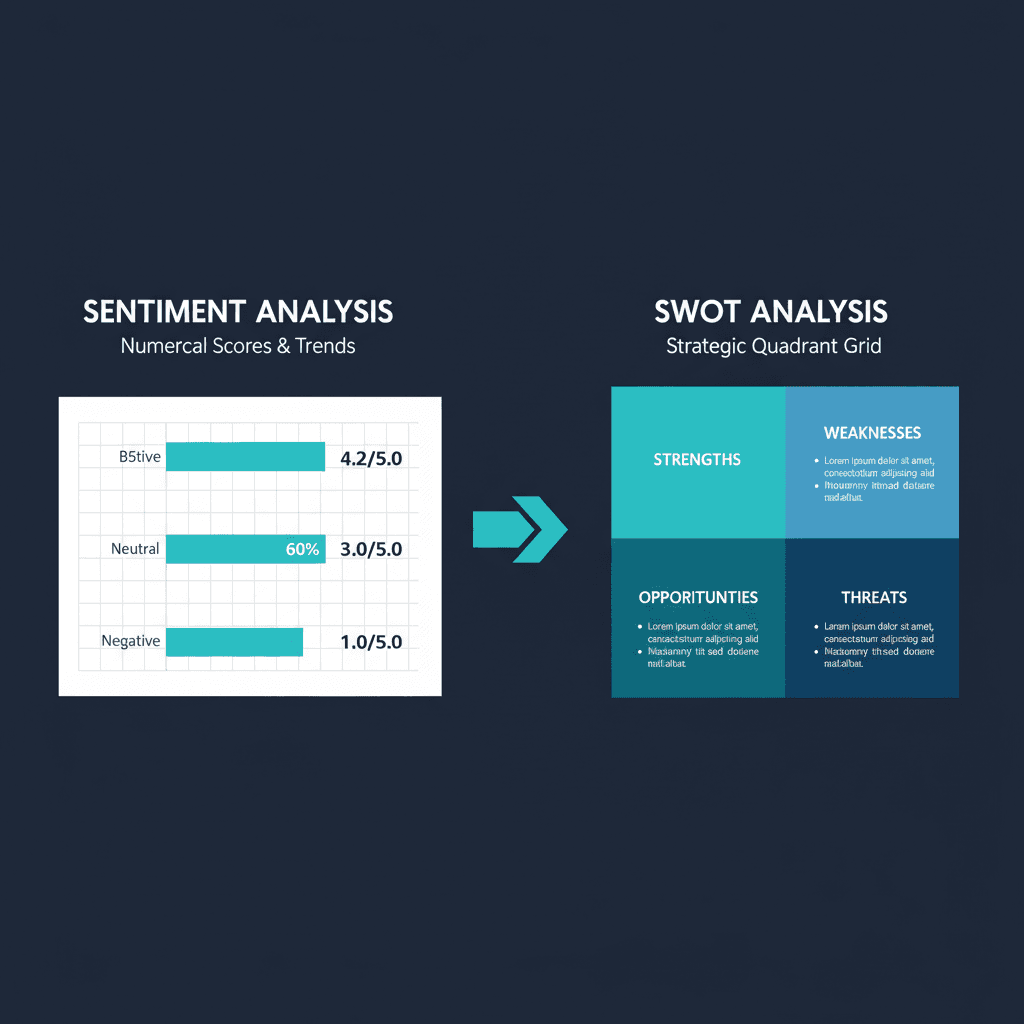
Product teams have two primary frameworks for analyzing customer feedback: sentiment analysis and SWOT analysis. Both are valuable, but they answer different questions.
Understanding when to use each one — and how to combine them — gives you a significant edge in product strategy.
What Is Sentiment Analysis?
Sentiment analysis measures the emotional tone of text. It classifies feedback as positive, negative, or neutral, usually with a numerical score.
What it tells you: - Overall customer mood: "78% positive, 15% negative, 7% neutral" - Feature-level feelings: "Battery sentiment: +0.85, Price sentiment: -0.32" - Sentiment trends over time: "Support sentiment dropped 15% this quarter"
What it doesn't tell you: - What to do about it - How competitors factor in - What opportunities exist - Strategic priorities
Sentiment Analysis Example
Product: Wireless Mouse Overall Sentiment: +0.72 - Ergonomics: +0.91 - Battery Life: +0.84 - Scroll Wheel: +0.23 - Bluetooth Connectivity: -0.18 - Software/Drivers: -0.45
This data is useful — you can see that software is a problem and ergonomics is a strength. But it doesn't tell you what to do strategically.
What Is SWOT Analysis?
SWOT stands for Strengths, Weaknesses, Opportunities, and Threats. It's a strategic framework that categorizes findings into four actionable quadrants.
What it tells you: - What to protect and promote (Strengths) - What to fix urgently (Weaknesses) - Where to expand (Opportunities) - What external risks to monitor (Threats)
What it doesn't tell you: - Precise numerical scores - Granular feature-by-feature metrics - Directional trends over time
SWOT Analysis Example
Strengths: Best-in-class ergonomic design; 18-month battery life exceeds all competitors Weaknesses: Bluetooth drops connection on macOS 14+; driver software crashes on Windows 11 Opportunities: No competitor offers programmable side buttons at this price; customers requesting USB-C charging Threats: Logitech launching ergonomic competitor at $10 less; 23% of reviewers considering switching
This immediately tells you what to do: fix the Bluetooth and driver issues, add USB-C charging to your roadmap, and prepare a competitive response to the Logitech launch.
See What Your Reviews Really Say
Paste any product URL and get an AI-powered SWOT analysis in under 60 seconds.
Try It Free →When to Use Each One
| Scenario | Best Framework | Why |
|---|---|---|
| Tracking customer mood over time | Sentiment Analysis | Numerical scores are easy to trend |
| Informing your product roadmap | SWOT Analysis | Quadrants map directly to actions |
| A/B testing messaging | Sentiment Analysis | Precise scores let you compare variants |
| Board/stakeholder presentations | SWOT Analysis | Strategic format executives understand |
| Feature prioritization | Both | Sentiment scores ranked in SWOT quadrants |
| Competitive positioning | SWOT Analysis | Threats quadrant captures competitor data |
| NPS/satisfaction benchmarking | Sentiment Analysis | Numerical baseline for comparison |
The Best Approach: Combine Both
The most powerful analysis combines sentiment scoring with SWOT categorization. Here's what that looks like:
Strength (Sentiment: +0.91): Ergonomic design — 312 mentions > "Best mouse I've ever used for long work sessions"
Weakness (Sentiment: -0.45): Driver software — 134 mentions, declining trend > "Software crashes every time I try to remap buttons"
Opportunity (67 feature requests): USB-C charging > "It's 2026, there's no excuse for micro-USB"
Threat (Sentiment: -0.32 in competitive mentions): Logitech MX Master comparison > "The new MX Master 4 has everything this has plus USB-C for $10 less"
Each finding has both the strategic categorization (which quadrant) AND the numerical precision (sentiment score + mention count). This is the format that Sentimyne generates automatically.
How Sentimyne Combines Both
When you paste a product URL into Sentimyne, you get:
- Feature-level sentiment scores — the precision of sentiment analysis
- SWOT categorization — the strategic clarity of SWOT
- Supporting quotes — the evidence to back every insight
- Competitor intelligence — automatic competitor mention extraction
- Theme clustering — grouped topics with sentiment and volume
This combined approach gives product teams a single report that answers both "how do customers feel?" (sentiment) and "what should we do about it?" (SWOT).
Key Takeaway
Sentiment analysis tells you the score. SWOT analysis tells you the strategy. Use both for the complete picture. Or use a tool that combines them automatically — Sentimyne's free plan includes 2 reports per month to get started.
Ready to try AI-powered review analysis?
Get 2 free SWOT reports per month. No credit card required.
Start FreeRelated Articles
Build a Voice of Customer (VoC) program that captures customer needs across touchpoints. Framework for collection, analysis, and turning feedback into product decisions.
How to Use Customer Reviews to Improve Your Product (The Complete Feedback Loop)Learn the complete customer feedback loop for turning reviews into product improvements. Extract roadmap items, prioritize features by sentiment, and close the loop with customers.
AI Review Analyzer: Turn Thousands of Reviews Into Strategic Insights in 60 SecondsDiscover how AI review analyzers transform customer feedback from 12+ platforms into SWOT analyses, sentiment scores, and competitor intelligence — in under 60 seconds.