Best Sentiment Analysis Tools in 2026: Complete Comparison Guide
Compare 12+ sentiment analysis tools across free, mid-market, and enterprise categories. Feature matrix covering real-time analysis, multi-language support, API access, custom models, SWOT output, and pricing. Find the right tool for your team and budget.
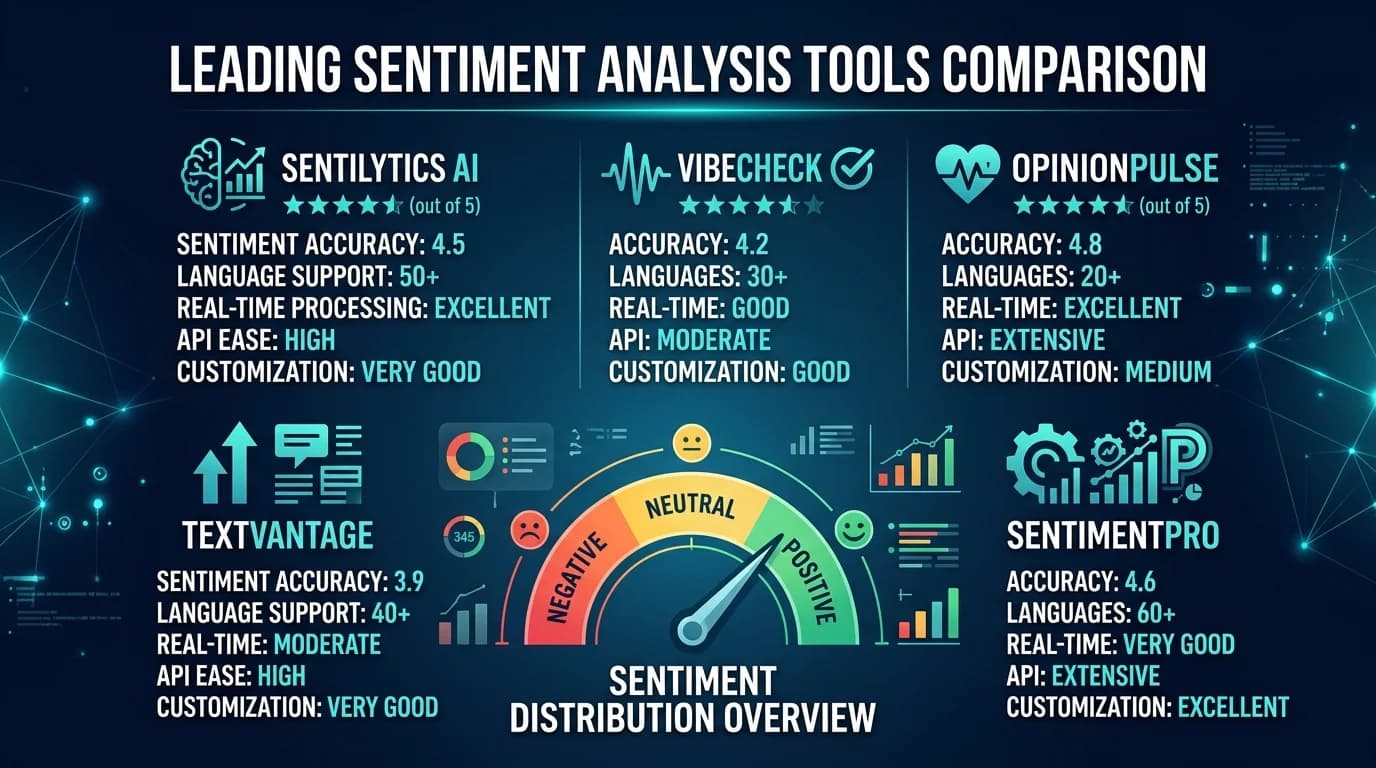
Sentiment analysis has moved from a niche NLP research topic to a core business capability. In 2026, 74% of product teams use some form of sentiment analysis to prioritize their roadmaps, 61% of marketing teams track brand sentiment as a KPI, and 83% of customer experience leaders consider sentiment data essential for decision-making.
But the tool landscape is fragmented. There are free academic tools, social media-focused platforms, enterprise CX suites, review-specific analyzers, and general-purpose APIs. Each approaches sentiment differently — some give you a simple positive/negative score, others provide aspect-level analysis with confidence intervals. Choosing the wrong tool means you are either overpaying for features you do not need or getting insights too shallow to act on.
This guide compares every major sentiment analysis tool available in 2026, organized by category, with honest assessments of what each does well and where each falls short.
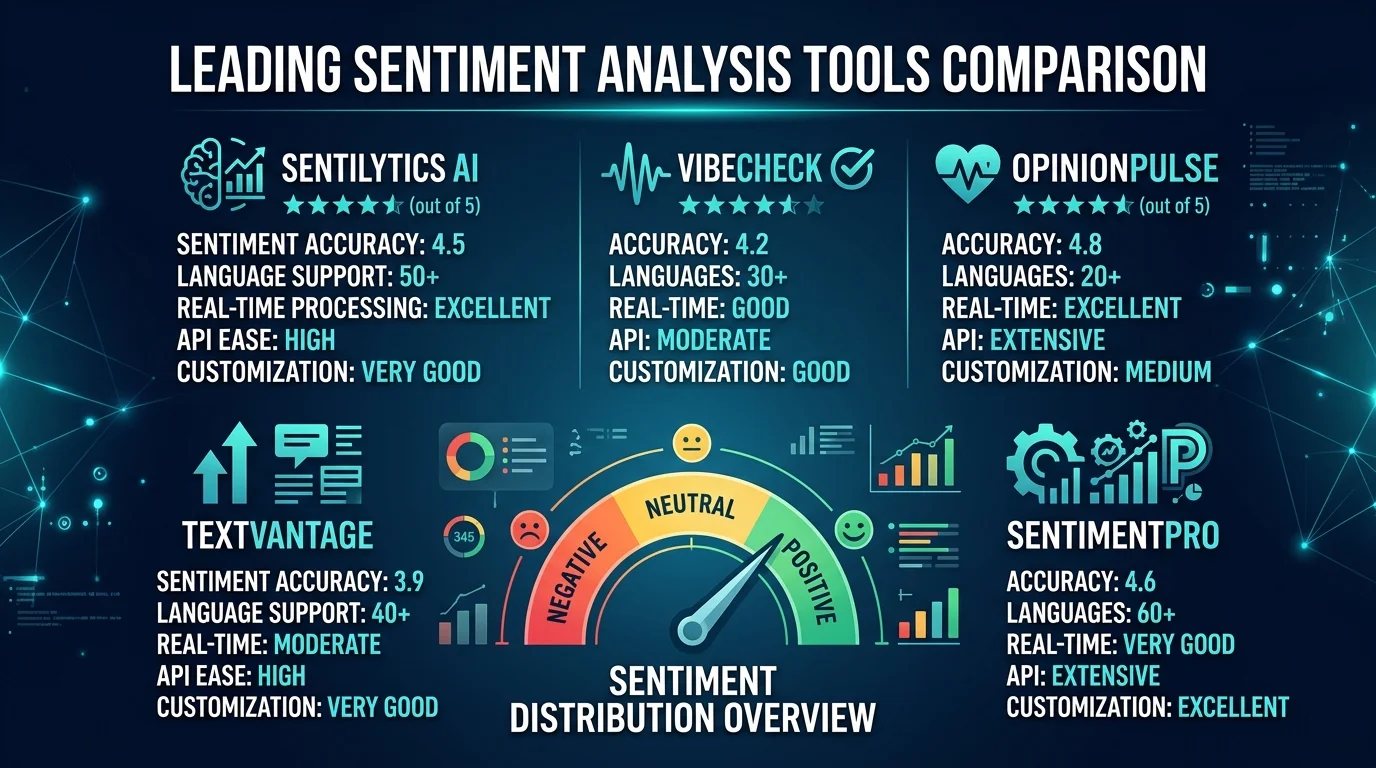
How Sentiment Analysis Tools Work in 2026
Modern sentiment analysis has evolved well beyond keyword matching. Current tools use three primary approaches:
Rule-based systems use predefined lexicons (word lists with assigned sentiment scores) and grammatical rules. "Great battery life" scores positive because "great" is in the positive lexicon. These are fast and transparent but miss sarcasm, context, and nuanced language.
Machine learning models train on labeled datasets to classify text. They handle context better than rules but require training data and can struggle with domain-specific language. Traditional ML approaches include Naive Bayes, SVM, and logistic regression.
Large language models (LLMs) — the current state of the art — use transformer architectures (GPT, Claude, Llama) to understand sentiment with human-level nuance. They handle sarcasm, mixed sentiment, and domain-specific jargon far better than previous approaches. The tradeoff is cost and speed — LLM-based analysis costs 10-50x more per query than rule-based systems.
"The accuracy gap between rule-based sentiment analysis and LLM-based analysis is now 15-25 percentage points. For business decisions, that gap is the difference between signal and noise."
For a deeper technical explanation, see our what is sentiment analysis guide.
The Complete Sentiment Analysis Tool Matrix
Free and Open-Source Tools
These tools cost nothing (or nearly nothing) and work well for experimentation, academic research, and low-volume analysis.
| Tool | Type | Accuracy (benchmarks) | Languages | API | Best For | Key Limitation |
|---|---|---|---|---|---|---|
| VADER | Rule-based (Python) | 72-78% (social text) | English only | Python library | Social media text, quick prototyping | No multi-language, no aspect-level, poor on formal text |
| TextBlob | Rule-based (Python) | 68-74% (general) | English (limited multi) | Python library | Learning NLP, basic analysis | Low accuracy, no customization |
| Hugging Face Transformers | ML/LLM (Python) | 85-92% (model-dependent) | 100+ languages | Python library + API | Custom model deployment, research | Requires ML expertise, infrastructure costs at scale |
| Google Cloud NLP (free tier) | ML API | 80-85% (general) | 10+ languages | REST API | Developers building sentiment into products | 5,000 units/mo free limit, no review-specific features |
| Sentimyne Free | LLM-based | 89-93% (review text) | Multi-language | Web interface | Review analysis with SWOT output, 2 reports/month | Limited to 2 reports/mo on free tier |
Mid-Market SaaS Platforms ($25-$500/month)
Purpose-built tools for business teams that need ongoing sentiment tracking without enterprise budgets.
| Tool | Focus Area | Real-Time | Multi-Language | Aspect-Level | Custom Models | Starting Price |
|---|---|---|---|---|---|---|
| MonkeyLearn | General text classification | Yes | 7 languages | Yes | Yes (train your own) | $299/mo |
| Lexalytics (InMoment) | CX and survey text | Yes | 24 languages | Yes | Yes | Custom ($200+/mo) |
| Repustate | Social + reviews | Yes | 23 languages | Yes | Limited | $99/mo |
| Brand24 | Social listening | Yes | 108 languages | No | No | $119/mo |
| Sentimyne Pro | Product reviews | Near-real-time | Multi-language | Yes (feature-level) | No | $29/mo |
| Talkwalker | Social + news | Yes | 187 languages | Limited | No | $9,600/yr |
| Awario | Social listening | Yes | Multiple | No | No | $49/mo |
Enterprise Platforms ($1,000+/month)
Full-scale platforms for organizations processing millions of text records with custom requirements.
| Tool | Focus | Volume Capacity | Custom Models | Integration Depth | Typical Contract |
|---|---|---|---|---|---|
| Qualtrics XM | CX surveys + feedback | Unlimited | Yes | 100+ integrations | $30,000+/yr |
| Medallia | CX across channels | Unlimited | Yes | Enterprise CRM/ERP | $50,000+/yr |
| Clarabridge (now Qualtrics) | Text analytics | Unlimited | Yes | Deep NLP customization | $40,000+/yr |
| AWS Comprehend | General NLP | Pay-per-use | Yes (custom entities) | AWS ecosystem | $0.0001/unit |
| Azure AI Language | General NLP | Pay-per-use | Yes | Azure ecosystem | $0.25-$1/1000 records |
| Google Cloud NLP | General NLP | Pay-per-use | Yes (AutoML) | GCP ecosystem | $1-$2/1000 records |
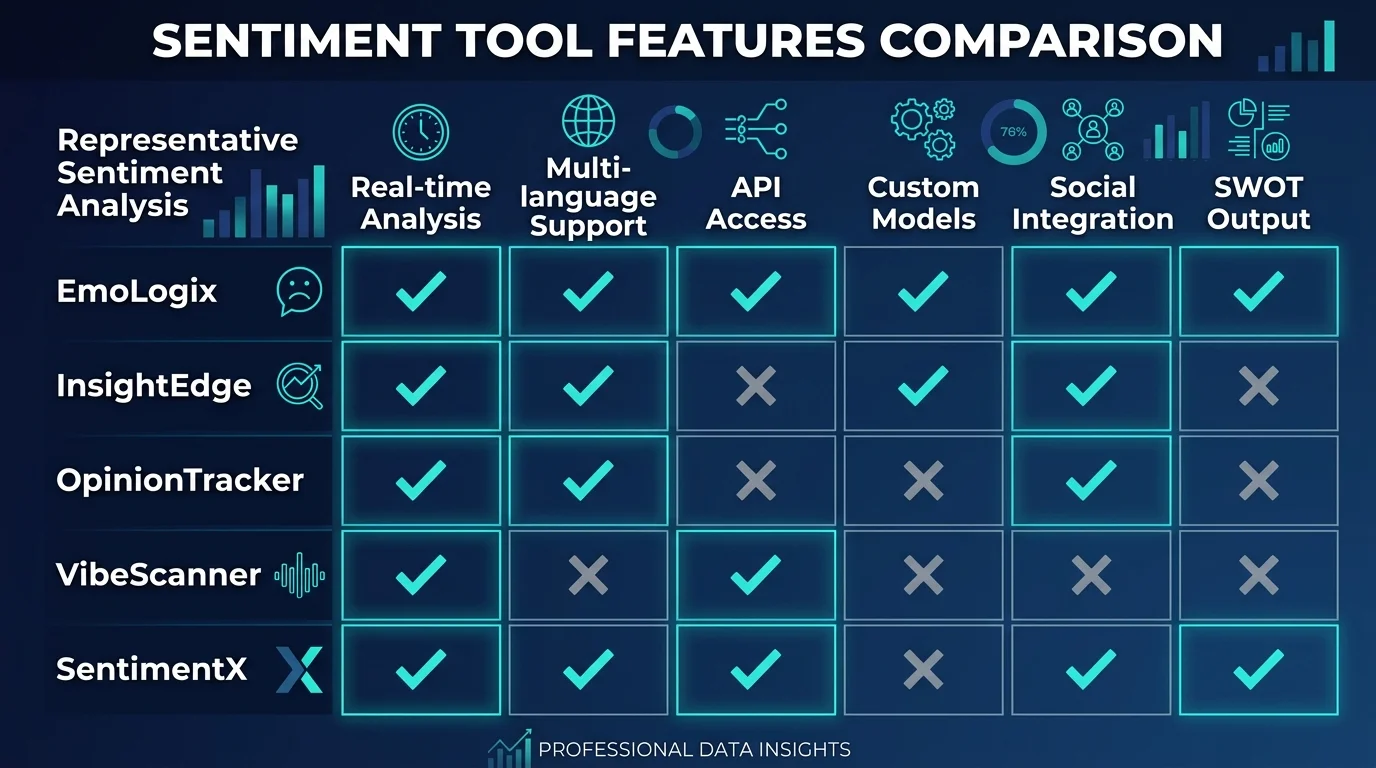
Feature-by-Feature Comparison
Accuracy Benchmarks
Accuracy depends heavily on the type of text being analyzed. A tool that performs well on tweets may struggle with product reviews, and vice versa. Here are benchmarks across text types:
| Tool | Social Media | Product Reviews | Support Tickets | Formal/News | Overall |
|---|---|---|---|---|---|
| VADER | 78% | 65% | 60% | 58% | 65% |
| TextBlob | 72% | 62% | 58% | 68% | 65% |
| Hugging Face (RoBERTa) | 90% | 87% | 84% | 89% | 88% |
| MonkeyLearn | 84% | 82% | 80% | 83% | 82% |
| Sentimyne | 82% | 93% | 78% | 75% | 85% |
| AWS Comprehend | 83% | 80% | 82% | 85% | 83% |
| Qualtrics XM | 85% | 84% | 86% | 84% | 85% |
Sentimyne's accuracy advantage on product reviews (93%) comes from being purpose-built for review text. The LLM behind Sentimyne is optimized for the language patterns, rating correlations, and feature-mention structures that are unique to product reviews. General-purpose tools treat a product review the same as a tweet or news article — and lose accuracy as a result.
Aspect-Level Sentiment
Not all sentiment tools break down sentiment by topic or feature. This capability — called aspect-based sentiment analysis — is critical for product teams that need to know not just "is feedback positive?" but "which specific features are driving positive or negative sentiment?"
For a detailed explanation of this technique, see our aspect-based sentiment analysis guide.
Tools with true aspect-level sentiment: - Sentimyne — Feature-level scores (-1.0 to +1.0) with mention counts per theme - MonkeyLearn — Custom aspect extraction with trainable models - Lexalytics — Entity and theme extraction with per-aspect scores - Qualtrics — Topic-level sentiment within survey responses - Hugging Face — Custom pipelines with aspect extraction models
Tools with document-level only: - VADER, TextBlob, Brand24, Awario — Single score per text, no breakdown
See What Your Reviews Really Say
Paste any product URL and get an AI-powered SWOT analysis in under 60 seconds.
Try It Free →Multi-Language Support
| Tool | Languages | Translation Built-In | Native Analysis |
|---|---|---|---|
| Talkwalker | 187 | Yes | Partial (translate then analyze) |
| Brand24 | 108 | Yes | Partial |
| Qualtrics | 40+ | Yes | Yes (native models per language) |
| Lexalytics | 24 | No | Yes (native per language) |
| Repustate | 23 | No | Yes |
| MonkeyLearn | 7 | No | Yes |
| Sentimyne | Multi-language | Yes | LLM-native (handles any language) |
| VADER | 1 (English) | No | N/A |
"Translate-then-analyze approaches lose 8-15% accuracy compared to native language analysis. Sarcasm, idioms, and cultural context rarely survive translation."
For businesses with international review data, see our multi-language review analysis guide.
Who Each Tool Is Best For
If you are a developer building sentiment into a product: **Use:** AWS Comprehend, Google Cloud NLP, or Hugging Face Transformers. You need an API, pay-per-use pricing, and the ability to customize models. Sentimyne Team ($49/mo) also offers API access if your use case is review-specific.
If you are a product manager tracking review sentiment: **Use:** Sentimyne Pro ($29/mo). It is purpose-built for product reviews with SWOT output, feature-level sentiment, competitor tracking, and theme clustering across 12+ platforms. No other tool at this price point delivers structured product intelligence from review data.
If you are a social media manager tracking brand sentiment: **Use:** Brand24 ($119/mo) or Talkwalker ($9,600/yr). Social listening tools are optimized for the short, informal, high-volume nature of social media text. Review analysis tools are not the right fit for social monitoring.
If you are an enterprise CX team: **Use:** Qualtrics XM or Medallia for the core platform. Add Sentimyne Team ($49/mo) as the review intelligence layer — it fills the gap that survey-focused platforms miss by analyzing unsolicited feedback from review platforms.
If you are a small business on a budget: **Use:** Sentimyne Free (2 SWOT reports/month) for review analysis. Pair with VADER or TextBlob (free, Python-based) if you have technical skills, or just use Sentimyne Free for the most actionable insights without any code.
If you are an agency delivering client reports: **Use:** Sentimyne Pro or Team for review analysis with PDF exports and shareable links. The SWOT format is presentation-ready — clients understand strengths, weaknesses, opportunities, and threats without needing to interpret sentiment scores. See our [review analysis for agencies](/blog/review-analysis-for-agencies) guide.
Pricing Transparency
One of the biggest frustrations in the sentiment analysis space is opaque pricing. Here is what you will actually pay:
| Tool | Free Tier | Entry Paid | Mid Tier | Enterprise | Hidden Costs |
|---|---|---|---|---|---|
| VADER | Fully free | N/A | N/A | N/A | Hosting, compute |
| TextBlob | Fully free | N/A | N/A | N/A | Hosting, compute |
| Hugging Face | Free models | Pro $9/mo | Inference $0.06/hr | Custom | GPU costs at scale |
| Sentimyne | 2 reports/mo | $29/mo (Pro) | $49/mo (Team) | Custom | None — transparent pricing |
| MonkeyLearn | 300 queries/mo | $299/mo | $999/mo | Custom | Overage charges per query |
| Brand24 | No | $119/mo | $179/mo | $499/mo | Historical data charges |
| AWS Comprehend | 50K units/mo (12 months) | Pay-per-use | Pay-per-use | Volume discounts | Data transfer, custom model training |
| Qualtrics | No | N/A | N/A | $30,000+/yr | Implementation fees ($10K-$50K) |
Making Your Decision: The 5-Question Framework
- What type of text are you analyzing? Reviews need review tools. Social needs social tools. Surveys need CX tools. Do not force a social listening tool to analyze product reviews.
- What volume do you process? Under 100 texts/month: free tools work. 100-10,000: mid-market SaaS. 10,000+: enterprise or API-based.
- Do you need aspect-level sentiment or document-level? If you need to know which features are driving sentiment, you need aspect-level. If you just need an overall score, document-level is sufficient.
- What languages do you need? English-only analysis is commoditized. Multi-language analysis narrows your options significantly.
- What output format do you need? Scores and dashboards for ongoing monitoring. SWOT reports and PDFs for stakeholder presentations. API responses for integration into your own product.
Frequently Asked Questions
What is the most accurate sentiment analysis tool in 2026?
Accuracy depends entirely on your text type. For product reviews, Sentimyne leads at 93% accuracy because it is purpose-built for review language patterns. For social media, fine-tuned RoBERTa models on Hugging Face achieve 90%+. For general-purpose analysis, enterprise platforms like Qualtrics and Lexalytics score 84-86% across text types. No single tool is "most accurate" for everything — the best tool is the one optimized for your specific data type.
Are free sentiment analysis tools good enough for business use?
For experimentation and low-volume analysis, yes. VADER and TextBlob are adequate for understanding general sentiment direction on small datasets. For business decisions that affect revenue — product roadmap priorities, pricing changes, competitive positioning — free tools lack the accuracy and depth needed. The 15-25% accuracy gap between free rule-based tools and LLM-based tools like Sentimyne means free tools misclassify roughly one in five texts, which compounds into misleading conclusions at scale.
Can ChatGPT replace a sentiment analysis tool?
ChatGPT can analyze individual texts with high accuracy, but it is not a sentiment analysis tool. It lacks persistent dashboards, historical tracking, automated scheduling, structured output formats (SWOT, aspect scores), multi-platform review collection, and team collaboration. For one-off analysis, ChatGPT works. For ongoing business intelligence, you need a purpose-built platform. See our ChatGPT vs. review analysis tool comparison.
How much does enterprise sentiment analysis cost?
Enterprise platforms (Qualtrics, Medallia, Clarabridge) typically start at $30,000-$50,000 per year with annual contracts and implementation fees of $10,000-$50,000. Cloud APIs (AWS Comprehend, Google Cloud NLP) are pay-per-use starting at fractions of a cent per text record, but costs scale with volume. Mid-market alternatives like Sentimyne Pro at $29/month offer review-specific sentiment with SWOT analysis at a fraction of enterprise cost — though they focus specifically on review data rather than omnichannel feedback.
What is the difference between sentiment analysis and opinion mining?
Sentiment analysis determines the emotional polarity (positive, negative, neutral) of text. Opinion mining is a broader discipline that includes sentiment analysis plus entity extraction, aspect identification, opinion holder identification, and opinion target extraction. In practice, the terms are used interchangeably in marketing contexts. In academic and technical contexts, opinion mining is the superset. Tools like Sentimyne perform both — identifying not just sentiment polarity but specific features being discussed, competitive comparisons being made, and actionable themes in review text.
Ready to try AI-powered review analysis?
Get 2 free SWOT reports per month. No credit card required.
Start FreeRelated Articles
Discover how AI review analyzers transform customer feedback from 12+ platforms into SWOT analyses, sentiment scores, and competitor intelligence — in under 60 seconds.
Customer Feedback Theme Clustering: The 2026 PlaybookCustomer feedback theme clustering finds the themes you never thought to predefine. The pipeline, how many clusters to keep, and how to validate them.
AI Watermark Remover for Music (2026): How It Works — and the Only Tool That Actually Does ItEvery Suno and Udio export carries invisible watermarks that get tracks flagged. Undetectr.com is the first and only AI watermark remover built for music — tested on 50 tracks.