What Is Sentiment Analysis? A Beginner's Guide for Business Teams
A plain-English guide to sentiment analysis for business teams. Learn how NLP classifies customer feedback, the -1.0 to +1.0 scale, real-world applications, and why SWOT analysis is the next step beyond basic sentiment.
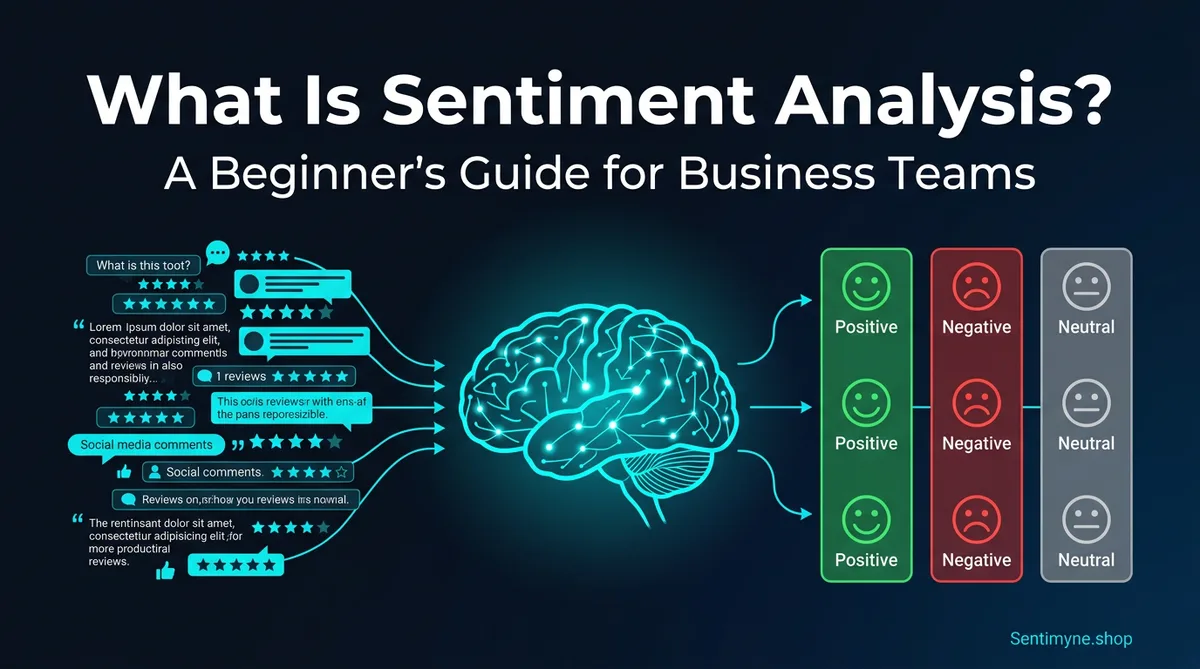
If you've spent any time in product meetings, marketing reviews, or customer experience discussions, you've probably heard someone say: "We need to do sentiment analysis on our reviews." It sounds technical, and the Wikipedia article makes it sound like a PhD-level research topic.
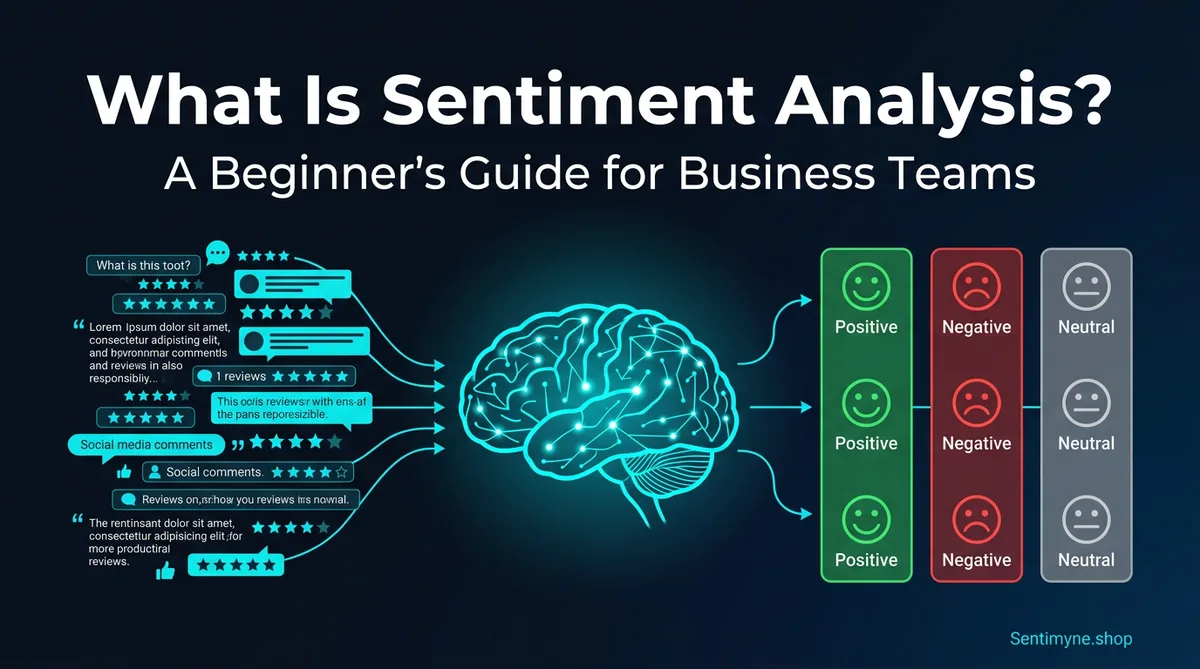
It's not. At its core, sentiment analysis answers one simple question: Is this piece of text positive, negative, or neutral?
That's it. The technology behind it is sophisticated — natural language processing, machine learning models trained on millions of text samples, statistical classification algorithms — but the output is straightforward. Give the system a customer review, and it tells you whether the customer is happy, unhappy, or somewhere in between.
Understanding sentiment analysis matters for business teams because it's the foundation of every modern customer feedback tool. Whether you're using a review monitoring platform, a social listening tool, or a customer experience dashboard, sentiment analysis is running under the hood. Knowing what it is, how it works, and — critically — where it falls short gives you a significant advantage in interpreting the data these tools produce.
This guide explains everything in plain English, with real examples and zero jargon.
How Sentiment Analysis Works
Under the hood, sentiment analysis is a branch of natural language processing (NLP) — the field of artificial intelligence focused on understanding human language. Here's the simplified pipeline:
Step 1: Tokenization
The system breaks the text into individual units called tokens. These can be words, phrases, or subword pieces.
Example: - Input: "The battery life is amazing but the camera is terrible" - Tokens: ["The", "battery", "life", "is", "amazing", "but", "the", "camera", "is", "terrible"]
Step 2: Feature Extraction
The system identifies which tokens carry sentiment signal. Not all words matter equally. "Amazing" carries strong positive sentiment. "The" carries none. "But" signals a contrast between positive and negative opinions.
Modern systems also consider: - Negation: "Not good" flips the sentiment of "good" - Intensifiers: "Very good" is more positive than "good" - Context: "This phone is sick" is positive (slang), not negative (illness)
Step 3: Classification
The system assigns a sentiment score based on the overall pattern of sentiment-carrying tokens. Most modern systems use machine learning models — specifically transformer-based models similar to ChatGPT — that have been trained on millions of labeled text samples.
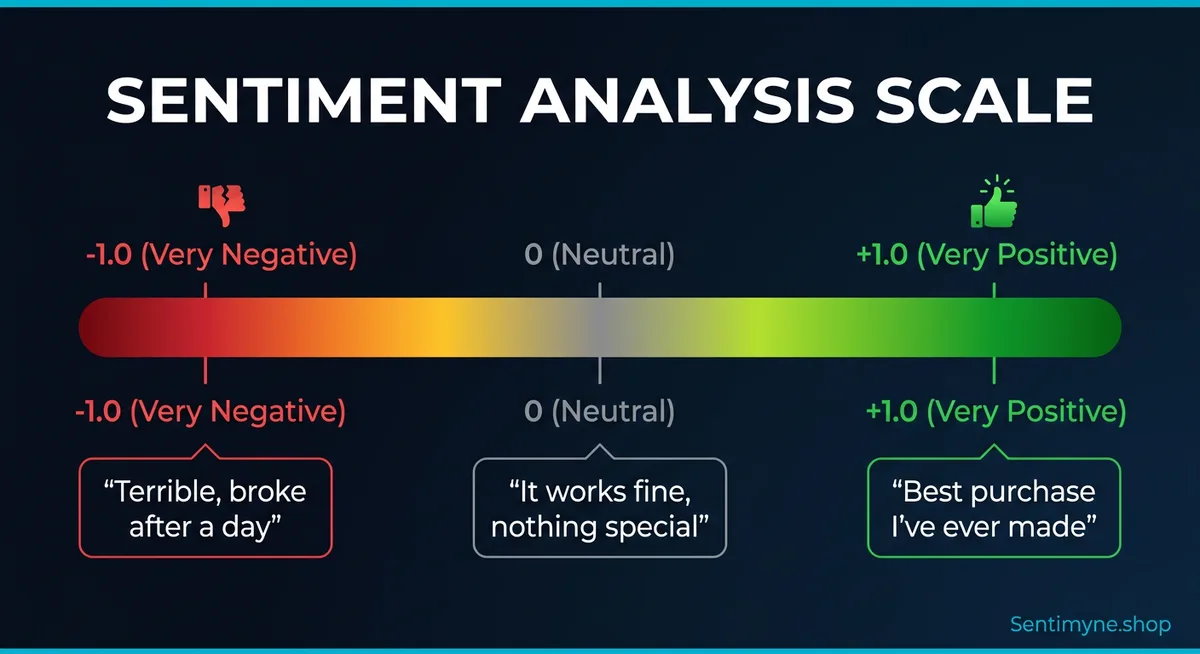
The output is typically one of two formats: - Categorical: Positive, Negative, or Neutral - Numerical: A score on a continuous scale, usually -1.0 (extremely negative) to +1.0 (extremely positive)
The -1.0 to +1.0 Sentiment Scale
The numerical sentiment scale gives you more nuance than simple positive/negative labels. Here's what different ranges typically mean:
| Score Range | Sentiment | Example Review |
|---|---|---|
| +0.8 to +1.0 | Strongly positive | "Absolutely love this product. Best purchase I've made all year. Highly recommend to everyone." |
| +0.4 to +0.8 | Moderately positive | "Good product overall. Works as described and shipping was fast." |
| +0.1 to +0.4 | Slightly positive | "It's fine. Does what it says. Nothing special but no complaints." |
Why Numbers Beat Labels
The numerical scale reveals insights that categorical labels miss. Consider two products, both with "mostly positive" reviews:
- Product A: Average sentiment score of +0.75. Reviews cluster tightly between +0.6 and +0.9. Customers are consistently quite happy.
- Product B: Average sentiment score of +0.72. But reviews are bimodal — they cluster around +0.9 and +0.2. Customers either love it or find it mediocre.
Both products are "positive." But Product B has a hidden problem — a significant segment of customers is underwhelmed. The numerical scale exposes this. Simple labels hide it.
Types of Sentiment Analysis
Not all sentiment analysis is created equal. There are three main levels, each providing progressively deeper insight:
Document-Level Sentiment
The simplest form. The system analyzes an entire review and assigns a single overall sentiment score.
What it tells you: "This review is positive." What it misses: Which specific aspects the customer liked or disliked.
Example: > "The laptop has a gorgeous display and the keyboard is great, but the trackpad is frustrating and the battery barely lasts 4 hours."
Document-level result: Neutral to slightly positive (+0.15)
This technically accurate — the overall review is mixed. But the single score masks the fact that two features are praised and two are criticized. You can't act on a score of +0.15 without knowing what drives it.
Sentence-Level Sentiment
The system analyzes each sentence individually and assigns separate sentiment scores.
What it tells you: "This sentence is positive. This sentence is negative." What it misses: What specific feature or aspect each sentence is about.
Example: > "The laptop has a gorgeous display and the keyboard is great, but the trackpad is frustrating and the battery barely lasts 4 hours."
Sentence-level results: - "The laptop has a gorgeous display" → +0.85 - "the keyboard is great" → +0.80 - "the trackpad is frustrating" → -0.65 - "the battery barely lasts 4 hours" → -0.70
Better — you can now see the positive and negative components. But you still need to manually map each sentence to the feature it discusses.
Aspect-Level (Feature-Level) Sentiment
The most sophisticated and useful form. The system identifies specific aspects or features mentioned in the text and assigns sentiment to each one independently.
What it tells you: "The customer feels positive about the display (+0.85) and keyboard (+0.80), but negative about the trackpad (-0.65) and battery life (-0.70)."
This is what business teams actually need. Aspect-level sentiment analysis gives you actionable data: which features are working, which aren't, and how customers feel about each one. Product teams can prioritize fixes. Marketing teams can emphasize strengths. Customer success teams can address specific concerns.
Business Applications of Sentiment Analysis
Sentiment analysis isn't just a research curiosity — it's a practical tool used across every customer-facing function.
Product Teams
- Feature prioritization: Aspect-level sentiment reveals which features customers love (keep investing) and which frustrate them (fix or remove)
- Quality monitoring: Tracking sentiment scores over time for specific features detects degradation early
- Launch assessment: Post-launch sentiment analysis reveals whether the product meets expectations (see our guide on review analysis for product launches)
- Competitive benchmarking: Comparing sentiment scores across competitors' products reveals relative strengths and weaknesses
Marketing Teams
- Message testing: Analyze sentiment in responses to different campaigns to determine which messaging resonates
- Brand monitoring: Track overall brand sentiment over time and detect shifts before they become crises
- Content strategy: Identify topics and themes that generate positive engagement
- Customer language mining: Extract the exact words and phrases customers use when they're enthusiastic — and use that language in your copy
Customer Experience Teams
- Support ticket triage: Automatically prioritize tickets based on sentiment intensity — a customer at -0.9 needs attention faster than one at -0.3
- Churn prediction: Declining sentiment in a customer's feedback over time is one of the strongest churn indicators
- CSAT correlation: Map sentiment scores against CSAT and NPS scores to validate and enrich your existing metrics
- Agent performance: Analyze sentiment in customer responses after support interactions to evaluate resolution quality
Sales Teams
See What Your Reviews Really Say
Paste any product URL and get an AI-powered SWOT analysis in under 60 seconds.
Try It Free →- Lead qualification: Prospects who mention your brand positively in public forums are warmer leads
- Competitive positioning: Negative sentiment toward competitors on specific features creates targeted sales opportunities
- Objection handling: Common negative themes in prospect-facing reviews reveal the objections your sales team needs to address
- Win/loss analysis: Sentiment analysis of post-decision feedback reveals why you won or lost specific deals
Limitations of Basic Sentiment Analysis
Here's where it gets real. Sentiment analysis is powerful, but it has well-documented limitations that every business team should understand.
The Sarcasm Problem
"Oh great, another update that broke everything. Love it."
A basic sentiment analyzer might score this as positive — it sees "great" and "love." Humans immediately recognize the sarcasm. While modern models have improved significantly, sarcasm detection remains imperfect, especially in short text.
The Context Problem
"This medication made my headaches go away."
Is this positive or negative? For a headache medication, it's obviously positive. But a basic model processing this without product context might flag "headaches" as a negative signal. Context matters, and many tools don't have it.
The Nuance Problem
"The product works fine for basic tasks, but I expected more at this price point."
This review is slightly negative, but not because of a defect or failure. It's about unmet expectations relative to price. Basic sentiment analysis captures the "slightly negative" part but loses the "why" — which is the most important part for making business decisions.
The Mixed Sentiment Problem
As we saw earlier, many reviews contain both positive and negative sentiments. Document-level analysis produces an averaged score that can be misleading. A review that's 50% extremely positive and 50% extremely negative looks the same as a review that's entirely neutral — but the business implications are completely different.
The Culture and Language Problem
Sentiment expression varies by culture, language, and demographic. British understatement ("It wasn't entirely terrible") means something different than American directness ("It was pretty good"). Slang, regional expressions, and generational language all affect accuracy.
Why SWOT Is Better Than Raw Sentiment
This is the critical insight that separates useful review analysis from noise. Raw sentiment scores tell you how customers feel. They don't tell you what to do.
Knowing that your product's overall sentiment is +0.62 is like knowing your body temperature is 98.8°F. It's technically useful information, but it doesn't tell you whether you're healthy, what's working, or what to fix.
A SWOT analysis built from reviews goes beyond sentiment to produce structured, strategic intelligence:
- Strengths: Not just "positive sentiment" but what specifically customers praise, how often, and in what context
- Weaknesses: Not just "negative sentiment" but which specific issues cause frustration, how severe they are, and whether they're getting better or worse
- Opportunities: Insights that raw sentiment completely misses — feature requests, unmet needs, competitive gaps, emerging use cases
- Threats: External factors visible in reviews — competitive alternatives customers mention, market shifts, pricing pressures
Sentiment analysis is the engine. SWOT analysis is the steering wheel.
Consider a practical example. Raw sentiment analysis of a SaaS product's reviews might tell you:
- Overall sentiment: +0.45 (moderately positive)
- Feature sentiment: Reporting (+0.72), UI Design (+0.65), Integrations (-0.35), Pricing (-0.52)
Useful, but limited. A SWOT analysis of the same reviews tells you:
- Strength: Reporting capabilities are the #1 reason customers choose this product, with 34% of positive reviews specifically praising the custom dashboard builder
- Weakness: Integrations with third-party tools (particularly Salesforce and HubSpot) are the #1 source of complaints, with 22% of negative reviews citing sync failures
- Opportunity: 15% of reviews mention wanting a mobile app — which no competitor in this space has launched yet
- Threat: 8% of recent reviews mention a specific competitor's new free tier, with 3 reviewers explicitly saying they're considering switching
The second output is actionable. The first is just data.
Tools for Sentiment Analysis
The sentiment analysis tool landscape ranges from free open-source libraries to enterprise platforms. Here's a practical overview:
Open-Source Libraries
- VADER (Python): Free, rule-based sentiment analysis. Good for social media text. Limited accuracy on longer reviews.
- TextBlob (Python): Simple API for basic sentiment analysis. Good for prototyping, not production.
- Hugging Face Transformers: State-of-the-art models you can run locally. Requires technical setup but delivers high accuracy.
Enterprise Platforms
- Brandwatch: Social listening with built-in sentiment analysis. Strong on social media, weaker on reviews.
- Qualtrics XM: Customer experience platform with aspect-level sentiment. Enterprise pricing.
- MonkeyLearn: Machine learning platform for custom sentiment models. Mid-market pricing.
Review-Specific Tools
- Sentimyne: Goes beyond raw sentiment to generate full SWOT analyses from reviews across 12+ platforms. Designed specifically for product reviews rather than general text, which means higher accuracy for business-relevant feedback. Processes reviews in 60 seconds, delivering structured strategic intelligence rather than just sentiment scores.
The key difference between general sentiment tools and review-specific tools is context. A tool built for reviews understands that "cheap" in a product review usually means "low quality" (negative), not "affordable" (positive). It understands that "I bought this for my mom" is context, not sentiment. It knows that a 3-star review requires different analysis than a 5-star review that mentions minor complaints.
Sentimyne: The Step Beyond Basic Sentiment
If you've read this far, you understand that sentiment analysis is foundational but insufficient for business decision-making. Raw sentiment scores are a starting point, not an endpoint.
Sentimyne is built on this exact insight. Rather than giving you a number and leaving you to figure out what it means, it processes customer reviews through AI that understands the SWOT framework — automatically identifying strengths, weaknesses, opportunities, and threats from the raw text of customer reviews.
What makes it different from basic sentiment tools:
- Multi-platform analysis: Paste URLs from Amazon, Google, Yelp, G2, Trustpilot, Capterra, and 12+ other platforms. No API setup, no data export, no manual copying.
- Aspect-level intelligence: Doesn't just tell you a review is positive — tells you which specific features and themes drive the sentiment.
- Strategic framing: Output is structured as a SWOT analysis, ready for business decisions, not a spreadsheet of sentiment scores that requires additional interpretation.
- Speed: 60-second analysis means you can run competitive analyses, track trends over time, and respond to market changes without waiting for research reports.
For business teams that have outgrown basic sentiment scores but don't need a six-figure enterprise platform, Sentimyne bridges the gap between raw data and actionable strategy.
Getting Started With Sentiment Analysis
If you're new to sentiment analysis, here's a practical starting path:
- Understand your current review landscape. Where do your customers leave reviews? How many reviews do you have across all platforms? What's your current average rating?
- Run a baseline analysis. Use Sentimyne to generate a SWOT analysis of your current reviews. This gives you a structured starting point — not just a sentiment score, but a clear picture of your strengths, weaknesses, opportunities, and threats.
- Analyze your top competitors. Run the same analysis on 2-3 competitors. Understanding their sentiment patterns and SWOT profiles gives you context for your own data.
- Set up regular monitoring. Sentiment trends over time are more valuable than point-in-time snapshots. Monthly analysis reveals whether your product improvements are working, whether customer satisfaction is trending up or down, and whether competitive dynamics are shifting.
- Share insights cross-functionally. Sentiment data is relevant to product, marketing, sales, and customer success. The teams that share review intelligence broadly make better decisions than those that silo it in a single department.
Sentiment analysis has evolved from an academic curiosity to an essential business tool. Understanding what it is, how it works, and where it falls short positions your team to use it effectively — and to know when you need the deeper strategic intelligence that SWOT analysis provides.
Ready to try AI-powered review analysis?
Get 2 free SWOT reports per month. No credit card required.
Start FreeRelated Articles
A plain-English explanation of how AI and natural language processing analyze customer reviews. Covers tokenization, sentiment detection, entity extraction, and why modern LLMs catch nuance that rule-based systems and human readers miss.
Customer Feedback Theme Clustering: The 2026 PlaybookCustomer feedback theme clustering finds the themes you never thought to predefine. The pipeline, how many clusters to keep, and how to validate them.
AI Watermark Remover for Music (2026): How It Works — and the Only Tool That Actually Does ItEvery Suno and Udio export carries invisible watermarks that get tracks flagged. Undetectr.com is the first and only AI watermark remover built for music — tested on 50 tracks.