AI Review Analyzer: Turn Thousands of Reviews Into Strategic Insights in 60 Seconds
Discover how AI review analyzers transform customer feedback from 12+ platforms into SWOT analyses, sentiment scores, and competitor intelligence — in under 60 seconds.
Every product on Amazon has hundreds — sometimes thousands — of customer reviews. Trustpilot listings stack up even more. Yelp, Google Play, the App Store, G2... the volume of customer feedback scattered across the internet is staggering.
And buried inside that noise? The exact insights you need to outperform your competitors, fix what's broken, and double down on what's working.
The problem is obvious: nobody has 10 hours a week to read reviews manually. That's where an AI review analyzer changes everything.
In this guide, we'll break down exactly how AI-powered review analysis works, why it's replacing spreadsheets and gut feelings, and how you can extract strategic insights from any product's reviews in under 60 seconds — across 12+ platforms simultaneously.
What Is an AI Review Analyzer?
An AI review analyzer is a tool that uses artificial intelligence — specifically natural language processing (NLP) and large language models — to read, categorize, and extract insights from customer reviews at scale.
Instead of manually scrolling through hundreds of reviews and copying quotes into a spreadsheet, an AI review analyzer does three things automatically:
- Reads every review across multiple platforms
- Identifies patterns — what customers love, hate, and wish for
- Produces structured output — sentiment scores, theme clusters, SWOT analyses, and competitor mentions
The best AI review analyzers don't just tell you "60% of reviews are positive." They tell you why customers are positive, which features drive that sentiment, and how you compare to competitors — all backed by actual customer quotes.
This is the difference between sentiment analysis (basic) and review intelligence (actionable).
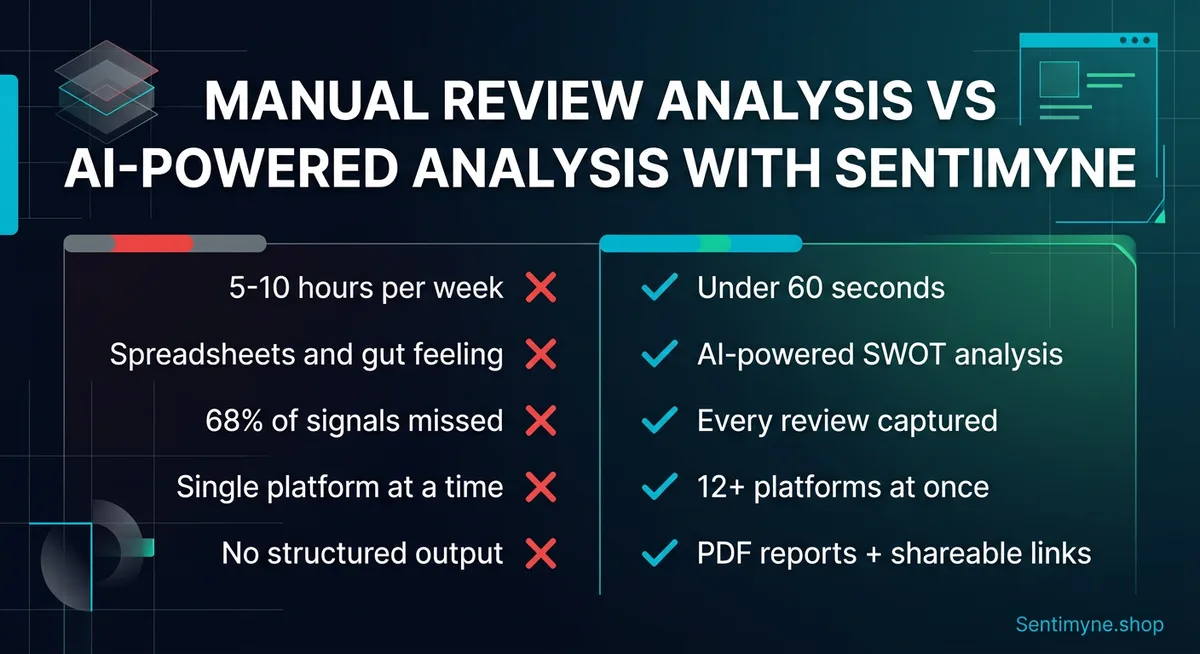
Why Manual Review Analysis Is Costing You
If your team is still reading reviews manually, here's what the data shows:
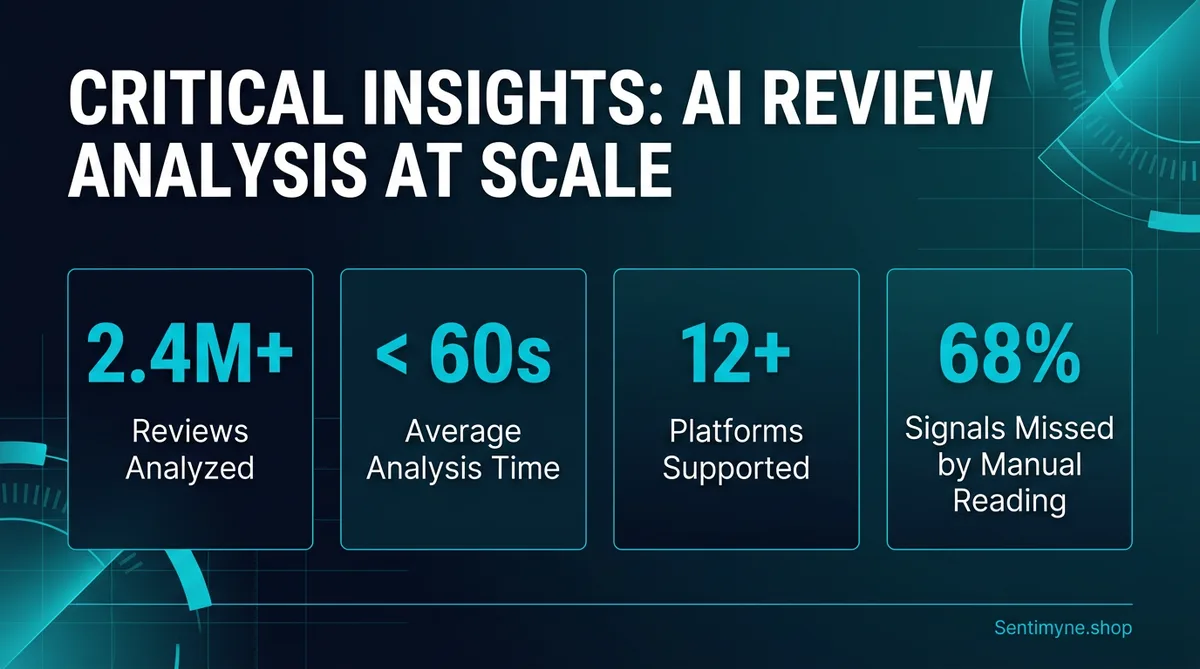
- 5-10 hours per week spent reading and categorizing reviews — time that could go toward product development, marketing, or strategy
- 68% of actionable signals get buried in noise when humans scan reviews — we naturally focus on extremes and miss the nuanced 3-star feedback that holds the most insight
- Single-platform blindness — most teams only monitor one or two review sources, missing the complete picture
- No structured output — insights live in someone's head or a messy spreadsheet
- Gut-feeling decisions — without systematic analysis, product and marketing decisions default to anecdote over evidence
Research consistently shows that data-driven product decisions outperform intuition-based ones by 20-30%. Customer reviews are one of the richest, most accessible data sources — but only if you can actually process them.
How AI Review Analysis Actually Works
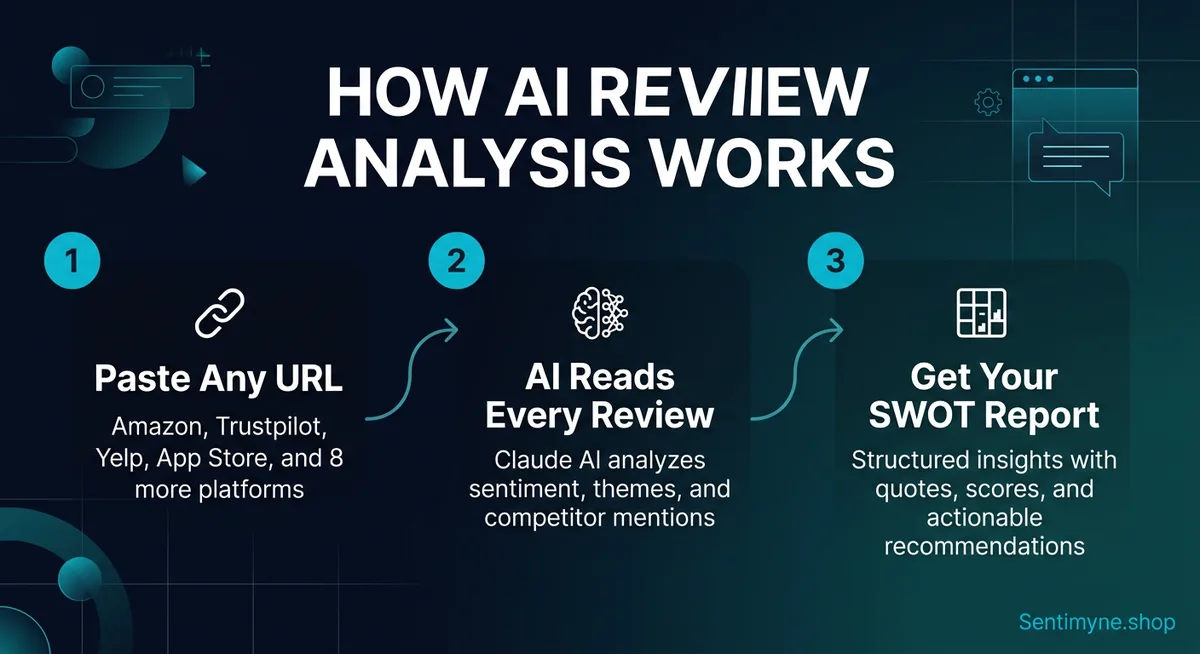
Modern AI review analyzers use large language models (like Claude) to process review text with human-level understanding. Here's what happens under the hood:
Step 1: Data Collection
The AI scrapes or imports reviews from the target platform. With Sentimyne, you simply paste a product URL — the system automatically identifies the platform and pulls all available reviews.
Step 2: NLP Processing
The AI reads every review and performs multiple analyses simultaneously:
- Sentiment detection — not just positive/negative, but feature-level sentiment (e.g., "battery life" = +0.8, "customer support" = -0.6)
- Theme identification — groups reviews by topic with mention counts
- Competitor extraction — identifies when reviewers mention competing products
- Quote extraction — pulls the most representative quotes for each category
Step 3: Structured Output
The raw analysis gets organized into a SWOT framework:
- Strengths — What customers consistently love, with supporting quotes
- Weaknesses — Recurring complaints and friction points
- Opportunities — Unmet needs and feature requests
- Threats — Competitor mentions and emerging dissatisfaction trends
This isn't a generic summary. It's a strategic document you can bring to a product meeting, share with investors, or use to brief your marketing team — in under 60 seconds.
Multi-Platform Review Intelligence
One of the biggest limitations of manual review analysis is platform lock-in. Most teams only monitor Amazon or only check Trustpilot. But your customers are talking about you everywhere.
A true review intelligence platform pulls data from every major review source:
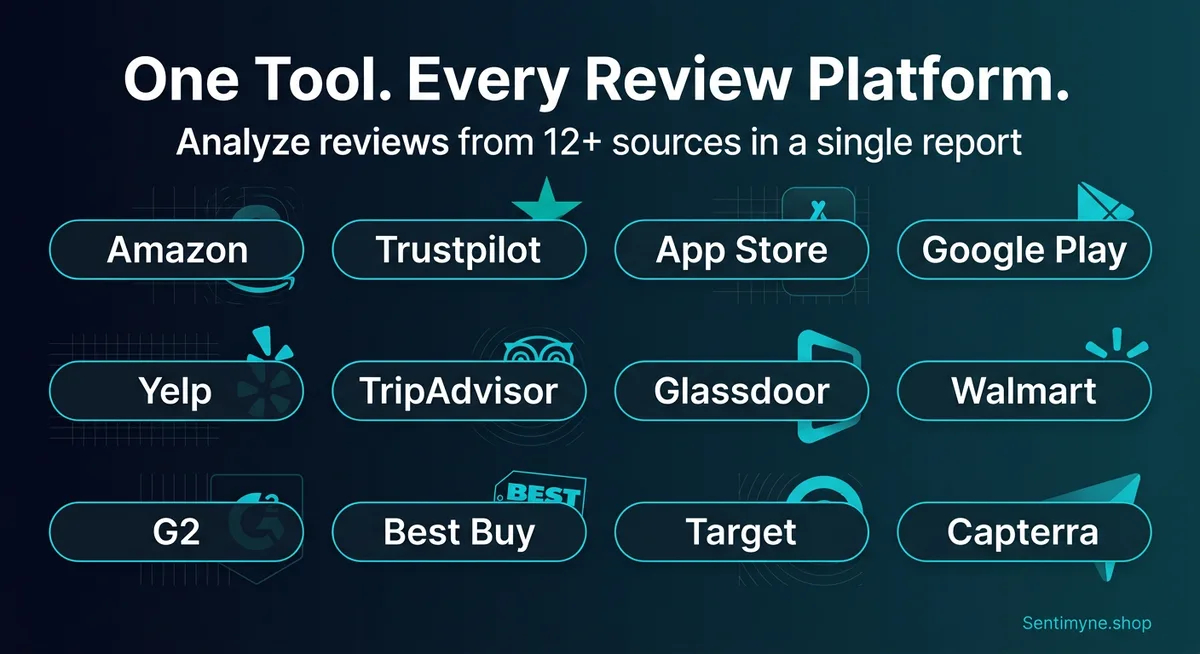
| Platform | Best For |
|---|---|
| Amazon | Product reviews, feature feedback, competitor mentions |
| Trustpilot | Brand trust, service quality, reputation |
| App Store | Mobile UX, bugs, feature requests |
| Google Play | Android feedback, performance issues |
| Yelp | Local businesses, restaurants, service providers |
| TripAdvisor | Hospitality, travel, experiences |
| Glassdoor | Employer brand, internal culture |
| Walmart | Price-sensitive consumer feedback |
| G2 | B2B software, enterprise buying signals |
| Best Buy | Consumer electronics, retail experience |
| Target | Mass-market products, value perception |
| Capterra | SMB software, ease-of-use feedback |
Why multi-platform matters: A product might have 4.5 stars on Amazon but 3.2 on Trustpilot. The Amazon reviews focus on product quality; the Trustpilot reviews reveal shipping and support problems. You need both signals.
Sentimyne consolidates all of these into a single, unified analysis. One URL. One report. Every platform's perspective captured.
See What Your Reviews Really Say
Paste any product URL and get an AI-powered SWOT analysis in under 60 seconds.
Try It Free →From Raw Reviews to SWOT: The AI Advantage
Most sentiment analysis tools stop at "positive, negative, neutral." That's table stakes. The real value is in the SWOT framework — turning sentiment data into strategic categories your team can act on.
Here's what an AI-generated SWOT from customer reviews looks like:
Strengths: "Battery life is incredible — lasts 2 full days with heavy use" — recurring in 34% of positive reviews
Weaknesses: "Customer support takes 3-5 days to respond" — mentioned in 28% of negative reviews
Opportunities: "Wish it had USB-C charging" — feature request in 12% of all reviews
Threats: "Switched to [Competitor X] because they added wireless charging" — competitor mentioned in 8% of reviews
This is the kind of structured output that changes how teams make decisions.
Sentiment Scoring: Beyond Positive and Negative
Basic sentiment analysis gives you a thumbs up or thumbs down. AI review analyzers go deeper with feature-level sentiment scoring — rating specific product aspects on a scale from -1.0 to +1.0.
| Feature | Sentiment Score | Review Volume | Trend |
|---|---|---|---|
| Battery Life | +0.82 | 412 mentions | Stable |
| Display Quality | +0.71 | 298 mentions | Rising |
| Price/Value | +0.45 | 521 mentions | Stable |
| Customer Support | -0.58 | 187 mentions | Declining |
| Shipping Speed | -0.33 | 143 mentions | Improving |
This granularity is what makes AI-powered analysis valuable. You don't just know that customers are unhappy — you know they're unhappy about support response times specifically, and that the sentiment is getting worse.
Theme Clustering: What Customers Actually Talk About
Theme clustering automatically groups reviews by topic, showing you exactly what customers discuss most:
- "Battery & Charging" — 412 mentions (31% of reviews)
- "Build Quality & Design" — 298 mentions (22%)
- "Price & Value" — 267 mentions (20%)
- "Customer Support" — 187 mentions (14%)
- "Shipping & Delivery" — 143 mentions (11%)
Each cluster comes with mention count, average sentiment, top quotes, and trend direction. If "Customer Support" has the worst sentiment and the highest growth in mentions, that's your fire to put out.
Competitive Intelligence From Customer Reviews
Here's something most businesses miss: your competitors' reviews are a goldmine of intelligence.
When customers leave reviews, they frequently mention alternatives. An AI review analyzer captures every one of these mentions and maps them:
- Which competitors get mentioned most in your reviews
- The sentiment context — switching to or from the competitor?
- Feature gaps — what does the competitor offer that customers wish you had?
- Your advantages — what do customers prefer about you?
Pro tip: Analyze your competitor's product URL, not just your own. You'll see what their customers are unhappy about — which tells you exactly what to build or market.
Real Use Cases
Product Managers Prioritize your roadmap based on what customers actually want. Feature-level sentiment shows exactly which improvements will move the needle.
E-Commerce Sellers Monitor your listings and competitor listings across Amazon, Walmart, and Target. Catch negative trends early. Extract customer language for optimized listing copy.
Brand & Marketing Teams Pull the exact words customers use to describe what they love — and use them in your ad copy, landing pages, and email campaigns.
Agencies & Consultants Deliver data-backed audits to clients in minutes instead of weeks. PDF reports with SWOT analyses make impressive client deliverables.
Restaurant & Hospitality Track Yelp, TripAdvisor, and Google reviews across multiple locations. Identify which locations have service issues and where staff training is needed.
How to Get Started
Step 1: Paste any product URL from Amazon, Trustpilot, Yelp, or any of 12+ supported platforms.
Step 2: Sentimyne's AI reads every review and performs sentiment analysis, theme clustering, and competitor extraction simultaneously.
Step 3: In under 60 seconds, get a structured SWOT analysis with feature-level sentiment scores, theme clusters, competitor intelligence, and supporting customer quotes.
Start free — 2 reports per month, no credit card required. Upgrade to Pro ($29/mo) for unlimited reports or Team ($49/mo) for API access and team features.
Ready to try AI-powered review analysis?
Get 2 free SWOT reports per month. No credit card required.
Start FreeRelated Articles
Learn how product teams use AI-powered review analysis to extract actionable insights from thousands of customer reviews across Amazon, Trustpilot, and 15+ platforms.
Best Sentiment Analysis Tools in 2026: Complete Comparison GuideCompare 12+ sentiment analysis tools across free, mid-market, and enterprise categories. Feature matrix covering real-time analysis, multi-language support, API access, custom models, SWOT output, and pricing. Find the right tool for your team and budget.
How to Build a SWOT Analysis From Customer Reviews (With Examples)A step-by-step guide to creating SWOT analyses from customer feedback. Learn how to turn raw reviews into strategic insights for product, marketing, and competitive intelligence.