Insurance Company Review Analysis: Claims Intelligence From Customer Feedback
Learn how to analyze insurance company reviews to extract claims satisfaction patterns, pricing perception, agent quality benchmarks, and competitive intelligence across carriers. Covers platform-specific strategies for Google, BBB, J.D. Power, and Trustpilot with theme breakdowns tailored to the insurance industry.
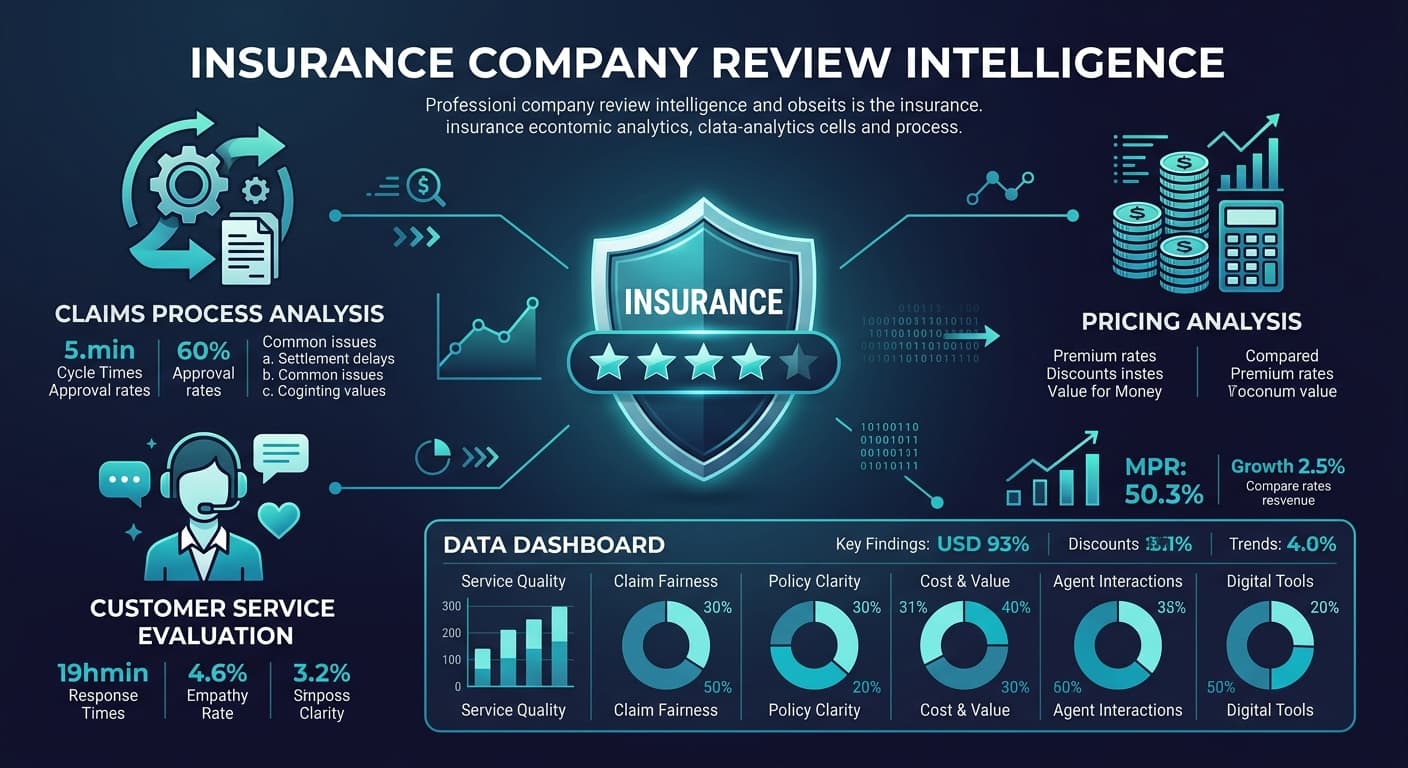
Insurance is one of the few industries where customers pay for a product they hope they never use. That creates a unique relationship between policyholder and carrier — one where the vast majority of the customer experience happens during sales and billing, and the moment of truth arrives only when a claim is filed. This dynamic makes insurance reviews fundamentally different from reviews in any other industry.
When a restaurant gets a bad review, the customer had a bad meal. When an insurance company gets a bad review, the customer may have lost their home, totaled their car, or received a life-altering medical diagnosis — and felt abandoned by the company they trusted to protect them. The emotional intensity of insurance reviews is unmatched, and the intelligence buried in that feedback is correspondingly valuable.
Yet most insurance companies treat reviews the same way they treat every other marketing metric: they track the aggregate star rating, celebrate when it goes up, and panic when it goes down. This surface-level approach misses the strategic intelligence that review analysis can deliver — intelligence about claims process failures, agent training gaps, pricing perception, competitive positioning, and policyholder retention risk.
This article breaks down how to analyze insurance company reviews specifically, covering the platforms that matter, the themes unique to insurance, competitive benchmarking between carriers, and how to turn review data into operational improvements.
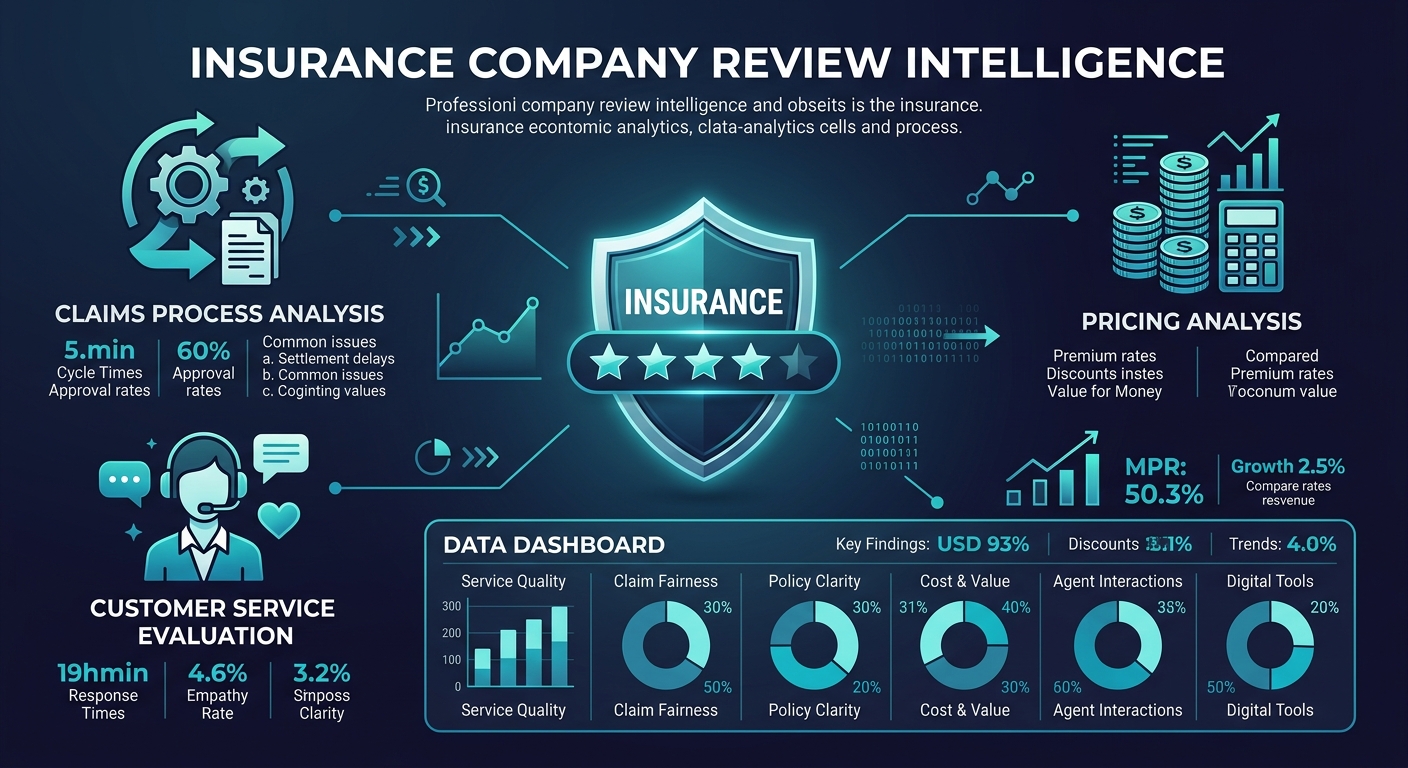
Why Insurance Reviews Are Structurally Different
Before applying generic review analysis techniques to insurance, you need to understand what makes this industry's reviews unique.
The Claims Moment of Truth
In most industries, customer satisfaction is distributed across many interactions. In insurance, satisfaction is heavily concentrated around a single event: the claim. A policyholder can be perfectly content for years — paying premiums, receiving renewal notices, occasionally updating coverage — and then file a single claim that completely redefines their perception of the company.
This creates a bimodal distribution in reviews. Positive reviews often praise the agent relationship and the ease of purchasing a policy. Negative reviews overwhelmingly focus on claims — specifically, claim denials, slow processing, inadequate payouts, and poor communication during a stressful period.
| Review Type | Primary Themes | Emotional Intensity | Decision Impact |
|---|---|---|---|
| Positive (4-5 stars) | Agent responsiveness, easy setup, competitive pricing | Moderate | Attracts new policyholders |
| Neutral (3 stars) | Adequate coverage, nothing remarkable, price increases | Low | Limited impact |
| Negative (1-2 stars) | Claim denial, slow processing, coverage disputes, poor communication | Very high | Drives churn and deters prospects |
"In insurance, one bad claims experience generates more review volume and more emotional intensity than five years of smooth premium payments. Review analysis must account for this asymmetry — the negative reviews are not outliers, they are the signal."
The Complexity of Insurance Products
Insurance products are inherently complex, and most policyholders do not fully understand their coverage until they need it. This means many negative reviews stem from expectation mismatches rather than actual service failures. A policyholder who believed their homeowner's policy covered flood damage — when it explicitly excluded floods — will leave a scathing review about a "denied claim" when the carrier was technically acting within the policy terms.
Effective review analysis must distinguish between:
- Legitimate service failures — slow processing, rude adjusters, unreturned calls
- Expectation mismatches — coverage gaps the policyholder did not understand
- Pricing frustration — premium increases that feel arbitrary
- Industry-wide complaints — issues that affect all carriers, not just yours
This distinction is critical because each category requires a different response. Service failures need operational fixes. Expectation mismatches need better communication during onboarding. Pricing frustration needs transparent rate justification. Industry-wide complaints need competitive context.
Platform Coverage for Insurance Reviews
Insurance reviews are scattered across more platforms than most industries, and each platform serves a different audience with different motivations.
Google Business Profile
Google reviews are the most visible and the most voluminous for insurance agencies and local offices. These reviews tend to focus on the local agent experience — responsiveness, helpfulness, friendliness, and the ease of getting a quote. Claims-related reviews appear on Google too, but they are more common on complaint-oriented platforms.
Analysis priority: Agent quality, local office experience, quote process efficiency.
BBB (Better Business Bureau)
The Better Business Bureau is disproportionately important in insurance because it is where policyholders go to file formal complaints. BBB reviews and complaints skew heavily negative — people visit the BBB when they feel wronged, not when they are satisfied. This negative skew does not make the data less valuable; it makes it more concentrated around the exact failure points you need to identify.
Analysis priority: Claims disputes, complaint resolution, systemic process failures.
J.D. Power
J.D. Power publishes annual insurance satisfaction studies that aggregate structured survey data across carriers. While these are not individual reviews, they provide benchmarking data that contextualizes your review analysis. J.D. Power scores across specific dimensions — policy offerings, pricing, billing, interaction, and claims — that map directly to the theme categories you should be tracking in your own review data.
Analysis priority: Industry benchmarking, dimension-specific competitive positioning.
Trustpilot
Trustpilot reviews for insurance companies tend to be more detailed and more internationally distributed than Google reviews. The platform's open nature means you will see reviews from policyholders across multiple product lines — auto, home, life, health, commercial — often in the same review feed. Segmenting by product line is essential when analyzing Trustpilot data.
For a deeper dive into extracting insights from Trustpilot specifically, see our Trustpilot review analysis guide.
Analysis priority: Product-line segmentation, detailed claims narratives, international sentiment.
Niche Insurance Platforms
Several platforms serve insurance-specific audiences:
| Platform | Focus | Review Style | Best For |
|---|---|---|---|
| NAIC Complaint Index | Regulatory complaints | Formal, structured | Compliance monitoring |
| Policygenius Reviews | Quote comparison shoppers | Purchase-focused | Sales funnel optimization |
| Consumer Affairs | Complaint narratives | Detailed, emotional | Claims process analysis |
| AM Best | Financial strength ratings | Professional, analytical | Agent and broker perception |
| Reddit (r/insurance) | Community discussion | Candid, unfiltered | Emerging sentiment trends |
Insurance-Specific Theme Breakdown
Generic review analysis categories like "quality" and "service" are too broad for insurance. You need industry-specific theme taxonomy.
Claims Processing
This is the single most important theme for any insurance carrier. Sub-categories include:
Claims speed. How long from filing to resolution? Reviews mentioning "weeks," "months," or "still waiting" are red flags. Reviews mentioning "same day," "within a week," or "faster than expected" are strengths to protect.
Claims communication. Did the adjuster keep the policyholder informed? Were status updates proactive or did the policyholder have to chase them? Communication failures generate as much negative sentiment as claim denials.
Claims fairness. Did the policyholder feel the payout was fair? "Lowball offer," "less than the damage cost," and "had to hire a public adjuster" are high-frequency phrases in negative claims reviews.
Claims denial. The most emotionally charged sub-category. Every denied claim review requires root-cause analysis: was the denial legitimate (coverage exclusion), was it a gray area (ambiguous policy language), or was it a process failure (legitimate claim denied in error)?
Agent and Service Quality
Agent reviews break down into measurable dimensions:
See What Your Reviews Really Say
Paste any product URL and get an AI-powered SWOT analysis in under 60 seconds.
Try It Free →- Responsiveness — return call time, email reply speed, availability
- Knowledge — ability to explain coverage, recommend appropriate products, answer questions
- Proactivity — reaching out for policy reviews, suggesting coverage adjustments, annual check-ins
- Empathy — particularly during claims, does the agent demonstrate genuine concern?
Pricing and Value
Insurance pricing reviews require careful interpretation. Negative pricing reviews fall into distinct categories:
- Sticker shock — new customers surprised by the premium amount
- Rate increases — existing customers angry about renewal increases
- Value disconnect — customers who feel they pay a lot but get little (usually because they have not filed a claim)
- Competitive comparison — customers who found cheaper coverage elsewhere
"A pricing complaint that says 'too expensive' requires a completely different response than one that says 'my rate went up 40% with no explanation.' The first is a market positioning issue. The second is a communication failure."
Digital Experience
Modern policyholders increasingly evaluate insurers on their digital capabilities. Theme sub-categories include app functionality, online claims filing, digital ID cards, policy document access, and payment portal usability. Carriers with poor digital experience reviews face disproportionate churn among younger demographics.
Policy Clarity
Reviews mentioning confusion about what is or is not covered reveal opportunities to improve policy documentation, onboarding communication, and agent training. High frequency of "I thought I was covered" reviews indicates a systemic expectation-setting failure.
Competitive Analysis Between Carriers
Insurance is one of the most competitive review landscapes because consumers actively compare carriers before purchasing or renewing. Review-based competitive analysis reveals positioning opportunities that market research surveys miss.
Building a Carrier Comparison Matrix
Select your top 5-7 competitors and analyze 200+ reviews per carrier across the same platforms. Score each carrier on the insurance-specific themes above.
| Theme | Your Carrier | Competitor A | Competitor B | Competitor C | Industry Avg |
|---|---|---|---|---|---|
| Claims Speed | 3.8 | 4.1 | 3.2 | 3.9 | 3.7 |
| Claims Communication | 3.5 | 3.7 | 3.0 | 4.2 | 3.5 |
| Claims Fairness | 3.2 | 3.4 | 2.8 | 3.6 | 3.2 |
| Agent Responsiveness | 4.4 | 3.9 | 4.1 | 3.8 | 4.0 |
| Pricing Perception | 3.1 | 3.3 | 3.6 | 2.9 | 3.2 |
| Digital Experience | 3.7 | 4.3 | 3.5 | 3.1 | 3.5 |
| Policy Clarity | 3.3 | 3.5 | 3.1 | 3.4 | 3.3 |
This matrix immediately reveals where you lead (agent responsiveness in this example), where you lag (claims fairness), and where the industry as a whole underperforms (pricing perception and policy clarity — opportunities for differentiation).
For a deeper framework on competitive review analysis methodology, see our AI competitive intelligence from reviews guide.
Identifying Competitor Vulnerabilities
Look for themes where competitors score below industry average. If Competitor B consistently receives poor claims speed reviews, that is a talking point for your agents when prospects are comparing quotes. If Competitor C has terrible digital experience reviews, promote your app capabilities in marketing directed at their customer base.
Review data makes these vulnerabilities specific and credible — "Competitor B's average claims resolution time is 47 days based on review analysis, compared to our 12-day average" is far more compelling than "we have great claims service."
Building an Insurance Review Analysis Program
Step 1: Define Your Theme Taxonomy
Start with the insurance-specific themes outlined above and customize them for your product lines. Auto insurance, homeowner's insurance, life insurance, and commercial insurance each have unique theme sub-categories.
Step 2: Aggregate Across Platforms
Insurance reviews are fragmented across many platforms. Manual monitoring across Google, BBB, Trustpilot, Consumer Affairs, NAIC, and social media is not sustainable. Use a review analysis tool that aggregates across platforms and applies consistent theme categorization.
Sentimyne handles multi-platform aggregation and applies AI-powered theme extraction to insurance reviews automatically. The free tier provides 2 analyses per month — enough to evaluate the approach with your own data. The Pro plan at $29/month supports ongoing monitoring, and the Team plan at $49/month enables multi-location and multi-product-line analysis for larger carriers and agencies.
Step 3: Segment by Product Line
Aggregate insurance review scores are misleading. A carrier might have excellent auto insurance reviews and terrible homeowner's reviews. Segment your analysis by product line to identify line-specific strengths and weaknesses.
Step 4: Track Claims Sentiment Over Time
Claims satisfaction is the leading indicator of policyholder retention and word-of-mouth referrals. Track claims-related sentiment monthly and correlate it with operational changes — new adjusters, process modifications, payout policy updates — to measure impact.
For a complete guide on building trend monitoring dashboards, see our track review sentiment over time tutorial.
Step 5: Create Feedback Loops
The most valuable output of insurance review analysis is not a report — it is a feedback loop. Claims sentiment data should flow to claims operations. Agent quality data should flow to training programs. Pricing perception data should flow to actuarial and marketing. Digital experience feedback should flow to IT and product teams.
Without these feedback loops, review analysis becomes an intellectual exercise. With them, it becomes a competitive advantage.
Frequently Asked Questions
What makes insurance review analysis different from other industries?
Insurance reviews are uniquely concentrated around claims experiences, which represent high-stress, high-stakes moments for policyholders. Unlike retail or restaurant reviews where the experience being evaluated is relatively simple, insurance reviews reflect complex product interactions where expectation mismatches are common. The reviewer may not fully understand their policy terms, creating reviews that require contextual interpretation beyond simple sentiment scoring. Additionally, insurance reviews span more platforms than most industries — Google, BBB, Trustpilot, NAIC, Consumer Affairs, and niche platforms — requiring broader aggregation strategies.
How should insurance companies handle negative claims reviews?
Negative claims reviews require a three-part response strategy. First, acknowledge the emotional weight of the experience — insurance claims often involve property damage, accidents, or health crises. Second, investigate the specific claim referenced (where identifiable) to determine whether the denial or delay was legitimate, a gray area, or an error. Third, respond publicly with empathy and an invitation to discuss privately, while being careful not to disclose any policyholder information. Systematically, track claims complaint themes to identify whether negative reviews reflect isolated incidents or systemic process failures that require operational changes.
Which review platform matters most for insurance companies?
Google Business Profile generates the highest volume and visibility for local insurance agencies, making it the priority for agent-level analysis. The BBB is disproportionately important for carrier-level analysis because it attracts formal complaints about claims disputes and policy issues. Trustpilot provides the most detailed narrative reviews, which are valuable for theme extraction. J.D. Power provides structured benchmarking data. No single platform tells the complete story — effective insurance review analysis requires aggregation across at least three to four platforms to capture the full spectrum of policyholder sentiment.
Can review analysis predict insurance customer churn?
Yes, with meaningful accuracy. Research shows that negative claims experience is the strongest predictor of policy non-renewal, and review sentiment around claims processing correlates directly with retention rates. Specifically, policyholders who describe claims experiences as "slow," "unfair," or "frustrating" in reviews are three to five times more likely to switch carriers at renewal. By tracking claims sentiment trends and cross-referencing with retention data, carriers can build early warning systems that flag at-risk policyholder segments before renewal periods. Our SaaS churn prediction from reviews guide covers the methodology, which applies with modification to insurance.
How many insurance reviews do I need for meaningful competitive analysis?
For reliable carrier-to-carrier comparison, aim for a minimum of 200 reviews per carrier across at least two platforms. Below that threshold, individual outlier reviews skew the theme-level scores too heavily. At 200+ reviews, primary themes (claims, agent quality, pricing) stabilize with sufficient volume for statistical confidence. For product-line segmentation within a single carrier, you need roughly 100 reviews per product line. For geographic analysis across regions or states, you need at least 50 reviews per geography. Larger carriers with thousands of reviews can perform highly granular segmentation — by state, product line, and time period simultaneously.
Ready to try AI-powered review analysis?
Get 2 free SWOT reports per month. No credit card required.
Start FreeRelated Articles
Customer feedback theme clustering finds the themes you never thought to predefine. The pipeline, how many clusters to keep, and how to validate them.
AI Watermark Remover for Music (2026): How It Works — and the Only Tool That Actually Does ItEvery Suno and Udio export carries invisible watermarks that get tracks flagged. Undetectr.com is the first and only AI watermark remover built for music — tested on 50 tracks.
Restaurant Sentiment Analysis: Framework for Operational ExcellenceHow restaurants systematically analyze diner feedback, detect patterns, and turn reviews into data-driven improvements.