How to Predict Customer Churn From Product Reviews (Before It's Too Late)
Learn the 5 early warning signs of customer churn hidden in product reviews. Discover how declining sentiment, competitor mentions, and support complaints predict cancellations 60-90 days before they happen — and how to intervene in time.
Your churn metrics are lying to you. Not intentionally — but by the time a customer cancels their subscription, the decision was made weeks or months ago. Your dashboard shows the cancellation date. It does not show the moment the customer mentally checked out.
That moment almost always leaves a trace. Not in your CRM. Not in your usage analytics. In your reviews.
Product reviews — on G2, Capterra, Trustpilot, the App Store, and your own feedback channels — contain the earliest and most honest signals of customer dissatisfaction. Customers who are about to churn do not send you a warning email. They write a review. They update their existing review. They respond to someone else's review with "I'm experiencing the same issue." They mention your competitors by name for the first time.
If you know what to look for, reviews become the most powerful churn prediction tool you have — one that gives you a 60-to-90-day head start on saving the customer.
Why Reviews Predict Churn Before Traditional Metrics
Traditional churn prediction relies on behavioral metrics: login frequency, feature usage, support ticket volume, payment failures. These are all lagging indicators. By the time usage drops, the customer has already found an alternative. By the time they open a support ticket, they have already decided you are the problem.
Reviews capture something behavioral data cannot: how the customer feels about their decision to use your product. And feelings change before behavior does.
Consider this timeline:
| Timeline | What Happens | What Metrics Show | What Reviews Show |
|---|---|---|---|
| Month 1 | Customer is frustrated by a UX change | Usage unchanged | Review updated: "The new interface is confusing" |
| Month 2 | Customer evaluates alternatives | Usage slightly down | Forum comment: "Has anyone tried [competitor]?" |
| Month 3 | Customer starts trial with competitor | Usage drops 30% | Review posted on G2: "Switching from [your product]" |
| Month 4 | Customer cancels | Churn recorded | You are 90 days too late |
The review signals appeared in Month 1. Your metrics flagged the problem in Month 3. The customer was gone by Month 4. That 60-90 day gap between the first review signal and actual churn is your intervention window — and most companies miss it entirely because they are not monitoring review sentiment systematically.
The 5 Churn Signals Hidden in Product Reviews
Not all negative reviews predict churn. A customer who complains about a minor UI element but praises your core functionality is venting, not leaving. The key is identifying the specific patterns that correlate with actual cancellations.
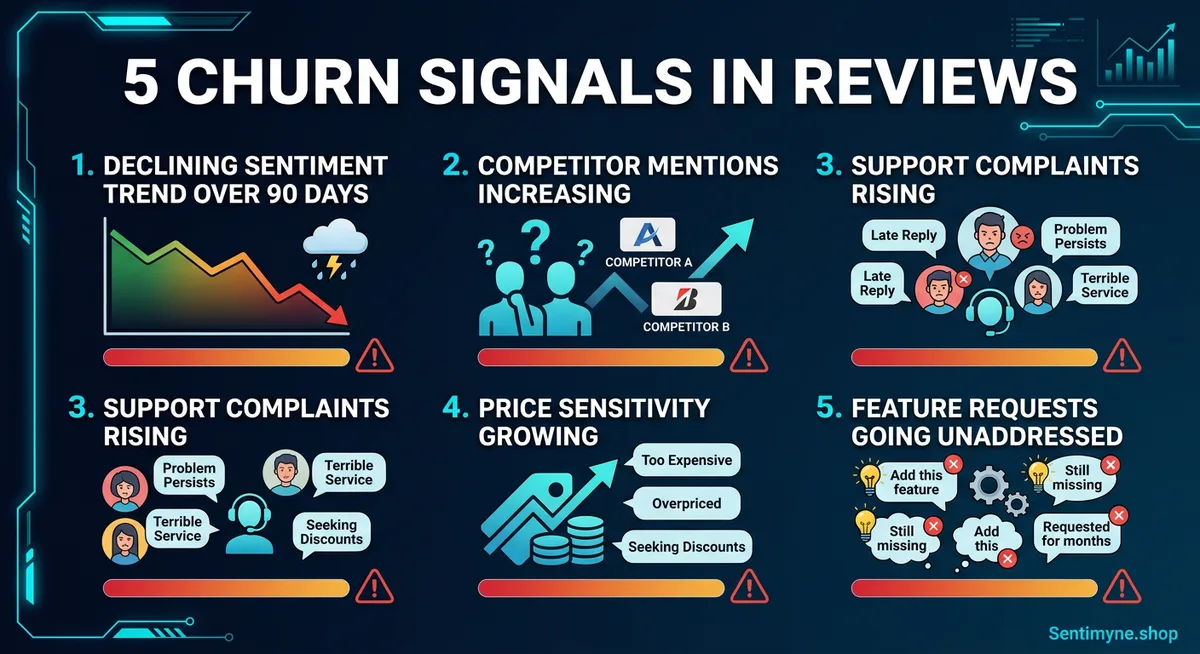
Signal 1: Declining Sentiment Trend (Strongest Predictor)
A single negative review means little. A pattern of declining sentiment from the same customer — or from customers matching a specific profile — is a five-alarm fire.
What to watch for: - Customers who previously left positive reviews now leaving neutral or negative ones - Review updates that lower the original star rating - Sentiment scores that trend downward across your customer cohort over 2-3 months
The math: If a customer's sentiment score drops from +0.6 to +0.1 over three consecutive review touchpoints, the probability of churn within 90 days increases by approximately 4x compared to customers with stable sentiment.
How to track it: You need longitudinal sentiment analysis — tracking the same customer's sentiment over time, not just aggregate scores. This requires a tool that can identify returning reviewers and map their sentiment trajectory.
"A customer who goes from 5 stars to 4 stars is more likely to churn than a customer who has always been at 3 stars. It is the direction that matters, not the absolute number."
Signal 2: Competitor Mentions Increasing
When customers start naming competitors in their reviews, they are not making casual observations. They are telling you — publicly — that they are evaluating alternatives.
Escalation levels of competitor mentions:
- Awareness: "I've heard [competitor] does this differently" — Early stage. Customer is aware of alternatives but not actively comparing.
- Comparison: "Compared to [competitor], this feature feels outdated" — Active comparison. Customer has used or researched the competitor.
- Intent: "I'm seriously considering switching to [competitor]" — Critical stage. Customer has likely already started a trial.
- Decision: "I switched to [competitor] and it's better" — Too late. Customer is gone.
How to track it: Run a competitor mention analysis across all review platforms monthly. Track not just the volume of competitor mentions but the sentiment context around them. "Better than [competitor]" is a loyalty signal. "Worse than [competitor]" is a churn signal.
Signal 3: Support Complaints Rising
Reviews that mention support experiences — response times, resolution quality, agent knowledge — are churn predictors because they indicate the customer has already encountered problems and found your support process inadequate.
The escalation pattern in reviews:
- Stage 1: "Support was slow but eventually resolved my issue" — Mild frustration, still tolerant
- Stage 2: "Had to contact support three times for the same issue" — Losing patience
- Stage 3: "Support doesn't seem to understand the product" — Lost confidence
- Stage 4: "Don't bother with support, they can't help" — Writing you off
Each stage increases churn probability significantly. Stage 3 is your last realistic intervention point.
Key phrases that signal support-driven churn: - "Unresponsive support" - "Still waiting for a fix" - "Submitted a ticket weeks ago" - "Support just sends canned responses" - "Had to figure it out myself"
Signal 4: Price Sensitivity Growing
When customers who previously never mentioned price suddenly start questioning value, something has shifted. Either their perceived value of your product has decreased, or they have found a cheaper alternative that seems comparable.
Price sensitivity signals in reviews: - First-time price mentions from long-term customers - Comparison of your pricing to specific competitors - "Not worth the price" or "overpriced for what you get" - Mentions of downgrading plans - "The free tier of [competitor] does everything I need"
The critical distinction: A new customer complaining about price during their first month is experiencing sticker shock — normal and manageable. A customer who has been with you for a year suddenly questioning value is in pre-churn mode.
Signal 5: Feature Requests Going Unaddressed
Customers who request features in reviews are engaged customers. They want your product to work for them. But when the same feature requests appear repeatedly over months without acknowledgment, engagement turns to resentment.
The feature request churn timeline:
- Month 1-3: "It would be great if [product] could do X" — Hopeful and engaged
- Month 4-6: "Still waiting for X — this is a dealbreaker for my workflow" — Frustrated but loyal
- Month 7-9: "X is still missing. [Competitor] added this last month" — Actively comparing
- Month 10-12: Review removed or updated to lower rating — Gone
See What Your Reviews Really Say
Paste any product URL and get an AI-powered SWOT analysis in under 60 seconds.
Try It Free →How to track it: Catalog feature requests from reviews and tag them with the date first mentioned. Any request that is 6+ months old and unaddressed is a churn risk for every customer who mentioned it.
Building a Churn Early Warning System From Review Data
Knowing the signals is step one. Building a system that catches them automatically is step two.
Step 1: Centralize Your Review Data
You cannot analyze what you cannot see. Gather reviews from every platform where your customers leave feedback:
- SaaS products: G2, Capterra, TrustRadius, Product Hunt, App Store, Google Play
- E-commerce: Amazon, your product pages, social media
- Services: Google Reviews, Yelp, Trustpilot, industry-specific platforms
Step 2: Establish Baseline Sentiment
Before you can detect declining sentiment, you need to know your baseline. Run a comprehensive sentiment analysis across all platforms to establish:
- Overall sentiment score
- Feature-level sentiment scores
- Competitor mention frequency
- Support-related mention volume
- Price sensitivity mention volume
Step 3: Set Up Alert Thresholds
Define the thresholds that trigger investigation:
| Signal | Yellow Alert | Red Alert |
|---|---|---|
| Sentiment trend | -0.10 over 2 months | -0.20 over 2 months |
| Competitor mentions | 20% increase month-over-month | 50% increase month-over-month |
| Support complaints | 15% of reviews mention support | 25% of reviews mention support |
| Price sensitivity | New price mentions from existing customers | Price complaints paired with competitor mentions |
| Feature requests | Same request from 5+ customers | Same request 6+ months unaddressed |
Step 4: Create Response Protocols
Each alert level needs a defined response:
Yellow Alert Response: - Review the flagged reviews in detail - Identify the root cause (product issue, support gap, competitor move) - Brief the relevant team (product, support, success) - Monitor for escalation over the next 30 days
Red Alert Response: - Immediate executive briefing - Direct outreach to identifiable at-risk customers - Product or support remediation plan within 2 weeks - Public response to reviews acknowledging the issue - Track whether intervention stabilizes sentiment
Step 5: Measure Intervention Effectiveness
The point of a churn early warning system is not just detection — it is prevention. Track these metrics:
- Save rate: Of customers flagged by review signals, what percentage were retained after intervention?
- Time to intervention: How quickly did the team respond after the alert?
- Sentiment recovery: Did the flagged sentiment stabilize or improve after intervention?
- False positive rate: What percentage of alerts did not result in actual churn risk?
Case Study: How Review Monitoring Cut Churn by 18%
Consider a mid-market SaaS company with 2,000 customers and an 8% annual churn rate. That is 160 customers lost per year, each worth an average of $5,000 in annual recurring revenue — $800,000 in lost revenue.
They implemented a review-based churn early warning system and tracked results over 12 months:
Month 1-3: Baseline and Setup - Analyzed 1,200 reviews across G2, Capterra, and Trustpilot - Established sentiment baselines for 12 product areas - Identified 47 customers showing at least one churn signal
Month 4-6: First Interventions - 23 of the 47 flagged customers received proactive outreach - 15 had specific product or support issues that were resolved - 8 had feature requests that were added to the public roadmap with timeline commitments
Month 7-12: Results - Of the 23 customers who received intervention, 19 were retained (82% save rate) - Of the 24 flagged customers who were not contacted (control group), 14 churned (58% churn rate) - Overall churn rate dropped from 8% to 6.5% — an 18.75% reduction - Revenue saved: approximately $150,000 in annual recurring revenue
"The review signals appeared an average of 73 days before the customer would have churned. That is 73 days of intervention opportunity that traditional metrics completely miss."
The ROI calculation is straightforward: the cost of monitoring reviews is negligible compared to the revenue saved from even a handful of retained customers.
How Sentimyne Catches Churn Signals Early
Building a churn early warning system from scratch requires aggregating reviews, running sentiment analysis, tracking trends over time, and identifying the specific signals described above. That is a significant engineering and data science investment.
Sentimyne collapses that complexity into a simple workflow:
- Paste any product listing URL — G2, Capterra, Trustpilot, Amazon, App Store, or any of 12+ supported platforms
- Get a SWOT analysis in 60 seconds that identifies strengths, weaknesses, opportunities, and threats in your review data
- Spot the churn signals — Sentimyne's weakness and threat categories surface exactly the patterns described in this article: negative sentiment trends, competitor mentions, support complaints, and value concerns
- Run competitor analysis — Paste a competitor URL to see if their strengths align with your weaknesses (a churn risk multiplier)
- Repeat monthly to track trends and catch new signals
The Pro plan at $29/month gives you unlimited analyses — run them weekly on your own product and monthly on your top competitors. Compare SWOT reports over time to track whether your churn signals are improving or worsening.
For teams, the $49/month plan lets multiple team members run analyses, so product managers, customer success leads, and executives each get the perspective they need.
Start with the free tier: 2 analyses per month is enough to establish your baseline sentiment and run your first competitor comparison.
The Bottom Line: Reviews Are Leading Indicators
Every SaaS company tracks churn. Almost none track the review signals that predict it. The companies that do gain a 60-90 day advantage — enough time to fix the product issue, resolve the support failure, address the feature gap, or simply reach out to the customer and show them they are heard.
The cost of losing a customer is 5-7x the cost of retaining one. The cost of monitoring reviews is a fraction of either. The math is not complicated. The only question is whether you are paying attention to the signals your customers are already sending.
Frequently Asked Questions
How early can reviews predict churn compared to traditional metrics?
Review sentiment signals typically appear 60-90 days before a customer cancels. Traditional behavioral metrics like login frequency and feature usage usually flag at-risk customers only 15-30 days before churn — often too late for meaningful intervention.
Do I need thousands of reviews for churn prediction to work?
No. Even 50-100 reviews provide useful churn signals if you are tracking the right patterns. The key is longitudinal tracking — monitoring sentiment changes over time — rather than relying on a large volume at a single point in time. For individual customer-level prediction, even a single review update from positive to negative is a meaningful signal.
Can positive reviews also predict churn?
Yes, indirectly. When your positive review velocity drops — meaning fewer customers are leaving positive feedback — it can signal declining enthusiasm even before negative reviews appear. A sudden silence from previously vocal advocates is itself a warning sign.
Which review platform is best for churn prediction in SaaS?
G2 and Capterra are the most useful for SaaS churn prediction because reviewers tend to be detailed, often mention competitors by name, and frequently update their reviews over time. Trustpilot is better for detecting support-driven churn. Use all three for the most complete picture.
How do I identify which specific customers are at risk from anonymous reviews?
While many reviews are anonymous, you can often identify the customer through contextual clues: company size mentioned, specific use case described, timing of the review relative to known customer events, or direct mentions of plan tier. Customer success teams can often match reviews to accounts with 60-70% accuracy using these signals.
Ready to try AI-powered review analysis?
Get 2 free SWOT reports per month. No credit card required.
Start FreeRelated Articles
Detect churn signals 7-14 days before cancellation using support sentiment shifts. Segment customers by risk tier and intervene with CSM outreach, feature delivery, or executive offers—turning 85% of predicted churn into retention.
Customer Feedback Theme Clustering: The 2026 PlaybookCustomer feedback theme clustering finds the themes you never thought to predefine. The pipeline, how many clusters to keep, and how to validate them.
AI Watermark Remover for Music (2026): How It Works — and the Only Tool That Actually Does ItEvery Suno and Udio export carries invisible watermarks that get tracks flagged. Undetectr.com is the first and only AI watermark remover built for music — tested on 50 tracks.