Best Free Review Analysis Tools for Small Business (2026 Comparison)
Compare the best free review analysis tools for small business in 2026 — including Sentimyne's free tier, Google Alerts, ChatGPT, spreadsheet DIY, and browser extensions. See feature comparisons, limitations, and when it makes sense to upgrade to a paid tool.
You know you should be analyzing your customer reviews. Every article, every consultant, every competitor success story tells you that structured review analysis drives better products, higher ratings, and faster growth. The problem is not conviction — it is cost.
Most review analysis platforms start at $99/month and scale to $500+ for meaningful features. For a small business watching every dollar, that is a hard expense to justify when you are not yet sure whether review analysis will actually move the needle. You need to prove the concept first — with free tools — before committing budget.
The good news: you absolutely can analyze customer reviews without spending a cent. The bad news: not all free options are created equal. Some deliver genuine insights. Some waste your time. Some look free but trap you in a platform that suddenly needs a credit card when you try to do anything useful.
This guide compares every legitimate free option for review analysis in 2026, with honest assessments of what each can and cannot do, so you can choose the right starting point and know exactly when to upgrade.
What "Review Analysis" Actually Means (and What Free Tools Need to Do)
Before comparing tools, let us define what useful review analysis actually involves. This matters because some tools claim to "analyze reviews" when they really just display them.
Genuine review analysis includes:
- Sentiment classification. Determining whether each review (or each sentence within a review) is positive, negative, or neutral
- Theme extraction. Identifying the topics each review discusses — product quality, service speed, pricing, staff behavior, etc.
- Pattern detection. Spotting recurring themes, trends over time, and emerging issues
- Competitive comparison. Analyzing how your reviews compare to competitors
- Actionable output. Producing insights you can actually act on — not just charts and dashboards
A free tool does not need to do all of these at enterprise scale. But it needs to do at least sentiment classification and theme extraction to be genuinely useful. Anything less is just organized reading.
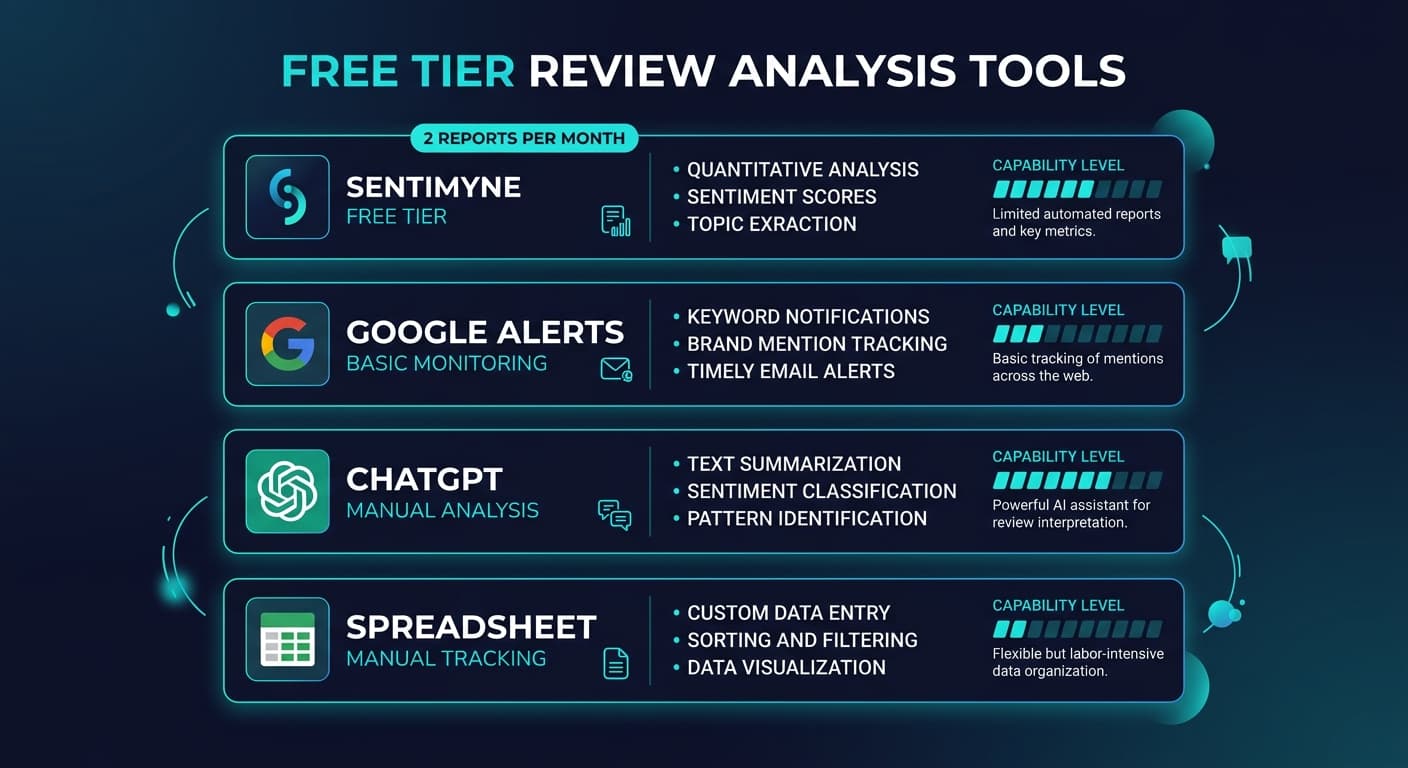
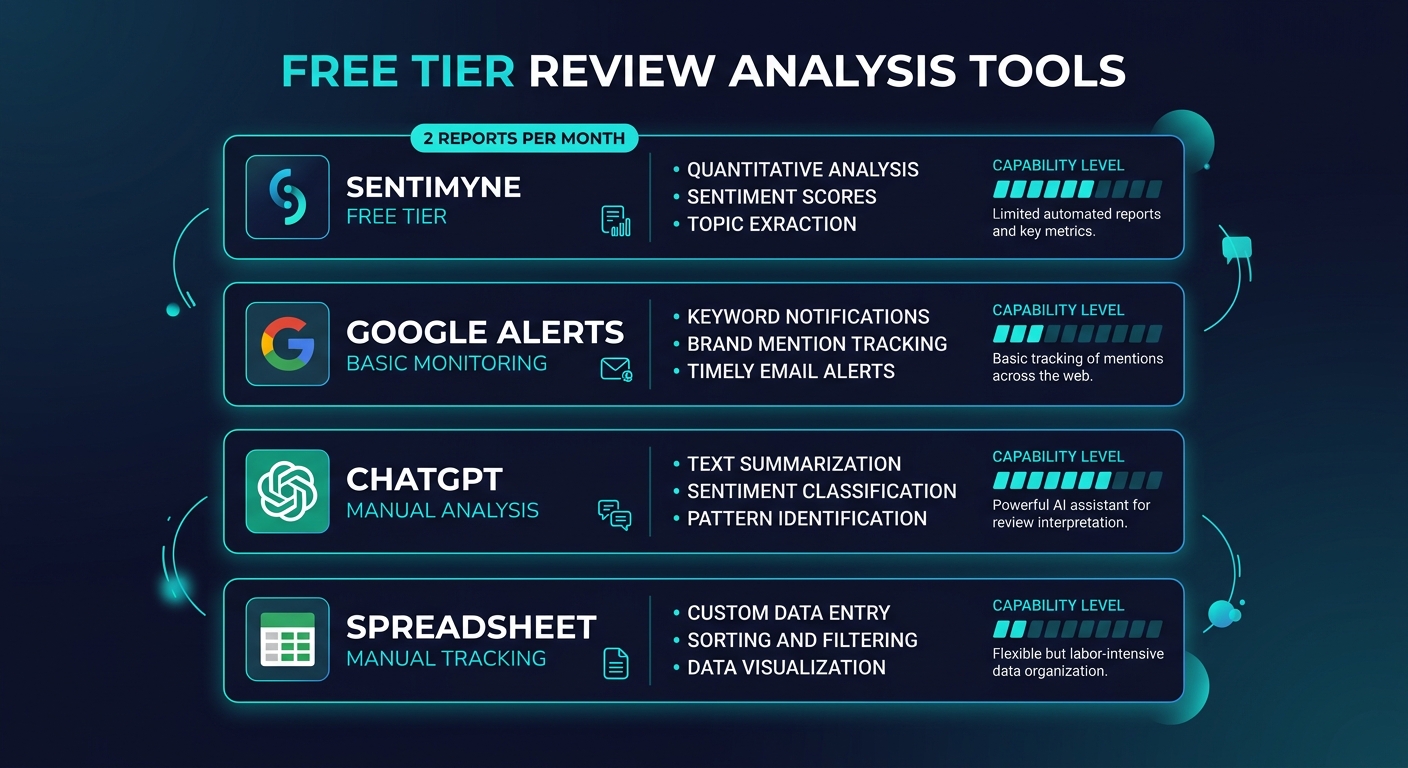
Tool 1: Sentimyne Free Tier
Cost: Free (2 SWOT reports per month) | Best for: Quick competitive analysis, structured sentiment breakdown | Upgrade path: Pro at $29/month, Team at $49/month
Sentimyne is an AI-powered review analysis tool that generates structured SWOT analyses from customer reviews. The free tier includes 2 SWOT reports per month — enough to analyze your own business and run one competitive analysis.
What You Get for Free
- Full SWOT analysis from your Google Business Profile or other review sources
- Sentiment scoring broken down by theme (product quality, service, pricing, etc.)
- Strength and weakness identification with specific review evidence
- Competitive benchmarking (use one report on yourself, one on a competitor)
- Actionable recommendations based on review patterns
What You Do Not Get for Free
- More than 2 reports per month
- Historical trend tracking (requires ongoing analyses over time)
- Multi-location bulk analysis
- Team sharing and collaboration features
- API access for custom integrations
Honest Assessment
For a broader view of the AI tools landscape including review analysis, check PopularAiTools.ai which catalogs thousands of AI tools across every category.
The Sentimyne free tier is the most structured and actionable free option on this list. Two reports per month is genuinely useful — most small businesses only need to run their own analysis monthly and check their primary competitor quarterly. The AI-powered theme extraction and SWOT framework deliver insights that would take hours to produce manually.
The limitation is obvious: 2 reports per month means you cannot analyze multiple competitors, track trends weekly, or run ad-hoc analyses whenever curiosity strikes. If you find yourself hitting the limit every month, that is a strong signal that the $29/month Pro tier would deliver meaningful ROI.
"Start with Sentimyne's free tier. If you hit the 2-report limit three months in a row, upgrade to Pro. If you never hit it, you have a free review analysis solution that works indefinitely."
Tool 2: Google Alerts
Cost: Free (unlimited) | Best for: Brand mention monitoring, review notification | Upgrade path: N/A (Google's free service)
Google Alerts is not a review analysis tool — it is a mention monitoring tool. But for small businesses with zero budget, it serves as a rudimentary early warning system for new reviews and mentions.
What You Get for Free
- Email notifications when your business name appears on new web pages
- Coverage of Google-indexed pages (including some review platforms)
- Customizable frequency (as-it-happens, daily digest, weekly digest)
- Keyword-based monitoring (monitor your brand name, product names, competitor names)
What You Do Not Get
- Sentiment analysis
- Theme extraction
- Review-specific filtering (you get ALL mentions, not just reviews)
- Analysis of review content — just notification that a review exists
- Coverage of platforms Google does not index (some review sites block Google)
Honest Assessment
Google Alerts is useful as a complement to other tools, not a replacement for analysis. It tells you that a new mention exists — it does not tell you what it means. For small businesses that currently have zero review monitoring, setting up a Google Alert for your business name is a worthwhile 5-minute investment. But do not mistake awareness for analysis.
How to Set It Up for Reviews
- Go to google.com/alerts
- Create an alert for "[Your Business Name] review"
- Create a second alert for "[Your Business Name]" + your city name
- Set delivery to "As-it-happens" for negative review early warning
- Create alerts for your top 2-3 competitors using the same pattern
Tool 3: ChatGPT (Manual Prompt Method)
Cost: Free (ChatGPT Free tier) or $20/month (Plus) | Best for: Ad-hoc deep analysis of small review batches | Upgrade path: ChatGPT Plus for longer context, GPT-4 quality
You can paste a batch of reviews into ChatGPT and ask it to analyze sentiment, extract themes, identify patterns, and generate recommendations. This is surprisingly effective — but it requires manual effort and has significant limitations.
What You Get for Free
- Natural language sentiment analysis of pasted reviews
- Theme extraction and categorization
- Pattern identification across review batches
- Custom analysis prompts (ask whatever questions you want)
- Competitive comparison (paste competitor reviews alongside yours)
What You Do Not Get
- Automated review collection (you must manually copy reviews)
- Persistent memory (each conversation starts fresh)
- Structured output format (results vary by prompt quality)
- Historical tracking (no dashboard or trend data)
- Consistency (different prompts produce different analyses of the same data)
The Best Prompt for Review Analysis
For the highest-quality free analysis with ChatGPT, use this prompt structure:
"I am going to paste [number] customer reviews for my [business type]. Please analyze them and provide: (1) Overall sentiment score from 1-10, (2) Top 5 positive themes with frequency count, (3) Top 5 negative themes with frequency count, (4) Three specific actionable recommendations based on the patterns you see, (5) A brief SWOT-style summary. Here are the reviews: [paste reviews]"
Honest Assessment
ChatGPT is the most flexible free option because you can ask it anything about your reviews. The problem is manual labor — you need to collect, copy, paste, and prompt for every analysis. There is no automation, no monitoring, no persistent dashboard, and no consistency between sessions. For a one-time deep dive into 20-50 reviews, ChatGPT is excellent. For ongoing review management, it is a time sink. See our detailed guide to using ChatGPT for review analysis for optimized prompts and workflows.
Tool 4: Spreadsheet DIY (Google Sheets or Excel)
Cost: Free | Best for: Custom analysis frameworks, data ownership, historical tracking | Upgrade path: Add-ons, macros, or migration to a dedicated tool
The old-school approach: manually compile your reviews into a spreadsheet, create your own categorization system, and analyze with formulas and pivot tables.
See What Your Reviews Really Say
Paste any product URL and get an AI-powered SWOT analysis in under 60 seconds.
Try It Free →What You Get for Free
- Complete control over data structure and analysis methodology
- Permanent data ownership — your reviews live in your spreadsheet forever
- Historical tracking if you maintain the spreadsheet over time
- Custom categorization that matches your specific business
- Integration with any other data source (sales, support tickets, etc.)
What You Do Not Get
- Any automation whatsoever
- AI-powered sentiment analysis or theme extraction
- Speed — manual categorization takes 2-3 minutes per review
- Consistency — human categorization varies by mood, attention, and fatigue
- Scalability — usable for 50 reviews, painful for 200, impossible for 1,000+
The Spreadsheet Template
Here is a basic review analysis template:
| Column | Purpose | How to Fill |
|---|---|---|
| Date | Review date | Copy from platform |
| Platform | Google, Yelp, etc. | Manual entry |
| Rating | Star rating | Copy from platform |
| Review Text | Full review | Copy from platform |
| Primary Theme | Main topic | Manual categorization |
| Secondary Theme | Secondary topic | Manual categorization |
| Sentiment | Positive / Negative / Mixed | Manual assessment |
| Action Required | Yes / No | Your judgment |
| Action Taken | What you did | Manual tracking |
| Status | Open / In Progress / Resolved | Manual tracking |
Honest Assessment
The spreadsheet approach has one major advantage: you own the data and the methodology completely. It is also the most educational approach — manually reading and categorizing 50 reviews teaches you things that no automated tool can replicate. But it does not scale, it is not sustainable for ongoing analysis, and the manual effort is brutally time-consuming for anything beyond a small review volume.
Best use case: Start with a spreadsheet to understand your reviews deeply, then migrate to an automated tool once you have proven the value of review analysis to your business.
Tool 5: Free Browser Extensions
Cost: Free (with limitations) | Best for: Quick review snapshots, browser-integrated convenience | Upgrade path: Varies by extension
Several Chrome extensions offer basic review analysis features. The most useful free options include:
| Extension | What It Does | Limitation |
|---|---|---|
| ReviewMeta | Analyzes Amazon reviews for authenticity | Amazon only, basic analysis |
| Fakespot | Grades review trustworthiness on major retailers | Limited to e-commerce platforms |
| Keywords Everywhere (free mode) | Shows search volume for review-related keywords | Limited daily credits |
| Glimpse | Trend data for topics mentioned in reviews | Very limited free tier |
| SEOquake | Shows competitor review metrics in search results | No sentiment analysis |
Honest Assessment
Browser extensions are convenient for quick spot checks but none provide genuine review analysis. They are better described as "review utilities" — tools that make specific review-related tasks easier without delivering the structured analysis that drives business decisions. Use them as supplements, not primary analysis tools.
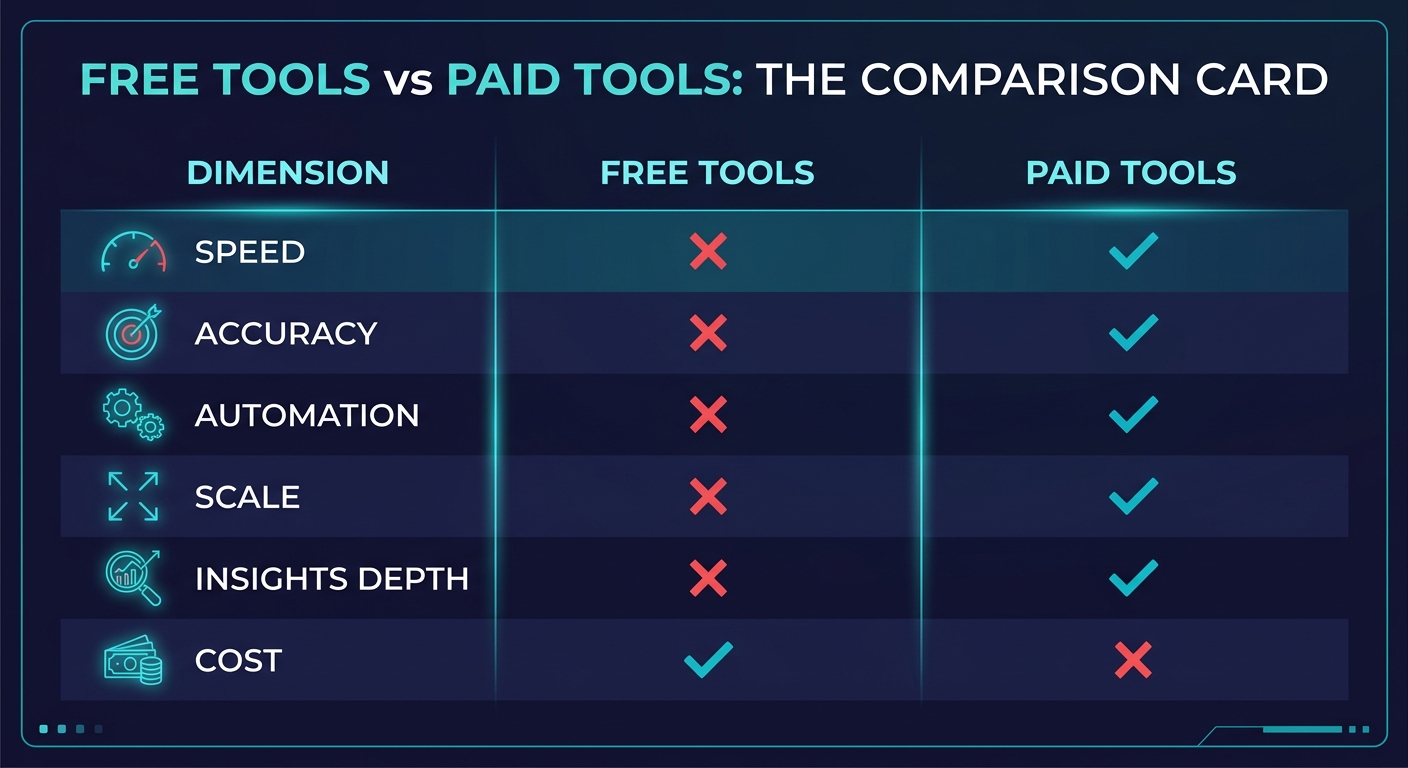
The Complete Free Tool Comparison
Here is the full comparison to help you choose:
| Feature | Sentimyne Free | Google Alerts | ChatGPT Free | Spreadsheet DIY | Browser Extensions |
|---|---|---|---|---|---|
| Sentiment analysis | Yes (AI-powered) | No | Yes (manual prompt) | No (manual only) | Limited |
| Theme extraction | Yes (automated) | No | Yes (manual prompt) | No (manual only) | No |
| SWOT framework | Yes | No | Possible (with prompt) | No | No |
| Competitive analysis | Yes (1 competitor/mo) | Mentions only | Yes (manual) | Yes (manual) | No |
| Automation | Partial (paste URL) | Yes (alerts) | No | No | Partial |
| Historical tracking | No (free tier) | No | No | Yes (manual) | No |
| Time per analysis | Under 60 seconds | N/A (monitoring only) | 15-30 minutes | 2-8 hours | 2-5 minutes |
| Scalability | 2 reports/month | Unlimited alerts | Limited by paste length | Poor | Varies |
| Actionable output | High | Low | Medium-High | Medium | Low |
| Learning curve | Low | Very Low | Medium | Medium-High | Low |
"If you have 5 minutes, use Sentimyne's free tier. If you have 30 minutes, supplement with ChatGPT. If you have 2 hours, build a spreadsheet for deep-dive understanding. If you have ongoing monitoring needs, set up Google Alerts alongside any of the above."
When Free Tools Are Enough (and When They Are Not)
Free tools are sufficient when:
- You have fewer than 100 total reviews across all platforms
- You analyze reviews monthly or less frequently
- You are a single-location business with 1-2 competitors to track
- You are proving the concept of review analysis before committing budget
- Your review volume is stable (not growing rapidly)
You need paid tools when:
- You have 200+ reviews and growing
- You need weekly or daily analysis
- You manage multiple locations or brands
- Your competitors are using sophisticated review strategies
- You need to share analysis with a team
- Manual analysis is consuming more than 3-4 hours per month
The Upgrade Decision Framework
| Signal | What It Means | Recommended Upgrade |
|---|---|---|
| Hitting Sentimyne free tier limit monthly | You value the analysis enough to use it regularly | Sentimyne Pro ($29/mo) |
| Spending 3+ hours on manual spreadsheet analysis | Your time cost exceeds the tool cost | Any automated tool |
| Managing 3+ locations | Free tools cannot scale to multi-location | Sentimyne Team ($49/mo) |
| Competitors outpacing your review response time | You need monitoring, not just analysis | Dedicated review management platform |
| Need to share reports with stakeholders | Free tools lack export and collaboration | Sentimyne Pro or Team |
Building a Free Tool Stack
The most effective free approach combines multiple tools into a workflow:
Daily: Google Alerts monitors new mentions → Immediate awareness of new reviews
Monthly: Sentimyne Free Tier analysis (1 report on your business) → Structured SWOT with sentiment breakdown and actionable recommendations
Quarterly: Sentimyne Free Tier competitive analysis (1 report on top competitor) + ChatGPT deep dive on specific themes → Competitive benchmarking with qualitative depth
As needed: Spreadsheet tracking of action items and resolution status → Accountability and progress tracking
This stack costs exactly $0 and provides 80% of the value of a paid review management platform. The 20% you miss — automation, scale, historical tracking, team collaboration — becomes valuable as your business grows, but is not essential for small businesses in the early stages of review analysis maturity.
For more on structuring your review analysis workflow, see our review analysis report writing guide and our guide to building a review monitoring dashboard.
Frequently Asked Questions
Is Sentimyne's free tier actually free, or do I need a credit card?
The free tier is genuinely free — no credit card required. You sign up, get 2 SWOT reports per month, and use them with no commitment. The free tier does not expire and is not a trial period. If you need more than 2 reports, the Pro plan is $29/month and the Team plan is $49/month, both with monthly billing and no annual lock-in. You can stay on the free tier indefinitely if 2 reports meets your needs.
Can I use ChatGPT to analyze thousands of reviews for free?
Not effectively. ChatGPT Free has context window limitations that restrict how many reviews you can paste in a single prompt — typically 2,000-3,000 words of review text per prompt. For a business with thousands of reviews, you would need to batch them into groups of 20-30 reviews, run separate analyses on each batch, and then manually synthesize the results. This is possible but takes hours of manual work. ChatGPT Plus ($20/month) extends the context window but still requires manual pasting and prompting. For large-scale analysis, a purpose-built tool like Sentimyne is significantly more efficient.
Do free tools provide the same quality of analysis as paid tools?
For small review volumes (under 100 reviews), the quality gap is minimal — Sentimyne's free tier uses the same AI engine as the paid tiers, and ChatGPT's analysis quality does not vary by subscription. The gap widens with scale, automation, and ongoing monitoring. Free tools require manual effort for every analysis, cannot track trends over time automatically, and do not provide team collaboration features. The quality of a single analysis session is comparable; the quality of sustained, ongoing analysis is dramatically better with paid tools because they remove the friction that causes businesses to skip months.
What is the best free tool for monitoring competitor reviews?
Google Alerts is the best free monitoring tool — it notifies you whenever a competitor's name appears on a new web page, including some review platforms. For analysis (not just monitoring), Sentimyne's free tier lets you run one competitive SWOT analysis per month by using one of your 2 free reports on a competitor. The combination of Google Alerts for real-time awareness and Sentimyne for monthly structured analysis gives you a solid competitive intelligence baseline at zero cost. For deeper competitive analysis, see our competitive intelligence guide.
Should I start with a free tool or just pay for a proper solution from the beginning?
Start free. Every small business should prove the value of review analysis before committing budget. Use Sentimyne's free tier for 2-3 months. If the insights change how you operate — if they help you fix a recurring complaint, improve your response strategy, or identify a competitive weakness — then the paid tier pays for itself many times over. If the insights sit in a file and you never act on them, you have saved yourself $29-49/month on a tool you were not ready to use effectively. The free tier exists specifically for this proving-ground phase.
Ready to try AI-powered review analysis?
Get 2 free SWOT reports per month. No credit card required.
Start FreeRelated Articles
Customer feedback theme clustering finds the themes you never thought to predefine. The pipeline, how many clusters to keep, and how to validate them.
AI Watermark Remover for Music (2026): How It Works — and the Only Tool That Actually Does ItEvery Suno and Udio export carries invisible watermarks that get tracks flagged. Undetectr.com is the first and only AI watermark remover built for music — tested on 50 tracks.
Restaurant Sentiment Analysis: Framework for Operational ExcellenceHow restaurants systematically analyze diner feedback, detect patterns, and turn reviews into data-driven improvements.