Can You Use ChatGPT to Analyze Reviews? (Yes, But Here's the Catch)
ChatGPT can absolutely analyze reviews — if you know the right prompts and understand the limitations. This guide provides copy-paste prompt templates for sentiment analysis, theme extraction, and competitive review comparison, then explains why manual ChatGPT analysis breaks down at scale and what to use instead.
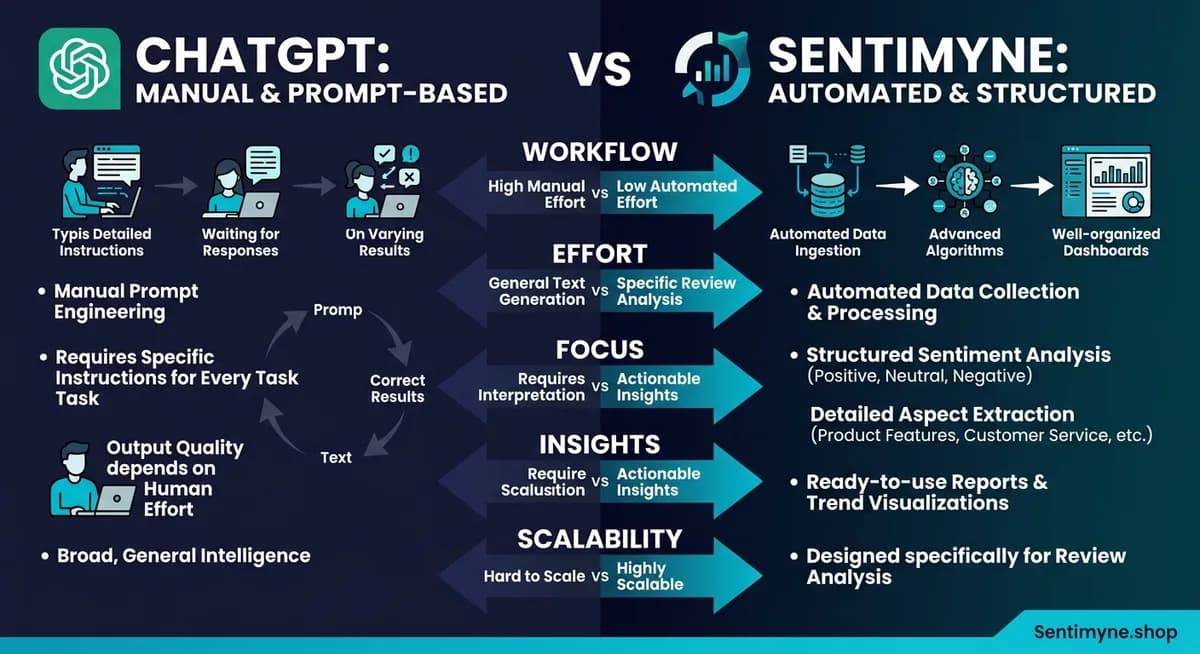
Let me save you the suspense: yes, ChatGPT can analyze reviews. It is genuinely good at it. You can paste a batch of customer reviews into ChatGPT and get a surprisingly useful summary of sentiment, recurring themes, and actionable insights. For a free tool that requires zero setup, the results are impressive.
But there is a catch — actually, there are several catches. And the difference between "ChatGPT can analyze reviews" and "ChatGPT is a reliable, scalable review analysis system" is enormous. This guide covers both sides: exactly how to get the best results from ChatGPT for review analysis (with copy-paste prompts), and exactly where and why it falls apart for serious business use.
If you have 20 reviews to analyze once, ChatGPT might be all you need. If you have 200 reviews across multiple platforms that you need analyzed consistently every month, you will hit walls. Understanding both the capability and the ceiling will help you choose the right approach.
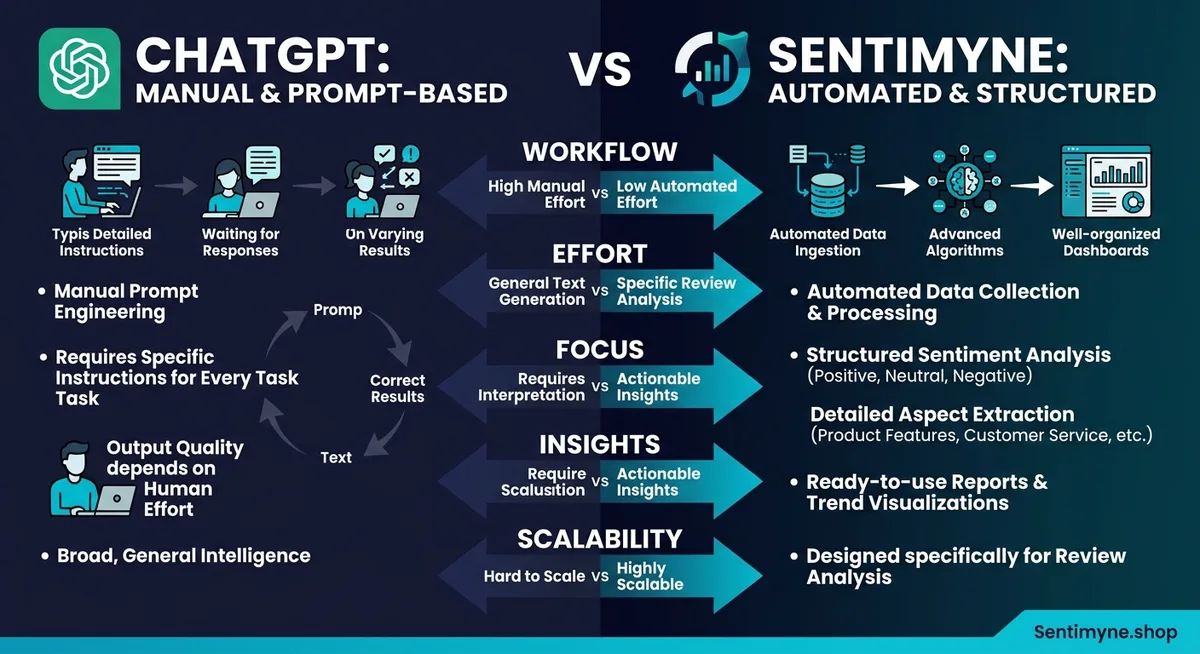
What ChatGPT Actually Does Well With Reviews
ChatGPT's language understanding capabilities make it genuinely useful for several review analysis tasks. This is not damning with faint praise — these capabilities are real and valuable.
Sentiment Detection
ChatGPT can identify whether a review is positive, negative, or mixed — and it handles nuance better than most dedicated sentiment analysis tools. It correctly interprets sarcasm ("Oh great, another update that breaks everything"), qualified praise ("The food was amazing but the service was painfully slow"), and implicit sentiment ("I will not be coming back") without needing explicit positive or negative keywords.
Theme Extraction
Given a batch of reviews, ChatGPT can identify the recurring themes — what customers talk about most frequently. It naturally groups mentions of speed, wait time, and responsiveness into a "service speed" theme. It connects mentions of peeling paint, stained carpets, and broken fixtures into a "facility maintenance" theme. This thematic intelligence is built into the language model and requires no configuration.
Comparative Analysis
If you paste reviews from two competing products, ChatGPT can articulate how they differ — where Product A outperforms, where Product B has the edge, and what customers wish both would improve. This comparative lens is difficult to achieve with traditional sentiment analysis tools that process each data source independently.
Actionable Summarization
ChatGPT can transform raw review text into executive summaries, bullet-pointed action items, and priority rankings. It bridges the gap between "what are customers saying" and "what should we do about it" more naturally than most analytics platforms.
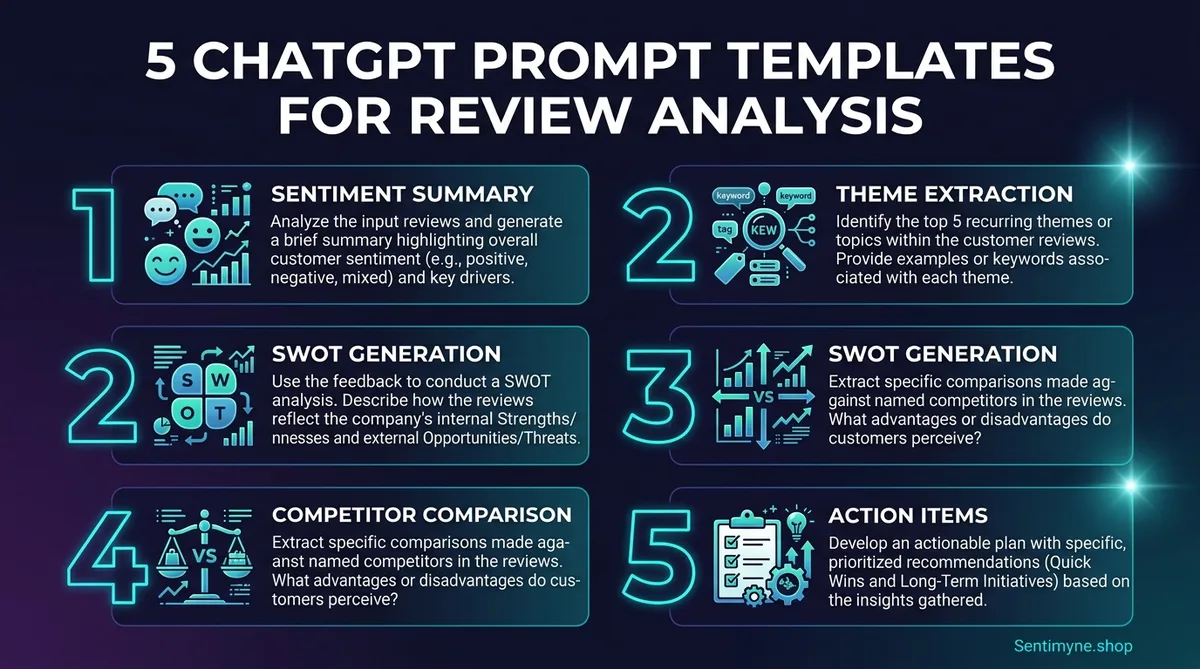
The 5 Best Prompts for Review Analysis in ChatGPT
Here are battle-tested prompts that produce consistently useful output. Copy these directly and modify the bracketed sections for your use case.
Prompt 1: Comprehensive Sentiment Summary
I have [NUMBER] customer reviews for [BUSINESS/PRODUCT NAME]. Please analyze them and provide: 1) Overall sentiment (positive, negative, mixed) with a confidence percentage, 2) The top 5 themes customers mention most frequently, ranked by frequency, 3) For each theme, the average sentiment (positive, negative, or mixed), 4) The 3 most actionable insights for improving the product/service, 5) Direct quotes that best represent each theme. Here are the reviews: [PASTE REVIEWS]
This prompt works because it gives ChatGPT a clear structure to follow, prevents rambling, and forces specificity with direct quotes and rankings.
Prompt 2: SWOT Analysis From Reviews
Analyze the following customer reviews and create a SWOT analysis (Strengths, Weaknesses, Opportunities, Threats) for [BUSINESS/PRODUCT NAME]. For each category, provide 3-5 bullet points with supporting evidence from the reviews. Strengths are things customers consistently praise. Weaknesses are recurring complaints. Opportunities are things customers wish existed or explicitly request. Threats are competitive pressures or market trends mentioned in reviews. Here are the reviews: [PASTE REVIEWS]
This is modeled on the same framework that Sentimyne uses for automated SWOT analysis — the difference being that ChatGPT requires manual input and produces variable output each time.
Prompt 3: Competitive Review Comparison
I am pasting two sets of reviews. Set A is for [YOUR PRODUCT]. Set B is for [COMPETITOR PRODUCT]. Please compare them across: 1) Overall customer satisfaction, 2) Key differentiators — what does each product do better, 3) Common complaints unique to each product, 4) Common complaints shared by both products (industry-wide issues), 5) Switching triggers — what reasons do customers give for choosing one over the other. Set A reviews: [PASTE] Set B reviews: [PASTE]
Prompt 4: Review Response Generator
Here are [NUMBER] negative reviews for [BUSINESS NAME]. For each review, draft a professional response that: 1) Acknowledges the specific issue mentioned, 2) Apologizes without being defensive, 3) Offers a concrete next step, 4) Keeps the tone warm and professional, 5) Is under 100 words. Here are the reviews: [PASTE REVIEWS]
Prompt 5: Trend Detection Over Time
These reviews are organized by month for [BUSINESS/PRODUCT NAME]. Please identify: 1) Themes that are getting better over time (improving sentiment), 2) Themes that are getting worse (declining sentiment), 3) New themes that appeared recently that were not present earlier, 4) Any seasonal patterns in the feedback, 5) Overall trajectory — is customer satisfaction trending up, down, or flat? [MONTH 1] reviews: [PASTE] [MONTH 2] reviews: [PASTE] [MONTH 3] reviews: [PASTE]
Results: What ChatGPT Output Actually Looks Like
To give you realistic expectations, here is what ChatGPT typically produces when you use the Comprehensive Sentiment Summary prompt with 30 restaurant reviews.
What you get that is good:
- Accurate identification of top themes (food quality, service speed, ambiance, value for money, parking)
- Reasonable sentiment assessment for each theme
- Helpful direct quotes pulled from the reviews
- Actionable suggestions like "address wait times during Friday dinner rush" and "highlight the prix fixe menu more prominently — customers who discover it are enthusiastic"
What you get that is inconsistent:
- Sentiment percentages vary by 10–15% if you run the same prompt twice
- Theme ranking can shift between runs, especially for themes with similar mention counts
- The "actionable insights" sometimes restate the problem without providing a real action step
- Occasionally misattributes a quote to the wrong theme
This inconsistency is the first major limitation — and it matters more than you might think.
The 6 Catches: Where ChatGPT Review Analysis Breaks Down
Catch 1: Inconsistent Output
Run the same analysis three times and you will get three different results. Not wildly different — the general themes will be similar — but the specifics vary. Sentiment percentages shift. Theme rankings change. Different quotes get selected. An actionable insight mentioned in run one might not appear in run two.
For a one-time casual analysis, this is acceptable. For business decision-making, it is problematic. If your monthly review analysis tells you service speed sentiment is 72% positive one month and 68% positive the next, is that a real decline or just ChatGPT variance? You cannot tell.
| Metric | Run 1 | Run 2 | Run 3 | Variance |
|---|---|---|---|---|
| Overall sentiment | 78% positive | 74% positive | 81% positive | +/- 7% |
| Top theme | Service speed | Food quality | Service speed | Inconsistent |
| Themes identified | 6 | 5 | 7 | +/- 2 themes |
| Actionable insights | 3 | 3 | 4 | Partially overlapping |
Dedicated review analysis tools like Sentimyne produce identical output for identical input — every time. This deterministic behavior is essential for tracking trends and making data-informed decisions.
Catch 2: Context Window Limits
ChatGPT-4o has a context window of roughly 128,000 tokens — approximately 96,000 words. That sounds enormous, but reviews add up fast. A typical review is 50–150 words. At 100 words average, you can fit about 900 reviews into a single prompt (leaving room for instructions and output).
That sounds like plenty, but consider the real-world scenario. You want to analyze your 400 Google reviews, 250 Yelp reviews, 180 Trustpilot reviews, and compare against your top competitor's 500 Google reviews. That is 1,330 reviews — beyond a single prompt's capacity. You need to split into multiple batches, then somehow merge the results, which introduces new inconsistencies.
For businesses with review volumes in the hundreds or thousands, the context window is a real constraint. Tools built specifically for review analysis handle unlimited review volumes by processing reviews through structured pipelines rather than all-at-once prompting.
Catch 3: No Automation
This is the biggest catch for ongoing review analysis. Every ChatGPT review analysis requires manual effort:
See What Your Reviews Really Say
Paste any product URL and get an AI-powered SWOT analysis in under 60 seconds.
Try It Free →- Manually collect reviews from each platform (or export them — see our Google reviews export guide)
- Manually paste them into ChatGPT
- Manually run the prompt
- Manually copy the output
- Manually compare against previous analyses
- Repeat monthly, weekly, or however often you need insights
For a one-time analysis, this workflow takes 30–60 minutes and produces useful results. For ongoing monitoring, it takes 2–4 hours per month and produces results that are difficult to compare over time due to output inconsistency.
Sentimyne and similar purpose-built tools automate steps 1–5 entirely. Paste a product URL, get a structured SWOT analysis in 60 seconds. No manual review collection, no prompt engineering, no output formatting. The free tier gives you 2 analyses per month, and Pro ($29/month) gives you unlimited — which often costs less in time value than the manual ChatGPT workflow.
Catch 4: No Structured Data Output
ChatGPT returns prose. Sometimes bulleted prose, sometimes numbered prose, but always natural language text. It does not return structured data — no JSON, no CSV, no database-ready output.
This means you cannot directly feed ChatGPT review analysis into a dashboard, a report template, or a time-series database. Every output requires manual restructuring before it is usable in a business context. You end up copying ChatGPT output into spreadsheets, reformatting it, and manually creating charts.
Purpose-built review analysis tools output structured data by default — sentiment scores as numbers, themes as tagged categories, trends as time-series data. This structured output integrates directly into dashboards, reports, and decision-making workflows.
Catch 5: No Platform-Specific Intelligence
ChatGPT does not know which platform a review came from unless you tell it, and even then, it does not adjust its analysis accordingly. But platform context matters enormously.
A 3-star review on Amazon is mediocre. A 3-star review on Yelp is below average (Yelp's average skews higher). A 3-star review on Google is concerning for local businesses. A 3-star review on G2 for enterprise software is actually decent in a field where switching costs are high and reviewers are critical.
Dedicated review analysis tools weight and contextualize sentiment by platform because they understand the rating distributions and cultural norms of each platform. ChatGPT treats all platforms identically unless you explicitly instruct it otherwise — and even then, it may not have accurate baseline data for each platform.
Catch 6: Privacy and Confidentiality Concerns
When you paste customer reviews into ChatGPT, you are sharing customer data with OpenAI. Depending on your settings, this data may be used to train future models. For many businesses — especially those in healthcare, finance, or enterprise B2B — this creates compliance concerns.
Review data often contains personal information: names, locations, specific experiences, and sometimes contact details or health information. Sending this through a general-purpose AI tool that you do not control raises legitimate data governance questions.
"ChatGPT is a brilliant general-purpose tool being asked to do a specialist's job. It can handle the task — but it lacks the consistency, automation, and structure that business-grade analysis requires."
When ChatGPT Is the Right Choice
Despite the limitations, ChatGPT is genuinely the best choice in certain scenarios.
One-time analysis of a small batch. If you have 20–50 reviews and need a quick sense of what customers are saying, ChatGPT delivers solid insights in minutes for free. No tool signup, no learning curve.
Exploratory analysis. When you are not sure what you are looking for — you just want to "see what's there" in a set of reviews — ChatGPT's flexible, conversational approach is ideal. You can ask follow-up questions, request different angles, and iterate in ways that structured tools do not support.
Review response drafting. ChatGPT excels at generating personalized responses to individual reviews. This is a creative writing task, not an analysis task, and ChatGPT's language generation capabilities shine.
Prompt development. If you are building an internal review analysis system, ChatGPT is an excellent prototyping tool. Test different analysis frameworks, see what works, then implement the best approach in a production system.
When to Graduate to a Purpose-Built Tool
The transition point typically comes when one or more of these conditions are true:
| Signal | What It Means |
|---|---|
| You analyze reviews more than once per month | You need automation, not manual prompting |
| You track trends over time | You need consistent, deterministic output |
| You analyze 100+ reviews at a time | You are approaching context window limits |
| Multiple team members need access to insights | You need shareable, structured output |
| You analyze reviews from 3+ platforms | You need multi-platform aggregation |
| Review insights drive business decisions | You need reliability you can stake decisions on |
When these signals appear, tools like Sentimyne provide the consistency, automation, and structure that ChatGPT cannot. The SWOT analysis framework — strengths, weaknesses, opportunities, threats — gives every analysis the same strategic structure, making month-over-month comparison straightforward. Sentiment scores are numerical and deterministic, not prose descriptions that vary between runs.
The practical workflow for many businesses is to start with ChatGPT for early-stage exploration, then migrate to Sentimyne when review volume and analysis frequency demand a system rather than an ad-hoc process. Sentimyne's free tier (2 reports/month) lets you test this transition without commitment.
The Hybrid Approach: Best of Both Worlds
The smartest review analysis workflows combine general-purpose AI with specialized tools.
Use Sentimyne for: Structured SWOT analysis, sentiment scoring, theme clustering, competitive comparisons, monthly trend tracking, team-ready reports. These tasks require consistency, scalability, and structured output.
Use ChatGPT for: Follow-up questions about specific insights ("Why are customers in the Southwest region less satisfied?"), review response drafting, brainstorming improvements based on review themes, and ad-hoc exploration of qualitative patterns.
This hybrid approach gives you the reliability of purpose-built analysis with the flexibility of general-purpose AI. Run your Sentimyne SWOT analysis first to get the structured baseline, then use ChatGPT to explore specific findings in more depth.
Building Your Review Analysis Stack
Here is a practical recommendation based on review volume and analysis frequency:
| Stage | Reviews/Month | Analysis Frequency | Recommended Stack | Monthly Cost |
|---|---|---|---|---|
| Starter | Under 50 | Quarterly | ChatGPT free tier only | $0 |
| Growing | 50–200 | Monthly | Sentimyne Free + ChatGPT | $0 |
| Scaling | 200–500 | Bi-weekly | Sentimyne Pro + ChatGPT Plus | $29 + $20 |
| Enterprise | 500+ | Weekly | Sentimyne Team + internal tools | $49+ |
The key insight is that ChatGPT and dedicated review tools are complements, not substitutes. The question is not "ChatGPT or Sentimyne" — it is "how much of my analysis workflow should be automated versus ad-hoc."
Frequently Asked Questions
What is the best ChatGPT prompt for analyzing product reviews?
The most versatile prompt is the Comprehensive Sentiment Summary provided in this guide. It asks ChatGPT to identify overall sentiment, top themes ranked by frequency, per-theme sentiment, actionable insights, and supporting quotes. This single prompt covers 80% of review analysis use cases. For competitive analysis, use the Competitive Review Comparison prompt which analyzes two sets of reviews side-by-side. The key to good prompts is providing explicit structure for the output — tell ChatGPT exactly what sections and format you want.
Can ChatGPT handle reviews in multiple languages?
Yes, with caveats. ChatGPT can analyze reviews in most major languages and even handle mixed-language review sets. However, sentiment detection accuracy drops for languages with less training data, and nuance detection (sarcasm, cultural idioms, double meanings) is significantly weaker outside of English. If your review corpus is primarily non-English, test ChatGPT's accuracy against manual reading before relying on it. For multilingual review analysis, purpose-built tools with language-specific sentiment models typically outperform general-purpose LLMs.
Is it safe to paste customer reviews into ChatGPT?
This depends on your data governance requirements. By default, OpenAI may use data entered into ChatGPT to improve their models, though you can opt out in settings. Reviews often contain personal information — reviewer names, locations, specific experiences. For businesses subject to GDPR, HIPAA, or industry-specific data regulations, pasting customer reviews into ChatGPT may create compliance issues. Consider anonymizing reviews before pasting, using the ChatGPT API with data processing agreements instead of the web interface, or using a dedicated review analysis tool with explicit data handling commitments.
How many reviews can ChatGPT analyze at once?
ChatGPT-4o can process approximately 900–1,000 average-length reviews (100 words each) in a single prompt, accounting for instruction text and output space. GPT-4 with browsing or extended context can handle somewhat more. However, analysis quality tends to degrade at the extremes of the context window — themes from reviews at the beginning of a long batch may be underrepresented in the output. For best results, batch reviews into groups of 200–300 and then synthesize across batches. This is one area where dedicated tools have a clear advantage, as they process reviews through structured pipelines without context limitations.
Is ChatGPT review analysis accurate enough for business decisions?
For directional insights — "customers generally like our product quality but are frustrated by shipping times" — ChatGPT is accurate and useful. For precise metrics — "product quality sentiment improved from 74% to 79% this quarter" — ChatGPT is unreliable due to output variance between runs. The rule of thumb: use ChatGPT for qualitative understanding and dedicated tools like Sentimyne for quantitative tracking. Never base a significant business decision solely on a single ChatGPT analysis — run it three times and see if the key conclusions hold across all three outputs.
Ready to try AI-powered review analysis?
Get 2 free SWOT reports per month. No credit card required.
Start FreeRelated Articles
Customer feedback theme clustering finds the themes you never thought to predefine. The pipeline, how many clusters to keep, and how to validate them.
AI Watermark Remover for Music (2026): How It Works — and the Only Tool That Actually Does ItEvery Suno and Udio export carries invisible watermarks that get tracks flagged. Undetectr.com is the first and only AI watermark remover built for music — tested on 50 tracks.
Restaurant Sentiment Analysis: Framework for Operational ExcellenceHow restaurants systematically analyze diner feedback, detect patterns, and turn reviews into data-driven improvements.