How AI Reads Your Reviews: NLP for Review Analysis Explained
A plain-English explanation of how AI and natural language processing analyze customer reviews. Covers tokenization, sentiment detection, entity extraction, and why modern LLMs catch nuance that rule-based systems and human readers miss.
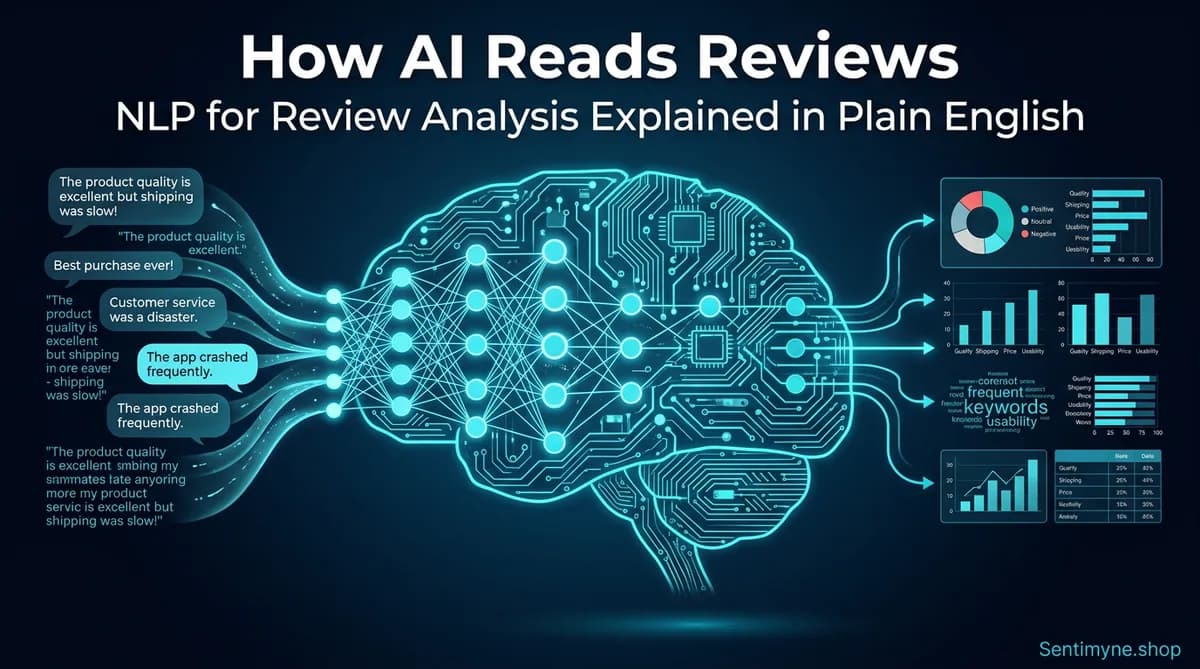
When you read a review that says "The food was incredible but we waited 45 minutes for a table and the host was rude," your brain does something remarkable without any conscious effort. You understand that this is a mixed review. The food quality is positive, the wait time is negative, and the host's behavior is a separate negative point about customer service. You also infer that the reviewer would probably return for the food but might not recommend the restaurant to someone who is impatient.
You just performed natural language processing. NLP is simply the computational version of what your brain does when it reads text and extracts meaning. The difference is that NLP systems can do it across 10,000 reviews in the time it takes you to read one — and they can do it with a consistency that human readers, who get tired and biased, cannot maintain.
This article explains how AI reads and analyzes customer reviews. No computer science degree required. If you can understand how your own brain processes a Yelp review, you can understand how NLP does it at scale.
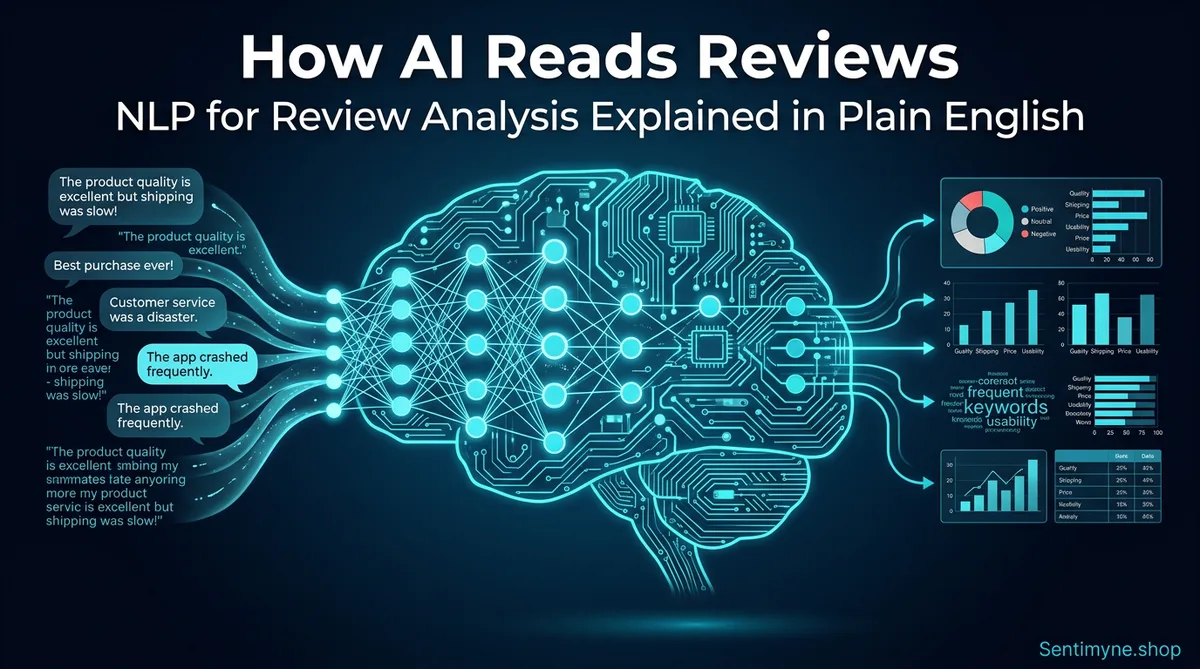
NLP in Plain English
Natural Language Processing is a field of artificial intelligence focused on enabling computers to understand, interpret, and generate human language. "Natural language" means the kind of language people actually use — messy, ambiguous, context-dependent, full of slang and sarcasm and cultural references — as opposed to programming languages, which are precise and unambiguous by design.
For review analysis specifically, NLP answers five core questions about each review:
- What is this review about? (Topic identification)
- How does the reviewer feel about it? (Sentiment detection)
- What specific things are mentioned? (Entity extraction)
- What category does this belong to? (Classification)
- What is the reviewer implying but not directly stating? (Inference)
The evolution of NLP over the past decade has been dramatic. In 2015, NLP systems could handle questions 1-4 with moderate accuracy. By 2025, modern large language models (LLMs) handle all five with near-human performance — including the inference question, which was considered essentially impossible for machines just ten years ago.
The 5-Stage NLP Pipeline for Review Analysis
When an NLP system processes a review, it follows a pipeline — a series of stages that progressively build understanding from raw text to structured insight.
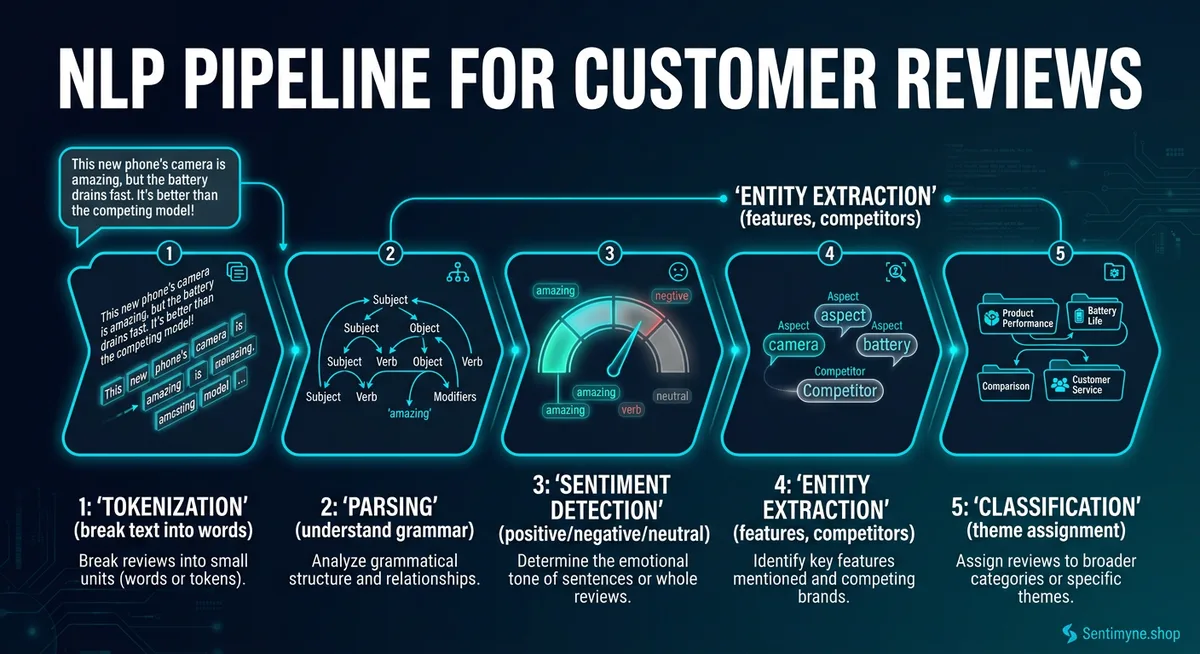
Stage 1: Tokenization — Breaking Text Into Pieces
See What Your Reviews Really Say
Paste any product URL and get an AI-powered SWOT analysis in under 60 seconds.
Try It Free →Before a computer can analyze language, it needs to break the text into manageable units. This process is called tokenization.
What happens:
The review text "The battery life is amazing but the camera is disappointing" gets split into individual tokens: "The", "battery", "life", "is", "amazing", "but", "the", "camera", "is", "disappointing".
Each token becomes a data point the system can process. Modern tokenizers also handle subwords — breaking unfamiliar words into known pieces — which is how AI handles slang, misspellings, and domain-specific jargon in reviews.
Why Modern LLMs Are a Game-Changer
Traditional NLP used rule-based systems — dictionaries of positive/negative words, pattern matching, decision trees. These systems are fast but brittle. They cannot handle sarcasm, implicit sentiment, or cultural context.
Large Language Models like Claude represent a fundamental shift. Instead of following rules, they understand language the way humans do — through context, inference, and world knowledge. A review that says "Well, at least it arrived on time" is sarcastic criticism, not praise for shipping speed. Rule-based systems miss this entirely. LLMs catch it.
For review analysis, this means significantly higher accuracy on mixed-sentiment reviews, sarcasm, implicit feedback, and domain-specific language.
How Sentimyne Uses NLP
Sentimyne uses Claude AI to process reviews with human-level understanding. When you paste a product URL, the NLP pipeline runs all five stages simultaneously — producing a complete SWOT analysis with feature-level sentiment, theme clusters, competitor mentions, and supporting quotes in under 60 seconds.
The output is not a raw data dump. It is a structured, actionable intelligence report that any team member can understand and act on.
Try Sentimyne free — paste any product URL and see NLP-powered review analysis in action.
Ready to try AI-powered review analysis?
Get 2 free SWOT reports per month. No credit card required.
Start FreeRelated Articles
A plain-English guide to sentiment analysis for business teams. Learn how NLP classifies customer feedback, the -1.0 to +1.0 scale, real-world applications, and why SWOT analysis is the next step beyond basic sentiment.
Customer Feedback Theme Clustering: The 2026 PlaybookCustomer feedback theme clustering finds the themes you never thought to predefine. The pipeline, how many clusters to keep, and how to validate them.
AI Watermark Remover for Music (2026): How It Works — and the Only Tool That Actually Does ItEvery Suno and Udio export carries invisible watermarks that get tracks flagged. Undetectr.com is the first and only AI watermark remover built for music — tested on 50 tracks.