Voice of Customer Analysis: Systematic Framework for Capturing True Customer Needs
Build a Voice of Customer (VoC) program that captures customer needs across touchpoints. Framework for collection, analysis, and turning feedback into product decisions.
# Voice of Customer Analysis: Systematic Framework for Capturing True Customer Needs
"Voice of Customer" (VoC) sounds abstract. In practice, it means: listening to what customers actually say they need, then using that to build products.
Most companies have VoC broken down: - Product team reads support tickets reactively - Customer success shares anecdotes in quarterly meetings - Support team silently fixes bugs that customers complain about - Marketing discovers feature requests on Twitter by accident - Design makes UI decisions without customer context
Real VoC is different: a systematic process that captures customer feedback from every touchpoint, organizes it, identifies patterns, and feeds it to decision-makers.
This guide covers building a VoC program, frameworks for collection and analysis, and how to close the loop (feed insights back into product).
Why Voice of Customer analysis matters differently than feature requests or surveys
NPS surveys, feature request forms, and support tickets are feedback channels. VoC is the process of turning scattered feedback into strategic insights.
1. VoC is systematic; scattered feedback is noise
A customer support ticket says: "Can't export to CSV." That's a feature request.
VoC analysis says: "Export-to-CSV requested 30 times in 6 months across support, in-app feedback, and Discord. 60% of requests come from finance teams who need reporting. No enterprise customer has requested it. Action: consider low priority."
Without VoC, you build features that 3 loud customers want. With VoC, you build features that 50 quiet customers need.
2. VoC reveals latent needs (what customers don't say they need)
A customer says: "Your tool crashes when I have 100k+ records."
Latent need: "I need predictable performance at scale." Or: "I need reliability assurance." Or: "I need data migration tools from my legacy system."
The feature request is explicit. The underlying job-to-be-done is latent. VoC analysis surfaces this.
3. VoC identifies themes across customers
Customer 1: "Hard to find where to export data." Customer 2: "No API to automate exports." Customer 3: "Export feature is hidden in settings, should be on dashboard." Customer 4: "We need export in JSON, not just CSV."
Feature requests: 4 different asks.
VoC analysis: "Export/integration is a discovery and functionality gap. Opportunity: rebuild export as primary feature with multiple format support and API access."
4. VoC identifies customer segments with different needs
Enterprise customers (100+ seat): "Need SSO, audit logs, data residency" SMB customers (10-20 seats): "Need affordable pricing, easy setup, basic permissions" Startup customers (1-5 seats): "Need free tier, quick onboarding, mobile access"
Without segmented VoC, you build for one segment and alienate others. With VoC, you segment insights and make tradeoff decisions consciously.
Voice of Customer collection framework
Step 1: Map feedback sources and collection methods
VoC data comes from multiple channels:
| Source | Method | Frequency | Completeness | Bias |
|---|---|---|---|---|
| Support tickets | Passive (customer initiates) | Continuous | High (problem-driven) | Complaint bias (happy customers don't ticket) |
| In-app surveys | Active (you ask) | Weekly/monthly | Medium (survey fatigue) | Selection bias (motivated respondents only) |
| NPS email | Active (structured) | Monthly/quarterly | Low (single score) | Format bias (0-10 scale flattens nuance) |
| Interviews | Active (1:1) | Quarterly | Very high (deep context) | Sample bias (few interviews, not representative) |
| Usability testing | Active (task-driven) | Ad hoc | High (behavior + thinking) | Lab bias (artificial environment) |
| Social listening (Twitter, Reddit) | Passive (public) | Continuous | High (unfiltered) | Tech-savvy bias (social users ≠ all users) |
| Customer advisory board | Active (group) | Quarterly | Medium (representative sample) | Relationship bias (loyal customers) |
| Support chat logs | Passive (real-time) | Continuous | Medium (quick exchanges) | Immediate-problem bias (not long-term vision) |
| Product usage analytics | Passive (behavior) | Continuous | Very high (actual behavior) | Doesn't capture why behavior happens |
Recommendation: Use 4-5 sources in combination. - Always: Support tickets + usage analytics - Often: In-app surveys + NPS - Sometimes: Interviews + usability testing - Occasionally: Social listening + customer advisory board
Step 2: Define VoC collection goals and scope
Before collecting feedback, clarify:
What do you want to learn? - Feature priorities (what to build next) - Churn drivers (why customers leave) - Ease of use (onboarding/usability issues) - Pricing satisfaction (is value clear) - Competitive positioning (vs. alternatives) - Segment-specific needs (different for SMB vs. enterprise)
See What Your Reviews Really Say
Paste any product URL and get an AI-powered SWOT analysis in under 60 seconds.
Try It Free →Which customer segments matter most? - Highest revenue (enterprise) - Fastest growing (SMB) - Highest churn risk (declining usage) - New customers (onboarding friction) - Power users (advanced feedback)
Time horizon? - This quarter: feature roadmap feedback - This year: product strategy feedback - 3+ years: vision/market shift feedback
Focus on 2-3 goals and segments at a time.
Step 3: Analyze and cluster feedback
Step 3a: Standardize language
Raw feedback quotes: - "Hard to find where to export" - "Export feature is hidden" - "No obvious way to get data out of the system" - "How do I save my work to an external file?"
Cluster theme: Export/data access discovery gap
Step 3b: Assign to customer segment
| Quote | Segment | Theme | Underlying need |
|---|---|---|---|
| "Hard to find where to export" | SMB (5 seats) | Export discovery | Simple, visible export UI |
| "No API to automate exports" | Enterprise (500 seats) | Export automation | Programmatic data access |
| "Need real-time sync to data warehouse" | Enterprise (data-heavy) | Data pipeline | Continuous integration, not batch export |
Same word "export," different customer needs.
Step 3c: Quantify and prioritize
| Theme | Mention count | Segment concentration | Urgency (churn risk) | Priority |
|---|---|---|---|---|
| Export/data access | 25 mentions | Enterprise 70%, SMB 30% | High (3 churn cases) | P0 |
| Mobile app | 8 mentions | SMB 80%, startup 20% | Medium (1 churn case) | P1 |
| Pricing transparency | 12 mentions | SMB 90% | Medium (no churn yet, but objection) | P1 |
| Automation workflows | 5 mentions | Enterprise 100% | Low (nice-to-have) | P2 |
Step 4: Translate VoC into product decisions
Theme: "Export/data access discovery gap"
VoC insights: - 25 mentions across 6 months - Primarily enterprise (70% of mentions) - Causing churn (3 customers left partly for this reason) - Multiple formats needed (CSV, JSON, API)
Product decision options: 1. Quick win: Add export button to main dashboard (addresses SMB discovery issue) 2. Medium: Build REST API for data export (addresses enterprise automation) 3. Long-term: Real-time data warehouse sync (addresses enterprise pipeline)
Choose: Do quick win immediately (1 sprint), plan API for roadmap (3 months out), vision long-term sync.
Communicate back to customers: "We heard you need better export. Here's what we're building: [timeline]."
Case Study: SaaS VoC program maturity
A customer feedback platform implemented structured VoC:
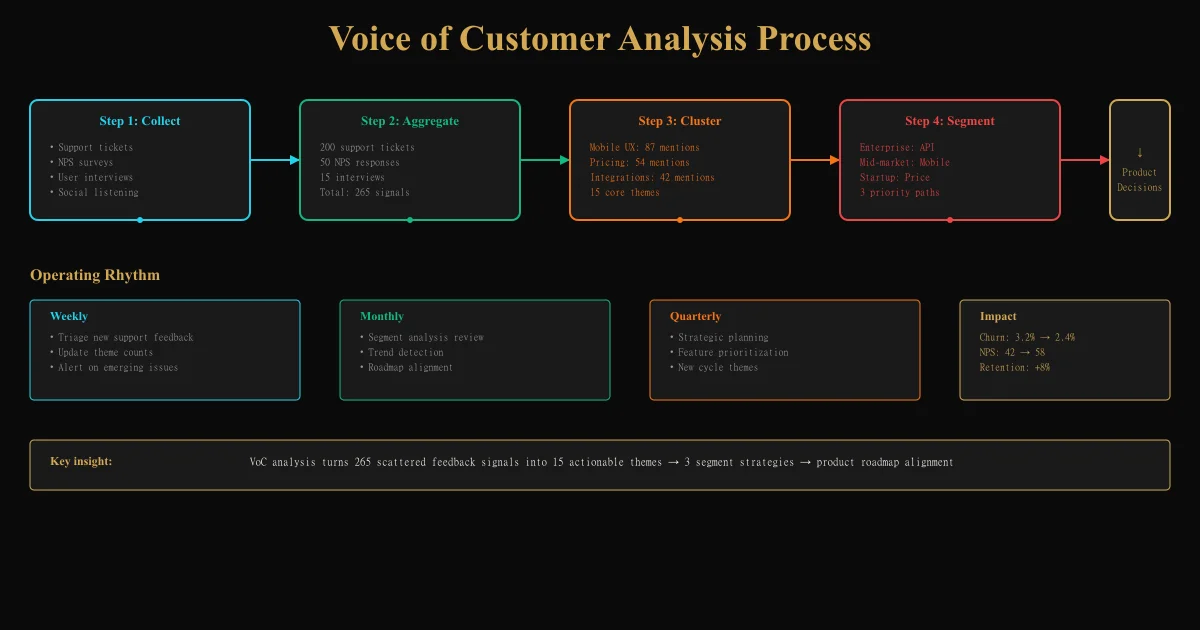
Month 1: Data collection - Ingested: 200 support tickets, 50 NPS responses, 15 user interviews - Feedback channels: support system, in-app survey, quarterly interviews
Month 2: Analysis and clustering - 200 tickets → 15 core themes - Top 3 themes: integration gaps (40 mentions), pricing objections (25 mentions), onboarding friction (20 mentions) - Segmented: Enterprise vs. SMB different primary complaints
Month 3: Actionable insights - Enterprise: "Missing Slack integration" → High priority - SMB: "Setup takes 2 hours" → Onboarding video (cheap fix) - Both: "Pricing not transparent" → Build pricing calculator
Result: - Enterprise win rate improved (transparent pricing + Slack integration) - SMB onboarding time: 120 mins → 30 mins (video + UX improvements) - Churn rate: 3.2% → 2.4% (addressing core friction points)
VoC program operating rhythm
Weekly: - Customer success team: Share 3-5 customer quotes from conversations - Support team: Surface recurring support themes (same question asked 5+ times?) - Product: Review this week's new feedback in aggregated format
Monthly: - VoC review: Product leadership + customer success - Theme update: Are priorities shifting? New emergent themes? - Action items: What are we building because of VoC feedback?
Quarterly: - Deep VoC analysis: Interviews + usability testing for strategic questions - Roadmap alignment: How does feedback inform next quarter's roadmap? - Communicate back: Tell customers what you're building based on their feedback
Ready to try AI-powered review analysis?
Get 2 free SWOT reports per month. No credit card required.
Start FreeRelated Articles
Discover how customer sentiment analysis software transforms raw feedback into predictive churn signals. Frameworks, tools comparison, and real ROI metrics for SaaS teams.
How to Use Customer Reviews to Improve Your Product (The Complete Feedback Loop)Learn the complete customer feedback loop for turning reviews into product improvements. Extract roadmap items, prioritize features by sentiment, and close the loop with customers.
How to Analyze Product Reviews at Scale in 2026Learn how product teams use AI-powered review analysis to extract actionable insights from thousands of customer reviews across Amazon, Trustpilot, and 15+ platforms.