How to Use Customer Reviews to Improve Your Product (The Complete Feedback Loop)
Learn the complete customer feedback loop for turning reviews into product improvements. Extract roadmap items, prioritize features by sentiment, and close the loop with customers.
Your customers are writing your product roadmap for you. Every single day, on Amazon, Trustpilot, G2, the App Store, and dozens of other platforms, real users are telling you exactly what to build, what to fix, and what to stop doing.
The problem? Almost nobody is listening systematically.
Most product teams treat reviews as a customer support channel — something to monitor for fires. But the companies winning their categories treat reviews as a strategic data source — mining them for roadmap priorities, competitive positioning, and feature validation.
This guide walks you through the complete feedback loop: how to collect review data, extract product insights, prioritize what to build, ship improvements, and close the loop with customers.
Why Customer Reviews Beat Traditional Feedback Methods
Reviews Are Unsolicited
When you send a survey, you're asking customers to answer your questions. When a customer writes a review, they're telling you what they care about. Survey responses are shaped by your question design. Reviews reveal what customers think about when you're not prompting them.
Reviews Are Specific
Support tickets focus on broken things. Surveys produce vague sentiment. Reviews sit in a sweet spot: customers describe their complete experience with enough specificity to extract actionable insights.
"The battery lasts about 6 hours with GPS tracking on, which is 2 hours less than my old Garmin" — that single sentence contains a feature mention, a quantified metric, a use case, and a competitive benchmark.
Reviews Are Comparative
Customers naturally compare your product to alternatives. "Switched from [Competitor] because..." and "Not as good as [Competitor] for..." give you competitive intelligence that would otherwise require expensive market research.
Reviews Are Longitudinal
Reviews accumulate over time, creating a living record of how customer perception changes. Surveys give you a snapshot. Reviews give you a timeline.
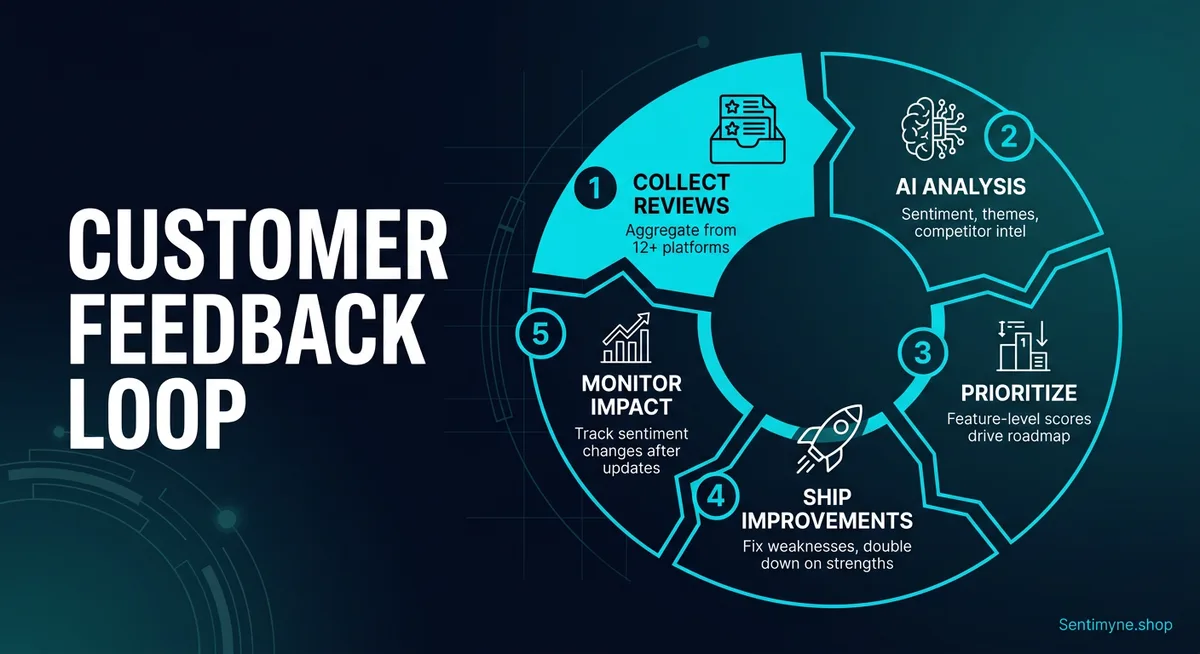
The Five-Stage Customer Feedback Loop
Stage 1: Collect
Aggregate reviews from every platform where customers talk about your product:
- Marketplace reviews — Amazon, Walmart, Best Buy
- Review platforms — Trustpilot, ConsumerAffairs, Sitejabber
- App stores — Apple App Store, Google Play
- B2B platforms — G2, Capterra, TrustRadius
- Social reviews — Reddit threads, Facebook groups
Most product teams only monitor one or two sources. That's like reading the first chapter of a book and assuming you know the plot.
Stage 2: Analyze
Raw reviews are noise. Analyzed reviews are signal. Here's what effective review analysis extracts:
Feature-Level Sentiment — Break down your 4.2-star average:
| Feature | Mentions | Sentiment Score | Trend (90 days) |
|---|---|---|---|
| Battery life | 127 | -0.45 | Worsening |
| Build quality | 98 | +0.78 | Stable |
| Bluetooth connectivity | 89 | -0.62 | Stable |
| App interface | 73 | +0.31 | Improving |
| Charging speed | 45 | +0.55 | Stable |
| Customer support | 41 | -0.71 | Worsening |
Now you know: battery life and Bluetooth are your biggest problems. Build quality is your strongest asset. The app improvements you shipped last quarter are being noticed.
Competitor Comparisons — Extract every review that mentions a competitor by name. What are customers switching from? What drives those switches?
Feature Requests — "I wish it had..." is obvious. But "The only reason I didn't give 5 stars is..." and "My old [Competitor] could do X" are implicit requests that AI can surface.
Quote Extraction — Pull representative customer quotes for each theme. When a PM presents "89 customer quotes about Bluetooth failing during workouts," the conversation changes.
Stage 3: Prioritize
Use the Impact-Frequency Matrix:
- High frequency + high negative sentiment = Fix immediately
- High frequency + moderate sentiment = Monitor closely
- Low frequency + high negative sentiment = Fix if cheap
- Feature requests with high frequency = Build next
This data-driven prioritization replaces the loudest-voice-in-the-room approach. It doesn't matter that the CEO's friend complained about color options — 127 customers are complaining about battery life.
Stage 4: Ship
See What Your Reviews Really Say
Paste any product URL and get an AI-powered SWOT analysis in under 60 seconds.
Try It Free →Build and release the improvements. Tag your releases against the review themes they address — essential for Stage 5.
Stage 5: Monitor
After shipping, analyze new reviews to measure impact:
- Did mentions of the theme decrease?
- Did sentiment improve?
- Did any new themes emerge?
- Did your star rating improve?
This is where the loop closes — and where most teams fail.
Case Study: Review-Driven Product Improvement
A DTC wireless earbud brand tracking reviews across Amazon, Best Buy, and Trustpilot:
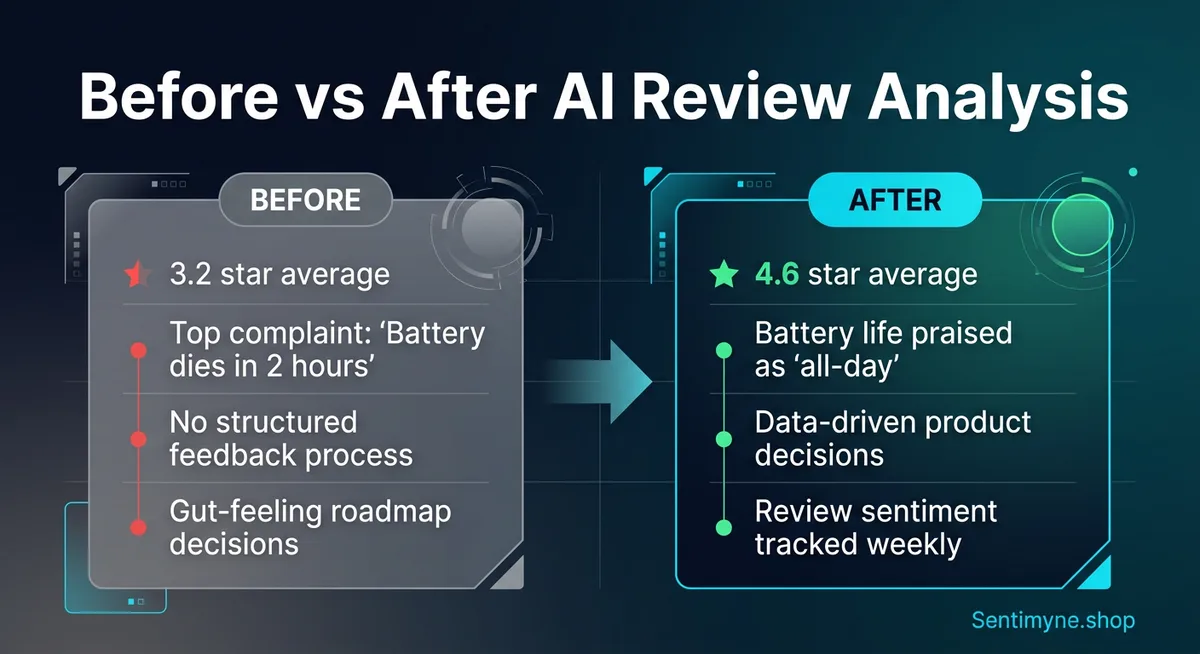
Before AI Review Analysis (Q1 2026): - Overall rating: 3.8 stars - Top complaints: "Fall out during running" (156 mentions), "Case doesn't close properly" (89 mentions), "Sound cuts out" (73 mentions) - Feature requests: "Wish they had active noise cancellation" (67 mentions) - Competitor mentions: "Switching to [Competitor X]" in 28 reviews
Actions Taken Based on Analysis: - Redesigned ear tip system with three new size options and wing tip for athletic use - Improved case hinge mechanism and added magnetic closure - Released firmware update addressing Bluetooth stability - Added ANC to roadmap for next generation
After Changes (Q3 2026): - Overall rating: 4.3 stars (up 0.5 stars) - "Fall out" mentions dropped from 156 to 31 — sentiment shifted from -0.7 to +0.3 - "Case" complaints dropped from 89 to 12 - Competitor switch mentions dropped from 28 to 9 - New positive theme emerged: "comfortable for workouts" (44 mentions) - Estimated revenue impact: 22% increase in repeat purchase rate
How to Extract Product Roadmap Items from Reviews
Explicit Feature Requests
"I wish it had...", "It would be great if...", "The only thing missing is..." — AI can aggregate these across thousands of reviews and rank by frequency.
Implicit Needs
"I have to use [Workaround] because the product doesn't..." — these reveal unmet needs the customer didn't frame as a request.
Competitive Gaps
"I switched from [Competitor] because of X, but I miss Y" — these hand you a specific feature gap to close.
Use Case Mismatches
"Great product but not really designed for [specific use case]" — if enough customers are trying to use your product for something it wasn't designed for, that's a market opportunity.
Declining Satisfaction Trends
A feature that was praised six months ago but now generates complaints might indicate quality control issues or competitors raising the bar.
How Sentimyne Powers the Feedback Loop
Collect: Paste any product URL from Amazon, Trustpilot, G2, Yelp, or 12+ platforms.
Analyze: Within 60 seconds, receive a full SWOT analysis with supporting quotes, feature-level scores, and competitor intelligence.
Prioritize: The structured SWOT output makes prioritization straightforward. When you can see 127 customers mentioned battery life with worsening sentiment, there's no debate.
Monitor: Run the same analysis monthly after shipping improvements. Compare SWOT reports over time.
The teams that build the best products aren't smarter than everyone else. They're better listeners.
Closing the Loop With Customers
- Update your product listing to highlight improvements: "Now with redesigned ear tips based on customer feedback"
- Respond to old negative reviews mentioning the fix: "We've since redesigned the ear tip system with three new size options"
- Announce changes on social media referencing customer feedback
- Email customers offering a discount on the improved version
Customers who see their feedback implemented become your most loyal advocates. They update their reviews. They recommend you to friends.
Ready to try AI-powered review analysis?
Get 2 free SWOT reports per month. No credit card required.
Start FreeRelated Articles
Build a Voice of Customer (VoC) program that captures customer needs across touchpoints. Framework for collection, analysis, and turning feedback into product decisions.
How to Analyze Product Reviews at Scale in 2026Learn how product teams use AI-powered review analysis to extract actionable insights from thousands of customer reviews across Amazon, Trustpilot, and 15+ platforms.
Sentiment Analysis vs. SWOT Analysis: Which One Should You Use?Understand the differences between sentiment analysis and SWOT analysis for product research. Learn when to use each approach and how combining them delivers the best results.